
Our Infrastructure Matters Ad
Home Blog Page 9

Environmental groups oppose Sherrill’s nuclear strategy

What does mean for energy costs, reliability, emissions, and jobs?

New Jersey runs on nuclear

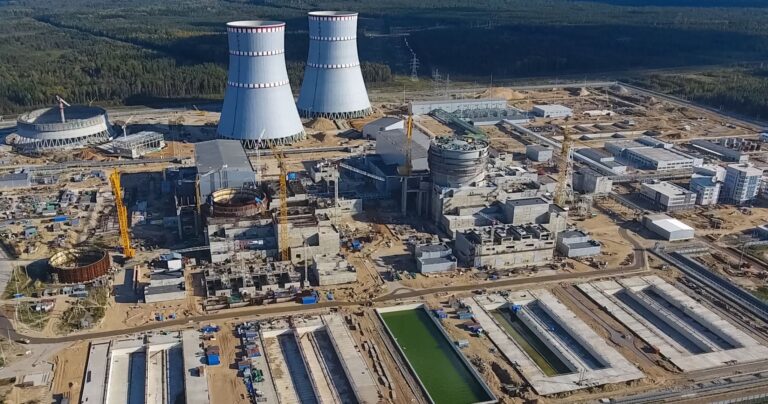
Few states rely on nuclear power as heavily as New Jersey. The Salem and Hope Creek generating stations in Lower Alloways Creek Township – together known as the Artificial Island complex – produce roughly 40 percent of the state’s electricity and more than 80 percent of its carbon‑free power. Only Illinois and South Carolina depend more on nuclear as a share of total generation.

New Jersey’s nuclear fleet dates back to the 1970s and 1980s, when Salem Units 1 and 2 and Hope Creek came online. For decades, they have served as the backbone of the state’s grid, operating at high capacity factors and providing steady baseload power even as natural gas, solar, and offshore wind have expanded. Nationally, nuclear power accounts for about 19 percent of U.S. electricity. In New Jersey, it is more than double that share—an indication of how central the technology has been to the state’s energy identity.

Nuclear’s role

Nuclear power remains one of the few large‑scale, zero‑emission energy sources capable of running around the clock. Unlike natural gas or coal, nuclear reactors emit no carbon dioxide during operation. Unlike solar and wind, they are not dependent on weather conditions.

Modern reactor designs, particularly small modular reactors (SMRs) and advanced Gen III+ systems, have also made significant strides in reducing waste volumes, improving safety systems, and simplifying construction. Many designs use passive safety features that rely on gravity and natural circulation rather than pumps or external power.

Globally, nuclear remains a key pillar of decarbonization strategies. France, long the world’s most nuclear‑dependent nation, still generates about 70 percent of its electricity from reactors and is now planning a major new build‑out. Germany, by contrast, shuttered its last nuclear plants in 2023 and has since faced rising emissions and increased reliance on coal and imported natural gas—an outcome that has sparked political regret even among some former anti‑nuclear advocates.

Murphy’s wind

When New Jersey debated whether to keep its nuclear plants open in 2017, the state commissioned a detailed economic analysis from the Brattle Group. The findings were unequivocal: keeping Salem and Hope Creek online would save consumers money, even after accounting for the Zero Emission Certificate (ZEC) subsidies needed to keep the plants financially viable. Brattle’s economists concluded that if the reactors closed, wholesale electricity prices would rise, costing New Jersey households and businesses hundreds of millions of dollars per year. Nuclear plants, they found, suppress market prices because they operate at low marginal cost and run nearly continuously.

But while the Murphy administration extended the ZEC, their primary focus was launching offshore wind, and they expended considerable resources towards that end. 

Sherrill’s pivot

Governor Mikie Sherrill has made clear that New Jersey must expand its in-state energy supply to keep costs down and meet rising demand driven by data centers, electrification, and economic growth. Contrary to the prior administration, Sherrill is favoring an all-of-the-above energy approach, including nuclear. In April, Sherrill signed legislation lifting a decades‑old restriction that effectively prevented new nuclear construction in the state. She also launched a Nuclear Task Force charged with evaluating siting, financing, workforce needs, and technology options for next‑generation reactors.

New Jersey is not alone. New York Governor Kathy Hochul has directed her administration to explore advanced nuclear as part of the state’s long‑term energy strategy. States including Virginia, Wyoming, Tennessee, and Kentucky are also positioning themselves for SMR deployment. The shift reflects a broader national trend: as renewable energy grows but grid reliability challenges mount, policymakers are increasingly looking to nuclear as a firm, carbon‑free anchor.

Salem 2.0

If New Jersey builds a new reactor, Salem County is the most likely location. The Artificial Island complex already hosts three reactors, a trained workforce, transmission infrastructure, and a community accustomed to nuclear operations. Industry analysts say co‑locating new reactors at existing sites dramatically reduces permitting challenges and construction costs. It also maximizes job creation.

A new large‑scale reactor at Salem could generate 8,000 to 10,000 construction jobs at peak—similar to the workforce needed for Plant Vogtle Units 3 and 4 in Georgia, the first new U.S. reactors built in more than 30 years. Vogtle also created roughly 800 permanent jobs once operational. Even a smaller SMR project would likely create 1,500 to 3,000 construction jobs and 200 to 400 permanent positions, according to industry estimates.

For Salem County – one of the most economically challenged regions in the state – the potential impact is significant.

Environmental opposition

Despite nuclear power’s track record of providing low‑cost, zero‑emission electricity, many of New Jersey’s environmental organizations remain staunchly opposed to new reactors. Groups including Clean Water Action, Environment New Jersey, Empower NJ, NJ Citizen Action, and the Sierra Club have argued that nuclear waste, safety concerns, and high capital costs outweigh the benefits. They have urged the state to focus instead on offshore wind, solar, storage, and energy efficiency.

These groups have also opposed recent nuclear‑related legislation in Trenton, including bills directing the Department of Environmental Protection to study new reactor feasibility and proposals to create a state‑run advanced nuclear procurement program. Their opposition stands in contrast to the position of many climate scientists, grid experts, and international agencies, including the Intergovernmental Panel on Climate Change, which have concluded that nuclear power is essential to meeting global decarbonization goals.

Giant steps

New Jersey’s nuclear future will be shaped by several key decisions in the coming months:

  • The Nuclear Task Force will deliver recommendations on siting, technology, and financing.
  • The Legislature will continue debating the “Power NJ Act,” which would authorize the state to procure advanced nuclear generation.
  • PSEG and potential private developers will evaluate whether to pursue SMRs or larger reactors at Salem.
  • The Board of Public Utilities will determine how nuclear fits into long‑term planning for affordability and reliability.

The stakes are high. With electricity demand rising faster than new generation is coming online, and with Murphy’s offshore wind ambitions essentially dead in the water, New Jersey must decide whether nuclear will remain a cornerstone of its energy system. For now, the Sherrill administration appears to be charting a pragmatic middle path: preserving the existing fleet, exploring next‑generation options, and weighing nuclear’s role alongside renewables in a rapidly changing grid.

Sources:

Berkman, M., & Murphy, D. (2026). Salem and Hope Creek nuclear power plants’ contribution to the New Jersey economy. The Brattle Group. https://www.brattle.com/insights-events/publications/brattle-economists-evaluate-impacts-of-the-salem-and-hope-creek-nuclear-power-plants-on-new-jerseys-economy-and-environment/

U.S. Energy Information Administration. (2024). New Jersey: State energy profile. https://www.eia.gov/state/?sid=NJ

U.S. Energy Information Administration. (2024). Nuclear power and the U.S. electricity mix. https://www.eia.gov/tools/faqs/faq.php?id=207&t=3

International Energy Agency. (2023). France 2023 energy policy review. https://www.iea.org/reports/france-2023

Reuters. (2023). Germany shuts last nuclear plants, critics warn of higher emissions. https://www.reuters.com/world/europe/germany-shuts-last-nuclear-plants-critics-warn-higher-emissions-2023-04-15

U.S. Nuclear Regulatory Commission. (2024). Reactor information: Salem & Hope Creek. https://www.nrc.gov/reactors/operating/list-power-reactor-units.html

Southern Company. (2024). Plant Vogtle Units 3 & 4. https://www.southerncompany.com/innovation/vogtle-3-and-4.html

U.S. Department of Energy. (2023). Vogtle Unit 3 begins commercial operation. https://www.energy.gov/ne/articles/vogtle-unit-3-begins-commercial-operation

New Jersey Legislature. (2026). Bill S3870/A4528. https://www.njleg.state.nj.us/

New Jersey Legislature. (2026). Bill S4296. https://www.njleg.state.nj.us/

Office of the Governor of New Jersey. (2026). Governor Sherrill launches Nuclear Task Force. https://nj.gov/governor/news/

New York State Energy Research and Development Authority. (2024). Advanced nuclear feasibility and planning. https://www.nyserda.ny.gov/

Intergovernmental Panel on Climate Change. (2022). Mitigation of climate change: Summary for policymakers. https://www.ipcc.ch/report/ar6/wg3

Food & Water Watch. (2024). Statement on nuclear expansion proposals in New Jersey.  https://www.foodandwaterwatch.org/

Sierra Club New Jersey. (2024). Sierra Club NJ opposes new nuclear development. https://www.sierraclub.org/new-jersey


We’ve Heard This Before: The Reality Behind World Cup Projections

0

What Past Events Tell Us About World Cup Promises

New Jersey is preparing to host one of the largest sporting events in the world.

The 2026 FIFA World Cup is being promoted as a once-in-a-generation opportunity for the New York and New Jersey region, bringing millions of visitors, global attention, and billions in projected economic impact. Supporters point to those numbers as proof that the investment will be worth it. Maybe it will be, but we’ve heard this before.

When Super Bowl XLVIII came to MetLife Stadium, it was accompanied by similar projections: hundreds of millions in economic impact, a surge of visitors, and a major boost for the region. In the lead-up, estimates in the $500 to $600 million range were widely cited.

Those figures were ultimately acknowledged as estimates, based on economic modeling rather than direct revenue. A full accounting of the actual impact was never publicly detailed in a way that matched the confidence of the original projections. What was clear, however, were the real, measurable costs: millions spent on transportation, public safety, and foregone tax revenue.

At the same time, the event exposed operational strain: particularly in transportation. With heavy reliance on rail service, tens of thousands of fans were funneled through a single system. While the game itself went off without issue, getting people home proved far more difficult, with long delays and overcrowding after the final whistle.

That pattern isn’t unique to the World Cup. Other major events hosted at MetLife Stadium have been accompanied by similarly large projections. WrestleMania, for example, was estimated to generate more than $165 million in economic impact for the region in 2019, following a $101 million estimate for its 2013 event. Like most economic impact figures, those numbers are based on modeled spending and assumptions about visitor behavior offering a broad picture of activity, but not a precise accounting of costs, benefits, or how that impact is distributed.

These events are a warning for FIFA and the region: while large-scale events bring some (often exaggerated)  economic opportunity, they also test the limits of the systems that support them.

That context matters, now as  the World Cup is being framed at a much larger, regional scale. Projections of economic impact ($2-3 billion) combine activity across New York City, North Jersey, and surrounding areas. Those numbers are meant to capture everything from hotel bookings and restaurant spending to transportation and retail.But like past events, those projections rely on assumptions: how many visitors will come, how much they will spend, and how much of that activity is truly new, rather than displaced from existing tourism.

And just as importantly, those numbers don’t always reflect the full cost side of the equation. Public agencies, particularly in New Jersey, are already preparing for significant operational demands. Transportation systems will carry a major share of the load. Security, staffing, and infrastructure will require coordination across multiple levels of government. And unlike projected economic impact, those costs are not hypothetical, they are real, immediate, and measurable.

At the same time, New Jersey has authorized spending across departments and agencies in “amounts as are determined to be necessary” to support hosting the event. That flexibility may be intended to ensure success, but it also makes it harder to define the total public commitment upfront.

Taken together, the pattern is familiar.

Large events generate large projections but the costs are more concrete, and more widely shared. And the gap between the two is not always clear until long after the event has passed. 

None of this means the World Cup won’t be a success. But success on the field and success on paper are not always the same thing.

Source:

New Jersey Transit. (2014). Super Bowl XLVIII operational and financial summary.
https://www.njtransit.com

New Jersey State Police. (2014). Super Bowl XLVIII security cost reporting.
https://www.nj.gov/njsp

New Jersey Sports and Exposition Authority. (2022). Board meeting minutes and event impact discussions.
https://www.njsea.com

Baade, R. A., & Matheson, V. A. (2011). Financing professional sports facilities. Journal of Economic Perspectives, 25(3), 95–114.

Matheson, V. A. (2006). Mega-events: The effect of the world’s biggest sporting events on local, regional, and national economies. College of the Holy Cross, Department of Economics Working Paper Series.

Enigma Research Corporation. (2019). Economic impact of WrestleMania 35 on the New York/New Jersey region.

Enigma Research Corporation. (2013). Economic impact of WrestleMania 29 on the New York/New Jersey region.FIFA. (2023). FIFA World Cup 2026 host city and regional economic impact projections.
https://www.fifa.com

Highway reconstruction project transforms notorious South Jersey interchange

The Direct Connection project is one of the largest infrastructure improvements ever undertaken in South Jersey.

Construction continues on the Direct Connect project, a nearly $900 million highway reconstruction effort designed to improve safety and traffic flow at one of South Jersey’s busiest interchanges.

Led by New Jersey Department of Transportation (NJDOT) in partnership with the Federal Highway Administration (FHA), the multi-phase project is rebuilding the interchange between Interstate 295, Interstate 76 and Route 42. For decades, drivers traveling on I-295 were forced to navigate “Al-Jo’s Curve,” a notoriously sharp left-hand interchange connecting I-295 southbound to Route 42 and I-76. The curve, named after a popular nightclub that once operated along West Kings Highway in Mt. Ephraim, was known for its confusing traffic pattern and abrupt speed reduction. Motorists were forced to slow from 65 mph to 35 mph in a short distance as they entered the ramp, which contributed to crash rates significantly higher than the state average.

Correcting those long-standing issues has been years in the making with phases of planning, engineering and phased construction throughout Bellmawr, Mount Ephraim, Brooklawn and surrounding communities. The project began in 2013 and is currently in its third major phase. Phase 1, completed in 2016, included improvements along I-295, I-76 and Route 42, replacement of the Creek Road and Bell Road bridges and construction of temporary roadway widening to support future stages of work. Phase 2, completed in 2019, focused on sections of I-295 north of Browning Road and portions of Ramps C and D. Phase 3, which began in 2017, is centered on completing the I-295 direct connection, improvements to Browning Road and Ramp A and includes the relocation of 12 housing units within the Bellmawr Park Mutual Housing Corporation.Completion of Phase 3 is expected in spring 2027. Phase 4, the final phase, will complete work along I-76/Route 42, I-295 northbound and several remaining interchange ramps, with overall project completion estimated by 2032. 

The centerpiece of the project is a new flyover that will allow I-295 traffic to pass over the Route 42 and I-76 interchange instead of moving through it. Other project cornerstones include the replacement or rehabilitation of four bridges, retaining walls and drainage systems, major roadway realignments, highway widening, local access road improvements, noise walls and environmental protections near residential neighborhoods.

Construction continues on the new I-295 flyover bridge, a major part of NJDOT’s Direct Connection project designed to improve traffic flow and safety through the interchange. 

The project has also presented significant engineering and logistical challenges, including the relocation of 12 housing units, utility relocations, noise mitigation efforts, and extensive ground improvements. One of the most high-profile challenges occurred in 2021 when a major retaining wall structure, known as Wall 22, partially collapsed before the roadway was opened to traffic. The incident prompted a complete redesign of the structure and delayed portions of the overall project timeline. Engineers rebuilt the wall using hundreds of deep steel piles and a heavily reinforced poured-in-place concrete foundation system designed to provide greater long-term stability.

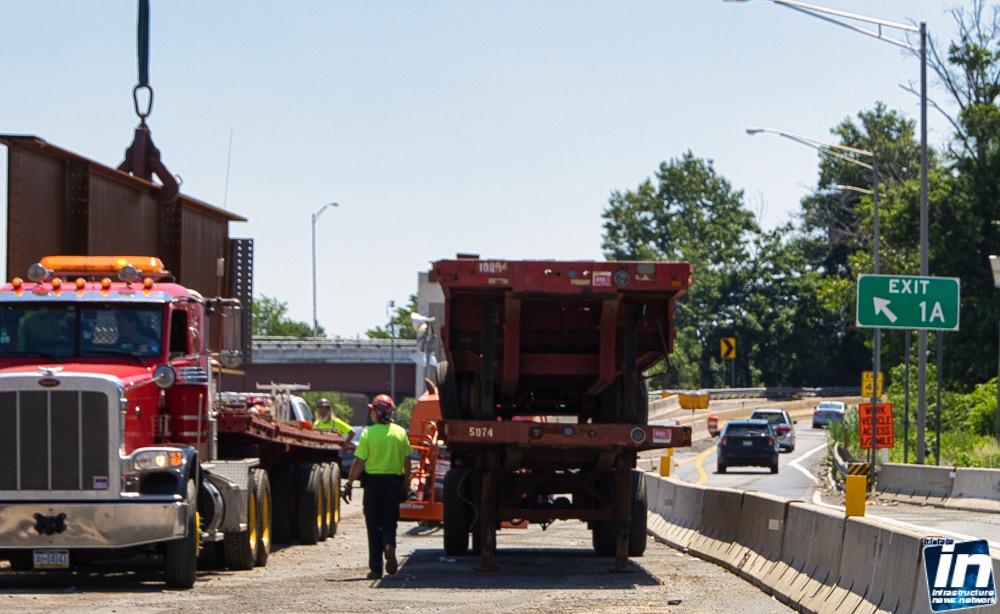
In recent years, construction has continued to advance with the installation of massive steel girders for new elevated I-295 direct connection bridges over Browning Road, Route 42 and I-76. Crews have worked through overnight lane closures and traffic shifts to maintain traffic flow while new flyover ramps and retaining walls take shape above and around active roadways. Beams are also being installed for the second section of the new Browning Road Bridge, spanning Big Timber Creek in Brooklawn.

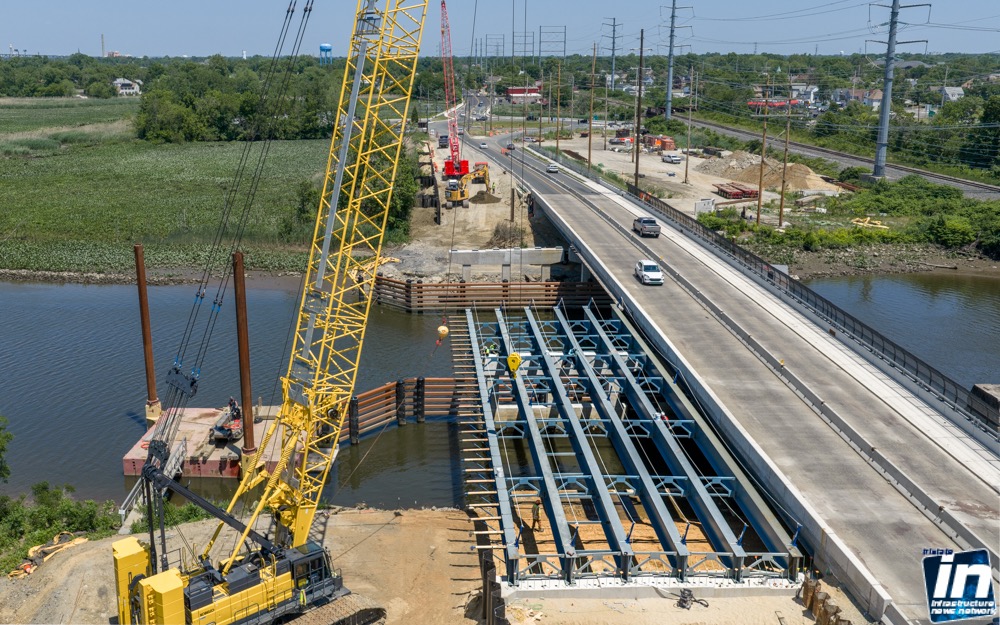
Crews begin setting beams for the second side of the bridge carrying Route 130 over Big Timber Creek.

The completed interchange is expected to significantly improve traffic flow and safety for commuters, freight traffic and travelers moving between South Jersey, Philadelphia and the Jersey Shore.

Sources:

New Jersey Department of Transportation. (n.d.). I-295/Route 42/I-76 direct connection project. State of New Jersey. https://dot.nj.gov/transportation/commuter/roads/rt295/index.shtml

South State, Inc. (n.d.). Route 295/42/I-76 direct connection contract 3.https://www.southstateinc.com/project/route-295-42-i-76-direct-connection-contract-3/

Zeff, J. (2025, April 28). 4 years after N.J. highway wall collapsed, it’s close to being rebuilt. NJ.com.https://www.nj.com/news/2025/04/4-years-after-nj-highway-wall-collapsed-its-close-to-being-rebuilt.html

Repauno terminal positions South Jersey as growing energy export hub

GREENWICH TOWNSHIP, GLOUCESTER COUNTY, N.J. — Along the Delaware River in Gloucester County, the Repauno Port & Rail Terminal is transforming a former industrial site into a significant energy and logistics hub.

The 1,600-acre facility is evolving into a strategic gateway for the movement of liquefied petroleum gas, bulk commodities, project cargo and other industrial products. Operated by Delaware River Partners, a subsidiary of FTAI Infrastructure, the port combines deep-water marine access, rail connectivity and underground storage capacity in a location that provides direct access to domestic and international markets.

The terminal features a 40-foot-deep draft capable of handling large vessels, direct rail service through Conrail with connections to CSX and Norfolk Southern, and proximity to Interstate 295, Interstate 95 and the New Jersey Turnpike. According to Repauno, the site was designed to support energy products, roll-on/roll-off cargo, warehousing and large-scale logistics operations.

One of the facility’s most distinctive assets is its underground granite storage cavern system. Repauno currently operates a cavern capable of storing approximately 180,000 barrels of liquefied petroleum gas products. The storage infrastructure allows propane, butane and other LPG products to be safely stored underground before being loaded onto vessels for export.

The company is now pursuing an expansion that would significantly increase storage capacity and strengthen its position in the Northeast energy market. In late 2025, the New Jersey Department of Environmental Protection (NJDEP) approved plans for two additional underground granite caverns, each capable of storing more than 600,000 barrels of LPG products. The expansion would more than triple the terminal’s existing storage capacity and establish Repauno as one of the region’s largest LPG storage and export facilities. Company officials have said the project could generate more than 500 construction jobs while increasing regional energy storage capabilities.

Industry analysts view the expansion as a direct challenge to Energy Transfer’s Marcus Hook terminal in Pennsylvania, which has long dominated Appalachian LPG exports. Repauno’s location on the Delaware River allows producers in the Marcellus and Utica shale regions to access international markets with shorter transit times than many Gulf Coast export facilities.

Understanding LNG and LPG

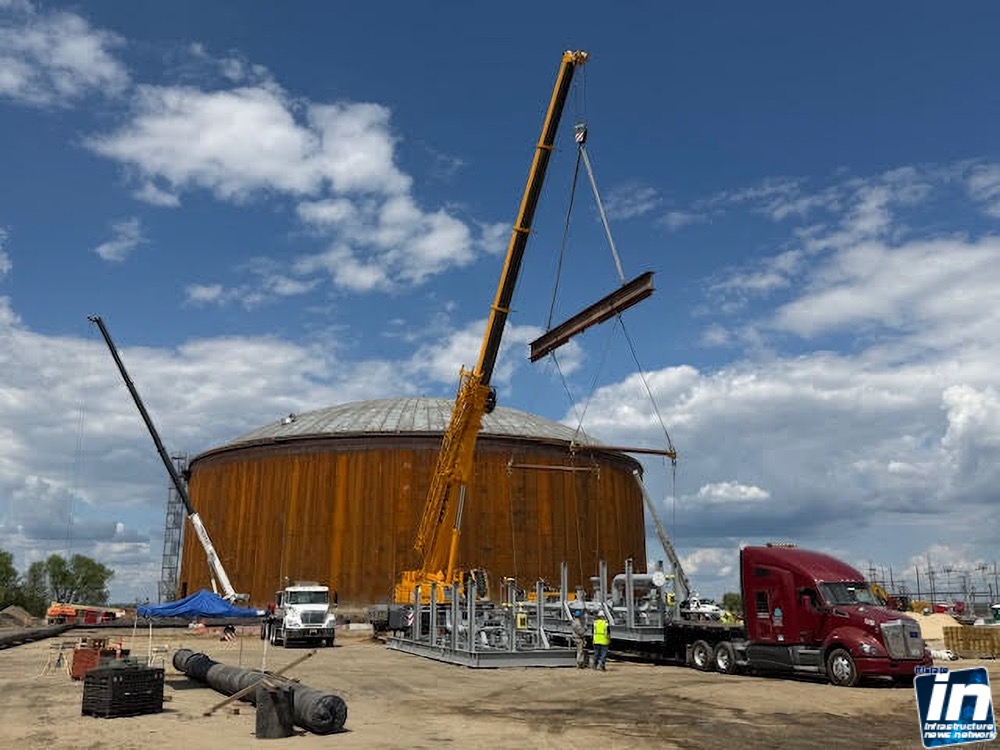
Construction of a 26-million-gallon above-ground LPG storage tank at Repauno Port in Gloucester County, New Jersey.

The Repauno project involves two different energy products that are often confused: liquefied natural gas (LNG) and liquefied petroleum gas (LPG).

LNG is primarily methane, the same natural gas used to heat homes and generate electricity. To become a liquid, natural gas must be cooled to approximately minus 260 degrees Fahrenheit, reducing its volume and making it economical to transport long distances.

LPG consists primarily of propane, butane or a mixture of the two. Unlike LNG, LPG can be liquefied under moderate pressure and is commonly used for residential heating, cooking, agricultural applications and industrial processes.

Repauno’s existing operations and planned cavern expansions are focused on LPG storage and exports. The proposed LNG export project is a separate initiative that would use the terminal as a transfer point for liquefied natural gas produced elsewhere in the Appalachian Basin.

LNG export plans remain under scrutiny

While Repauno’s current operations focus primarily on liquefied petroleum gas products such as propane and butane, the facility has also been at the center of a long-running proposal involving liquefied natural gas exports.

The proposed LNG project would create a supply chain linking Pennsylvania’s Marcellus Shale gas fields to international markets. Unlike traditional LNG export terminals along the Gulf Coast, which receive natural gas by pipeline and liquefy it at the waterfront, the Repauno proposal was designed around transporting already-liquefied natural gas from inland Pennsylvania to the Delaware River for export.

Under the plan, natural gas would be converted into LNG at a processing facility in northeastern Pennsylvania before being transported to South Jersey by truck or rail. Once at Repauno, the LNG would be transferred directly from transportation equipment onto ocean-going vessels at the proposed Dock 2 facility. Because New Jersey law prohibits bulk LNG storage at the site, the project relies on direct transloading operations rather than long-term storage tanks, making transportation logistics a critical component of the proposal.

Supporters view the approach as a way to connect Appalachian natural gas producers to overseas markets without constructing major new pipeline infrastructure, while opponents have focused on the safety and environmental implications of moving LNG through communities by rail and truck. Some energy advocates argue that expanded pipeline infrastructure could provide a safer, cleaner and lower-cost alternative to large-scale rail or truck transportation by reducing handling requirements and limiting fuel movement through populated areas.

The future of the LNG export project remains uncertain. A key component of the original plan involved transporting LNG by rail from northeastern Pennsylvania to South Jersey, but federal approvals governing LNG-by-rail transportation have faced legal regulatory challenges. At the same time, plans for associated liquefaction facilities in Pennsylvania are evolving, creating additional questions about how the export chain would operate.

Growing role in regional infrastructure

Despite ongoing debate surrounding LNG exports, Repauno continues to expand its role as a critical logistics and energy facility for the Delaware River region. The combination of deep-water access, rail infrastructure, highway connectivity and underground storage capacity has positioned the terminal as a major asset for energy producers seeking access to domestic and international markets.

The project also arrives as New Jersey faces growing questions about long-term energy supply. The state has become increasingly dependent on imported electricity following the retirement of several coal-fired power plants and continues to rely heavily on energy produced elsewhere in the PJM grid. At the same time, electricity demand is expected to rise as data centers, electrification initiatives and industrial development increase power consumption throughout the region.

Supporters of projects such as Repauno argue that maintaining energy affordability and reliability will require an all-of-the-above strategy that includes renewables, nuclear power, natural gas infrastructure and expanded energy transportation networks. From that perspective, facilities capable of moving domestically produced fuels to market are viewed as an important component of the region’s broader energy portfolio.

As new cavern construction moves forward and additional infrastructure investments are considered, Repauno is expected to remain one of the most closely watched energy and logistics developments on the Delaware River waterfront.

Sources:

Delaware Riverkeeper Network. (n.d.). Gibbstown Logistics Center LNG/NGL export proposal. Delaware Riverkeeper Network. https://delawareriverkeeper.org/issues/climate-change-fossil-fuels-and-energy/gibbstown-logistics-center-lng-ngl-exports-proposed/

Delaware River Partners. (n.d.). Repauno Port & Rail Terminal. Repauno Port & Rail Terminal. https://www.repauno.com/

East Daley Analytics. (2024, August 28). Repauno port challenges ET’s dominance in Northeast. East Daley Analytics. https://eastdaley.com/ngl-insider/repauno-port-challenges-ets-dominance-in-northeast-3

FTAI Infrastructure. (2025, October 9). Repauno Port & Rail Terminal receives approval for Phase 3 development. MarketScreener. https://www.marketscreener.com/news/repauno-port-rail-terminal-receives-approval-for-phase-3-development-ce7d5ad2dd89f02c

Greenwich Township. (n.d.). Proposed port development. Greenwich Township, New Jersey. https://www.greenwichtwp.com/2202/Proposed-Port-Development

Mele, C. (2025, April 21). Backers of Gibbstown LNG dock seek permit renewal from the DRBC. Delaware Currents. https://delawarecurrents.org/2025/04/21/gibbstown-lng-port/ 

New Jersey Department of Environmental Protection. (2025). Draft approval to construct: Repauno Port & Rail Terminal cavern expansion project (Program Interest No. 1032630). State of New Jersey. https://dep.nj.gov/wp-content/uploads/brp/caverns/usc-public-notices/final-dep-bulletin-notice-draft-approval-to-construct_1032630.pdf

New Jersey Spotlight News. (2025, September 18). Controversial Gibbstown port project wins permit extension. NJ Spotlight News.https://www.njspotlightnews.org/2025/09/controversial-gibbstown-port-project-wins-permit-extension/

Ryan, M. (2019, December 18). Controversial Gibbstown LNG export terminal gets final DRBC approval. WHYY.https://whyy.org/articles/controversial-gibbstown-lng-terminal-gets-final-drbc-approval/

The history of the D&R Canal

0

When we think about New Jersey infrastructure, we usually picture highways, rail lines, ports and pipelines. But long before route one or the Northeast Corridor Railroad, there was another transportation spine running quietly through the heart of the state. It was hand dug. It reshaped cities, and it still matters today. This is the story of the Delaware and Raritan Canal.

Transcript

1

00:00:00,417 –> 00:00:03,753

When we think about New Jersey infrastructure, we usually picture

2

00:00:03,753 –> 00:00:06,756

highways, rail lines, ports and pipelines.

3

00:00:06,923 –> 00:00:10,343

But long before route one or the Northeast Corridor Railroad,

4

00:00:10,593 –> 00:00:12,262

there was another transportation

5

00:00:12,262 –> 00:00:15,223

spine running quietly through the heart of the state.

6

00:00:15,265 –> 00:00:16,599

It was hand dug.

7

00:00:16,599 –> 00:00:20,020

It reshaped cities, and it still matters today.

8

00:00:20,437 –> 00:00:23,690

This is the story of the Delaware and Raritan Canal.

9

00:00:24,607 –> 00:00:26,609

The idea of cutting a canal across

10

00:00:26,609 –> 00:00:29,612

New Jersey is older than the United States itself.

11

00:00:29,696 –> 00:00:35,201

In 1676, William Penn, founder of Pennsylvania, proposed creating

12

00:00:35,201 –> 00:00:39,289

a water route across what he called the narrow waist of New Jersey.

13

00:00:39,873 –> 00:00:44,419

His goal was ambitious a protected inland passage connecting Philadelphia

14

00:00:44,419 –> 00:00:47,964

to New York Harbor, avoiding the dangerous Atlantic route.

15

00:00:48,423 –> 00:00:51,134

Penn even ordered a survey to see if it was possible

16

00:00:51,134 –> 00:00:54,220

to cut away across the country to Sandy Hook.

17

00:00:54,637 –> 00:00:59,434

No record survives that the survey ever happened, but the idea never disappeared.

18

00:00:59,976 –> 00:01:03,480 

For the next hundred years, the concept slipped quietly

19

00:01:03,480 –> 00:01:07,567

while colonies grew, fought a revolution, and became a nation.

20

00:01:08,151 –> 00:01:11,654

But by the early 1800s, America turned its attention

21

00:01:11,654 –> 00:01:16,493

to internal improvements, and New Jersey found itself at the center of everything.

22

00:01:17,327 –> 00:01:20,622

By the 1820s, enthusiasm for a canal linking

23

00:01:20,622 –> 00:01:23,625

New York and Philadelphia reached a fever pitch.

24

00:01:24,000 –> 00:01:27,003

But there was a problem. Railroads.

25

00:01:27,295 –> 00:01:31,758

New Jersey lawmakers were split between canal supporters and railroad advocates.

26

00:01:32,175 –> 00:01:35,804

Each side was powerful, and each side blocked the other.

27

00:01:36,262 –> 00:01:40,517

The stalemate ended in 1830 with a uniquely New Jersey compromise.

28

00:01:41,142 –> 00:01:44,354

The legislature chartered both and then merged them,

29

00:01:44,521 –> 00:01:48,525

creating a canal rail partnership known as the Joint Companies.

30

00:01:48,983 –> 00:01:53,696

The Delaware and Raritan Canal Company and the Camden and Amboy Railroad.

31

00:01:54,030 –> 00:01:57,033

Construction on both began the same year.

32

00:01:57,117 –> 00:02:02,038

By 1833, the railroad was running from Bordentown to South Amboy.

33

00:02:02,539 –> 00:02:05,875

Parts of the canal opened at the same time, but the full canal

34

00:02:05,875 –> 00:02:08,878

wouldn’t be completed until 1834.

35

00:02:09,504 –> 00:02:13,508

On June 25th, 1834, the canal officially opened.

36

00:02:13,967 –> 00:02:17,512

Governor Peter Dumont’s room boarded a ceremonial barge

37

00:02:17,512 –> 00:02:19,848

for a two day journey across the state.

38

00:02:19,848 –> 00:02:22,851

At every lock and bridge, crowds cheered.

39

00:02:23,393 –> 00:02:26,354

In New Brunswick, he was greeted with a 24 gun

40

00:02:26,354 –> 00:02:29,357

salute and a brass band parade through the city.

41

00:02:29,691 –> 00:02:33,903

The canal itself formed a giant meandering “Y” across new Jersey,

42

00:02:34,487 –> 00:02:37,490

44 miles from Bordentown to New Brunswick,

43

00:02:38,074 –> 00:02:41,411

a 22 mile feeder canal from Raven Rock to Trenton.

44

00:02:42,078 –> 00:02:45,039

The engineering was remarkably sophisticated.

45

00:02:45,039 –> 00:02:48,209

The feeder canal was six feet deep and 50ft wide.

46

00:02:48,710 –> 00:02:50,753

The main canal was seven feet deep.

47

00:02:50,753 –> 00:02:54,090

Later expanded to eight and 75ft wide.

48

00:02:54,591 –> 00:02:57,552

Seven locks lifted boats up to Trenton.

49

00:02:57,552 –> 00:03:01,264

Seven more brought them back down to sea level at the Raritan River.

50

00:03:01,931 –> 00:03:04,934

Stone riprap lined the banks to prevent erosion.

51

00:03:05,393 –> 00:03:09,689

Swing bridges pivoted sideways so vessels of any mast height could pass.

52

00:03:10,106 –> 00:03:15,195

By 1868, even the locks were powered by steam, and once built,

53

00:03:15,361 –> 00:03:18,740

the canal barely needed modification for the next century.

54

00:03:19,616 –> 00:03:22,368

But this achievement came at a price.

55

00:03:22,368 –> 00:03:26,206

Most of the canal was dug by hand by Irish immigrant laborers.

56

00:03:26,748 –> 00:03:30,210

In 1832, cholera swept through the work camps.

57

00:03:30,543 –> 00:03:33,546

Dozens, possibly hundreds, died.

58

00:03:33,630 –> 00:03:36,049

They were buried in unmarked mass graves

59

00:03:36,049 –> 00:03:39,886

at Bull’s Island, Ten Mile Run and Griggstown.

60

00:03:40,929 –> 00:03:43,806

In 2003, a granite monument

61

00:03:43,806 –> 00:03:47,602

cut from a former canal lock was dedicated to their memory.

62

00:03:48,228 –> 00:03:51,648

It stands today as a reminder that infrastructure is built

63

00:03:51,814 –> 00:03:55,652

not just with money and materials, but with human lives.

64

00:03:57,153 –> 00:03:59,822

A canal journey from Bordentown to New Brunswick

65

00:03:59,822 –> 00:04:02,909

took nearly two days, but that was revolutionary.

66

00:04:03,451 –> 00:04:06,079

Before the canal, shipping goods from Philadelphia

67

00:04:06,079 –> 00:04:09,082

to New York by sea could take two weeks.

68

00:04:09,165 –> 00:04:12,168

The canal transformed cities at its ends.

69

00:04:12,418 –> 00:04:15,004

Trenton’s population quadrupled.

70

00:04:15,004 –> 00:04:19,300

Ironworks, ceramic factories and manufacturers surged in.

71

00:04:19,968 –> 00:04:23,930

But the canal’s greatest beneficiaries were New York and Pennsylvania.

72

00:04:24,514 –> 00:04:28,101

Pennsylvania anthracite coal destined for New York’s

73

00:04:28,101 –> 00:04:31,354

furnaces and homes became the canal’s lifeblood.

74

00:04:31,688 –> 00:04:35,525

At its peak in 1871, nearly 3 million

75

00:04:35,525 –> 00:04:39,696

tons of freight passed through the canal, more than the Erie Canal carried

76

00:04:39,696 –> 00:04:41,447

That same year.

77

00:04:41,447 –> 00:04:45,618

And it wasn’t just canal boats, sailboats, steam tugs, yachts,

78

00:04:45,952 –> 00:04:49,038

and even naval vessels passed through this narrow waterway.

79

00:04:49,956 –> 00:04:52,041

Ironically, the canal’s decline

80

00:04:52,041 –> 00:04:55,461

began with its own partner in 1871.

81

00:04:55,545 –> 00:04:59,299

The Pennsylvania Railroad leased the canal and its rail connection

82

00:04:59,549 –> 00:05:02,552

for 999 years.

83

00:05:02,552 –> 00:05:05,888

From that moment on, canal traffic steadily fell.

84

00:05:06,514 –> 00:05:08,141

Railroads were faster.

85

00:05:08,141 –> 00:05:09,559

They ran day and night.

86

00:05:09,559 –> 00:05:11,561

They didn’t freeze in the winter.

87

00:05:11,561 –> 00:05:16,733

By 1893, the canal was operating at a loss and never recovered.

88

00:05:17,233 –> 00:05:20,653

Some historians believe the railroad intentionally starved

89

00:05:20,653 –> 00:05:24,574

the canal of maintenance while favoring rail shipments with lower rates.

90

00:05:25,158 –> 00:05:28,411

In 1933, the canal closed for the winter.

91

00:05:28,828 –> 00:05:30,580

It never reopened.

92

00:05:30,580 –> 00:05:34,250

Four years later, ownership reverted to the state of New Jersey.

93

00:05:35,585 –> 00:05:37,920

Yet the canal wasn’t finished.

94

00:05:37,920 –> 00:05:40,923

As industry spread out in the 1930s and 40s.

95

00:05:41,090 –> 00:05:45,261

They needed water and the canal could provide it cheaper than wells.

96

00:05:45,762 –> 00:05:49,390

So the canal reinvented itself, not as a transportation

97

00:05:49,390 –> 00:05:52,393

corridor, but as a water supply system.

98

00:05:52,602 –> 00:05:56,773

Parts were filled in, including a section in Trenton that became route one.

99

00:05:57,357 –> 00:06:00,360

Other sections were modernized with concrete structures,

100

00:06:00,401 –> 00:06:03,404

steel gates, and improved flow systems.

101

00:06:03,404 –> 00:06:08,576

In 1973, the canal was listed on the National Register of Historic Places.

102

00:06:09,035 –> 00:06:12,622

One year later, Citizen Advocacy helped create the Delaware

103

00:06:12,622 –> 00:06:15,625

and Raritan Canal State Park.

104

00:06:15,792 –> 00:06:19,295

Today, more than a million people visit the canal each year.

105

00:06:19,754 –> 00:06:23,091

It’s a recreational corridor, a conservation link,

106

00:06:23,591 –> 00:06:28,554

a historic landmark, and it still supplies water to industry.

107

00:06:28,596 –> 00:06:30,056

Agriculture and drinking

108

00:06:30,056 –> 00:06:33,810

water systems serving nearly 1 million New Jersey residents.

109

00:06:34,477 –> 00:06:37,480

This canal helped build city’s power industry

110

00:06:37,647 –> 00:06:40,149

and shaped the economy of an entire region.

111

00:06:41,150 –> 00:06:43,820

The Delaware and Raritan Canal reminds us

112

00:06:43,820 –> 00:06:47,782

that infrastructure doesn’t disappear when its original purpose ends.

113

00:06:48,157 –> 00:06:51,619

When we preserve it, adapt it, and understand its history.

114

00:06:51,828 –> 00:06:55,748

It continues to serve us in ways its builders could never have imagined.

115

00:06:56,249 –> 00:06:59,669

And that’s why our infrastructure matters.

The race to cool AI: How modern data centers keep from overheating

Not all data centers are cooled the same way. In fact, the biggest shift happening in AI infrastructure right now may not be the chips themselves, but how operators prevent them from melting down.

Traditional cloud data centers were designed around rows of servers cooled with circulating air. But AI processors generate exponentially more heat than conventional computing equipment, pushing many facilities beyond what standard air conditioning systems can handle. This has triggered a race to redesign cooling systems that are faster, cheaper, more energy efficient and less water intensive.

Here’s a look at data center cooling through the ages. 

1. Traditional air cooling

The original data center model

This is the classic method that powered the internet boom of the 1990s and 2000s. Early generations of Google data centers built in the early 2000s relied heavily on this design, and it is still commonly used for traditional cloud computing, storage and business applications.

Cold air is pumped into a room through large HVAC-style systems called CRAC (Computer Room Air Conditioner) or CRAH (Computer Room Air Handler) units. Servers are arranged in “hot aisles” and “cold aisles,” where cool air enters from the front of racks and hot exhaust exits through the back. Raised floors often distribute chilled air underneath equipment.

Pros

  • Cheapest and most familiar system
  • Easier maintenance because servers remain dry
  • Proven technology with decades of operational history
  • Lower upfront construction costs

Cons

  • Struggles with high-density AI computing
  • Requires enormous airflow and electricity
  • Cooling becomes inefficient as racks get hotter
  • Larger physical footprint

2. Chilled water cooling

A more powerful version of air cooling

Instead of refrigerant-based air conditioning, chilled water circulates through heat exchangers that cool air before it reaches servers.

These systems are more efficient than conventional AC because water transfers heat more effectively than air. Many large-scale hyperscale data centers adopted chilled water systems during the 2010s. Several early hyperscale campuses from Google Cloud and Amazon Web Services used chilled water plants during the expansion of cloud computing in the 2010s. This model is still used for many cloud campuses with heavy workloads.

Pros

  • More efficient than conventional HVAC
  • Better for larger facilities
  • Can support denser computing loads

Cons

  • Higher construction cost
  • Often requires substantial water infrastructure
  • More plumbing and mechanical complexity

3. Evaporative cooling

The water-saving system that sometimes uses more water

Evaporative systems cool air using water evaporation, similar to how sweat cools skin. Warm air passes over water, and evaporation lowers the temperature before the air re-enters the building. This can dramatically reduce electricity consumption compared to refrigeration-based cooling. It is often called adiabatic cooling or swamp cooling. Many Western U.S. facilities from major hyperscalers used evaporative cooling because of hot, dry climates. The Google Mesa Data Center in Mesa, Arizona became one of the most discussed examples of data center water use in the desert Southwest because it planned to use evaporative cooling, which can significantly reduce electricity consumption compared to conventional refrigeration systems. Google reportedly secured water allocations tied to cooling operations, with local reporting indicating allowances of up to millions of gallons per day depending on project phases and demand. That sparked public concern over whether large industrial users should expand in drought-prone regions Critics raised concerns because Mesa relies heavily on water supplies tied to the stressed Colorado River system. 

The concern is not hypothetical. A major Georgia project operated by QTS drew scrutiny after millions of gallons of water were consumed during development amid drought conditions, raising questions about infrastructure strain and transparency. The company said its future operations would rely on a closed-loop system with minimal cooling water demand.

Many of the data centers have pledged to offset their water use. Amazon, for example, does not provide overall figures for the water its datacentres use worldwide. But it does claim that it will be “water positive” by 2030, offsetting its consumption by providing water to communities and ecosystems in areas of scarcity elsewhere. 

Pros

  • Highly energy efficient
  • Lower electricity bills
  • Effective in dry climates

Cons

  • Can consume enormous amounts of water
  • Less effective in humid climates like New Jersey
  • Community concern and water permitting challenges

4. Direct-to-chip liquid cooling

The AI-era favorite

Instead of cooling the room, liquid is piped directly to the hottest components — usually CPUs and GPUs.

Tiny tubes carry coolant to processors, removing heat at the source. This is becoming one of the dominant approaches for AI facilities because modern GPUs generate extraordinary amounts of heat. Microsoft announced a new chip-level liquid cooling architecture for AI data centers in 2024–2025 as part of a zero-water strategy. Amazon is redesigning next-generation AI facilities with liquid cooling to support high-power NVIDIA systems.

Pros

  • Far more efficient than air cooling
  • Supports much denser AI racks
  • Lower cooling energy demand
  • Reduces overall facility footprint

Cons

  • Expensive retrofits
  • More engineering complexity
  • Requires leak prevention systems
  • High upfront cost

5. Closed-loop cooling systems

The technology everyone is suddenly talking about

Closed-loop systems recycle the same cooling water repeatedly instead of constantly consuming new water. Rather than evaporating water through cooling towers, heat moves through sealed loops and heat exchangers. Some systems use outside air or dry coolers to reject heat without major water loss. The goal is to reduce freshwater demand. 

CoreWeave’s new data center in Kenilworth, NJ is using a closed-loop cooling system designed to require very little water during normal operations. According to project materials, the system will need approximately 310,000 gallons of water one time during construction. After startup, the cooling loop will be filled with a pre-mixed propylene glycol solution that continuously circulates through the system. 

Pros

  • Major reduction in water consumption
  • Less stress on municipal water systems
  • Better public acceptance
  • Easier permitting in water-sensitive areas

Cons

  • Higher upfront capital costs
  • More complex mechanical systems
  • May still require occasional replacement water
  • Less effective in some extreme heat scenarios

6. Immersion cooling

The futuristic option: dunking servers in liquid

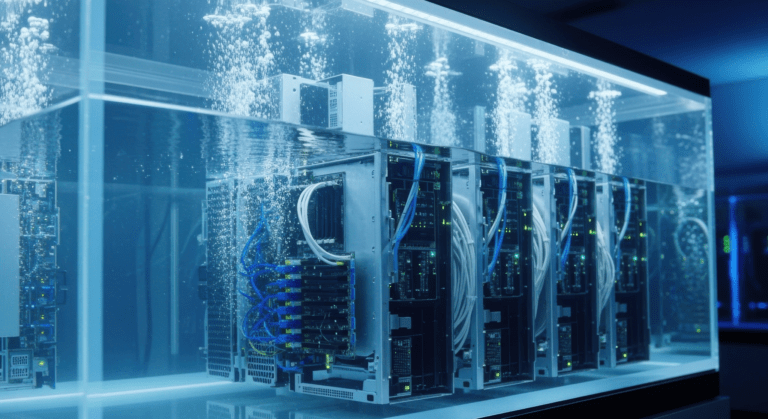
Servers are submerged in a special nonconductive liquid that absorbs heat directly. Instead of cooling air, the liquid itself pulls heat away from electronics. Think of it as a giant mineral-oil bath for computers. There are two main approaches. Single-phase immersion cooling submerges servers in a non-conductive dielectric fluid that remains in liquid form throughout the cooling process. As the hardware generates heat, the surrounding fluid absorbs it and is circulated through a heat exchanger, where the heat is removed before the cooled fluid is returned to the tank. Because the fluid never changes state, single-phase systems are relatively simple to operate and maintain, making them the most common form of immersion cooling in commercial deployments.

Two-phase immersion cooling uses a specialized dielectric fluid with a low boiling point. When hot processors and other components heat the fluid, it boils and turns into vapor. The vapor rises to a cooled condenser above the servers, where it condenses back into liquid and falls into the tank to repeat the cycle. This phase-change process removes heat very efficiently and can support extremely high-density computing environments, but the systems are more complex and typically carry higher installation and operating costs than single-phase designs.

High-performance computing and crypto-mining operations pioneered immersion cooling. It is currently being used by Bitcoin miners in Texas, Wyoming, and Alberta. It is also used by the University of Teaxas’ TACC Frontera, one of the world’s fastest academic supercomputers.

  Researchers say immersion systems can cut cooling energy dramatically while shrinking building size requirements. Major AI operators are testing it for next-generation GPU clusters.

Pros

  • Extremely energy efficient
  • Handles ultra-dense AI computing
  • Smaller building footprint
  • Potentially lower operating costs

Cons

  • Maintenance is harder
  • Specialized equipment required
  • Retrofitting older centers is expensive
  • Limited operating history

The next challenge for data centers 

As AI drives demand for ever-larger and more powerful data centers, cooling technology is becoming as important as the processors inside the buildings. The industry is rapidly moving beyond the air-cooled designs that powered the internet era toward systems that prioritize efficiency, water conservation and higher computing density. Whether through direct-to-chip liquid cooling, closed-loop systems or even immersion tanks, operators are searching for ways to support the next generation of AI while addressing growing concerns about energy use, water consumption and community impact. The result is a new arms race in infrastructure, one where the future of computing may depend as much on how facilities remove heat as on how fast their chips can process information.

Sources:

Amazon Web Services. AWS rolls out liquid cooling in data centers. About Amazon. https://www.aboutamazon.com/news/aws/aws-liquid-cooling-data-centers

Amazon Web Services. AWS announces new data center components to support AI innovation and further improve energy efficiency. Business Wire. https://www.businesswire.com/news/home/20241201928268/en/AWS-Announces-New-Data-Center-Components-to-Support-AI-Innovation-and-Further-Improve-Energy-Efficiency

LiquidStack. (n.d.). Immersion cooling technology overview. https://liquidstack.com

Microsoft. Sustainable by design: Next-generation datacenters consume zero water for cooling. Microsoft Cloud Blog. https://www.microsoft.com/en-us/microsoft-cloud/blog/2024/12/09/sustainable-by-design-next-generation-datacenters-consume-zero-water-for-cooling/

Data Center Dynamics. Microsoft’s upcoming data centers to use closed-loop, zero-water evaporation design. https://www.datacenterdynamics.com/en/news/microsofts-upcoming-data-centers-to-use-closed-loop-zero-water-evaporation-design/

TechCrunch. AWS bets on liquid cooling for its AI servers. https://techcrunch.com/2024/12/02/aws-bets-on-liquid-cooling-for-its-ai-servers/

Texas Advanced Computing Center. Frontera supercomputer. https://www.tacc.utexas.edu/systems/fronteraWired. Data center operators are trying to fix their water use problems. https://www.wired.com/story/data-center-operators-fix-water-use-problems

Infrastructure Update – week of June 8, 2026

All the regional infrastructure news that’s fit to email. Get the TLDR in this edition of Infrastructure Update.

NJDEP Releases Final FY2026–27 Water Infrastructure Investment Plan

The New Jersey Department of Environmental Protection published its Final Clean Water and Drinking Water Intended Use Plans for FY2026–27 on May 21, outlining the state’s priorities for allocating federal and state financing through the New Jersey Water Bank. The IUP establishes the project priority lists, funding packages, and eligibility criteria that determine which municipal drinking‑water, wastewater, and stormwater projects receive subsidized loans and Bipartisan Infrastructure Law dollars. According to NJDEP, the Water Bank “provides low‑cost financing for the design, construction, and implementation of projects that help to protect, maintain and improve water quality and ensure safe drinking water.” The updated lists include hundreds of projects under active review, from lead‑service‑line replacement to treatment‑plant upgrades. This is the state’s most important annual planning document for water infrastructure investment.

Read more: NJDEP| Water Infrastructure Investment Plan | Intended Use Plan and Project Priority Lists 

New Jersey Joins Multistate Lawsuit Over Canceled Offshore Wind Leases

New Jersey has joined New York, Connecticut, Massachusetts, Rhode Island, Maine, and Vermont in suing the U.S. Department of the Interior over the cancellation of Attentive Energy’s offshore wind leases, originally purchased for $795 million. The leases were expected to support 2.7 GW of offshore wind, enough to power 1.3 million homes. Attorney General Jennifer Davenport called the cancellation “a lawless attack on clean energy development,” arguing it will raise costs and undermine grid reliability. The lawsuit seeks to void the federal settlement, restore the leases, and prevent further implementation of the cancellation agreement. Offshore wind development in New Jersey has largely stalled following the collapse of Ocean Wind 1 & 2 and delays at Atlantic Shores, making this legal challenge a major pivot point for the state’s clean‑energy strategy.

Read more: New Jersey joins lawsuit over canceled offshore wind leases 

Samsung Leaving Englewood Cliffs for Texas

In a major corporate shift, Samsung Electronics America confirmed it will relocate its U.S. headquarters from Englewood Cliffs to Plano, Texas by the end of 2026 — just nine months after opening its 312,000‑square‑foot New Jersey campus. The move affects roughly 1,200 employees and follows Samsung’s broader consolidation near its semiconductor and mobile‑network operations in Austin and Plano. Business groups blamed New Jersey’s high taxes and regulatory climate, while Texas officials touted their “pro‑business environment.” The departure marks one of the most significant corporate exits from New Jersey in recent years, raising concerns about competitiveness and long‑term economic strategy.

Read more: Samsung leaving Englewood Cliffs NJ for Texas. Here’s why 

Assembly Panel Advances $50B ‘Polluters Pay’ Bill Targeting Fossil Fuel Firms

The Assembly Environment Committee advanced the Polluters Pay to Make New Jersey Affordable Act, which would require major fossil‑fuel extractors — specifically Shell, ExxonMobil, and BP — to pay $50 billion over 20 years for climate‑related damages. Supporters argue the companies “profited enormously” while contributing to climate impacts that now burden New Jersey taxpayers. Business groups warned the costs will ultimately fall on consumers and predicted years of litigation. Funds would support climate‑adaptation projects statewide. The bill mirrors similar efforts in New York and Vermont and signals an aggressive new phase in New Jersey’s climate‑liability strategy.

Read more: NJ Assembly panel advances bill aimed at fining fossil fuel firms • New Jersey Monitor 

Poll Shows Broad Support for Natural Gas Expansion in New Jersey

A new statewide poll shows strong bipartisan support for expanding natural‑gas infrastructure to improve grid reliability and lower energy costs. Voters cited rising electricity prices, PJM capacity shortages, and stalled offshore wind development as reasons to support new gas capacity. The findings come as lawmakers debate A4882, the Natural Gas Reliability Act, which would streamline upgrades to existing gas plants and firm‑capacity procurement.

Read more: https://tristateinfrastructurenews.com/new-jersey-poll-shows-broad-support-for-natural-gas-expansion/

New York Aims for 1GW of Nuclear Energy

New York has taken a major step toward expanding its clean‑energy portfolio, launching a search for developers to build at least 1 gigawatt of advanced nuclear capacity in Upstate New York. The New York Power Authority issued a Request for Qualifications for companies capable of delivering either a large‑scale reactor such as the AP1000 or an SMR like the BWRX‑300. The state also opened $40 million in workforce‑training grants to prepare welders, technicians, and operators. Gov. Hochul said the initiative positions New York to lead the next era of round‑the‑clock, emissions‑free power.

Read more: https://interestingengineering.com/energy/new-york-gigawatt-nuclear-power-project?utm_source=copilot.com

Nuclear Policy Task Force Members to Headline Rowan University Conference

Four members of Governor Sherrill’s newly formed Nuclear Policy Task Force will speak at Rowan University’s June 9 conference on expanding nuclear‑generation capacity. Speakers include BPU President Christine Guhl‑Sadovy, DEP Commissioner Ed Potosnak, EDA CEO Evan Weiss, and Holtec’s Patrick O’Brien. The event focuses on the fiscal, regulatory, and workforce challenges of building new full‑scale reactors and SMRs. Rowan officials emphasized that nuclear must be part of New Jersey’s strategy to meet rising demand from electrification, manufacturing, and data‑center growth.

Read more: Rowan’s Conference on Nuclear Generation Capacity – BINJE | New Jersey Business News 

The buildings behind every click

0

Before the morning coffee is finished, most Americans have already interacted with a data center dozens of times.

The alarm on a smartphone syncs with the cloud. A weather app downloads the day’s forecast. An online bank account updates overnight transactions. Emails arrive, music streams and social media feeds refresh. Each action feels instantaneous, but behind every click is a network of buildings that most people never see and rarely think about.

Those buildings are data centers, and they have become one of the most important pieces of infrastructure in modern life. 

The modern library 

At their simplest, data centers are facilities that house computer servers. While that definition sounds technical, a better comparison might be a modern library. Instead of shelves filled with books, data centers contain rows of servers that store, process and distribute the information that powers today’s digital world. Every photo saved to the cloud, online purchase, streaming movie, medical record and business transaction relies on data centers operating around the clock.

As technology has evolved over the past 50 years, so has the need for facilities capable of storing and processing information. The computing landscape has progressed from massive mainframe computers in the 1970s to personal computers in the 1980s and 1990s, followed by the rise of the internet in the 2000s and the cloud computing revolution of the 2010s. Today, artificial intelligence, streaming services, smart devices and an increasingly connected economy are driving demand for even more computing power. That growth has transformed data centers from niche facilities into essential infrastructure.

The importance of these facilities becomes clearer when imagining a world without them. No cloud storage. No online banking. No streaming services. No rideshare apps. No social media. No online shopping. No video conferencing. Much of the technology that defines modern life would simply stop functioning, and the impact extends far beyond personal convenience. Hospitals rely on data centers to access patient records and coordinate care. Utilities use them to monitor and manage critical systems. Emergency responders depend on digital communications networks. Businesses use them to process transactions and maintain operations. Governments rely on them to deliver services and safeguard information. In many ways, data centers have become as essential to modern society as highways, power plants and water systems.

New Jersey’s economy is particularly dependent on digital infrastructure. The state sits within one of the most densely connected regions in the country, positioned between New York City and Philadelphia and supported by extensive fiber-optic networks. Financial institutions, healthcare systems, logistics companies, pharmaceutical firms and technology businesses all rely on secure and reliable data storage and processing. The rise of artificial intelligence is only accelerating that demand.

AI applications require enormous computing resources to train models, process information and generate responses in real time. Every AI-powered search, recommendation engine and chatbot relies on the same underlying infrastructure that supports cloud computing, streaming and digital commerce. As AI adoption expands, data centers are increasingly viewed as foundational infrastructure for future economic growth.

The debate over data centers

Yet as data centers become more visible, they have also become the subject of growing public debate. Community meetings about proposed projects often draw passionate opposition and social media platforms are filled with arguments about their impact on neighborhoods, power grids and the environment. In some cases, the criticism has evolved into suspicion, with data centers portrayed as mysterious facilities that consume resources while providing little public benefit.

There is an irony in many of those discussions. The very platforms where much of the debate takes place, Facebook, Instagram, X, TikTok, Reddit and countless others, exist because of data centers. Every comment posted, video uploaded and opinion shared depends on the same infrastructure being criticized. That does not mean concerns about data center growth should be dismissed. Questions about electricity demand, water consumption, land use, noise and the potential impact on utility costs are legitimate issues that communities and policymakers are increasingly grappling with, particularly as artificial intelligence drives a new wave of development. It does, however, highlight how deeply data centers have become woven into everyday life. For most people, using digital services has become second nature while the infrastructure that makes those services possible remains largely invisible.

The next time a text message arrives, a bank balance updates or a favorite show begins streaming, it is worth remembering that none of it happens by accident. Behind every click, swipe and search is a vast network of infrastructure working silently in the background. Most people may never visit a data center, but they rely on one every day.

Sources:

U.S. Cybersecurity & Infrastructure Security Agency. (n.d.). Critical infrastructure sectors. https://www.cisa.gov/topics/critical-infrastructure-security-and-resilience/critical-infrastructure-sectors

U.S. Department of Energy. (n.d.). Data center energy efficiency.https://www.energy.gov/eere/buildings/data-centers-and-servers

International Energy Agency. (2024). Electricity 2024: Analysis and forecast to 2026.https://www.iea.org/reports/electricity-2024

Infrastructure Update – Week of June 1, 2026

Tunnels, Turnpikes, and NJ Transit – Oh my! This and more in this edition of Infrastructure Update.

Hudson Tunnel Project Enters High‑Stakes Phase  

The Hudson Tunnel Project has reached a pivotal milestone as crews in North Bergen begin excavating the 600‑foot‑long, 80‑foot‑deep launch box that will house the massive tunnel‑boring machines (TBMs) for the Palisades Tunnel. These German‑built, 500‑foot‑long TBMs will grind through extremely hard, 35,000‑psi rock at a pace of 25–30 feet per day — a process complicated by abrasive geology and fault‑related water infiltration.

Engineers are deploying probe drilling every 150 feet and extensive grouting to manage water risks. The Palisades section will eventually sit nearly 280 feet below grade at its deepest point. Officials emphasize that schedule discipline is critical: each segment of the Hudson Tunnel Project must align precisely with the next to avoid cascading delays. The project also includes surface alignments, bridges, and eventual integration into Penn Station.

This phase marks one of the most technically demanding components of the Gateway Program — and one that must succeed to enable the rehabilitation of the storm‑damaged North River Tunnel.

Read more at ConstructConnect: https://news.constructconnect.com/hudson-tunnel-project-reaches-pivotal-phase-as-palisades-tunnel-start-nears

Could NJ Transit and the Turnpike Authority Merge? 

Gov. Mikie Sherrill is exploring a dramatic restructuring of New Jersey’s transportation governance: merging NJ Transit with the New Jersey Turnpike Authority. The idea, once floated by political opponents, gained traction after Sherrill appointed Kris Kolluri to lead both agencies — a move intended to break down silos and improve coordination during crises like winter storms and major events such as the 2026 World Cup.

Supporters argue that a merger could stabilize NJ Transit’s finances, much like the 2003 consolidation that helped rescue the Driscoll Bridge. The Turnpike Authority already sends $470 million annually to NJ Transit, and some believe a unified capital structure could reduce redundancy and improve long‑term planning.

Skeptics, however, warn of “food fights” over capital priorities and fear politicization of funding decisions. Legislators remain divided, though bills have been introduced to study the concept. With NJ Transit’s aging fleet causing record breakdowns and fare hikes, the debate over structural reform is intensifying.

Read more at The Ridgewood Blog: https://theridgewoodblog.net/to-fix-crumbling-trains-new-jersey-weighs-an-unprecedented-transportation-merger/

NJ Transit Unveils Multilevel III Rail Cars

NJ Transit is preparing to roll out its next‑generation Multilevel III rail cars — a 374‑car order built by Alstom in Plattsburgh, NY. These double‑deck cars will replace aging Arrow III and Comet equipment from the 1970s and 1980s, addressing chronic reliability issues and overcrowding.

The new fleet introduces major performance upgrades: speeds up to 110 mph, smoother acceleration and braking, and — for the first time — power cars equipped with traction motors, allowing flexible train formations without relying solely on locomotives.

Passenger amenities reflect modern commuter expectations: USB‑A and USB‑C charging ports, digital information displays, improved lighting, and enhanced accessibility. Up to 40 cars are expected to enter service by late 2026, with a broader modernization program extending through 2031.

Read more at Tri‑State Infrastructure News Network:  https://tristateinfrastructurenews.com/a-look-at-nj-transits-new-multilevel-iii-rail-cars/

Sherrill Proposes First‑in‑Nation Data Center Regulations

With AI‑driven energy demand surging, Gov. Sherrill has introduced what her administration calls the nation’s first comprehensive statewide framework for regulating data centers. New Jersey already hosts more than 80 facilities, but proposed mega‑projects have sparked backlash over electricity use, water consumption, noise, and environmental impacts.

The four‑pillar plan would require data centers to:  

  • fund new clean‑energy generation and grid upgrades,  
  • disclose energy and water usage,  
  • negotiate standardized community‑benefits agreements, and  
  • use local trades and prevailing‑wage labor.

Sherrill cited PJM data showing data centers accounted for 70% of projected load growth last year. With some towns already banning new facilities, the administration aims to balance economic opportunity with affordability and environmental protection.

Read more at NJBIZ: https://njbiz.com/sherrill-nj-data-center-regulations/

New Jersey poll shows broad support for natural gas expansion

0

Voters are backing an “all-of-the-above” energy approach, with voters backing natural gas expansion alongside renewables, nuclear and grid modernization.

A new poll from Fairleigh Dickinson University, conducted in partnership with the International Union of Operating Engineers, finds strong support among New Jersey voters for expanding natural gas power generation as part of efforts to lower energy costs.

According to the survey, 76% of respondents said they favor building new natural gas power plants, making it the most widely supported energy option tested.

Support for natural gas development cuts across political lines. The poll found 83% of Republicans and 70% of Democrats back new natural gas plants, indicating relatively little partisan division compared with other energy sources.

The data also shows consistent support across ideological groups. Majorities of conservatives, moderates and liberals all expressed support for new natural gas facilities, with higher backing among conservative and Republican-leaning voters but still majority support among progressive respondents.

Researchers noted that natural gas projects were described in the survey as able to come online more quickly than other types of power generation, a factor that may influence voter support.

The poll results place natural gas ahead of other generation options tested. Renewable energy projects received 67% support, while nuclear power was supported by 56% of respondents.

Overall, the findings indicate that natural gas expansion is the most broadly supported approach among New Jersey voters in the poll, with backing that spans party affiliation and ideology.

Sources:

Binje. (n.d.). Energy survey: Residents favor “all of the above” approach if it means more generation, lower costs. https://binje.com/energy-survey-residents-favor-all-of-the-above-approach-if-it-means-more-generation-lower-costs/

Binje. (n.d.). 10 things about the FDU–IUOE poll on energy.https://binje.com/10-things-about-the-fdu-iuoe-poll-on-energy/

Fairleigh Dickinson University. (n.d.). FDU poll finds voters support anything to bring down prices.https://www.fdu.edu/news/fdu-poll-finds-voters-support-anything-to-bring-down-prices/