


TLDR:
Data centers are the invisible infrastructure behind modern life.
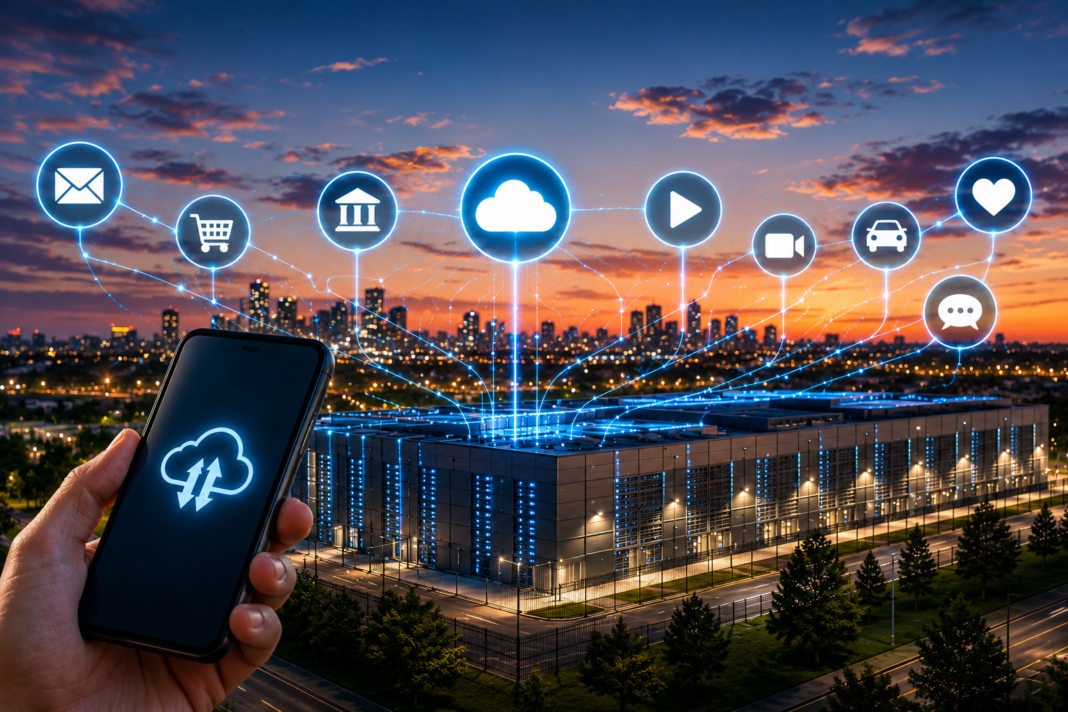
Every text message, streamed movie, online purchase, bank transaction and AI query relies on facilities that store and process massive amounts of information.
While they often go unnoticed, data centers have become as essential to society as roads, power plants and water systems.
As demand for cloud computing, streaming and artificial intelligence continues to grow, so does the need for the digital infrastructure that keeps the modern world connected.
Before the morning coffee is finished, most Americans have already interacted with a data center dozens of times.
The alarm on a smartphone syncs with the cloud. A weather app downloads the day’s forecast. An online bank account updates overnight transactions. Emails arrive, music streams and social media feeds refresh. Each action feels instantaneous, but behind every click is a network of buildings that most people never see and rarely think about.
Those buildings are data centers, and they have become one of the most important pieces of infrastructure in modern life.
The modern library
At their simplest, data centers are facilities that house computer servers. While that definition sounds technical, a better comparison might be a modern library. Instead of shelves filled with books, data centers contain rows of servers that store, process and distribute the information that powers today’s digital world. Every photo saved to the cloud, online purchase, streaming movie, medical record and business transaction relies on data centers operating around the clock.
As technology has evolved over the past 50 years, so has the need for facilities capable of storing and processing information. The computing landscape has progressed from massive mainframe computers in the 1970s to personal computers in the 1980s and 1990s, followed by the rise of the internet in the 2000s and the cloud computing revolution of the 2010s. Today, artificial intelligence, streaming services, smart devices and an increasingly connected economy are driving demand for even more computing power. That growth has transformed data centers from niche facilities into essential infrastructure.
The importance of these facilities becomes clearer when imagining a world without them. No cloud storage. No online banking. No streaming services. No rideshare apps. No social media. No online shopping. No video conferencing. Much of the technology that defines modern life would simply stop functioning, and the impact extends far beyond personal convenience. Hospitals rely on data centers to access patient records and coordinate care. Utilities use them to monitor and manage critical systems. Emergency responders depend on digital communications networks. Businesses use them to process transactions and maintain operations. Governments rely on them to deliver services and safeguard information. In many ways, data centers have become as essential to modern society as highways, power plants and water systems.
New Jersey’s economy is particularly dependent on digital infrastructure. The state sits within one of the most densely connected regions in the country, positioned between New York City and Philadelphia and supported by extensive fiber-optic networks. Financial institutions, healthcare systems, logistics companies, pharmaceutical firms and technology businesses all rely on secure and reliable data storage and processing. The rise of artificial intelligence is only accelerating that demand.
AI applications require enormous computing resources to train models, process information and generate responses in real time. Every AI-powered search, recommendation engine and chatbot relies on the same underlying infrastructure that supports cloud computing, streaming and digital commerce. As AI adoption expands, data centers are increasingly viewed as foundational infrastructure for future economic growth.
The debate over data centers
Yet as data centers become more visible, they have also become the subject of growing public debate. Community meetings about proposed projects often draw passionate opposition and social media platforms are filled with arguments about their impact on neighborhoods, power grids and the environment. In some cases, the criticism has evolved into suspicion, with data centers portrayed as mysterious facilities that consume resources while providing little public benefit.
There is an irony in many of those discussions. The very platforms where much of the debate takes place, Facebook, Instagram, X, TikTok, Reddit and countless others, exist because of data centers. Every comment posted, video uploaded and opinion shared depends on the same infrastructure being criticized. That does not mean concerns about data center growth should be dismissed. Questions about electricity demand, water consumption, land use, noise and the potential impact on utility costs are legitimate issues that communities and policymakers are increasingly grappling with, particularly as artificial intelligence drives a new wave of development. It does, however, highlight how deeply data centers have become woven into everyday life. For most people, using digital services has become second nature while the infrastructure that makes those services possible remains largely invisible.
The next time a text message arrives, a bank balance updates or a favorite show begins streaming, it is worth remembering that none of it happens by accident. Behind every click, swipe and search is a vast network of infrastructure working silently in the background. Most people may never visit a data center, but they rely on one every day.
Sources:
U.S. Cybersecurity & Infrastructure Security Agency. (n.d.). Critical infrastructure sectors. https://www.cisa.gov/topics/critical-infrastructure-security-and-resilience/critical-infrastructure-sectors
U.S. Department of Energy. (n.d.). Data center energy efficiency.https://www.energy.gov/eere/buildings/data-centers-and-servers
International Energy Agency. (2024). Electricity 2024: Analysis and forecast to 2026.https://www.iea.org/reports/electricity-2024