


[Part 2 of a series on water. Read Part 1 here.]
From polluted rivers and epidemics to reservoirs and regulations, New Jersey’s municipal water systems were built out of crisis during the dawn of a new industrial era. Smoke from mills and the sharp tang of tannery waste hung over river towns. Families drank from shallow wells or public pumps that sometimes tasted of sewage. Outbreaks of typhoid and cholera left streets lined with mourning. Public outrage, lawsuits and the work of early engineers forced a shift: cities bought failing private companies, built protected reservoirs and adopted filtration and disinfection that finally made running water reliably safe. This article traces the arc of New Jersey’s water systems, from the failures that made reform urgent to the challenges on tap today.
Roots of crisis
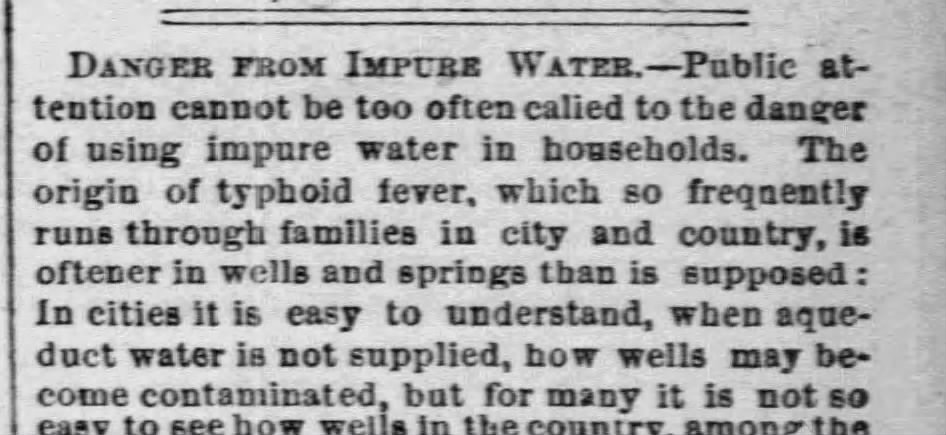
The Star Ledger, March 17, 1875
In the 19th century, New Jersey’s population and industrial activity rose sharply. Towns clustered along rivers because mills and factories needed water for power, cooling and chemical processes. At the same time, households still relied on shallow wells, springs, or small private water companies with minimal treatment. The combination of industrial waste, limited sanitation, and fragmented private suppliers created the perfect conditions for public‑health and service failures.
Newark and the age of waterborne disease
Newark provides one of the clearest examples. During the mid‑ to late‑1800s, the city suffered repeated cholera and typhoid outbreaks traced directly to contaminated drinking water. Public‑health investigators found sewage from upstream communities — Paterson, Passaic, Clifton — flowing into the very rivers Newark used as drinking sources. Newspapers ran stark headlines linking typhoid to the Passaic intake and a New Jersey State Board of Health report in 1898 described parts of the river as “little better than an elongated sewer.” Hundreds died of typhoid between 1890 and 1900. This human toll galvanized residents and city leaders, who demanded a safe, reliable supply rather than the improvised and under‑regulated systems of earlier decades.
Police chase boys for swimming in the Passaic River, 1936. Photo courtesy of Newark Public Library
Industrial contamination and the decline of the Passaic
Disease was not the only threat. As industrialization intensified, the Lower Passaic became a symbol of unchecked pollution. By the early 1900s, factories involved in silk‑dying, tanning and chemical production discharged their wastes directly into the river. Local newspapers described stretches of the Passaic turning black and putrid; fish kills and foul odors became routine. Downstream residents reported chronic illness linked to the water. These visible harms spurred court cases, street‑level protests and growing agreement that no single town could solve pollution that crossed municipal boundaries. A watershed problem demanded a watershed‑scale solution.
Fragmentation, private suppliers and small‑town failures
Throughout the state, many small municipalities depended on private water companies that often delivered intermittent service, charged high rates and invested little in maintenance or treatment. Wells ran dry in summer or became contaminated after storms. In some places, low water pressure undermined firefighting, allowing small blazes to spread. These failures made it clear that water needed to be a public responsibility with professional management, consistent standards and long‑term planning.
How municipal governments and regions fixed the problem
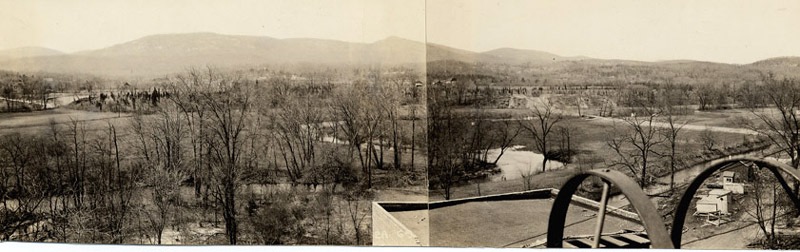
Caption: The Wanaque Reservoir, built to replace polluted river sources, became a lifeline for cities like Paterson and Newark. Built in the 1920’s, it provided more reliable water from protected upland watersheds and ended decades of dependence on the contaminated Passaic. Photo provided by the New Jersey State Archives.
The path from crisis to stability unfolded through several practical steps. Cities and towns began acquiring private companies or building their own waterworks. Cities and towns began acquiring private companies or building their own waterworks. In Newark, municipal control was established in 1892, Jersey City expanded its city-owned system with the Boonton Reservoir in 1904, and Camden purchased its private water system in 1899, reflecting a statewide shift toward public water supply. Public ownership allowed decisions to be made around health and safety, not profit margins and created predictable budgets for upgrades and repairs.
Many of these early municipal systems were also built with materials that were later found to pose serious health risks. Lead service lines were widely used in the late 19th and early 20th centuries because lead was durable, easy to work with, and thought to be safe for drinking water at the time. In reality, corrosion inside older pipes can cause lead to leach into tap water, especially when water chemistry is not carefully controlled. It wasn’t until decades later that the public health impacts became clear, linking lead exposure to neurological damage and other long-term health problems, particularly in children. As a result, many of the same systems that marked a shift toward public control are now undergoing expensive replacement efforts to remove legacy lead infrastructure.
Recognizing that river pollution and supply shortages affected entire watersheds, New Jersey established regional bodies to build and operate protected water sources. A key turning point came with the formation of state‑supervised commissions and the construction of reservoirs, pipelines and conduits. These systems drew water from cleaner upland watersheds and reduced dependence on polluted rivers. The Boonton and Wanaque reservoir systems, built in 1904 and 1296, became foundational to North Jersey’s modern supply.
Advances in filtration and the adoption of chlorination in the early 20th century drastically reduced waterborne disease. Cities built sand‑filtration plants, later expanding to multi‑stage treatment that removed sediment, pathogens and chemical contaminants.
State health boards and later state agencies, introduced sanitary surveys, source‑water protection zones and rules governing industrial discharges. Municipalities and industries were required to limit activities that threatened drinking‑water sources, often enforced through litigation and state oversight.
Because single towns often lacked the financial or technical resources to manage large systems, authorities and regional utilities became a practical solution. These entities pooled money and expertise, borrowed at lower interest rates and operated systems more efficiently.
Federal laws and the modern regulatory framework
By the 1970s, growing environmental awareness and lingering industrial pollution prompted national reform. The Clean Water Act (1972) placed strong limits on wastewater discharges, while the Safe Drinking Water Act (1974) set nationwide standards for contaminants, monitoring and treatment. In New Jersey, the Department of Environmental Protection (DEP) became the state’s enforcement agency. These laws raised expectations and ensured that even small systems followed consistent health standards.
Asbury Park Evening Press, September 13, 1970
Legacy systems and today’s challenges
Much of New Jersey’s water infrastructure was built 50 to 100 years ago. That legacy now strains under modern demands.
Cast-Iron Mains
Cast-iron water mains are almost everywhere in New Jersey’s older towns and cities, especially in systems built between about the 1890s and 1960s, when cast‑iron was the standard material for both mains and service lines. These can crack and leak, wasting water and driving up maintenance costs. Cast-iron main failures can also surface as water‑main breaks and road‑bed collapses
Lead service lines
Lead service lines (LSLs) are the pipes that carry water from the public main under the street into individual homes and buildings. In much of New Jersey, these lines were installed from the late 1800s through the mid‑20th century, long before the health risks of lead exposure were understood.
New Jersey took an aggressive stance with a 2021 law requiring every community water system to inventory and replace all lead service lines within 10 years. Full replacement typically costs $5,000 – $10,000 per line, depending on the property and soil conditions.
Plants and PFAS
Water treatment plants built decades ago were designed for different contaminants. New threats, including PFAS and other emerging pollutants, require advanced treatment technology that aren’t always available.
Combined Sewer Overflows (CSOs)
Combined sewer systems, common in many of New Jersey’s older cities, were designed to carry both stormwater and wastewater through a single pipe. During dry weather, the system works as intended, directing flow to treatment plants. But during heavy rain or snowmelt, the volume can overwhelm the system.
This causes CSOs to discharge a mix of stormwater and untreated sewage directly into waterways. New Jersey has identified dozens of CSO outfalls that require long-term control plans under state and federal mandates. Addressing them often involves major infrastructure upgrades, including storage tunnels, expanded treatment capacity and green infrastructure designed to absorb stormwater before it enters the system.
These projects are complex and costly, but they represent a critical investment in modernizing aging infrastructure.
Ensuring Tomorrow’s Water
New Jersey has no shortage of options for rebuilding its water systems, but none of them are simple or inexpensive. The choices range from expanding state loans and grants to forming stronger regional water authorities, turning to public‑private partnerships, or selling systems to private utilities. Communities can also invest in green infrastructure to handle stormwater more effectively or adopt phased, risk‑based replacement programs that tackle the most urgent pipes and lead lines first. Each approach carries its own costs, trade‑offs and political implications, but the reality is that the work must be done.
Sources:
City of Newark, Department of Water & Sewer Utilities. (2021). Lead service line replacement program. newarkleadserviceline.com
Jersey Water Works. (2023). New Jersey’s water infrastructure: Status, needs, and financing options. jerseywaterworks.org
New Jersey Department of Environmental Protection. (n.d.). Lead service line replacement: SRF requirements. dep.nj.gov
North Jersey District Water Supply Commission. njdwsc.com
New Jersey Turnpike Authority. (n.d.). About the reservoir. http://njturnpikewidening.com/pdf/about_reservoir.html
U.S. Environmental Protection Agency. (1972). Federal Water Pollution Control Act Amendments (Clean Water Act). epa.govU.S. Environmental Protection Agency. (2024). Basic information about lead in drinking water. https://www.epa.gov/ground-water-and-drinking-water/basic-information-about-lead-drinking-water