
Our Infrastructure Matters Ad
Home Blog

Our Infrastructure Matters – Episode 12

0

Military Infrastructure Part 1

“Our Infrastructure Matters” is a news program highlighting important infrastructure projects and issues throughout the region. From roads and bridges to rails and tunnels. From the energy and communications grids to drinking water, wastewater, and stormwater.

Episode 12 includes the following segments:

  • Military Infrastructure, Part 1 – 0:58
  • Understanding Data Centers – 7:33
  • Training for Operating Engineers – 14:14
  • New Jersey’s Airport Network – 16:55
  • The Delaware and Raritan Canal – 24:23

News 12 +

Watch Our Infrastructure Matters on New 12 +

http://news12.plus/new-jersey/

Additional Episodes

Transcript

[01:00:58:09 – 01:01:45:04]

 New Jersey is often associated with suburbs, beaches, and its location between two major American cities. But hidden across the state is a network of military infrastructure that has shaped the defense of the United States for more than two centuries. From revolutionary war encampments to modern joint military bases, from experimental weapons laboratories to massive naval ammunition depots, New Jersey has repeatedly served as a strategic backbone for American defense. Constructing and maintaining these installations required enormous engineering efforts, runways capable of supporting the world’s largest aircraft, research laboratories for advanced weapons development, and even rail-connected piers stretching miles into the Atlantic.

[01:01:46:05 – 01:03:21:01]

 Behind these projects were thousands of skilled workers, ironworkers, electricians, laborers, operating engineers, and carpenters. Many organized through building trades unions that supplied the trained workforce needed for large federal construction programs. This is the story of New Jersey’s military infrastructure, how it began, how it expanded, and how these historic installations continue to shape the state today. Revolutionary War, the Strategic Crossroads New Jersey’s military importance began during the American Revolution. Because the state sat between British-controlled New York City and the revolutionary capital in Philadelphia, it became a strategic battleground. During the war, George Washington and the Continental Army camped repeatedly across the state while maneuvering against British forces. One of the most important locations was Morristown, where Washington established winter headquarters during 1777, and again during the brutal winter of 1779 to 1780. The second encampment occurred at Jockey Hollow, where thousands of soldiers built a grid of nearly a thousand small log huts to house the army while Washington directed military operations from nearby Ford Mansion. Another major encampment site was Middlebrook encampment, located along the Wachung Mountains. From the ridge above the Raritan Valley, Washington’s troops could monitor British forces stationed in New Brunswick while maintaining a strong defensive position.

[01:03:22:02 – 01:04:22:10]

 Continental Army troops also moved through and fought in areas such as Princeton, where Washington secured a crucial victory during the winter campaign of 1777. Though these early encampments consisted largely of temporary structures, they established New Jersey’s strategic importance in American military planning. The War of 1812, Coastal Defenses Several decades later, New Jersey again became strategically important during the War of 1812. The young United States faced the threat of British naval attacks along the Atlantic coast, particularly near the entrance to New York Harbor. To defend this vital harbor, the federal government expanded coastal fortifications along Sandy Hook. The site that would later become Fort Hancock began developing defensive installations during this era. Early batteries and artillery placements were built to monitor the harbor entrance and provide warning of approaching enemy ships.

[01:04:23:10 – 01:04:31:09]

 Construction during this period involved masonry fortifications, earthen embankments, powder magazines, and coastal artillery platforms.

[01:04:32:10 – 01:05:31:12]

 Although the defensive network was still relatively small compared with later fortifications, the War of 1812 marked the beginning of permanent coastal defense systems in New Jersey. These early installations laid the groundwork for the much larger harbor defense complexes that would be built in the late 19th and early 20th centuries. The Civil War, Training, and Mobilization During the American Civil War, New Jersey again became an important mobilization center. Although the state was far from the main battlefields, it played a key role in training and organizing Union troops. One of the most important military camps was Camp Olden, named after New Jersey Governor Charles Smith Olden. Located near Trenton, the camp served as a mustering and training ground for Union regiments before they were sent south to fight. Thousands of soldiers passed through Camp Olden between 1861 and 1865.

[01:05:32:20 – 01:05:44:00]

 Temporary barracks, drill fields, supply depots, and administrative buildings were constructed to support the mobilization effort. Other camps across the state also supported Union troops.

[01:05:45:05 – 01:06:40:01]

 Facilities near rail lines and ports allowed soldiers and equipment to move quickly toward major transportation hubs in Philadelphia and New York. These early mobilization camps demonstrated how New Jersey’s transportation network, railroads, ports, and roadways could support large military deployments. Picatinny Arsenal, the Weapons Laboratory One of the most important permanent military installations in the state is Picatinny Arsenal, established in 1880 in Morris County. The site was chosen because its valleys and hills provided natural containment for explosives testing. Picatinny quickly became the U.S. Army’s primary center for munitions research and weapons development. The complex required extensive infrastructure, laboratories, manufacturing buildings, testing ranges, and rail systems to safely move explosives.

[01:06:41:14 – 01:07:03:07]

 Explosive storage bunkers were constructed with reinforced concrete designed to contain accidental blasts. Union construction trades helped build many of these facilities, particularly electricians installing specialized laboratory systems, ironworkers erecting structural steel, and operating engineers handling large-scale excavation.

[01:07:04:07 – 01:07:31:05]

 Today, Picatinny remains one of the Army’s leading weapons research centers. By the beginning of the 20th century, New Jersey’s military role had evolved dramatically. A storied history of temporary encampments and coastal defenses had given way to permanent installations dedicated to training, weapons development, and national defense. But the scale of what came next would dwarf everything that had come before it.

[01:07:37:25 – 01:08:46:05]

 Before you’ve finished your morning coffee, you’ve probably interacted with a data center dozens of times. Your alarm synced with the cloud. Your weather app downloaded the forecast. Your bank account updated overnight transactions. Emails arrived. Music streamed. Social media feeds refreshed. Each action feels instant. But behind every click, swipe, search, and stream is a network of computers housed in buildings that most people never see and rarely think about. At its simplest, a data center is a facility that houses computer servers. But a better comparison might be a modern library. Instead of storing books, data centers store, process, and distribute information. Every photo saved to the cloud. Every online purchase. Every streaming movie. Every business transaction. Every medical record. All of it relies on data centers operating around the clock. The importance of these facilities becomes clearer when you imagine a world without them. Hospitals rely on data centers to access patient records. Emergency responders depend on digital communications.

[01:08:47:05 – 01:14:13:15]

 Businesses use them to process transactions. Governments rely on them to deliver services and safeguard information. In many ways, data centers have become just as essential to modern society as highways, power plants, and water systems. For decades, demand for computing power has continued to grow. From mainframe computers to personal computers. From the internet to cloud computing. Each technological revolution required more infrastructure. Today, artificial intelligence is driving the next wave of growth. Every AI-powered search, recommendation engine, image generator, and chatbots depends on powerful data centers working behind the scenes. But AI is also transforming industries far beyond consumer applications. Pharmaceutical companies are using AI to accelerate drug discovery. Financial institutions are deploying it to detect fraud and manage risk. Healthcare providers are exploring AI-assisted diagnostics. And businesses across the economy are using it to analyze data, automate processes, and improve decision-making. As AI adoption expands, data centers are increasingly viewed as foundational infrastructure for future economic growth. But AI creates a challenge that few people ever think about. Modern AI processors generate significantly more heat than traditional computing equipment. As computing power increases, so does the challenge of keeping these systems cool. For years, most data centers relied on traditional air cooling. Cold air moved through server rooms while hot air was pushed away. As computing demands increased, operators adopted chilled water systems and evaporative cooling technologies to improve efficiency. But the AI era is forcing the industry to rethink cooling altogether. Today, some of the most advanced facilities use direct-to-chip liquid cooling, sending coolant directly to the hottest processors. Others are adopting closed-loop systems that continuously recycle cooling fluid while minimizing water consumption. Some operators are even experimenting with immersion cooling, where entire servers are submerged in specialized non-conductive liquids. As AI continues to grow, cooling technology may become just as important as the processors themselves. These national conversations are now playing out right here in New Jersey. In Kenilworth, an artificial intelligence cloud computing company plans to redevelop a former pharmaceutical research facility into a modern data center. As with many data center projects across the country, residents have raised questions about noise, energy demand, water use, and quality of life. According to an independent acoustic study, normal operations are expected to generate between 42 and 49 decibels, roughly comparable to the sound of a household refrigerator. The study also found that existing background noise from the nearby Garden State Parkway is already higher than the projected operational noise levels. Questions about energy demand are also common. The project includes approximately $150 million in funding for a new electrical substation intended to increase capacity for both the facility and the broader local grid. Water use has become another major topic in data center development. The facility is expected to use a closed-loop cooling system designed to minimize ongoing water consumption. After an initial startup phase, cooling fluid continuously circulates through the system, reducing the need for significant ongoing water use. Construction activity will bring temporary increases in traffic and site activity. However, once operational, data centers typically employ smaller workforces and generate less daily traffic than many industrial or commercial facilities. As more facilities are proposed nationwide, communities are weighing important questions about energy consumption, water use, land development, and environmental impact. At the same time, nearly every digital service people use every day depends on this infrastructure. The challenge facing communities, policymakers, and industry leaders is finding the right balance between supporting technological growth and addressing legitimate local concerns. As artificial intelligence continues to reshape the economy, demand for computing power will continue to grow. That means the buildings behind our digital lives, the data centers that quietly power communication, commerce, healthcare, transportation, and countless other services will become increasingly important. The next time a text message arrives, a bank balance updates, a favorite show begins streaming, or an AI assistant answers a question, it’s worth remembering that none of it happens by accident. Behind every click, swipe, search, and prompt is a vast network of infrastructure working quietly in the background. Most people may never visit a data center, but they rely on one every day.

[01:14:13:29 – 01:14:57:03]

 (Engine Revving) Bulldozers, excavators, and cranes. Heavy machinery covers the lot of the Operating Engineers Training Center, Local 825 in Dayton, New Jersey. It’s where 7,800 union members across New Jersey and lower New York train before building local infrastructure. We have everything almost soup to nuts that you would see in the construction industry. We teach everything here. Greg Lullaby, a second generation crane operator, now oversees the training center’s operations. We invest in training every year because what we do is so critical. Before operating heavy equipment. Pull it back to you nice and easy. The trainees start here.

[01:14:57:03 – 01:15:42:27]

 We have about 170 students now, and then we retrain. A big component of what we do is taking somebody like myself who may have been around 40 years, but the technology changed. All students, both men and women, have to undergo OSHA safety training and get familiar with the heavy equipment. We’d have two people standing on the ground right there. You’re the pitcher and they’re standing where they want the ball to go. They told me practicing on the simulator gives them the confidence they need on the heavy hitters. This one just has different variations to it with cranes and drills. These future operators are in high demand with major construction ramping up. Local 825 is bridging tradition and technology for a brighter future. Roxanne Evans, News 12.

[01:15:44:06 – 01:16:51:06]

 When union labor and contractors come together for one common goal, anything can be accomplished. E-LEC, the engineers’ labor employer cooperative. We are the Labor Management Fund for the International Union of Operating Engineers, Local 825. From Kingston to Cape May, and from river to river, we’re creating the opportunities that spawn real economic development and building the future. As members of the business community and chambers of commerce, we create the partnerships needed to collaborate success. As advocates, we shape the public policy in local town halls and statehouses that protect our members and generate possibilities. We eliminate entry barriers that ensures our members are ready on day one for whatever work our contractors require. And as industry innovators, we develop grant programs to help our contractors compete in underrepresented market sectors. This is what the 21st century organized labor looks like. This is E-LEC. Building the infrastructure New York and Jersey relies on.

[01:16:53:27 – 01:17:05:25]

 Planes come in and out of New Jersey constantly because we sit at the center of New York City and Philadelphia. Within just a few dozen miles, millions of passengers move through the state’s airports every year,

[01:17:05:25 – 01:17:22:01]

 But New Jersey’s airport network didn’t appear overnight. It developed over more than a century through early aviation experimentation, wartime mobilization, the rise of commercial jet travel, and billions of dollars in modern infrastructure expansion.

[01:17:23:04 – 01:17:38:13]

 Building and expanding these airports required enormous engineering effort, draining wetlands, pouring miles of concrete runways, erecting terminals, installing navigation systems, and constantly rebuilding to accommodate new generations of aircraft.

[01:17:38:13 – 01:17:46:07]

 This is the story of how New Jersey’s airport network was created and the role union labor played in shaping it.

[01:17:47:11 – 01:18:13:24]

 In the early 1900s, planes were brand new to us. Early aircrafts needed very little infrastructure, just open land where pilots could take off and land. New Jersey quickly became an early hub for aviation activity because of its proximity to New York City and Philadelphia and its relatively flat terrain. One of the earliest and most important aviation facilities in the region was Teeterboro Airport, which opened in 1919.

[01:18:13:24 – 01:19:21:12]

 Construction crews cleared land, built early hangers, installed fuel systems, and graded landing fields. Even in these early years, skilled trades were essential. Building hangers required steel fabrication and structural assembly. Maintenance facilities required electrical wiring, plumbing, and machine shops. Many of these tradespeople performing this work were already members of emerging building trade unions that had begun organizing across the Northeast in the late 19th and early 20th centuries. As aviation technology improved, these simple airfields quickly became inadequate and outdated. Runways had to be longer, surfaces stronger, and facilities larger. The stage was set for a much bigger project. That project arrived in 1928 with the construction of Newark Liberty International Airport. At the time, Newark Airport was considered one of the most ambitious aviation projects in the country. The site chosen for the airport was a large stretch of marshland along Newark Bay. Turning wetlands into a functioning airport required massive earth-moving and engineering work.

[01:19:21:12 – 01:19:33:25]

 Iron workers assembled steel frameworks. Carpenters built structural supports and interior spaces. Laborers moved and compacted earth. Operating engineers ran bulldozers, dredges, and cranes.

[01:19:33:25 – 01:19:54:24]

 Unions such as the Laborers International Union of North America, the International Union of Operating Engineers, and the International Brotherhood of Electrical Workers represented many of the skilled trades involved in these large infrastructure projects. By the early 1930s, Newark Airport had become one of the busiest commercial airports in the world.

[01:19:54:24 – 01:20:50:04]

 The next major transformation came during World War II. Aviation became essential to the war effort, and airports across the United States were expanded or adapted for military use. In New Jersey, existing airfields were upgraded to handle military aircraft, cargo operations, and pilot training. Runways had to be lengthened and reinforced to support heavier planes. New hangars and maintenance facilities were built quickly to support wartime production and logistics. Union construction crews were heavily involved in these rapid expansion efforts. Skilled trades worked long hours to meet strict military deadlines, building infrastructure capable of supporting aircraft production, testing, and deployment. The wartime construction boom left a lasting legacy. Many of the improvements made during this period later supported the rapid expansion of commercial air travel after the war.

[01:20:50:13 – 01:22:20:02]

 the 1950s and 1960s, the introduction of jet aircraft dramatically increased passenger capacity and required even larger runways, terminals, and support infrastructure. Newark underwent multiple waves of reconstruction. Runways were lengthened and strengthened. Terminals were expanded. Cargo facilities were added. Road and rail connections were improved to handle increasing passenger traffic. Each expansion required coordinated construction by multiple building trades. Union agreements helped standardize wages, safety procedures, and training across large infrastructure projects. As passenger demand grew through the late 20th century, Newark evolved into one of the country’s busiest international gateways. While Newark dominates commercial aviation in the state, several other airports form an important regional network. Atlantic City International Airport began as a naval air station during World War II before transitioning into a civilian airport serving southern New Jersey. Further north, Trenton Mercer Airport grew from a small municipal airfield into a regional passenger airport with scheduled commercial service. And Teeterboro Airport evolved into one of the busiest business aviation airports in the United States. Each of these airports has undergone decades of runway improvements, terminal renovations, and infrastructure upgrades, many completed through projects involving union construction trades.

[01:22:21:07 – 01:23:17:26]

 Airport construction continues today. One of the largest recent projects was the new Newark Liberty International Airport Terminal A, which opened in 2023 after a multi-billion dollar redevelopment. The project involved thousands of construction workers across dozens of trades, installing structural steel, electrical systems, advanced baggage handling technology, and modern passenger facilities. Many of these projects operate under project labor agreements that coordinate union trades and ensure access to a highly skilled workforce. From early airfields carved out of farmland to massive modern terminals serving millions of passengers, New Jersey’s airport network reflects nearly a century of construction and expansion. And behind that infrastructure is the work of generations of builders, many of them union tradespeople, who helped shape one of the busiest aviation systems in the world.

[01:23:21:19 – 01:23:28:05]

 (Upbeat Music)

[01:24:21:28 – 01:24:45:12]

 When we think about New Jersey infrastructure, we usually picture highways, rail lines, ports, and pipelines. But long before Route 1 or the Northeast Corridor Railroad, there was another transportation spine running quietly through the heart of the state. It was hand dug, it reshaped cities, and it still matters today. This is the story of the Delaware and Raritan Canal.

[01:24:45:12 – 01:25:32:27]

 In 1676, William Penn, founder of Pennsylvania, proposed creating a water route across what he called the “Narrow Waste of New Jersey.” His goal was ambitious, a protected inland passage connecting Philadelphia to New York Harbor, avoiding the dangerous Atlantic route. Penn even ordered a survey to see if it was possible to cut a way across the country to Sandy Hook. No record survives that the survey ever happened, but the idea never disappeared. For the next hundred years, the concept slept quietly while colonies grew, fought a revolution, and became a nation. But by the early 1800s, America turned its attention to internal improvements, and New Jersey found itself at the center of everything.

[01:25:33:29 – 01:25:41:20]

 By the 1820s, enthusiasm for a canal linking New York and Philadelphia reached a fever pitch. But there was a problem.

[01:25:42:21 – 01:25:43:06]

 Railroads.

[01:25:43:06 – 01:25:47:27]

 New Jersey lawmakers were split between canal supporters and railroad advocates.

[01:25:48:10 – 01:26:00:20]

 The legislature chartered both, and then merged them, creating a canal-rail partnership known as the Joint Companies, the Delaware and Raritan Canal Company, and the Camden and Amboy Railroad.

[01:26:01:21 – 01:26:09:02]

 Construction on both began the same year. By 1833, the railroad was running from Bordentown to South Amboy.

[01:26:10:07 – 01:26:20:03]

 On June 25, 1834, the canal officially opened. Senator Peter Dumont Vroom boarded a ceremonial barge for a two-day journey across the state.

[01:26:20:03 – 01:26:51:27]

 The canal itself formed a giant meandering “Y” across New Jersey, 44 miles from Bordentown to New Brunswick, a 22-mile feeder canal from Ravenrock to Trenton. The engineering was remarkably sophisticated. The feeder canal was 6 feet deep and 50 feet wide. The main canal was 7 feet deep, later expanded to 8 and 75 feet wide. Seven locks lifted boats up to Trenton. Seven more brought them back down to sea level at the Raritan River.

[01:26:53:01 – 01:27:09:14]

 Stone riprap lined the banks to prevent erosion. Swing bridges pivoted sideways so vessels of any mast height could pass. By 1868, even the locks were powered by steam. And once built, the canal barely needed modification for the next century.

[01:27:10:00 – 01:28:12:14]

 Before the canal, shipping goods from Philadelphia to New York by sea could take two weeks. The canal transformed cities at its ends. Trenton’s population quadrupled. Ironworks, ceramic factories, and manufacturers surged in. But the canal’s greatest beneficiaries were New York and Pennsylvania. Pennsylvania anthracite coal, destined for New York’s furnaces and homes, became the canal’s lifeblood. At its peak in 1871, nearly three million tons of freight passed through the canal, more than the Erie Canal carried that same year. And it wasn’t just canal boats. Sailboats, steam tugs, yachts, and even naval vessels passed through this narrow waterway. Ironically, the canal’s decline began with its own partner. In 1871, the Pennsylvania Railroad leased the canal and its rail connection for 999 years. From that moment on, canal traffic steadily fell.

[01:28:13:18 – 01:28:23:05]

 Railroads were faster. They ran day and night. They didn’t freeze in the winter. By 1893, the canal was operating at a loss and never recovered.

[01:28:23:05 – 01:28:39:28]

 Yet, the canal wasn’t finished. As industries spread out in the 1930s and 40s, they needed water. And the canal could provide it, cheaper than wells. So the canal reinvented itself, not as a transportation corridor, but as a water supply system.

[01:28:39:28 – 01:28:51:21]

 In 1973, the canal was listed on the National Register of Historic Places. One year later, citizen advocacy helped create the Delaware and Raritan Canal State Park.

[01:28:53:01 – 01:29:36:15]

 Today, more than a million people visit the canal each year. It’s a recreational corridor, a conservation link, a historic landmark, and it still supplies water to industry, agriculture, and drinking water systems serving nearly one million New Jersey residents. This canal helped build cities, power industry, and shape the economy of an entire region. The Delaware and Raritan Canal reminds us that infrastructure doesn’t disappear when its original purpose ends. When we preserve it, adapt it, and understand its history, it continues to serve us in ways its builders could never have imagined. And that’s why our infrastructure matters.

[01:29:37:19 – 01:29:49:00]

 (Music)
Infrastructure Update – Week of October 05, 2026

0

There’s always infrastructure stories in the most densely-populated region of the country. Here’s what happened…

Hudson Tunnel Project reaches major boring milestone

The Gateway Program’s Hudson Tunnel Project has begun its most visible phase yet: tunnel boring beneath the Palisades. The first of two massive tunnel‑boring machines is now advancing roughly 30 feet per day, carving the initial 5,100‑foot segment toward the Hudson County Access Shaft. A second machine will follow shortly, with additional TBMs later deployed to excavate the section beneath the Hudson River. Officials say the new tunnel—expected to open in 2035—will double rail capacity, reduce delays, and generate tens of thousands of jobs. 

Read more: https://tristateinfrastructurenews.com/can-you-dig-it-hudson-tunnel-reaches-boring-milestone/

AI data centers reshape northeastern Pennsylvania’s workforce

AI‑driven data‑center development is transforming job prospects in northeastern Pennsylvania, reviving former industrial sites and creating new high‑skill opportunities. While developers tout thousands of potential jobs, experts warn that workforce gaps—especially in skilled trades—could limit the region’s ability to fully benefit. Local leaders emphasize the need for training programs, community engagement, and careful planning to ensure the economic gains are widely shared. 

Read more: https://www.pennlive.com/opinion/2026/09/ais-data-centers-are-rebuilding-careers-in-northeastern-pennsylvania-opinion.html

Pallone Urges FERC to Strengthen Oversite of PJM on Data Centers

New Jersey Congressman Frank Pallone has asked the Federal Energy Commission (FERC) to use its authority with grid operator PJM’s proposals on handling data centers. Pallone who serves as the Ranking Member of the Energy and Commerce Committee wrote to FERC Chairman Laura Swett regarding PJM’s proposed framework to connect data centers and urged FERC to use its authority to help protect customers. PJM has proposed requiring data centers to pay for new power plants to bring their own generating capacity on-line. Data centers have become a focus point in mid-term elections. Pallone has been outspoken on the need to have federal guardrails in place.

Read more: www.roi-nj.com/2026/09/29/industry/energy-utilities/pallone-urges-ferc-to-shield-pjm-customers-with-strong-rules-for-data-centers/

PJM Delays Auction Following FERC Decision

Grid operator PJM decided to delay its planned backstop procurement auction for data centers after the Federal Energy Regulatory Commission (FERC) decided to approve it only partially. FERC said parts of PJM’s plans were unjust and unreasonable, and it was filed late and did not give the agency enough time to offer corrections. PJM was going to accept offers for backstop procurement from the end of September through October 21 and select offers from October 22 through December 2, announcing them before holding its standard capacity auction. 

Read more: www.utilitydive.com/news/pjm-delays-backstop-procurement-ferc-data-center

Electric school buses expand across New York

New York districts are accelerating the shift to electric school buses, though progress remains uneven. The state currently operates 559 electric buses out of roughly 45,000, and recent policy changes have extended the deadline for full fleet conversion to 2040. Districts adopting early models report significantly lower fuel costs and smoother operations, but the scale of statewide transition remains daunting, requiring more than 3,000 conversions per year to meet the mandate. 

Read more: https://www.nytimes.com/2026/09/23/nyregion/electric-school-buses.html

Hurricane season remains unusually quiet

This year’s Atlantic hurricane season has been notably subdued, with forecasters observing fewer named storms and lower overall activity than average. Experts attribute the slowdown to emerging El Niño conditions, which typically suppress storm formation, though warmer ocean temperatures complicate predictions. Meteorologists caution that even in below‑normal seasons, a single storm can still cause major damage, urging coastal residents to maintain preparedness. 

Read more: https://www.usnews.com/news/national-news/articles/2026-09-25/whats-going-on-with-this-years-hurricane-season

Europe faces intensifying climate extremes

Record‑breaking heat continues to sweep across Europe, with France and the UK experiencing their hottest temperatures ever recorded for June. Meteorologists warn that extreme heat events once considered rare are becoming the “new normal,” driven by rapid climate change. The heatwave has triggered wildfires, evacuations, and widespread disruptions across multiple countries, underscoring the growing urgency of climate adaptation. 

Read more: https://www.bbc.com/news/articles/crq5x16w09z3o

Portal North Bridge enters final phase of construction

The century-old Portal Bridge is nearing retirement as Amtrak and NJ TRANSIT prepare to transfer the final track of rail service to the new Portal North Bridge over the Hackensack River.

TLDR
1. Amtrak and NJ TRANSIT will begin transferring the final track to the new Portal North Bridge on Oct. 9; regular schedules are expected to return Nov. 15, subject to safety testing.
2. Every NJ TRANSIT rail line except the Atlantic City Rail Line will have temporary schedule changes, including weekday Midtown Direct diversions to Hoboken.
3. The new fixed bridge will retire the 116-year-old swing bridge and eliminate a persistent source of Northeast Corridor delays; demolition of the old structure is scheduled for 2027.

Cutover work on the Portal North Bridge is scheduled to begin October 9 and will require approximately five weeks of temporary schedule changes across nearly the entire NJ TRANSIT rail system. If the work and safety testing remain on schedule, regular service is expected to resume November 15 with all trains traveling over the new bridge.

The transition will mark the end of passenger service on the 116-year-old Portal Bridge, a movable swing bridge that has long been a source of delays for trains traveling between New Jersey and New York. The replacement is one of the first major pieces of the broader Gateway Program to enter service.

Five weeks of schedule changes

Temporary NJ TRANSIT schedules will take effect Sunday, October 11. Every rail line except the Atlantic City Rail Line will experience some combination of changed departure times, altered stopping patterns, train consolidations or cancellations.

The largest changes will affect weekday Midtown Direct service. Trains on the Morris & Essex Lines, Gladstone Branch and Montclair-Boonton Line will be diverted to Hoboken rather than operating directly to New York Penn Station. Riders will be able to continue to Midtown using enhanced NY Waterway ferry service, the No. 126 bus or PATH; cross-honoring will be available under the temporary service plan.

Weekend Midtown Direct trains will continue operating to and from New York Penn Station. Raritan Valley Line one-seat rides to and from New York will end at Newark Penn Station throughout the cutover period.

NJ TRANSIT and Amtrak said the schedule was designed to maintain service on every rail line while providing enough access for crews to safely transfer the bridge’s rail, electrical and communications systems. Riders are being advised to review the temporary timetable for their line and allow additional travel time.

Additional work planned during service reductions

The agencies are using the reduced train traffic to complete other maintenance projects that would otherwise require separate disruptions.

On the North Jersey Coast Line, work on the movable bridge at Brielle will replace rail service with buses between Bay Head and Manasquan for two weeks beginning Oct. 11. On the Port Jervis Line, eight weekday midday trains will be replaced by buses between Suffern and Port Jervis from Oct. 11 through Nov. 14. Buses will also replace Raritan Valley Line trains between Cranford and Newark on Nov. 7 while Conrail replaces track.

Amtrak plans to complete eight additional maintenance projects across the Northeast Corridor in six states and Washington, D.C., during the same reduced-service period.

Replacing a persistent Northeast Corridor bottleneck

The original Portal Bridge opened in 1910 and must rotate open to allow boats to pass along the Hackensack River. Its age and movable design have made it a recurring point of failure on the Northeast Corridor; when the bridge does not properly lock back into position after an opening, trains cannot cross until crews resolve the problem.

The new Portal North Bridge is a two-track, high-level fixed span with 50 feet of clearance above the river, twice the clearance of the old bridge. Marine traffic will be able to pass beneath it without stopping trains.

One track on the new bridge entered passenger service March 16 following the first cutover earlier this year. The second cutover will move the remaining trains off the old bridge and place both tracks of the new structure into full operation.

The immediate benefit is reliability. Removing the movable bridge eliminates one of the corridor’s best-known mechanical failure points and reduces conflicts between rail and river traffic. The new structure is also designed for faster train speeds and greater operational resilience.

The Gateway Program’s longer-term plan calls for a future Portal South Bridge beside it; together, the two bridges would carry four tracks and match planned capacity improvements between Newark and New York.

A $1.56 billion construction contract

The Portal North Bridge project covers 2.44 miles of the Northeast Corridor and includes retaining walls, deep foundations, concrete piers, structural steel spans and new rail systems. NJ TRANSIT awarded the approximately $1.56 billion construction contract to the Skanska/Traylor Bros PNB Joint Venture in 2021, making it the largest construction award in the agency’s history at the time.

The project is funded primarily by the U.S. Department of Transportation, New Jersey and Amtrak. A federal Full Funding Grant Agreement provided $766.5 million toward construction.

The new bridge is built from approximately 23,000 tons of steel and 219,000 cubic yards of concrete. Construction also required more than 35 miles of pipe piles, over three miles of drilled shafts and nearly a mile of retaining walls.

After the final track enters service, work will continue around the corridor and on removal of the old structure. Dismantling of the original Portal Bridge is scheduled for 2027. For riders, the final cutover will mean several weeks of inconvenience before one of the Northeast Corridor’s oldest and least reliable structures leaves service permanently.

Sources:

Amtrak. (2026, March 12). NJ TRANSIT and Amtrak prepare to open first track on new Portal North Bridge. https://media.amtrak.com/2026/03/nj-transit-and-amtrak-prepare-to-open-first-track-on-new-portal-north-bridge/

Amtrak. (2026, September 17). Portal North Bridge enters final phase of construction as work begins to put final track into service. https://media.amtrak.com/2026/09/portal-north-bridge-enters-final-phase-of-construction-as-work-begins-to-put-final-track-into-service/

Gateway Development Commission. (n.d.). The Gateway Program. https://www.gatewayprogram.org/aboutgateway.html

NJ TRANSIT. (2026, September 17). Portal North Bridge enters final phase of construction as work begins to put final track into service. https://www.njtransit.com/press-releases/portal-north-bridge-enters-final-phase-construction-work-begins-put-final-track

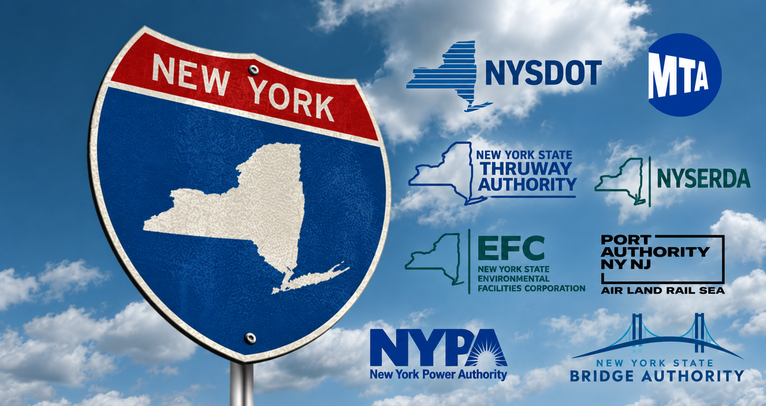
Who oversees New York’s infrastructure?

0

The agencies/authorities responsible for New York’s physical and digital infrastructure

New York’s trains, airports, roads, bridges, electrical grid, drinking and wastewater, and digital infrastructure is managed, protected, and administered by a host of state, regional and federal agencies and authorities.

Unlike a traditional state department, a public authority is generally created for a specific public purpose and governed by a board. New York relies heavily on these entities to operate toll roads, transit systems, bridges, power facilities and other major assets. The state’s Authorities Budget Office monitors their compliance with reporting, governance and transparency requirements.

NYDOT New York State Department of Transportation


State highways, bridges, roads, freight and passenger rail policy, aviation, ports and waterways, public transportation assistance, traffic operations, construction and transportation resilience

MTA Metropolitan Transportation Authority


New York City subways and buses, Long Island Rail Road, Metro-North Railroad, seven bridges and two tunnels, stations, accessibility, service reliability and major transit capital projects

New York State Thruway Authority


The 570-mile Thruway system, including I-87, I-90 and the Governor Mario M. Cuomo Bridge; toll collection, maintenance, safety and highway capital projects

NYSBA New York State Bridge Authority


The Bear Mountain, Newburgh-Beacon, Mid-Hudson, Kingston-Rhinecliff and Rip Van Winkle bridges across the Hudson River; tolls, maintenance and bridge capital projects

DMV New York State Department of Motor Vehicles


Driver licensing, vehicle registration, traffic-safety administration, inspection programs and motor-vehicle regulation

New York State Canal Corporation


The Erie, Champlain, Oswego and Cayuga-Seneca canals; locks, dams, navigation, trails, water management and canal infrastructure. The corporation is a subsidiary of the New York Power Authority

DEC Department of Environmental Conservation


Air and water quality, wastewater and stormwater permits, wetlands, dams, contaminated sites, solid waste, flood protection, coastal resources, climate policy and environmental enforcement

New York State Department of Health


Drinking-water standards, public water-system oversight, source-water protection, operator requirements and public-health response to contamination

EFC Environmental Facilities Corporation


Low-cost financing and grants for drinking-water, wastewater, sewer, stormwater, resiliency and other water-quality projects through the state revolving funds and state grant programs

PSC Public Service Commission and DPS Department of Public Service


Regulation and oversight of electric, gas, steam, telecommunications, cable and privately owned water utilities; utility rates, reliability, consumer protection and major energy infrastructure proceedings

NYPA New York Power Authority


State-owned power generation and transmission, hydropower, grid modernization, energy services, public-sector electrification and operation of the Canal Corporation

NYSERDA New York State Energy Research and Development Authority


Clean-energy programs, building efficiency, renewable energy, energy storage, grid research, offshore wind, emissions reduction and financing or incentives for energy projects

ORES Office of Renewable Energy Siting and Electric Transmission


Consolidated environmental review and permitting for major renewable-energy facilities and qualifying electric-transmission projects

HCR New York State Homes and Community Renewal


Affordable-housing development and preservation, housing finance, community renewal, disaster recovery, resilient housing and infrastructure connected to housing growth

ESD Empire State Development


Economic-development incentives, site preparation, redevelopment, infrastructure supporting business expansion, major public projects and regional investment programs

DASNY Dormitory Authority of the State of New York


Financing, design and construction services for health care, higher education, courts, nonprofits and other public-purpose facilities

Hudson River Valley Greenway


The Hudson River Valley Greenway coordinates trail development, public access and community planning. It provides planning grants and assistance to participating municipalities. 

New York State Office of General Services


State-owned buildings, design and construction, emergency construction, real estate, facility operations, public procurement and decarbonization of state facilities

NYSED New York State Education Department


Review of public-school capital projects, school building standards, facilities planning and health and safety requirements for school infrastructure

Office of Information Technology Services


State government networks, data centers, digital services, telecommunications, technology infrastructure and cybersecurity for state agencies

DHSES Division of Homeland Security and Emergency Services


Emergency management, disaster response and recovery, hazard mitigation, interoperable communications, cybersecurity assistance and protection of critical infrastructure

NYDOL New York State Department of Labor


Infrastructure workforce programs, apprenticeships, prevailing-wage enforcement and labor standards on public works

Department of Agriculture and Markets

Farmland protection, agricultural land use, food-system infrastructure and regulation affecting renewable-energy development on agricultural land

PANYNJ Port Authority of New York and New Jersey

JFK, LaGuardia, Newark Liberty, New York Stewart and Teterboro airports; PATH; interstate bridges and tunnels; the Port Authority Bus Terminal; ports and marine terminals

NYMTC New York Metropolitan Transportation Council


Federally required transportation planning and funding coordination for New York City, Long Island and the lower Hudson Valley; long-range planning, congestion management, freight and air-quality compliance

DRBC Delaware River Basin Commission


Interstate planning, regulation and management of water resources in the Delaware River Basin, including portions of southeastern New York

U.S. Army Corps of Engineers New York District


Federal navigation projects, harbor maintenance, dredging, coastal storm-risk reduction, flood mitigation, wetlands permitting and major water infrastructure

FEMA Federal Emergency Management Agency Region 2


Disaster declarations, recovery assistance, hazard-mitigation grants, flood mapping and resilience programs in New York

US EPA U.S. Environmental Protection Agency Region 2


Superfund sites, drinking water, wastewater, air quality, environmental review, federal grants and enforcement of federal environmental laws in New York

PJM framework could help data centers connect without raising regional power costs

The regional grid operator wants large electricity users to supply their own power or become the first customers curtailed during an emergency.

TLDR:
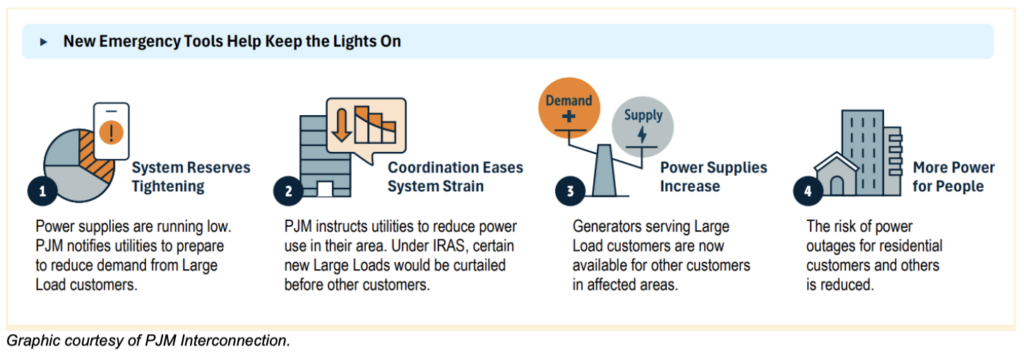
1. PJM is proposing new rules that could require data centers and other large electricity users to reduce demand before homes and traditional customers are affected during a grid emergency.
2. Data centers account for 30 gigawatts, or nearly 94%, of PJM’s projected electricity-demand growth between 2024 and 2030.
3. FERC must approve the framework before it can take effect.

PJM Interconnection has proposed a new framework that would allow data centers and other large electricity users to connect to the regional power grid without forcing existing customers to absorb the full cost or reliability risk created by their demand.

Under the proposal, new large energy users that do not bring enough additional power generation to support their operations could be required to reduce their electricity consumption before homes and other traditional customers are affected during a grid emergency. The framework would apply across PJM’s 13-state territory, which includes New Jersey, Pennsylvania and parts of the Mid-Atlantic and Midwest.

The proposal arrives as electricity demand from data centers is growing much faster than new generating capacity can be built. PJM expects demand across its territory to grow by approximately 32 gigawatts between 2024 and 2030; data centers account for 30 gigawatts, or nearly 94%, of that projected increase.

One gigawatt is roughly enough electricity to serve hundreds of thousands of homes, although the exact number varies depending on weather, consumption patterns and the type of generation involved.

“The unprecedented addition of large loads, most notably data centers, has given rise to resource adequacy shortfalls and associated real-time operational issues,” PJM said in its filing.

What is IRAS?

The centerpiece of the proposal is a new program called the Interim Resource Adequacy Service, or IRAS. It would cover new large customers that have not secured enough additional generation to meet their expected demand and whose needs are not addressed through another PJM reliability procurement program. PJM defines a large load as one or more facilities with a combined peak demand of at least 50 megawatts.

When available electricity supplies begin approaching dangerously low levels, PJM could direct utilities to reduce or transfer demand associated with these new large customers. Data centers equipped with backup generation could temporarily disconnect from the grid and operate using those on-site systems.

The reduction would occur before PJM moved toward shutting off traditional customers, including residential users. It would also come before certain customers that are already paid through demand-response programs to reduce electricity consumption during emergencies.

A large customer ordered to reduce its demand could receive a credit for providing a reliability service. States and utilities would determine how those credits and other retail costs are allocated; companies could also waive compensation to prevent the costs from being passed to other customers.

The Large Load Registry

PJM would also establish a Large Load Registry covering new and existing facilities across its territory. The database would track information including each facility’s size, location, expected opening date and available backup generation.

PJM would make the information available to states, utilities and regulators, subject to confidentiality restrictions. The registry is intended to improve demand forecasts and help officials determine which facilities should reduce their consumption during an emergency. 

States would retain authority over retail electric rates and local curtailment plans. PJM would determine how much demand must be removed from the regional system; state regulators and utilities would decide which eligible customers would be affected and how related costs would be distributed.

Bring, build or buy

The proposal follows a broader principle that new data centers would be expected to construct new generation, arrange for additional power supplies or purchase electricity from resources that expand the overall supply available to the grid. This is known as the  “build, bring or buy” model. PJM would require utilities and other electricity suppliers to secure new capacity equal to or greater than the combined peak demand of new large customers in their service territories. If they fail to do so, those areas could be directed to reduce demand during emergencies based on their share of unsupported large-load growth.

PJM is also proposing a significant change to its capacity market, which pays power plants to remain available several years into the future. Beginning with the 2029-2030 capacity auction, new large customers that have not supplied their own additional generation would be excluded from PJM’s calculation of the power that must be purchased through the auction. The provision is intended to prevent unsupported data center demand from increasing capacity costs for all customers. It also creates an incentive for developers to secure new power supplies before connecting to the grid.

New Jersey is moving in the same direction

PJM’s proposal closely aligns with data center policies recently adopted in New Jersey. Legislation signed by Gov. Mikie Sherrill in July requires large data centers to bring additional clean energy onto the grid and creates a separate electric rate classification for the industry. The goal is to prevent the cost of serving energy-intensive developments from being distributed across residential and small-business customers.

New Jersey followed that action in August with a law requiring data center operators to submit semiannual reports to the Board of Public Utilities detailing their electricity and water consumption. The reports must include information about total energy use, energy used for cooling and computing equipment, peak water demand and on-site or backup generation.

The state reporting requirement and PJM’s proposed registry address different levels of the same problem. New Jersey’s system would provide state regulators and communities with more information about individual facilities; PJM’s registry would help the regional grid operator track their combined effect on electricity demand and reliability.

FERC final steps

PJM filed the proposal with the Federal Energy Regulatory Commission on Aug. 13 and requested approval within 60 days. Until FERC acts, the framework remains a proposal and could be approved, rejected or modified.

The plan would not solve the region’s underlying shortage of new generation, but it would change the conditions under which new data centers connect to the system. Developers that arrive with enough additional power would receive conventional service; those that do not could face a higher risk of interruption and would no longer automatically add their full demand to capacity purchases funded by the wider customer base.

For New Jersey, the PJM framework could reinforce the state’s emerging position that data center development can continue, so long as their extraordinary electricity needs do not compromise reliability or increase costs for existing ratepayers. 

Sources:

New Jersey Legislature. (2026). Senate Bill No. 731: Requires electric public utilities to develop and apply special rules for certain data centers to protect non-data center customers from increased costs. https://www.njleg.state.nj.us/bill-search/2026/S731

New Jersey Legislature. (2026). Senate Bill No. 3379: Requires reporting concerning energy and water use by data centers. https://www.njleg.state.nj.us/bill-search/2026/S3379

Office of Governor Mikie Sherrill. (2026, August 27). Governor Sherrill delivers all four pillars of data center plan, puts power back in the hands of communities. State of New Jersey. https://www.nj.gov/governor/news/2026/20260827a.shtml

PJM Interconnection. (2026, August 13). Interim Resource Adequacy Service proposal [Fact sheet]. https://www.pjm.com/-/media/DotCom/about-pjm/newsroom/fact-sheets/interim-resource-adequacy-service-proposal.pdf

PJM Interconnection. (2026, August 13). PJM proposes framework to connect data centers without compromising reliability, affordability. https://insidelines.pjm.com/pjm-proposes-framework-to-connect-data-centers-without-compromising-reliability-affordability/

Can You Dig it? Hudson Tunnel reaches boring milestone

As Gateway advances on several fronts, the Hudson Tunnel Project has reached its most visible construction milestone yet.

TLDR
1. Gateway marked the start of Hudson Tunnel boring on September 28.
2. The machines are expected to reach the Hudson County Access Shaft about a year after launch. 
3. The entire Gateway program is moving forward on schedule.

Portal North Bridge is preparing to transfer its second track in October, while initial Sawtooth Bridges work and Dock Bridge rehabilitation are advancing.

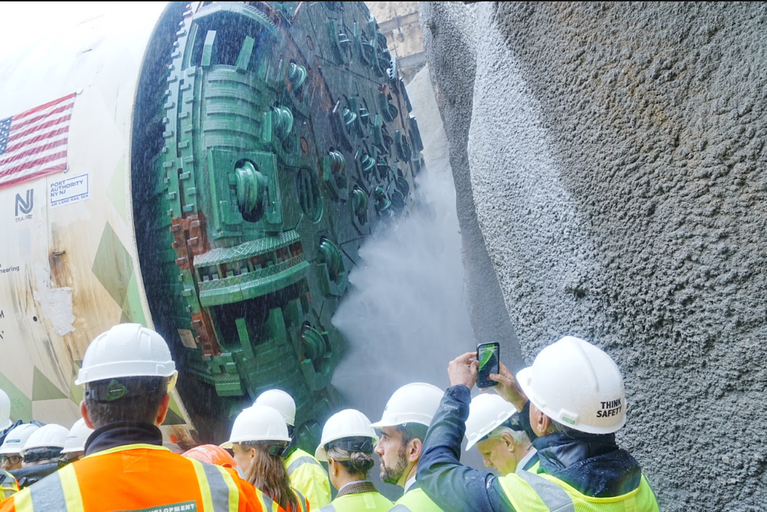
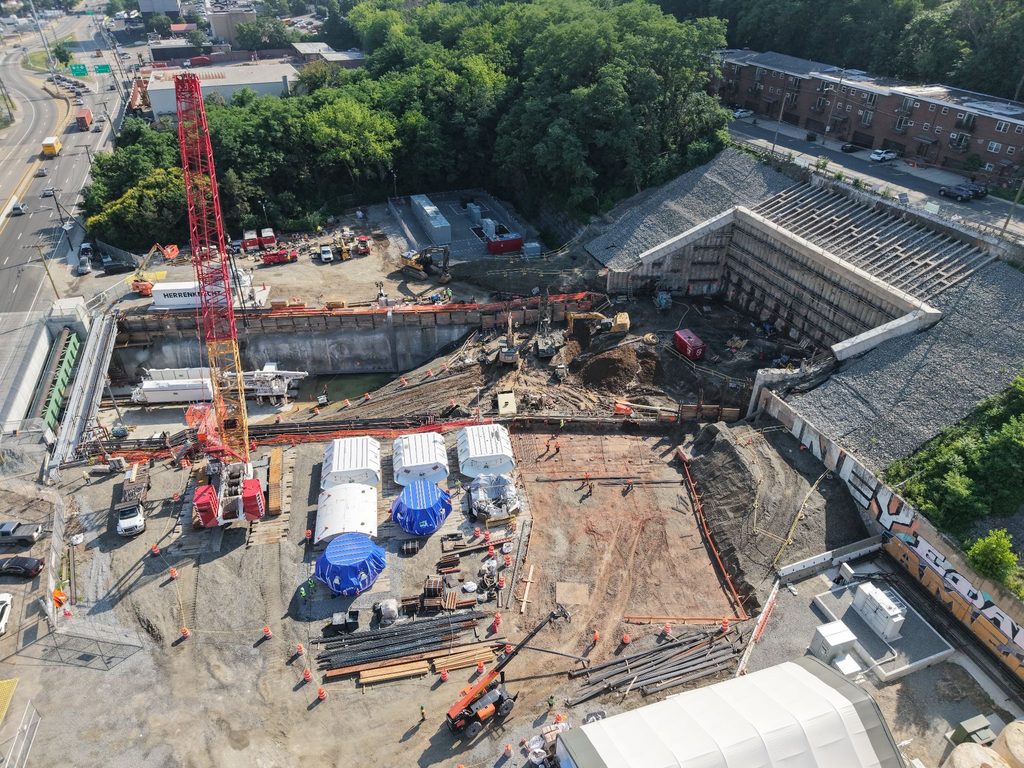
The first tunnel boring machine for the $16 billion Hudson Tunnel Project is undergoing final testing in North Bergen and is expected to begin digging in the coming days. The Gateway Development Commission marked the start of the boring phase at a September 28 ceremony and a second machine is expected to follow soon after. Together, they will excavate the first two tubes of a new rail connection between New Jersey and New York Penn Station.

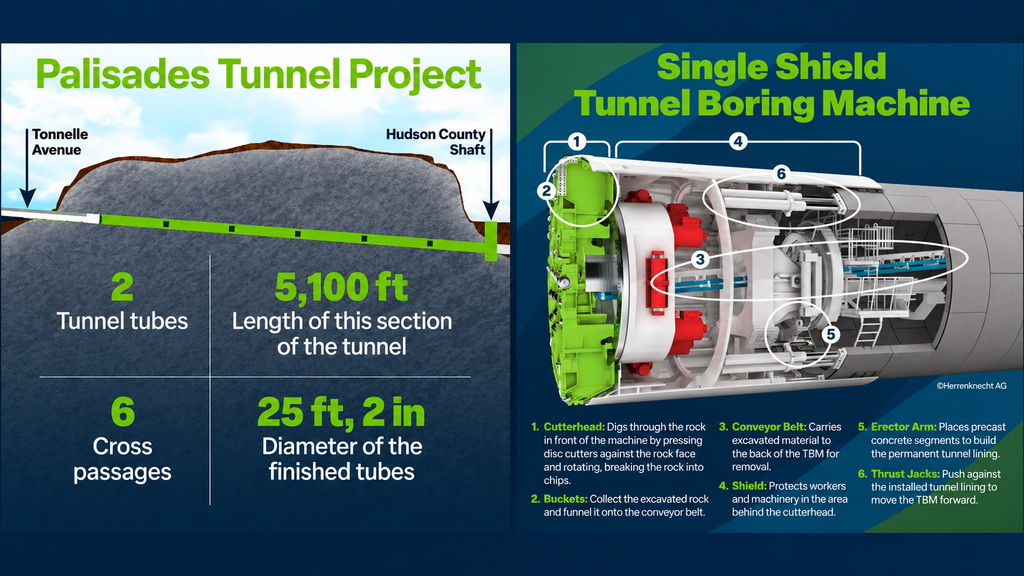
The two machines are built for the hard rock beneath the Palisades. Each weighs more than 1,680 tons, roughly the weight of 300 elephants, with a cutterhead 28 feet, 8 inches in diameter and an equipment assembly stretching about 500 feet behind it. Rotating cutters break the rock into chips, a conveyor carries the material out, and the machine installs precast concrete segments to line the tunnel as it advances.

Courtesy of the Gateway Development Commission 

Each machine will bore approximately 5,100 feet from the North Bergen portal to the Hudson County Access Shaft near the Weehawken–Hoboken border. Gateway expects progress of about 30 feet per day, including scheduled maintenance stops, and estimates that the machines will reach the shaft roughly one year after launch. They will then be removed and replaced with two machines suited to the changing rock and soil conditions beneath the Hudson River. Four boring machines, working in two pairs, are needed to complete the parallel tubes; the machines launching now will not dig the river section.

The launch follows nearly three years of construction. Since late 2023, crews have built a bridge carrying Tonnelle Avenue above the work area and excavated the launch box below it. Photo courtesy of the Gateway Development Commission. 

Manufacturing each machine took more than a year and involved nearly 100 components; after factory testing in late 2025, the machines were taken apart, shipped to New Jersey and reassembled on site. The Palisades tunneling contract is being carried out by Schiavone Lane Dragados JV, with the Port Authority of New York and New Jersey managing its delivery in partnership with Gateway.

The light at both ends of the tunnel

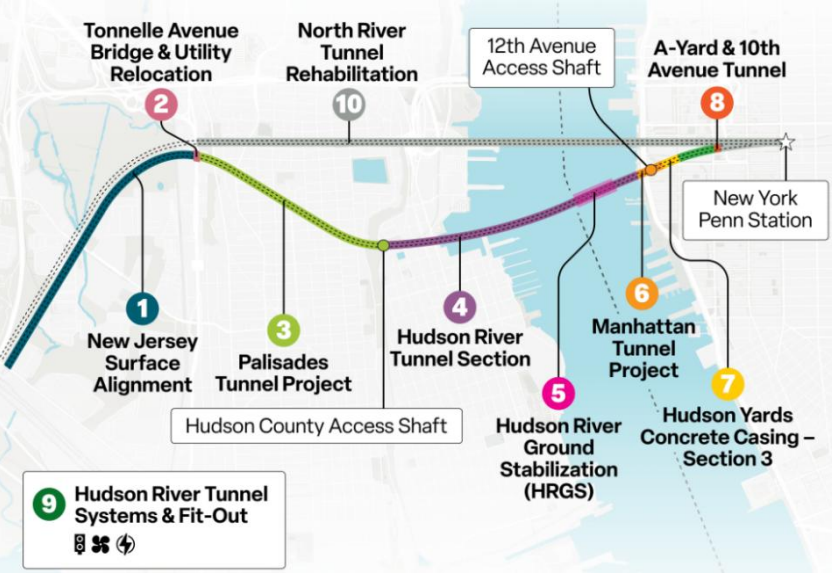
The next pair of machines will build two tubes beneath the Hudson River, each approximately 7,250 feet long, from the Hudson County Access Shaft to Manhattan’s 12th Avenue Access Shaft. Gateway awarded the $1.29 billion contract for that section to Traylor/Walsh/Skanska JV in April. The work also includes nine passages connecting the two tubes, providing routes between them.

Other crews are building the approaches that will make the tunnel usable. In New Jersey, the surface alignment will connect the North Bergen portal to the existing Northeast Corridor near Secaucus across approximately 1.5 miles. Plans call for 4,170 feet of retaining walls, a 3,150-foot viaduct over Meadowlands wetlands, and bridges measuring 90 and 150 feet. Tracks, signals and other railroad systems will follow under a future construction package.

In Manhattan, construction includes the access shaft, work beneath West 30th Street, stabilization of the riverbed near the shoreline and the final section of concrete casing beneath Hudson Yards. That casing will preserve the route into New York Penn Station. Gateway describes the Hudson Tunnel Project as 10 construction packages; one was completed in early 2026 and six more are in progress.

“This milestone is a major step toward fulfilling the Hudson Tunnel Project’s two-track tunnel and giving New Jerseyans the dependable rail infrastructure they’ve waited decades for.” U.S. Senator Cory Booker said, “Millions of people depend on the Northeast Corridor every day to get to work, to school, and back home to their families. I’m proud to help deliver a project that will lower costs, strengthen our rail system, boost reliability, double capacity, and make commutes better for generations of New Jerseyans to come.” 

The schedule calls for the new tunnel to open in 2035. Crews would then rehabilitate the existing North River Tunnel, which has carried trains since 1910 and was flooded during Hurricane Sandy; Gateway expects that work to finish in 2038. When both tunnels are available, Amtrak and NJ TRANSIT will have four tracks beneath the Hudson instead of two. That added flexibility matters on a crossing where trouble in one of the current tubes can disrupt trains in both directions.

Where the larger Gateway Program stands

Courtesy of the Gateway Development Commission 

Gateway covers the roughly 10-mile Northeast Corridor segment between Newark and New York Penn Station. Approximately 450 trains carry 200,000 passenger trips through it each day, according to the program. At rush hour, trains move through the corridor in close succession, while drivers face heavy traffic on the New Jersey Turnpike and the approaches to the Lincoln and Holland tunnels. The pressure on both rail and road travel makes clear the importance of adding capacity in this pinch point.

Portal North Bridge, another key piece of the Gateway program, also hit a milestone this month. Its first track entered passenger service in March. Amtrak and NJ TRANSIT plan to begin transferring the second track from the 116-year-old movable Portal Bridge on October 9, with approximately five weeks of adjusted service beginning October 11. Regular schedules are expected to resume November 15, subject to safety testing. The replacement is a fixed, two-track bridge rising about 50 feet above the Hackensack River, allowing boats to pass without requiring trains to stop for a bridge opening.

Farther west, Amtrak and NJ TRANSIT are moving ahead with initial construction for the Sawtooth Bridges replacement, backed by a $133 million federal grant for preparatory work. Amtrak has applied for additional funding for later construction. In July, it awarded contracts for a roughly $242 million rehabilitation of Dock Bridge over the Passaic River, where major work is expected to begin by the end of 2026. Longer-term Gateway plans include a second bridge over the Hackensack, additional tracks near Harrison and Secaucus, and expanded capacity at New York Penn Station.

Sources:

Gateway Development Commission. (2026, September 28). Gateway Development Commission celebrates start of tunnel boring for Hudson Tunnel Project

New Jersey Infrastructure Bank: 40 years helping communities fund local infrastructure

0

TLDR
1. The New Jersey Infrastructure Bank (I-Bank) provides low-cost financing for critical public works projects.
2. By blending federal grants and state funds with AAA-rated bonds, it offers below-market interest rates, saving local taxpayers and ratepayers billions of dollars.
3. While it successfully funds water, transportation, and resilience upgrades, it faces challenges from surging project demand, inflation, and complex regulatory mandates.

Aging infrastructure poses one of the most persistent financial and operational hurdles for local governments and utility authorities. In New Jersey, this challenge is met by the New Jersey Infrastructure Bank (NJIB)—widely known simply as the I-Bank. Operating as an independent state financing authority, the I-Bank provides and administers low-interest and subsidized loans to municipalities, counties, regional authorities, and water purveyors. Its overarching mission is to finance vital public works projects while shielding local property taxpayers and utility ratepayers from the crushing financial burden of traditional, high-interest municipal bonding.

Founding and history

The origins of the I-Bank date back to the mid-1980s, a period when New Jersey faced mounting federal mandates to clean up its waterways and upgrade aging municipal wastewater systems.

  • Establishment: The authority was created by an act of the New Jersey State Legislature under the New Jersey Infrastructure Trust Act, being signed into law in 1985 by Governor Thomas H. Kean.
  • Operations Launch: The I-Bank officially commenced operations in 1986, initially rolling out its pioneering clean water financing division.
  • Evolution of Scope: Over the decades, the I-Bank’s mandate expanded significantly beyond wastewater. Today, it operates three specialized divisions in partnership with state agencies: the NJ Water Bank (in partnership with the NJ Department of Environmental Protection), the NJ Transportation Bank (with the NJ Department of Transportation), and the NJ Resilience Infrastructure Bank (with the NJ Office of Emergency Management).

How it works and loan rates

The brilliance of the I-Bank model lies in its ability to leverage public capital to achieve below-market borrowing costs that small towns and regional utilities could never secure independently.

  • The Blended Financing Model: Instead of relying strictly on commercial capital markets, the I-Bank pools local borrowing needs and combines federal capitalization grants (from programs like the EPA and FEMA) with state contributions. It then issues AAA-rated revenue bonds.
  • Interest Rate Structure: Loans are typically structured as a blended package. Borrowers receive a mix of state-funded capital—frequently at a 0% interest rate—combined with market-rate financing from the I-Bank’s bond sales.
  • The Cost-Savings Result: This unique blend reduces overall borrowing costs by roughly 25% to 40% compared to traditional standalone municipal bond issues, translating to substantial lifetime savings for local communities.

Overall impact since inception

Since its creation four decades ago, the I-Bank has served as the backbone of New Jersey’s capital investment in public infrastructure, achieving remarkable milestones:

  • Billions in Financing: Through its flagship Water Bank alone, the program has issued over $9.28 billion in low-interest long-term loans, alongside billions more in short-term construction financing.
  • Direct Ratepayer Savings: New Jersey ratepayers and taxpayers have saved over $3.43 billion in reduced interest costs and principal forgiveness awards.
  • Widespread Reach: The I-Bank has issued more than 1,480 long-term loans, touching virtually all 21 counties and supporting hundreds of towns, municipal utilities, and regional authorities.
  • Job Creation: Cumulative loan spending has generated an estimated 180,730 direct construction jobs across the state, boosting local economic activity while modernizing critical networks.

2025 project examples

Demand for I-Bank financing remains exceptionally high, with recent fiscal years drawing thousands of project applications. A cross-section of projects advancing through the I-Bank illustrates its diverse reach:

  • Passaic Valley Sewerage Commission (PVSC): Secured an $183 million loan to construct a state-of-the-art standby power generating facility, guaranteeing uninterrupted backup electricity for regional wastewater treatment operations.
  • Stafford Township: Closed on a $5 million loan for continuing wastewater and stormwater infrastructure upgrades to replace aging sewer mains.
  • Brick Township Municipal Utilities Authority: Utilized a $9.27 million joint Water Bank and Resilience Bank loan (paired with federal grants) to harden critical reservoir infrastructure against severe storms.
  • Hoboken: Advanced major multi-modal safety projects, including the Sinatra Drive Redesign ($5.35 million) through the Transportation Bank framework.

Challenges looking forward

Despite its immense success, the I-Bank navigates a complex array of modern challenges:

  • Unmet Capital Demand: Statewide infrastructure needs—particularly for replacing lead service lines, removing PFAS “forever chemicals,” and upgrading century-old water mains—vastly exceed annual funding capacity, with total needs estimated well over $31 billion.
  • Administrative Barriers: Smaller, disadvantaged municipalities often lack the specialized engineering and grant-writing personnel required to navigate complex federal and state compliance rules, risking resource disparities.
  • Emerging Environmental Mandates: Balancing traditional repairs with modern climate resilience, storm-hardening, and emerging contaminant filtration places continuous bandwidth pressure on the authority.

Sources:

New Jersey Department of Environmental Protection. (2026). New Jersey environmental infrastructure financing program: State Fiscal Year 2027 financing program. State of New Jersey. https://dspace.njstatelib.org/bitstreams/aa8a8dea-23bd-483d-bcc4-f476099ec839/download

New Jersey Infrastructure Bank. (2023). New Jersey Infrastructure Bank annual report: State Fiscal Year 2022 appendix. State of New Jersey. https://nj.gov/njoem/mitigation/pdf/2023/Appendix%20A1%20Annual%20Report%202022.pdf

New Jersey Infrastructure Bank. (n.d.). About NJWB. State of New Jersey. https://www.njib.gov/nj/about-njeit

New Jersey Infrastructure Bank. (n.d.). About us. State of New Jersey. https://www.njib.gov/nj/about-us

Infrastructure Update – Week of September 28, 2026

0

New Jersey and New York saw major developments this week across data‑center regulation, water infrastructure, grid reliability, emissions policy, and battery‑storage planning, reshaping regional energy priorities.

Water industry groups praise overwhelming House passage of WRDA

Water‑sector organizations are celebrating the House’s 415–9 passage of the Water Resources Development Act, which authorizes major investments in flood control, navigation, ecosystem restoration, and water‑infrastructure upgrades. The bill strengthens Army Corps project delivery and expands support for communities facing aging systems and climate‑driven flooding. Groups say the vote reflects rare bipartisan consensus on water resilience. 

Read more: https://www.enr.com/articles/63686-water-industry-groups-praise-overwhelming-415-9-house-passage-of-wrda-bill

Newark office complex activates 14‑megawatt on‑site substation

A Newark office building along McCarter Highway has brought a 14‑megawatt on‑site substation online, providing tenants with enhanced reliability and reducing strain on the surrounding grid. The privately funded project supports energy‑intensive commercial operations and future redevelopment, reflecting a broader trend of large facilities investing in dedicated power infrastructure as data‑center growth increases grid pressure. 

Read more: https://www.roi-nj.com/2026/09/22/industry/energy-utilities/on-site-14-megawatt-power-substation-now-online-at-mccarter-highway-office-building-in-newark/

New York acknowledges Indian Point closure increased emissions

New York State has formally stated that closing the Indian Point nuclear plant raised statewide carbon emissions, confirming long‑standing warnings from grid analysts. Gas‑fired generation increased to fill the gap, complicating the state’s climate‑mandate compliance and raising questions about future nuclear retirements. The acknowledgment arrives amid debates over how to balance reliability, affordability, and decarbonization. 

Read more: https://yonkerstimes.com/new-york-state-now-says-in-writing-that-closing-indian-point-raised-emissions/

Opinion: permitting delays are driving up electric bills

A RealClearEnergy analysis argues that permitting bottlenecks – not generation shortages – are a major driver of rising U.S. electric bills. Long interconnection queues, slow environmental reviews, and transmission‑siting challenges delay new clean‑energy projects and force reliance on older, costlier fossil‑fuel plants. The piece contends that permitting reform is essential to lowering long‑term rates and accelerating renewable deployment. 

Read more: https://www.realclearenergy.org/articles/2026/09/22/your_electric_bill_is_a_permitting_problem_1207409.html

New data centers projected to reduce residential electricity rates

A new analysis suggests that upcoming data‑center projects could lower residential electric bills under New Jersey’s emerging regulatory framework. The state now requires data centers to fund their own generation, storage, or grid upgrades, preventing costs from being shifted onto households. Analysts say this private investment could stabilize rates and reduce grid congestion. 

Read more: https://tristateinfrastructurenews.com/new-data-centers-projected-to-reduce-residential-electricity-rates/

Op‑ed calls for major expansion of battery‑storage construction

A BINJE op‑ed argues that New Jersey must dramatically expand battery‑energy‑storage construction to meet reliability and clean‑energy goals. The author calls for faster permitting, clearer interconnection rules, and incentives for both utility‑scale and distributed storage. With data‑center growth and electrification increasing grid volatility, the piece frames storage as essential infrastructure.

Read more: https://binje.com/uncategorized/op-ed-what-we-need-to-build-battery-energy-storage/

New Jersey fines DataOne $1.07M for unpermitted generators

New Jersey issued $1.07 million in fines to DataOne after inspectors found 62 natural‑gas generators installed and operated without air‑quality permits. Regulators say the company bypassed preconstruction and operating approvals required under the Air Pollution Control Act, marking the largest enforcement action ever taken against a data center in the state. The case underscores rising scrutiny of data‑center emissions, noise, and grid impacts as the sector expands rapidly. 

Read more: https://www.yahoo.com/news/us/articles/jersey-fines-dataone-1-07-173211365.html

New Jersey storm resource directory

0

Track power outages across New Jersey and find utility contacts, cooling centers and emergency resources during severe weather.

Report a Power Outage

PSE&G

Jersey Central Power & Light

Atlantic City Electric

Customers served by a municipal electric department should report outages directly to their municipality. The outage numbers above match the utilities’ storm-reporting information; some general state directories list separate customer-service numbers. (NJOEM utility directory)

Downed Power Lines

Treat every downed wire as live and dangerous. Stay at least 30 feet away; do not touch the wire or anything it may be contacting. Call 911 and notify the appropriate electric utility.

If a power line falls on a vehicle, remain inside unless the vehicle is on fire or another immediate danger requires evacuation.

During an Outage

  • Use flashlights instead of candles whenever possible.
  • Keep refrigerator and freezer doors closed.
  • Never operate a generator, grill or fuel-burning appliance indoors or inside a garage.
  • Place generators outdoors, at least 20 feet from doors, windows and vents.
  • Do not use a gas oven or stove to heat a home.
  • Call 911 if someone is experiencing a medical emergency.
  • Call NJ 2-1-1 for information about warming or cooling centers, shelters and other non-emergency assistance.

Additional Resources

New Jersey Built a Perfect Light Rail, and Nobody Noticed [Classy Whale]

0

The Hudson-Bergen Light Rail is one of the country’s most successful light rail systems, but it rarely receives national attention. Learn more about how it has transformed transportation along the waterfront.