




The regional grid operator wants large electricity users to supply their own power or become the first customers curtailed during an emergency.
TLDR:
1. PJM is proposing new rules that could require data centers and other large electricity users to reduce demand before homes and traditional customers are affected during a grid emergency.
2. Data centers account for 30 gigawatts, or nearly 94%, of PJM’s projected electricity-demand growth between 2024 and 2030.
3. FERC must approve the framework before it can take effect.
PJM Interconnection has proposed a new framework that would allow data centers and other large electricity users to connect to the regional power grid without forcing existing customers to absorb the full cost or reliability risk created by their demand.
Under the proposal, new large energy users that do not bring enough additional power generation to support their operations could be required to reduce their electricity consumption before homes and other traditional customers are affected during a grid emergency. The framework would apply across PJM’s 13-state territory, which includes New Jersey, Pennsylvania and parts of the Mid-Atlantic and Midwest.
The proposal arrives as electricity demand from data centers is growing much faster than new generating capacity can be built. PJM expects demand across its territory to grow by approximately 32 gigawatts between 2024 and 2030; data centers account for 30 gigawatts, or nearly 94%, of that projected increase.
One gigawatt is roughly enough electricity to serve hundreds of thousands of homes, although the exact number varies depending on weather, consumption patterns and the type of generation involved.
“The unprecedented addition of large loads, most notably data centers, has given rise to resource adequacy shortfalls and associated real-time operational issues,” PJM said in its filing.
What is IRAS?
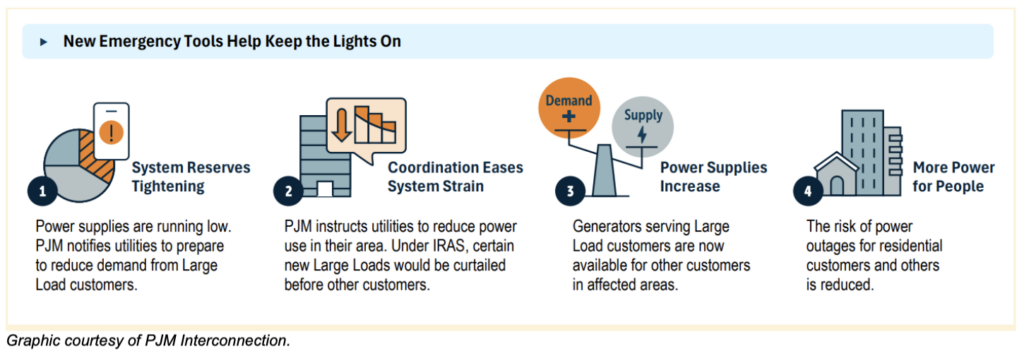
The centerpiece of the proposal is a new program called the Interim Resource Adequacy Service, or IRAS. It would cover new large customers that have not secured enough additional generation to meet their expected demand and whose needs are not addressed through another PJM reliability procurement program. PJM defines a large load as one or more facilities with a combined peak demand of at least 50 megawatts.
When available electricity supplies begin approaching dangerously low levels, PJM could direct utilities to reduce or transfer demand associated with these new large customers. Data centers equipped with backup generation could temporarily disconnect from the grid and operate using those on-site systems.
The reduction would occur before PJM moved toward shutting off traditional customers, including residential users. It would also come before certain customers that are already paid through demand-response programs to reduce electricity consumption during emergencies.
A large customer ordered to reduce its demand could receive a credit for providing a reliability service. States and utilities would determine how those credits and other retail costs are allocated; companies could also waive compensation to prevent the costs from being passed to other customers.
The Large Load Registry
PJM would also establish a Large Load Registry covering new and existing facilities across its territory. The database would track information including each facility’s size, location, expected opening date and available backup generation.
PJM would make the information available to states, utilities and regulators, subject to confidentiality restrictions. The registry is intended to improve demand forecasts and help officials determine which facilities should reduce their consumption during an emergency.
States would retain authority over retail electric rates and local curtailment plans. PJM would determine how much demand must be removed from the regional system; state regulators and utilities would decide which eligible customers would be affected and how related costs would be distributed.
Bring, build or buy
The proposal follows a broader principle that new data centers would be expected to construct new generation, arrange for additional power supplies or purchase electricity from resources that expand the overall supply available to the grid. This is known as the “build, bring or buy” model. PJM would require utilities and other electricity suppliers to secure new capacity equal to or greater than the combined peak demand of new large customers in their service territories. If they fail to do so, those areas could be directed to reduce demand during emergencies based on their share of unsupported large-load growth.
PJM is also proposing a significant change to its capacity market, which pays power plants to remain available several years into the future. Beginning with the 2029-2030 capacity auction, new large customers that have not supplied their own additional generation would be excluded from PJM’s calculation of the power that must be purchased through the auction. The provision is intended to prevent unsupported data center demand from increasing capacity costs for all customers. It also creates an incentive for developers to secure new power supplies before connecting to the grid.
New Jersey is moving in the same direction
PJM’s proposal closely aligns with data center policies recently adopted in New Jersey. Legislation signed by Gov. Mikie Sherrill in July requires large data centers to bring additional clean energy onto the grid and creates a separate electric rate classification for the industry. The goal is to prevent the cost of serving energy-intensive developments from being distributed across residential and small-business customers.
New Jersey followed that action in August with a law requiring data center operators to submit semiannual reports to the Board of Public Utilities detailing their electricity and water consumption. The reports must include information about total energy use, energy used for cooling and computing equipment, peak water demand and on-site or backup generation.
The state reporting requirement and PJM’s proposed registry address different levels of the same problem. New Jersey’s system would provide state regulators and communities with more information about individual facilities; PJM’s registry would help the regional grid operator track their combined effect on electricity demand and reliability.
FERC final steps
PJM filed the proposal with the Federal Energy Regulatory Commission on Aug. 13 and requested approval within 60 days. Until FERC acts, the framework remains a proposal and could be approved, rejected or modified.
The plan would not solve the region’s underlying shortage of new generation, but it would change the conditions under which new data centers connect to the system. Developers that arrive with enough additional power would receive conventional service; those that do not could face a higher risk of interruption and would no longer automatically add their full demand to capacity purchases funded by the wider customer base.
For New Jersey, the PJM framework could reinforce the state’s emerging position that data center development can continue, so long as their extraordinary electricity needs do not compromise reliability or increase costs for existing ratepayers.
Sources:
New Jersey Legislature. (2026). Senate Bill No. 731: Requires electric public utilities to develop and apply special rules for certain data centers to protect non-data center customers from increased costs. https://www.njleg.state.nj.us/bill-search/2026/S731
New Jersey Legislature. (2026). Senate Bill No. 3379: Requires reporting concerning energy and water use by data centers. https://www.njleg.state.nj.us/bill-search/2026/S3379
Office of Governor Mikie Sherrill. (2026, August 27). Governor Sherrill delivers all four pillars of data center plan, puts power back in the hands of communities. State of New Jersey. https://www.nj.gov/governor/news/2026/20260827a.shtml
PJM Interconnection. (2026, August 13). Interim Resource Adequacy Service proposal [Fact sheet]. https://www.pjm.com/-/media/DotCom/about-pjm/newsroom/fact-sheets/interim-resource-adequacy-service-proposal.pdf
PJM Interconnection. (2026, August 13). PJM proposes framework to connect data centers without compromising reliability, affordability. https://insidelines.pjm.com/pjm-proposes-framework-to-connect-data-centers-without-compromising-reliability-affordability/