



As Gateway advances on several fronts, the Hudson Tunnel Project has reached its most visible construction milestone yet.
TLDR
1. Gateway marked the start of Hudson Tunnel boring on September 28.
2. The machines are expected to reach the Hudson County Access Shaft about a year after launch.
3. The entire Gateway program is moving forward on schedule.
Portal North Bridge is preparing to transfer its second track in October, while initial Sawtooth Bridges work and Dock Bridge rehabilitation are advancing.
The first tunnel boring machine for the $16 billion Hudson Tunnel Project is undergoing final testing in North Bergen and is expected to begin digging in the coming days. The Gateway Development Commission marked the start of the boring phase at a September 28 ceremony and a second machine is expected to follow soon after. Together, they will excavate the first two tubes of a new rail connection between New Jersey and New York Penn Station.
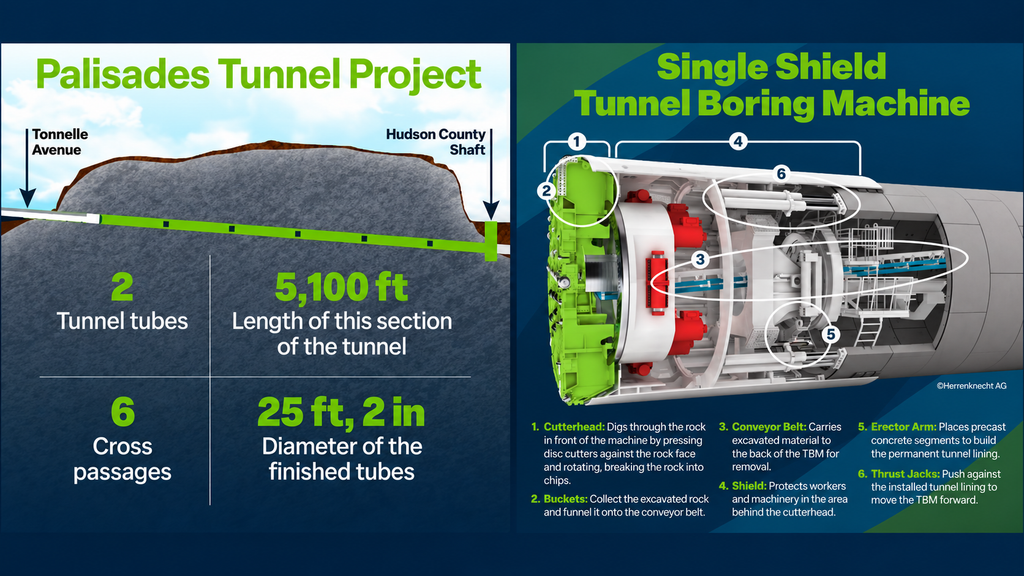
The two machines are built for the hard rock beneath the Palisades. Each weighs more than 1,680 tons, roughly the weight of 300 elephants, with a cutterhead 28 feet, 8 inches in diameter and an equipment assembly stretching about 500 feet behind it. Rotating cutters break the rock into chips, a conveyor carries the material out, and the machine installs precast concrete segments to line the tunnel as it advances.
Courtesy of the Gateway Development Commission
Each machine will bore approximately 5,100 feet from the North Bergen portal to the Hudson County Access Shaft near the Weehawken–Hoboken border. Gateway expects progress of about 30 feet per day, including scheduled maintenance stops, and estimates that the machines will reach the shaft roughly one year after launch. They will then be removed and replaced with two machines suited to the changing rock and soil conditions beneath the Hudson River. Four boring machines, working in two pairs, are needed to complete the parallel tubes; the machines launching now will not dig the river section.
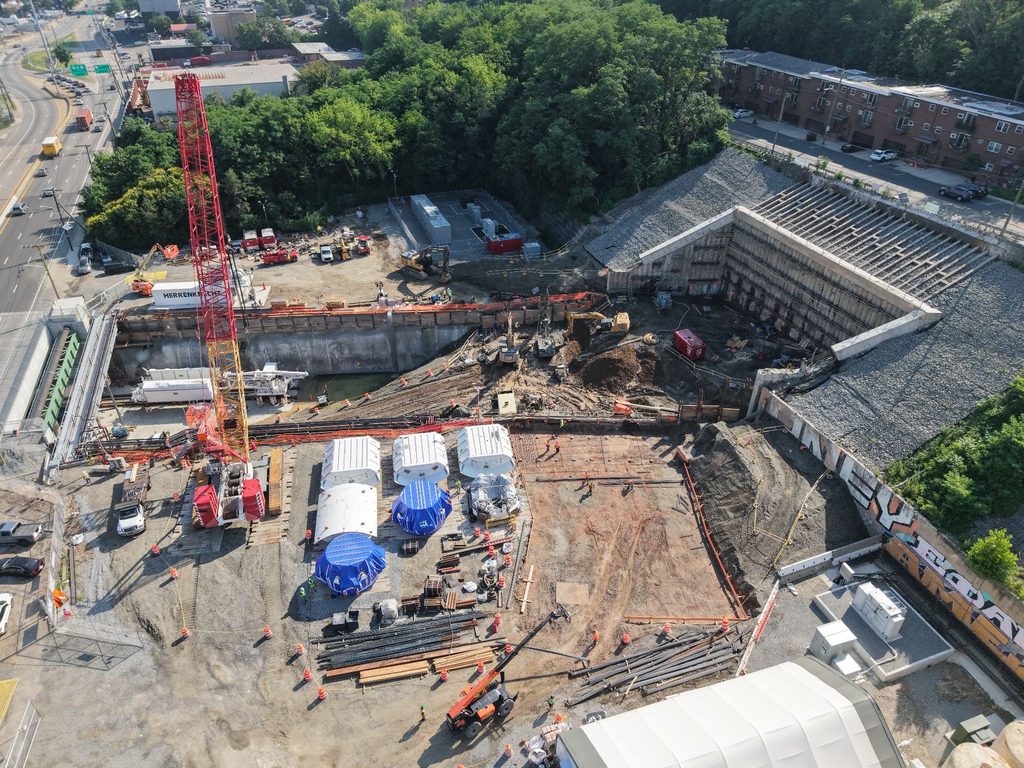
The launch follows nearly three years of construction. Since late 2023, crews have built a bridge carrying Tonnelle Avenue above the work area and excavated the launch box below it. Photo courtesy of the Gateway Development Commission.
Manufacturing each machine took more than a year and involved nearly 100 components; after factory testing in late 2025, the machines were taken apart, shipped to New Jersey and reassembled on site. The Palisades tunneling contract is being carried out by Schiavone Lane Dragados JV, with the Port Authority of New York and New Jersey managing its delivery in partnership with Gateway.
The light at both ends of the tunnel
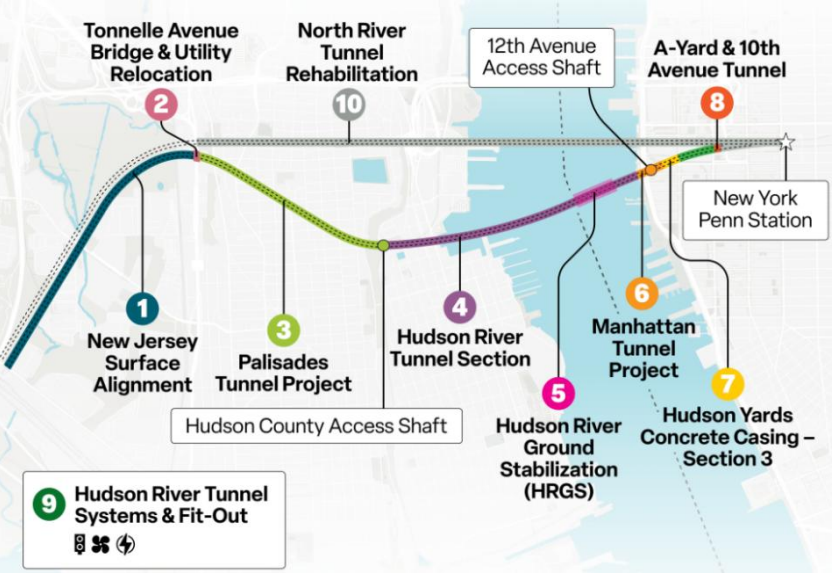
The next pair of machines will build two tubes beneath the Hudson River, each approximately 7,250 feet long, from the Hudson County Access Shaft to Manhattan’s 12th Avenue Access Shaft. Gateway awarded the $1.29 billion contract for that section to Traylor/Walsh/Skanska JV in April. The work also includes nine passages connecting the two tubes, providing routes between them.
Other crews are building the approaches that will make the tunnel usable. In New Jersey, the surface alignment will connect the North Bergen portal to the existing Northeast Corridor near Secaucus across approximately 1.5 miles. Plans call for 4,170 feet of retaining walls, a 3,150-foot viaduct over Meadowlands wetlands, and bridges measuring 90 and 150 feet. Tracks, signals and other railroad systems will follow under a future construction package.
In Manhattan, construction includes the access shaft, work beneath West 30th Street, stabilization of the riverbed near the shoreline and the final section of concrete casing beneath Hudson Yards. That casing will preserve the route into New York Penn Station. Gateway describes the Hudson Tunnel Project as 10 construction packages; one was completed in early 2026 and six more are in progress.
“This milestone is a major step toward fulfilling the Hudson Tunnel Project’s two-track tunnel and giving New Jerseyans the dependable rail infrastructure they’ve waited decades for.” U.S. Senator Cory Booker said, “Millions of people depend on the Northeast Corridor every day to get to work, to school, and back home to their families. I’m proud to help deliver a project that will lower costs, strengthen our rail system, boost reliability, double capacity, and make commutes better for generations of New Jerseyans to come.”
The schedule calls for the new tunnel to open in 2035. Crews would then rehabilitate the existing North River Tunnel, which has carried trains since 1910 and was flooded during Hurricane Sandy; Gateway expects that work to finish in 2038. When both tunnels are available, Amtrak and NJ TRANSIT will have four tracks beneath the Hudson instead of two. That added flexibility matters on a crossing where trouble in one of the current tubes can disrupt trains in both directions.
Where the larger Gateway Program stands
Courtesy of the Gateway Development Commission
Gateway covers the roughly 10-mile Northeast Corridor segment between Newark and New York Penn Station. Approximately 450 trains carry 200,000 passenger trips through it each day, according to the program. At rush hour, trains move through the corridor in close succession, while drivers face heavy traffic on the New Jersey Turnpike and the approaches to the Lincoln and Holland tunnels. The pressure on both rail and road travel makes clear the importance of adding capacity in this pinch point.
Portal North Bridge, another key piece of the Gateway program, also hit a milestone this month. Its first track entered passenger service in March. Amtrak and NJ TRANSIT plan to begin transferring the second track from the 116-year-old movable Portal Bridge on October 9, with approximately five weeks of adjusted service beginning October 11. Regular schedules are expected to resume November 15, subject to safety testing. The replacement is a fixed, two-track bridge rising about 50 feet above the Hackensack River, allowing boats to pass without requiring trains to stop for a bridge opening.
Farther west, Amtrak and NJ TRANSIT are moving ahead with initial construction for the Sawtooth Bridges replacement, backed by a $133 million federal grant for preparatory work. Amtrak has applied for additional funding for later construction. In July, it awarded contracts for a roughly $242 million rehabilitation of Dock Bridge over the Passaic River, where major work is expected to begin by the end of 2026. Longer-term Gateway plans include a second bridge over the Hackensack, additional tracks near Harrison and Secaucus, and expanded capacity at New York Penn Station.
Sources:
Gateway Development Commission. (2026, September 28). Gateway Development Commission celebrates start of tunnel boring for Hudson Tunnel Project