


![How to Build a Road [Wendover]](https://tristateinfrastructurenews.com/wp-content/uploads/2023/08/maxresdefault-768x432.jpg "How to Build a Road [Wendover]")
It’s hard to build transmission lines in the Northeast, so 8 states are asking the feds for help [WBUR]
![It’s hard to build transmission lines in the Northeast, so 8 states are asking the feds for help [WBUR]](https://tristateinfrastructurenews.com/wp-content/uploads/2023/07/AdobeStock_311915700-768x511.jpeg "It’s hard to build transmission lines in the Northeast, so 8 states are asking the feds for help [WBUR]")
This article from WBUR enumerates the challenges of building out the electrical grid:
The Northeast’s electrical transmission system is not robust enough to support the region’s ambitious clean energy goals. Most existing power lines are at capacity, and new transmission lines are needed to connect renewable energy sources to major population centers.
Eight states, including New Jersey and New York, are seeking federal support to fund and coordinate an interregional transmission planning collaborative. This effort aims to improve the flow of power between the New England grid and the grids in New York and New Jersey.
The federal government has expressed interest in supporting this collaborative effort. Federal leadership and technical expertise are seen as crucial for upgrading the grid and supporting clean energy initiatives.
Enhanced interregional connections can increase electric reliability, reduce electricity costs, and provide operational flexibility. This can help prevent power outages and reduce reliance on more expensive and polluting energy sources.
Read the full story on WBUR.org: https://www.wbur.org/news/2023/07/05/electrical-transmission-power-lines-massachusetts-new-england-clean-energy-doe
State and Local Governments Face Persistent Infrastructure Investment Challenges [Pew]
![State and Local Governments Face Persistent Infrastructure Investment Challenges [Pew]](https://tristateinfrastructurenews.com/wp-content/uploads/2023/02/AdobeStock_671993404-768x512.jpeg "State and Local Governments Face Persistent Infrastructure Investment Challenges [Pew]")
This article from Pew Trusts discusses the persistent challenges faced by state and local governments in the United States regarding infrastructure investment. Despite spending roughly half a trillion dollars annually on transportation and water infrastructure, there remains a significant backlog of needed repairs and modernization efforts. This backlog, estimated to be nearly $1 trillion, is exacerbated by the effects of climate change, such as rising sea levels and increased precipitation.
The decline in federal spending on infrastructure since the 1980s has contributed to this issue, although recent legislation like the American Rescue Plan Act and the Infrastructure Investment and Jobs Act aims to reverse this trend. However, factors such as inflation, supply chain disruptions, and worker shortages complicate the impact of these investments.
The lack of consistent data on deferred maintenance further hampers policymakers’ ability to address the problem effectively. The article emphasizes the need for more substantial investments, better data, and management tools to evaluate progress, highlighting the real-life effects of substandard infrastructure on communities, including public safety risks and economic impediments, particularly in marginalized areas. Despite these challenges, there is a consensus on the need for improved infrastructure investment and innovation to ensure equitable growth and climate resilience.
Read the full article on Pewtrusts.org: https://www.pewtrusts.org/en/research-and-analysis/articles/2023/02/03/state-and-local-governments-face-persistent-infrastructure-investment-challenges
NJ’s Energy Grid 10 Years After Superstorm Sandy [New Jersey Business]
![NJ’s Energy Grid 10 Years After Superstorm Sandy [New Jersey Business]](https://tristateinfrastructurenews.com/wp-content/uploads/2024/08/AdobeStock_164392514-768x513.jpeg "NJ’s Energy Grid 10 Years After Superstorm Sandy [New Jersey Business]")
The 2022 article from New Jersey Business Magazine discusses the aftermath of 2012’s Superstorm Sandy and the efforts made by New Jersey’s electric utilities to strengthen and modernize their infrastructure. Public Service Electric and Gas (PSE&G) launched the Energy Strong and Gas System Modernization Program, investing $4.8 billion to protect against future extreme weather events. Jersey Central Power & Light (JCP&L) introduced new technologies and infrastructure enhancements, including smart meters and automation technology. Atlantic City Electric completed critical projects to improve system resilience, such as building new substations and upgrading transmission lines. These utilities have made significant investments to ensure the reliability and resilience of New Jersey’s power grid, preparing for future extreme weather events. The article highlights the ongoing efforts and challenges faced by these utilities in maintaining and modernizing the state’s energy infrastructure.
Original story here: https://njbmagazine.com/njb-news-now/njs-energy-grid-10-years-after-superstorm-sandy/
Bayonne Bridge Construction Time-Lapse [Earthcam]
![Bayonne Bridge Construction Time-Lapse [Earthcam]](https://tristateinfrastructurenews.com/wp-content/uploads/2020/02/maxresdefault-768x432.jpg "Bayonne Bridge Construction Time-Lapse [Earthcam]")
See the entire 6-year construction process for the Bayonne Bridge “Raise the Roadway” project with EarthCam’s time-lapse movie. From 2013-2019, watch as the deck of the bridge is elevated from 151 feet to 215 feet. The Bayonne Bridge is an arch bridge spanning the Kill Van Kull connecting Bayonne, New Jersey with Staten Island, New York City.
Goethals Bridge Time Lapse
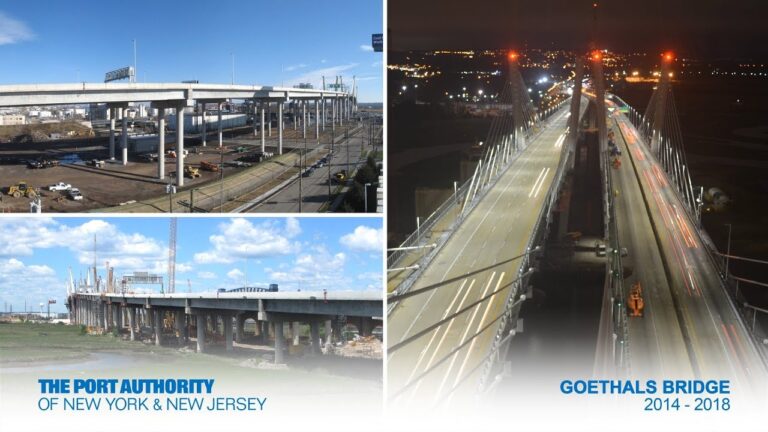
The old Goethals Bridge, constructed in 1928, was functionally obsolete, with four narrow 10-foot lanes and no walkways. The increasing traffic, maintenance costs, and the need to comply with the latest seismic standards prompted the Port Authority of NY and NJ to consider the bridge replacement.
The construction of the new Goethals Bridge, a $1.5 billion project linking Staten Island, New York, and Elizabeth, New Jersey, was a monumental task marked by numerous challenges.
One of the primary challenges was the bridge’s location in the direct flight path to Newark Liberty Airport. This necessitated a maximum cable tower height limit of 272 feet. The project also had to meet specific requirements, including a minimum main span of 900 feet and a minimum navigational clearance of 138 feet.
The project team faced constraints related to redundancy and resiliency standards, funding challenges, and traffic flow requirements. They also had to design for future mass transit capacity. Interestingly, even the work schedules were affected by natural factors, such as the mating season of flounder in the Arthur Kill tidal straight.
The new bridge, built to the south of the existing one, includes two parallel cable-stayed bridges providing three 12-foot travel lanes, a 12-foot outer shoulder, and a five-foot inner shoulder per span. The northern span also includes a 10-foot wide sidewalk and bikeway along its northern edge. The existing bridge remained in service during the construction period and was demolished after the new spans opened to traffic.
Despite the challenges, the project team successfully completed the construction, demonstrating the power of engineering ingenuity and effective project management. The new Goethals Bridge now stands as a testament to the progress of infrastructure development, serving as a vital link between New York and New Jersey.
Sources:
(1) Goethals Bridge Replacement Project, Staten Island, NY/NJ. https://www.transportation.gov/buildamerica/projects/project-highlights/goethals-bridge-replacement-project-staten-island-nynj.
(2) Goethals Bridge Replacement | Build America – Department of Transportation. https://www.transportation.gov/buildamerica/projects/goethals-bridge-replacement.
(3) ASCE Metropolitan Section – The New Goethals Bridge. https://ascemetsection.org/news-events/section-news/structures-group/1212-the-new-goethals-bridge.
(4) Goethals Bridge: ENR New York’s Project of the Year. https://massman.net/news/goethals-bridge-enr-new-yorks-project-year.
(5) Goethals Bridge Replacement Project, New York, US – Road Traffic Technology. https://www.roadtraffic-technology.com/projects/goethals-bridge-replacement-project-new-york/.
Meet A Professional Poo Diver [Vice]
![Meet A Professional Poo Diver [Vice]](https://tristateinfrastructurenews.com/wp-content/uploads/2018/12/maxresdefault-768x432.jpg "Meet A Professional Poo Diver [Vice]")
From Vice, “Next time you’re having a shit day at work, spare a thought for Australia’s professional poo divers. They’re tasked with making sure the country’s sewerage processing plants are running well. They suit up and dive down into toxic ponds of excrement to clear obstructions and manage the huge machines that keep things regular. In the nation’s poop they’ve found teeth, undies, and a lot of corn. The job is hard, they’re submerged in thick sludge, working in the pitch dark, with nothing to guide them other than their instincts. But what sounds like hell to us, they find strangely peaceful. And the smell? To them, it just ‘smells like money.'”