



Who will run the system when today’s operators retire?
New Jersey’s water workforce is approaching a generational turnover; state data show far more licensed operators in their 50s than in their 20s.
Billions of dollars are being invested in lead service line replacement, PFAS treatment and other water infrastructure projects, increasing the need for trained operators and technical workers.
Apprenticeships, paid training and stronger coordination among utilities can help build the workforce needed to operate and maintain those improvements.
New Jersey’s drinking water and wastewater systems need an estimated $24 billion in investment, according to the American Society of Civil Engineers’ 2025 state fact sheet. The consequences of that need are already visible: in 21 municipalities with combined sewer systems, heavy rain can overwhelm aging pipes and send untreated sewage into streets and waterways.
New Jersey is preparing to spend billions of dollars replacing lead service lines, treating emerging contaminants and upgrading aging water and wastewater systems. But the success of those investments will depend on something funding alone cannot provide: enough qualified people to operate and maintain them.
The state’s water sector is approaching a generational turnover. Experienced operators, mechanics, electricians and technicians are retiring faster than utilities can replace them; the training pipeline is growing, but it remains too small and fragmented to meet the industry’s long-term needs.
The clearest evidence comes from the state’s own workforce data. A late-2024 survey by the New Jersey Department of Environmental Protection was sent to 3,625 licensed operators who collectively held 6,261 licenses. NJDEP’s 2025 analysis found that the largest concentration of operators was in their 50s, with 503 people represented in that age group. Only 69 were in their 20s.
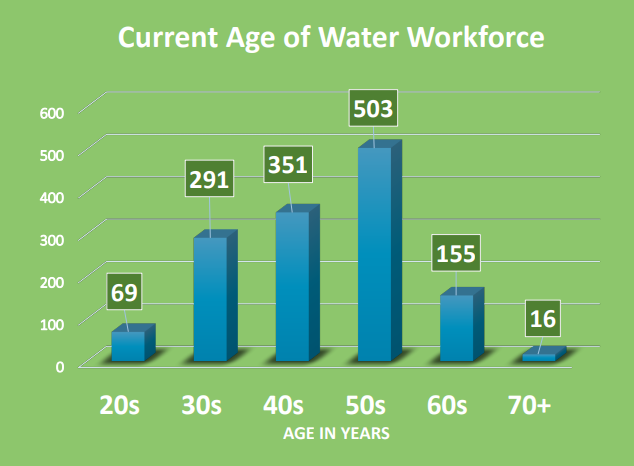
SOURCE: NJDEP.
The imbalance is creating a succession problem at precisely the wrong time. New Jersey is planning some of the largest water infrastructure investments in its history, but the workforce responsible for running those systems is steadily approaching retirement.
The problem extends well beyond New Jersey. The U.S. Environmental Protection Agency has estimated that nearly one-third of the nation’s water utility workforce will become eligible for retirement within a decade. The American Water Works Association has projected that approximately half of utility employees nationwide could retire over the same period.
More work, fewer workers
The retirements are arriving as demand for skilled water workers continues to grow. The Bipartisan Infrastructure Law allocated more than $50 billion nationally for drinking water and wastewater improvements. New Jersey is receiving hundreds of millions of dollars through its State Revolving Funds and related federal programs.
Utilities across the state are replacing lead service lines, installing PFAS treatment systems, modernizing treatment plants and preparing facilities for more severe storms. Every project requires construction workers to build it, but the need does not end when construction is complete. New systems must be operated, tested, inspected, repaired and maintained for decades.
Without enough licensed operators, mechanics, electricians, instrumentation technicians and maintenance personnel, even fully funded infrastructure projects could face delays. Utilities may also struggle to operate increasingly complex systems or preserve the knowledge that experienced employees have accumulated over long careers.
A fragmented industry
New Jersey’s highly decentralized water sector makes workforce planning more difficult. According to Jersey WaterCheck, approximately 10 percent of residents rely on private wells and septic systems. The remaining population is served by hundreds of drinking water, wastewater and stormwater systems operating under municipal, county, regional or investor-owned structures.
Investor-owned utilities serve roughly 40 percent of the state’s water-system population. The other 60 percent depends largely on municipal, county, regional and other non-investor-owned providers, which range from large authorities to small local systems.
That structure places much of the recruiting, training and employment challenge on municipalities, counties and regional authorities. Larger providers may have the resources to build formal training programs, recruit across a wider area and offer clearer advancement opportunities. Smaller systems often cannot do so alone, even though the services they provide are no less essential.
Apprenticeships create a path forward
Registered apprenticeships offer one of the most practical responses to the shortage. Labor unions have long used apprenticeship programs to prepare workers for skilled careers in construction; the model can provide the same combination of structure, technical instruction and hands-on experience for water and wastewater workers.
Apprentices earn wages while completing classroom instruction and mentored on-the-job training, which makes the model particularly valuable for people seeking a stable career without following a traditional four-year college path.
Several New Jersey programs are already creating these entry points. The New Jersey Water Association’s registered apprenticeship program includes 4,000 hours of mentored on-the-job training and 288 hours of technical instruction over two years. Hudson County Community College’s Water Workforce Utility Program offers another route into the industry.
New Jersey American Water’s WATER UP! program combines classroom instruction, hands-on training and exposure to utility careers; participants may also receive a stipend and earn college credit. The Atlantic County Utilities Authority offers wastewater, electrician and instrumentation technician apprenticeships, along with internships that include wastewater operations.
The Future-Forward Water Workforce Initiative, led by Jersey Water Works, New Jersey Future, the Atlantic County Utilities Authority and the Atlantic City Municipal Utilities Authority, is helping current utility employees build technical and professional skills. The initiative enrolled 20 workers in courses ranging from wastewater operations and CDL training to data analysis and project management.
These efforts provide useful models, but they remain spread across numerous organizations and employers. Closing a statewide workforce gap will require stronger coordination, sustained funding and clearer routes from training to permanent employment.
Workforce investment is infrastructure investment
New Jersey has recognized the need to invest heavily in its physical water systems. NJDEP has estimated that the Water Bank will receive nearly $1 billion from the Bipartisan Infrastructure Law over five years. The state also allocated $300 million in federal pandemic recovery funding for water infrastructure improvements. Individual projects demonstrate the scale of the work to be completed. The Atlantic County Utilities Authority received $10 million through the New Jersey Infrastructure Bank for wastewater treatment improvements, including $2 million supported by the Bipartisan Infrastructure Law. The Atlantic City Municipal Utilities Authority received $19.8 million for lead service line replacement.
The growing project list is a sign of long-overdue progress. Safe drinking water and reliable wastewater treatment are essential public services; replacing deteriorating infrastructure and meeting new water-quality standards cannot be postponed indefinitely.
However, the same investment is intensifying competition for workers. PFAS treatment, lead service line replacement, brownfield redevelopment, environmental remediation and wastewater compliance projects often require overlapping skills. Utilities must compete with engineering firms, contractors and environmental companies for a limited pool of qualified labor.
Addressing the shortage will require more than recruiting people to fill existing vacancies. New Jersey needs clearer career pathways from high schools, vocational programs and community colleges into permanent utility jobs, along with more paid opportunities for workers entering the field. Smaller systems must also have dependable access to qualified employees, whether by strengthening their own workforce, sharing personnel and training resources with neighboring utilities or integrating with larger regional systems. Experienced workers must have opportunities to pass along the technical knowledge that cannot be learned from a manual.
Sources:
American Water Works Association. Developing the next generation of water professionals. https://www.awwa.org/AWWA-Articles/developing-the-next-generation-of-water-professionals/
Atlantic County Utilities Authority. Internship opportunities. https://www.acua.com/About/Careers/Internships.aspx
Hudson County Community College. Water Workforce Utility Program. https://su.hccc.edu/programs-courses/workforce-development/water-workforce-utility-program/index.html
Jersey Water Works. Understanding how the water sector is organized in New Jersey. https://www.njwatercheck.com/Content/documents/Understanding%20How%20the%20Water%20Sector%20is%20Organized%20in%20NJ.pdf
Jersey Water Works. Partners for Places: Jobs and Inclusive Infrastructure Initiative. https://www.jerseywaterworks.org/latest-news/partners-for-places-jobs-and-inclusive-infrastructure-initiative/
New Jersey American Water. Water UP! Water Utility Pipeline Program. https://www.amwater.com/njaw/About-Us/Workforce-Development/water-up
New Jersey Department of Environmental Protection. NJDEP commissioner LaTourette, EPA administrator Regan and I-Bank officials mark billion-dollar water infrastructure milestone. https://dep.nj.gov/newsrel/24_0029/
New Jersey Department of Environmental Protection. Licensed operator program update [Conference presentation]. Association of Environmental Authorities of New Jersey Annual Conference. https://www.aeanj.org/wp-content/uploads/DEP-Licensed-Operator-Program-Update.pdf
New Jersey Water Association. Apprenticeship program: Water and wastewater operations specialists. https://www.njwater.org/docs/NJWA_AP_Guidance_1_2024.pdf
New Jersey Water Association. New Jersey’s water workforce: Strategies for strengthening recruitment, retention, and succession planning [Workshop agenda]. https://www.njwater.org/docs/NJ-Workforce_Agenda-SU-EFC_CC_NJWA_Flyer.pdf
U.S. Environmental Protection Agency. Interagency Water Workforce Working Group report to Congress. https://www.epa.gov/system/files/documents/2024-09/interagency-water-workforce-working-group-report-to-congress_august-2024-508-compliant.pdf
U.S. Environmental Protection Agency. Fact sheet: EPA and the Bipartisan Infrastructure Law. https://www.epa.gov/infrastructure/fact-sheet-epa-bipartisan-infrastructure-law
American Society of Civil Engineers. 2025 New Jersey infrastructure facts.
Tri-State Infrastructure News Network. Raw sewage in the streets: New Jersey’s dirty little secret. https://tristateinfrastructurenews.com/raw-sewage-in-the-streets-new-jerseys-dirty-little-secret/