



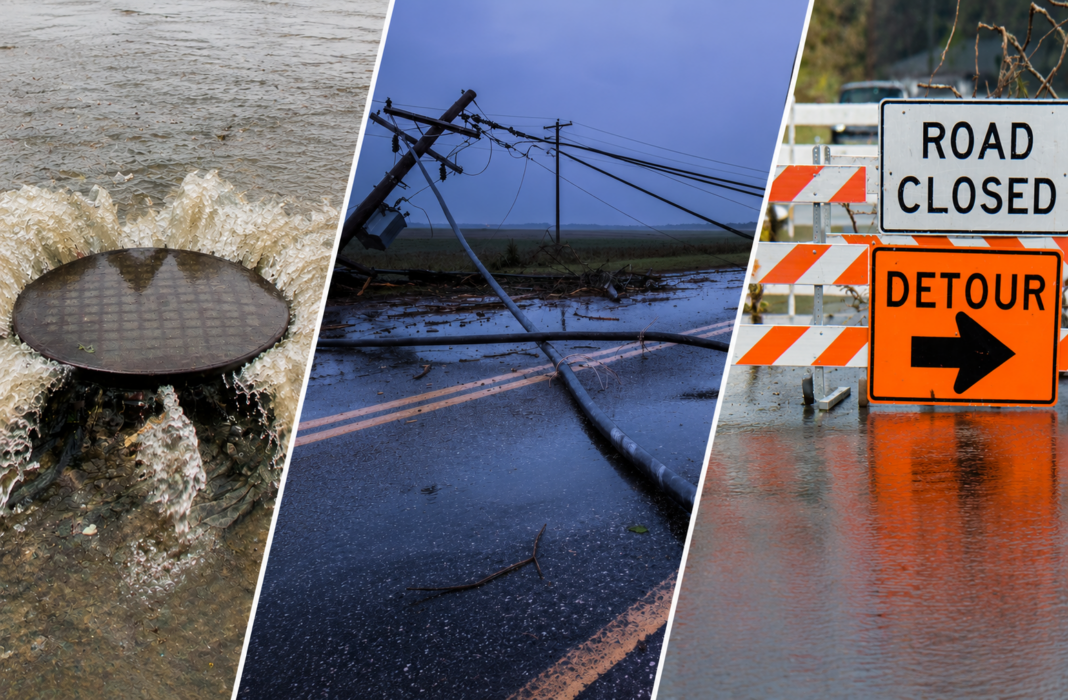
Hundreds of thousands lost power, roads flooded, transit slowed and sewer systems were put to the test. The numbers tell a story that extends well beyond a single week of severe weather.
The July 2026 storms brought nearly six inches of rain, wind gusts over 70 mph, widespread flooding, road closures, transit disruptions and more than 680,000 power restorations by PSE&G and JCP&L.
The storms exposed long-standing infrastructure challenges, including aging drainage systems, flood-prone roadways, vulnerable electric infrastructure and combined sewer systems that can discharge untreated wastewater during heavy rain.
One of the biggest gaps was transparency. While utilities provided real-time outage maps and millions of customer updates, New Jersey still lacks a centralized system to report when and where combined sewer overflows occur, leaving the public with little information about potential impacts to local waterways.
For one week in July, nearly every infrastructure system in New Jersey was tested by a series of severe storms that exposed just how interconnected the state’s water, transportation and energy networks have become. The storms were extraordinary, but many of the challenges that followed were anything but unexpected. Aging infrastructure, increasingly intense rainfall and decades-long capital improvement programs combined to create a cascade of disruptions that reached every corner of the state.
A grid pushed to its limits
Perhaps no system illustrates the scale of the storm better than New Jersey’s electric grid. Public Service Electric & Gas (PSE&G) described the response as one of the ten largest restoration efforts in the company’s history. Between July 1 and July 8, crews restored power to more than 380,000 customers following a combination of extreme heat and severe thunderstorms that battered much of the state.
Crews repaired or replaced approximately 700 utility poles, removed roughly 1,500 fallen trees, deployed 170 tree crews and 165 specialized utility crews, completed more than 7,000 air conditioner repairs, replaced 110 air conditioning systems, and sent more than 10 million text messages and emails to customers throughout the restoration effort.Jersey Central Power & Light (JCP&L) restored power to more than 300,000 customers.
Some communities were hit especially hard. In Point Pleasant, nearly 2,800 of the borough’s 9,930 electric customers lost power, leaving almost 30 percent of the community without electricity during a peak tourism time, America’s 250th birthday. The borough responded by opening Town Hall as a cooling center while temperatures remained dangerously high.
The widespread outages left New Jerseyans wondering how utilities prioritize restoration. Atlantic City Electric’s restoration plan explains. Downed energized lines and other life-threatening hazards are addressed before moving to high-voltage transmission facilities that restore service to the greatest number of customers. Critical facilities such as hospitals, police departments, fire stations and water treatment plants come next, followed by major distribution circuits and, finally, individual neighborhoods and homes. The approach maximizes the number of customers restored as quickly as possible, even if some neighborhoods must wait longer than others.
Transportation grinds to a halt
Transportation systems quickly became another point of failure. As flooding spread across the state, the New Jersey Department of Transportation activated its Emergency Operations Center and shifted personnel away from routine maintenance and construction work to clearing flooded highways, removing downed trees, inspecting bridges and reopening roads. At the local level, public works departments made similar shifts. Emergency responders were called upon not only for rescues, but also to clear drainage systems so floodwaters could recede. In Glendora, Camden County, firefighters fought back as floodwaters entered Tony Morelli’s Market by clearing clogged storm drains outside the business so water could begin draining away.
NJ Transit experienced service disruptions as flooding and fallen trees affected rail infrastructure, while weather-related delays rippled through Newark Liberty International Airport and other regional transportation hubs.
Unlike the electric grid, however, there is no comprehensive statewide database documenting flood-related road closures. Drivers instead relied on whatever information that could access, like county emergency alerts, municipal police departments, social media pages and google maps and to navigate what roads to travel.
Water system fails quietly
Unlike the electric grid, New Jersey’s drinking water systems generally remained operational throughout the storms. But the same cannot be said for the state’s wastewater infrastructure.
New Jersey still has 21 municipalities served by combined sewer systems, where stormwater and sanitary sewage share the same pipes. During intense rainfall, those systems are designed to release excess flows directly into nearby rivers, waterways and in some cases neighborhood streets through combined sewer overflow (CSO) outfalls rather than allowing wastewater to back up into homes and businesses.
What happened during the July storms should have made CSOs a major public conversation. Instead, one of the most striking aspects of the event is how little information is publicly available. Despite one of the state’s largest rainfall events in recent years, there is no centralized, publicly accessible system showing whether combined sewer overflows occurred, where they occurred, how long they lasted or how much untreated wastewater entered New Jersey’s waterways.
Residents could easily track power outages in real time. They could monitor road closures, weather alerts and restoration estimates. Yet there was no equivalent statewide dashboard allowing the public to determine whether untreated sewage had been discharged into their communities and rivers.
That lack of transparency is particularly notable given the enormous public investment already underway. New Jersey’s Long Term Control Plans for combined sewer communities are expected to cost billions of dollars. The projects include separating stormwater and sanitary sewer lines where practical, expanding wastewater treatment capacity, constructing storage facilities, rehabilitating aging infrastructure and installing green infrastructure designed to reduce stormwater entering the system.
The absence of timely reporting makes it difficult for residents, researchers and policymakers to evaluate how these systems actually performed during one of the state’s most significant storm events.
The cost of aging infrastructure
The July storms also underscored a broader reality: much of New Jersey’s infrastructure was built for a different climate and a smaller population.
When New Jersey’s older sewer systems were constructed in the late nineteenth and early twentieth centuries, cities were dramatically smaller and far less paved. Today, decades of development have replaced forests, wetlands and open fields with rooftops, roads and parking lots that rapidly channel stormwater into drainage systems. The result is a dramatic increase in runoff entering infrastructure that was never designed for today’s rainfall intensity.
The same challenge exists throughout the transportation network. Many roads that flooded during July are familiar trouble spots because storm drains and culverts simply cannot move water quickly enough during extreme rain events. Repeated flooding in the same locations suggests that these are no longer isolated weather emergencies. These are recurring infrastructure challenges that will not get better without upgrades.
Where New Jersey could improve
The July floods point toward several opportunities to strengthen the state’s resilience before the next major storm arrives.
For wastewater systems, accelerating implementation of Long Term Control Plans would reduce the frequency and volume of CSOs. Equally important would be improving transparency. New Jersey should have a statewide, real-time public dashboard reporting when CSOs occur, where they occur, how long they last and which communities are affected.
Electric utilities have made significant investments in grid modernization that likely reduced both the number and duration of outages. Continued investment in vegetation management, substation flood protection and undergrounding where practical and microgrids serving critical facilities could further improve resilience.
Transportation agencies face a similar challenge. Replacing undersized culverts, expanding stormwater storage, modernizing drainage systems and elevating chronically flooded roadways will become increasingly important as rainfall intensity continues to increase.
Communication also deserves attention. PSE&G’s restoration effort included more than 10 million customer updates. By comparison, information about road closures, wastewater impacts and other infrastructure disruptions were lacking. A centralized statewide infrastructure dashboard combining transportation, utility and water system information could significantly improve public awareness during future emergencies.
More than a weather story
July 2026 was a large-scale stress test of New Jersey’s critical infrastructure. The state’s utilities demonstrated remarkable restoration capabilities, mobilizing thousands of workers and restoring hundreds of thousands of customers in just days. Transportation agencies reopened roads, municipalities cleared debris and emergency responders worked around the clock to keep residents safe.
But even with these tremendous efforts, the storms revealed real vulnerabilities. New Jersey can tell residents exactly how many utility poles were replaced, how many trees were removed and how many customers remain without power. It can publish interactive outage maps that update almost in real time.
It still cannot tell the public, in any meaningful or timely way, whether combined sewer overflows occurred during one of the largest storm events of the year, where untreated wastewater entered local waterways or how those systems performed under extreme conditions. For a state investing billions of dollars to modernize its infrastructure, that may be one of the most important lessons the July floods left behind.
Sources:
6abc Philadelphia. Heavy rain causes flash flooding on roadways in Philadelphia and New Jersey. https://6abc.com/post/heavy-rain-causes-flash-flooding-roadways-philadelphia-new-jersey/19458231/
ABC7 New York. New Jersey storms cause NJ Transit disruptions, massive power outages. https://abc7ny.com/post/new-jersey-storm-powerful-storms-cause-nj-transit-disruptions-suspensions-massive-power-outages-1-man-killed/19456389/
Atlantic City Electric. Restoration priorities. https://www.atlanticcityelectric.com/Outages/ExperiencingAnOutage/Pages/RestorationProcess.aspx
FirstEnergy. Jersey Central Power & Light news and storm updates. https://www.firstenergycorp.com/jersey_central_power_light.html
Governor of New Jersey. Governor Sherrill provides update on severe weather response. https://www.nj.gov/governor/news/2026/20260706a.shtml
New Jersey Department of Environmental Protection. Combined sewer overflow (CSO) program. https://dep.nj.gov/dwq/combined-sewer-overflow/
NJ.com. New Jersey power outage tracker. https://projects.nj.com/data/outagetracker/
NJ Patch. Wall, K. Almost 30% of Point Pleasant loses power after July 4 storms. https://patch.com/new-jersey/pointpleasant
Public Service Electric & Gas. PSE&G continues final phase of major storm restoration effort, restoring power to more than 380,000 customers. https://nj.pseg.com/newsroom/newsrelease497
Public Service Electric & Gas. PSE&G continues around-the-clock restoration following week of extreme heat and successive storms. https://nj.pseg.com/newsroom/newsrelease496