


Virtual power plants are rapidly scaling nationwide as AI demand strains the grid and utilities seek fast, flexible alternatives to new infrastructure.
New Jersey and neighboring states are cautiously developing early VPP frameworks, with New York leading regional deployment and others preparing regulatory groundwork.
Distributed batteries, smart thermostats, and rooftop solar are emerging as key assets for future grid reliability.
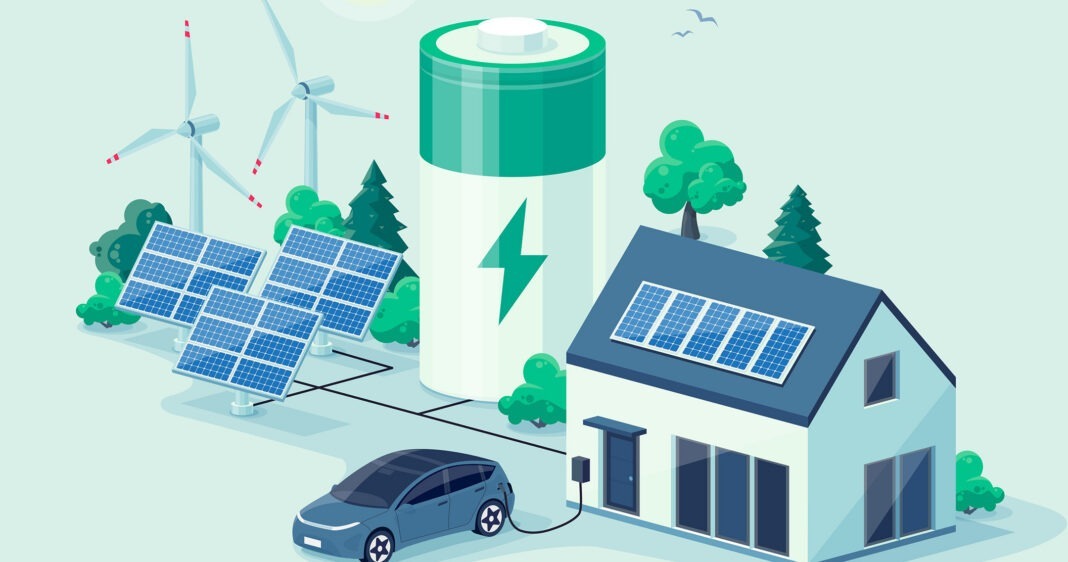
Virtual Power Plants (VPPs) – decentralized networks of home batteries, smart thermostats, EV chargers, and distributed solar – are rapidly becoming a mainstream tool for grid stability. The core idea behind VPPs is simple; during periods of peak demand, grid operators can send a digital signal to thousands of enrolled households with home batteries to increase supply to the grid. Home batteries discharge stored energy, while smart thermostats slightly reduce cooling demand. The combined effect is a real‑time drop in peak load, delivered without constructing a single new power plant. This model is scaling quickly because the hardware already exists inside millions of homes.
By mid‑2025, the U.S. VPP market reached nearly 40 GW of capacity – enough to power roughly 30 million homes under normal conditions. Historically, most of this capacity came from commercial and industrial users. But residential participation is now accelerating, driven by the rapid adoption of home batteries and smart thermostats. Sunrun, Tesla, and Renew Home recently announced a partnership to aggregate the energy‑saving potential of 9 million homes, creating a network capable of delivering 16.8 GW of flexible capacity. That figure rivals multiple traditional power plants and demonstrates how quickly decentralized resources can scale when aggregated effectively.
The rise of VPPs is directly tied to the strain created by AI data centers. Hyperscale developers are adding tens of gigawatts of new load to the grid, with more than 24 GW of demand from data‑center announcements tracked in the first half of 2025 – triple the volume from the previous year. Utilities cannot expand transmission or build new centralized generation fast enough to keep pace. As a result, Big Tech companies are increasingly bypassing the grid altogether by co‑locating solar and battery storage directly on data‑center campuses. Solar‑plus‑storage pipelines have surged to 245 GW of planned capacity, with Texas alone accounting for more than a quarter of the national total.
New Jersey and its neighboring states are beginning to map out their own VPP strategies – though each is moving at a different speed. New York is the clear regional leader, with Con Edison already running battery aggregation and thermostat‑based VPP pilots under its Reforming the Energy Vision (REV) framework. Connecticut’s ConnectedSolutions program is technically a VPP‑style model, though adoption remains modest. Pennsylvania and Maryland are exploring early pilots through PJM’s evolving DER aggregation rules. New Jersey sits in the middle: it has strong rooftop solar penetration, growing residential battery incentives, and peak‑load stress that makes VPPs attractive, but it has not yet launched a statewide VPP tariff or utility‑run aggregation program. The ingredients exist – the regulatory push has not yet arrived.
As AI accelerates load growth and centralized infrastructure lags, utilities need fast‑deploying, flexible resources that can respond instantly to demand spikes. VPPs provide exactly that. They turn everyday households into grid assets, reduce reliance on fossil peakers, and offer a scalable alternative to slow, capital‑intensive infrastructure expansion.
Sources:
PV Magazine. “The virtual power plant era has arrived.” June 29, 2026. https://www.pv-magazine.com/2026/06/29/the-virtual-power-plant-era-has-arrived/
GlobeNewswire. “Sunrun, Renew Home, and Tesla team up to deliver more than 16 gigawatts of fast, flexible power for data centers and large loads.” June 24, 2026. https://www.globenewswire.com/news-release/2026/06/24/3316793/0/en/sunrun-renew-home-and-tesla-team-up-to-deliver-more-than-16-gigawatts-of-fast-flexible-power-for-data-centers-and-large-loads.html
Wood Mackenzie. “North America power markets short-term outlook.” October 30, 2025. https://www.woodmac.com/reports/power-markets-north-america-power-markets-short-term-outlook-october-2025-150417303
Tesla. “Tesla Virtual Power Plant.” 2026 support guidance. https://www.tesla.com/support/energy/virtual-power-plant
National Grid New York. “ConnectedSolutions battery program overview.” 2026. https://www.nationalgridus.com/Upstate-NY-Home/ConnectedSolutions/BatteryProgram
Con Edison. “Smart usage rewards for aggregators or direct enrollees.” 2026. https://www.coned.com/en/save-money/rebates-incentives-tax-credits/rebates-incentives-tax-credits-for-commercial-industrial-buildings-customers/smart-usage-rewards
PJM Interconnection. “Distributed energy resources.” 2025 fact sheet. https://www.pjm.com/-/media/DotCom/about-pjm/newsroom/fact-sheets/distributed-energy-resources.ashx?la=en
New Jersey Clean Energy Program. “Energy storage incentives and residential battery adoption.” 2026.https://cleanenergy.nj.gov/programs/energy-storage
Maryland Public Service Commission. “Community solar and battery pilot filings.” 2026. https://www.psc.state.md.us/electricity/community-solar
Connecticut Department of Energy and Environmental Protection. “ConnectedSolutions demand response program.” 2026. https://portal.ct.gov/pura/electric/office-of-technical-and-regulatory-analysis/clean-energy-programs/energy-storage-solutions-program