


Matches puts Meadowland and NJ Transit inadequacies on the world stage
Getting to/from the Meadowlands is a longstanding problem
he World Cup is putting the failings of NJ Transit in the world spotlight
New Jersey has an opportunity to build world class entertainment venue supported by world class transportation infrastructure
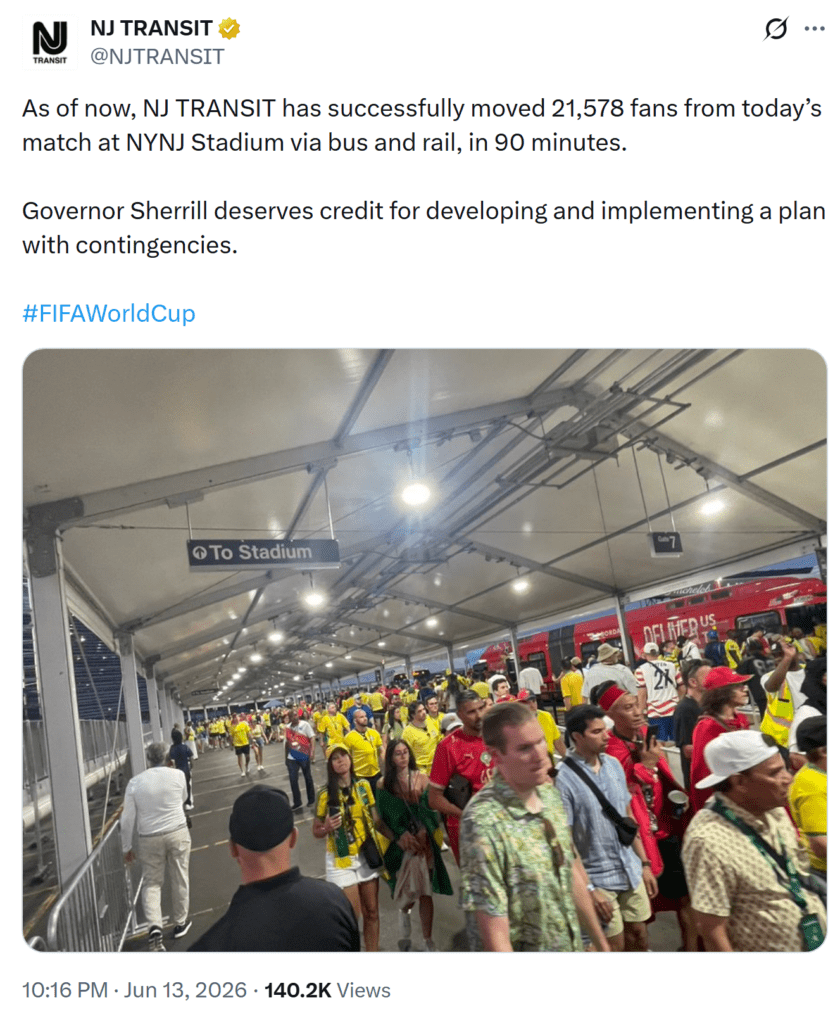
New Jersey Transit appeared to take a victory lap after the first World Cup match between Brazil and Morocco on June 13th at the Meadowlands. With soccer fans repping Brazil in yellow and green and Morocco in red, it certainly looked colorful and festive.
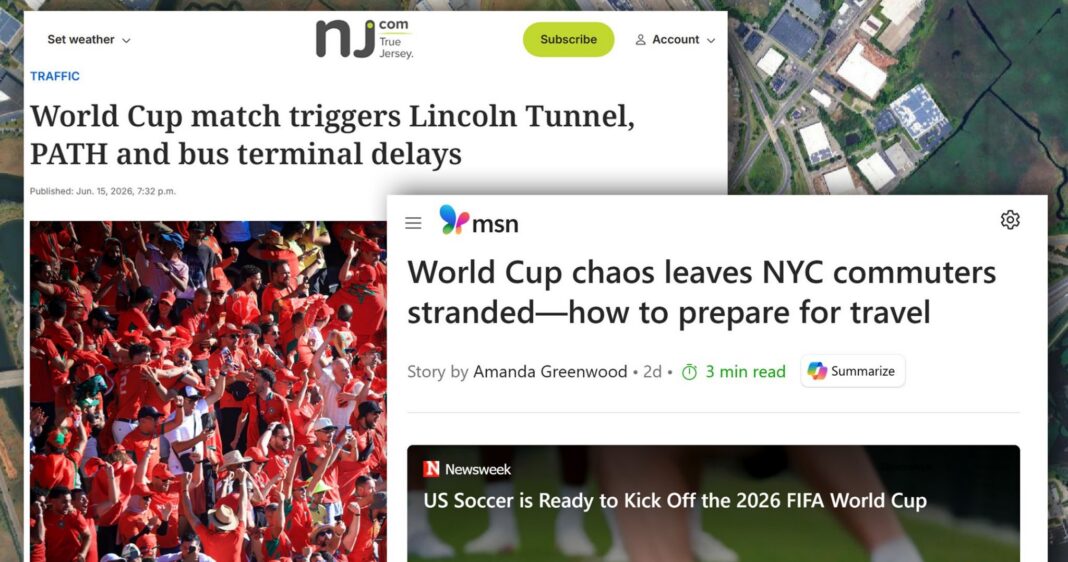
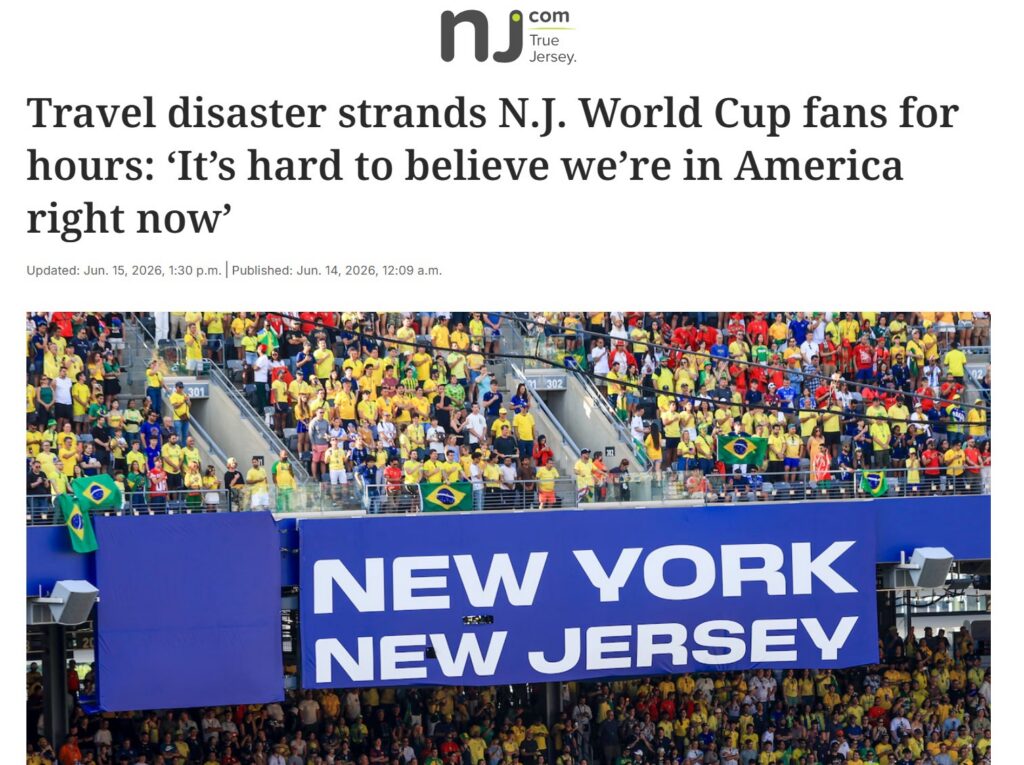
But it wasn’t long after the match ended that news reports of hours-long delays surfaced.
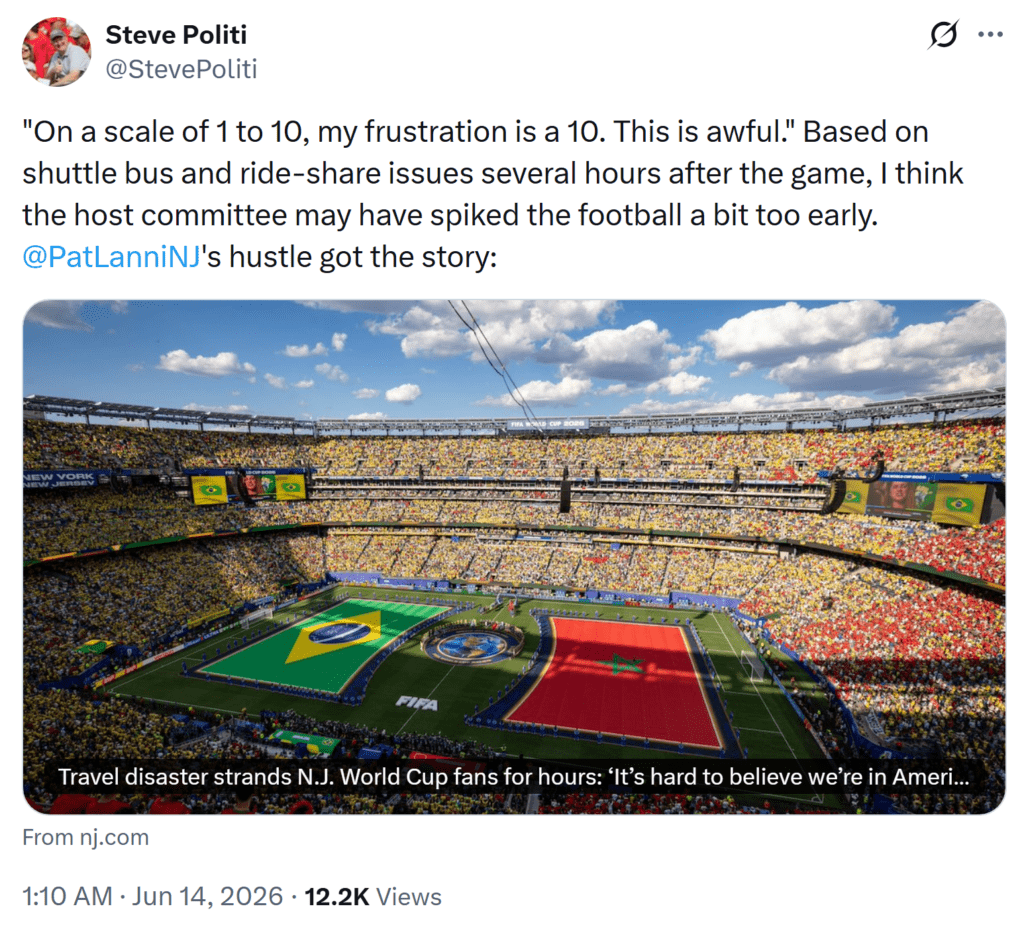
Delays stretched for well over two hours as shuttle buses crawled through gridlock and fans waited in lines that wrapped around multiple city blocks. Some buses took 90 minutes just to reach the stadium, and post‑match queues moved so slowly that many fans needed two to three hours to get back to Manhattan.
You could have seen this potential for a transportationpocalypse from Exit 9a. Anyone who has ever tried to get in or out of the Meadowlands for a major event knows exactly what the rest of the world is discovering during the 2026 World Cup: the transportation system serving New Jersey’s premier entertainment complex is fundamentally broken.
We’ve heard this song before
The 2014 “Mass Transit Super Bowl” was supposed to showcase the region’s ability to move enormous crowds efficiently. Instead, it became a case study in what happens when you funnel tens of thousands of people through a single‑track rail spur and a single transfer station. Fans were stuck for hours at Secaucus Junction, packed shoulder‑to‑shoulder, chanting in frustration as trains backed up and platforms overflowed. Five years later, 2019’s WrestleMania 35 delivered a sequel no one asked for. A rain delay pushed the event late into the night, and NJ Transit was overwhelmed. Thousands of fans waited until 2 or 3 a.m. for trains. Some didn’t get home until nearly dawn. Once again, the Meadowlands made national news for all the wrong reasons.
Pick your artist, pick your year — the story is the same. Taylor Swift’s 2023 shows produced gridlock stretching miles down Route 3. Beyoncé’s concerts saw crushing crowds at Secaucus and long delays boarding trains. Even Bruce Springsteen, the patron saint of New Jersey, couldn’t escape the dysfunction: fans routinely waited more than an hour to leave the stadium.
These weren’t anomalies. They were symptoms. Ask any Jets or Giants season‑ticket holder. Leaving a Sunday game often means sitting in the parking lot for 45 minutes before you even reach the exit. Or inching along the Turnpike western spur. Or waiting in a snaking line for a train that can only move one direction at a time. But because this is our normal, we’ve adapted. Like frogs in a pot of slowly heating water, we’ve learned to live with the dysfunction. We joke about it. We plan around it. We accept it. That acceptance is exactly why nothing has changed.
Now, on the world stage
The problems we’re seeing during the World Cup aren’t surprising to anyone who has ever set foot in the Meadowlands. They were predictable and they were warned about repeatedly. New Jersey applied band‑aids (wristbands at Secaucus Junction, temporary 10-gate bus terminal, extra staff) to a problem that is much bigger than band‑aids. These measures help manage chaos. They do not eliminate it. They do not increase capacity. They do not fix the underlying structural constraints. They are clever workarounds for a system that was never designed to handle global‑scale events.
New Jersey has the region’s largest entertainment complex – the largest stadium hosting the biggest events – but not a world‑class one. Instead of being a crown jewel, the Meadowlands has become a global punchline. The stadium is world‑class. The events are world‑class. The transportation system is not. And that mismatch is costing New Jersey money, reputation, and opportunity.
The Meadowlands should be a source of pride – a place that attracts investment, tourism, and global attention. We deserve a world-class stadium district, a world-class convention center, and a world-class transportation network creating a world-class visitor experience. Instead, we have world‑class events sitting on top of what is essentially 1970s infrastructure.
Let’s fix this
There is no single solution, but there are several viable paths. Some are big, some are small, all are necessary.
1. Double‑track the Meadowlands rail spur
This is the most important fix. A single‑track line can only move one train at a time. A second track would double capacity and eliminate the biggest bottleneck.
2. Build the Secaucus–Meadowlands Transitway
This bus rapid transit corridor would create a dedicated, high‑capacity link between Secaucus and the stadium. It’s the most realistic near‑term project.
3. Add a second platform at the stadium
Right now, trains can only load and unload from one side. A second platform would speed up operations and reduce dwell times.
4. Create a direct rail connection from the Northeast Corridor
A wye (a triangular track junction) or bypass would allow direct trains from New York, Newark, and Philadelphia without forcing everyone through Secaucus.
5. Expand pedestrian and micromobility access
Right now, you can’t walk or bike to the stadium. That’s absurd for a venue this large. Safe, separated pathways would reduce car dependency.
6. Build a true entertainment district
Restaurants, hotels, retail, and public spaces would spread out arrivals and departures — and generate revenue beyond event days.
7. Long‑term: Consider a PATH extension
Expensive, yes. Transformative, absolutely.
None of these are impossible. All of them are achievable. What’s missing is the will to treat the Meadowlands as the economic engine it truly is.
Jersey pride
With eight matches scheduled for the Meadowlands (including the final), the state is holding its collective breath during each match, crossing its fingers that an equipment issue that challenges commuters daily doesn’t happen while the whole world is watching. It does not have to be this way.
Major events bring hundreds of thousands of visitors who spend on hotels, restaurants, transportation, retail, and entertainment. Building a modern entertainment district would spur new hotels, restaurants, retail, and even new residential and commercial development. These improvements not only bring construction jobs, but also stadium jobs, hospitality jobs, media jobs. The World Cup alone is projected to support tens of thousands of jobs across the region.
Infrastructure investments pay for themselves through increased event hosting, higher tourism spending, greater economic activity, and long‑term regional growth. The Meadowlands can be an economic powerhouse – if we treat it like one. Hosting global events with a world class facility puts New Jersey on the world stage. That visibility attracts investment, business relocations, and future events. More visitors = more spending = more revenue for state and local governments.
New Jersey has everything it needs to build a world‑class entertainment complex. What we lack is the vision and the infrastructure to match. It’s time to stop accepting dysfunction as normal. It’s time to stop applying band‑aids to structural failures. Let’s turn the Meadowlands into a source of pride, not a punchline.
Sources:
Higgs, L. (2023, May 25). Taylor Swift N.J. concerts: How NJ Transit plans to avoid a repeat of Super Bowl, Wrestlemania. NJ.com. https://www.nj.com/news/2023/05/taylor-swift-nj-concerts-how-nj-transit-plans-to-avoid-a-repeat-of-super-bowl-wrestlemania.html
Wilson, C. (2026, June 3). What NJ Transit learned from 2014 Super Bowl to handle World Cup. NorthJersey.com / The Bergen Record (via Yahoo News).
https://news.yahoo.com/nj-transit-learned-2014-super-082800996.html
Rivard, R. (2024, February 10). NJ’s World Cup transit challenge: Replicate Taylor Swift success, avoid Super Bowl disaster. POLITICO.
https://www.politico.com/news/2024/02/10/nj-world-cup-transit-challenge-00140738
CBS New York. (2026, June 14). Fans face long delays leaving MetLife Stadium after World Cup opener. CBS News.
https://www.cbsnews.com/newyork/world-cup-metlife-stadium-delays
NBC New York. (2026, June 13). World Cup kickoff brings traffic gridlock, long bus lines, and transit headaches across NYC and New Jersey. NBC 4 New York.
https://www.nbcnewyork.com/news/local/world-cup-traffic-delays-metlife-stadium
ABC7 New York. (2026, June 14). Hours‑long waits for World Cup shuttle buses frustrate fans after MetLife match. ABC7 Eyewitness News.
https://abc7ny.com/world-cup-metlife-stadium-bus-delays
NJ Advance Media. (2026, June 14). ‘A transportation nightmare’: Fans report 2‑hour delays after first World Cup match at MetLife. NJ.com.
https://www.nj.com/news/2026/06/world-cup-metlife-stadium-transportation-delays.html