Our Infrastructure Matters Ad
Home Blog Page 42

EPA announces new drinking water standards. How could NJ water systems be impacted? [USA Today]

0

This article in USA Today discusses the Environmental Protection Agency’s (EPA) new national drinking water standards for PFAS chemicals, also known as “forever chemicals.” These standards aim to protect communities from exposure to harmful PFAS, which have been linked to various health issues, including reproductive and developmental effects, increased cancer risk, and immune system interference. The new regulations set maximum contaminant levels for individual PFAS chemicals like PFOA and PFOS at 4 parts per trillion (ppt) and for mixtures of certain PFAS chemicals at 10 ppt. The EPA’s initiative includes nearly $1 billion in funding from the Bipartisan Infrastructure Law to help states implement PFAS testing and treatment.

New Jersey, a state with significant PFAS contamination, supports the new federal standards and plans to take proactive measures to comply, such as increased monitoring and treatment. The state has a history of addressing PFAS contamination, having set its own standards in 2018 and taking legal action against corporations responsible for PFAS pollution. Despite these efforts, many water systems in New Jersey have exceeded state PFAS limits, leading to costly solutions and ongoing legal battles.

Source: https://www.usatoday.com/story/news/environment/2024/04/15/pfas-in-drinking-water-nj-standard-epa-levels/73286400007/

End of $2.3 billion NJ Turnpike widening hailed [WHYY]

It’s been 10 years since the completion of the New Jersey Turnpike Widening Project between Exits 6 and 9. This WHYY article is from 2014 when the project was completed. Here’s a brief summary of the article:

  • NJ Turnpike Expansion: The largest expansion in the 63-year history of the New Jersey Turnpike is nearly complete, adding extra lanes between Exit 6 and Exit 9 to alleviate congestion.
  • Project Details: The $2.3 billion project is finishing ahead of schedule and under budget by $200 million.
  • Benefits: The expansion is expected to significantly reduce travel delays, especially during peak times like Thanksgiving.
  • Future Plans: Savings from the project will fund other transportation initiatives, and discussions are ongoing about replenishing the state’s Transportation Trust Fund.

See the original story here: https://whyy.org/articles/end-of-23-billion-nj-turnpike-widening-project-hailed/

Wind targets remain out of reach without massive grid expansion [Wind Power Monthly]

0

Extensive electricity grid and transmission buildout, along with upgrades, are underway around the world, but nowhere near fast enough to keep up with plans for the green energy transition.

Outdated regulatory frameworks – which already leave projects such as wind farms languishing in grid connection queues for years – are only compounding the problem, as are supply chain constraints.

Combined, these issues are denting project profitability and wind developer bottom lines significantly.

In the US alone, more than 360GW of wind projects were in grid interconnection queues at the end of 2023, according to the Federal Electricity Regulatory Commission’s (Ferc) latest State of the Market report, with offshore wind accounting for 120GW. This is alongside even larger amounts of solar and storage capacity. 

And the queues are growing.

As we highlight in this report, the picture is the same in other key wind markets. Grid queues are growing almost everywhere, wind projects are suffering delays and increased costs as a result, and governments, regulators and transmission system operators (TSOs) are scrambling for solutions.

Read more

Drinking water in communities of color is more likely to be contaminated by ‘forever chemicals,’ research finds [Northeastern Global News]

0

An article in Northeaster Global News discusses new research from Northeastern University. Key findings from the research includes:

  • PFAS Contamination: PFAS, or “forever chemicals,” are widespread in New Jersey’s public water systems, particularly affecting low-income and minority communities. From 2019-2021, PFAS were detected in 63% of New Jersey water systems, serving 84% of the state’s population.
  • Environmental Justice: The study highlights that communities of color and low-income households are more likely to be served by water systems with PFAS contamination. For example, 92% of the Hispanic population and 94% of the Black population were served by contaminated water systems
  • Regulatory Efforts: New Jersey was the first state to regulate certain PFAS in drinking water. The EPA has also finalized drinking water regulations for six PFAS and allocated $9 billion for tackling PFAS and other contaminants through the Bipartisan Infrastructure Law.
  • Positive Developments: PFAS levels appear to be declining over time, and water systems with treatment technologies are less likely to detect these chemicals. Additionally, two PFAS compounds were recently added to the Superfund list of hazardous chemicals, holding polluters accountable for remediation.

Read the full story here: https://news.northeastern.edu/2024/04/24/new-jersey-pfas-drinking-water/

Energy Security and Affordability Act 

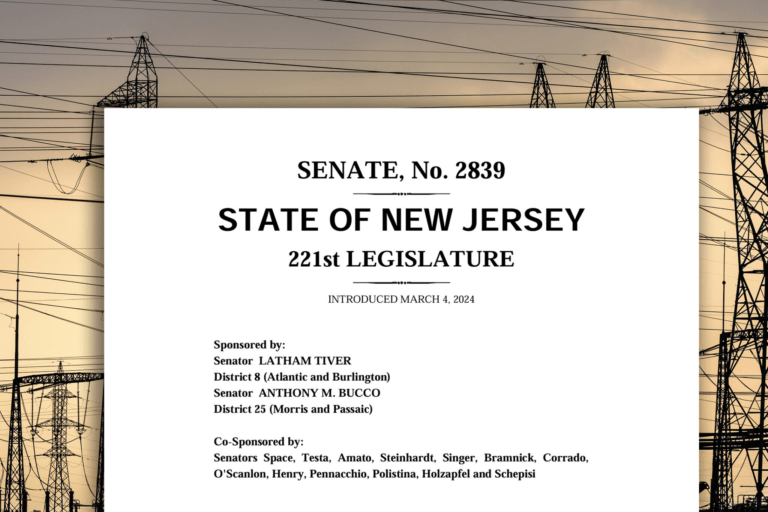
The “Energy Security and Affordability Act” (Bill S2839), introduced in the NJ Senate March 2024, aims to reshape New Jersey’s energy planning by mandating the Board of Public Utilities (BPU) to prioritize energy security, diversity, and affordability alongside environmental goals when creating the Energy Master Plan. This necessitates a balanced approach considering reliable supply across all regions, a variety of energy sources, and the impact on ratepayer costs. The bill emphasizes the importance of in-state energy generation and consumer choice through transparent incentives.

A significant aspect of the legislation is the requirement for the BPU to conduct and publicly release detailed analyses of both individual energy projects and the comprehensive Energy Master Plan. These analyses must utilize open-source software, meticulously detail cost implications and ratepayer impacts, and incorporate public feedback. The findings will be accessible online for a decade. The bill also modifies the composition of the Energy Master Plan Committee and mandates annual BPU testimony to relevant legislative committees regarding these analyses.

Key Issues:

  • Prioritization of Energy Security, Diversity, and Affordability: Elevates these factors alongside environmental concerns in energy planning.
  • Cap on Intermittent Energy Sources: Limits intermittent sources (like solar and wind) to a maximum of 50% of the state’s energy portfolio.
  • Mandated Detailed Analysis: Requires thorough cost-benefit analyses of energy projects and the Energy Master Plan using open-source tools.
  • Enhanced Transparency and Public Input: Demands public comment periods and long-term online availability of analyses.
  • Changes to Energy Master Plan Committee: Alters the membership of the committee responsible for developing the plan.
  • Increased Legislative Oversight: Requires annual BPU testimony to legislative committees.

Bill S2839 was introduced by primary sponsors Senator Latham Tiver and Anthony M Bucco.

The status and text of the Bill S2839l can be found here: https://www.njleg.state.nj.us/bill-search/2024/S2839

Warning About Drinking Water Issued Nationwide [Newsweek]

A nationwide warning has been issued regarding potential cyberattacks on water and wastewater systems in the United States. The Environmental Protection Agency (EPA) and the White House National Security Adviser highlighted that these attacks, often linked to the Iranian Government’s Islamic Revolutionary Guard Corps (IRGC), have targeted operational technology at water facilities. These attacks exploit vulnerabilities such as unchanged default manufacturer passwords, posing significant risks to the critical infrastructure of clean and safe drinking water. Federal authorities are actively investigating these incidents and collaborating with sector partners to provide necessary support and guidance.

The warning also mentions the involvement of a Chinese state-sponsored cyber group, Volt Typhoon, which has compromised multiple critical infrastructure systems, including drinking water. The EPA and the White House are urging state governors to ensure that all water systems assess their cybersecurity practices, identify vulnerabilities, and implement measures to mitigate risks.

The emphasis is on the need for comprehensive cybersecurity practices to protect these essential services from nation-state adversaries and terrorist organizations. The call to action aims to secure water systems against increasing cyber threats and ensure the safety and reliability of drinking water across the country.

Complete story here: https://www.newsweek.com/warning-drinkin-water-issued-nationwide-iran-cyberattack-1881427

NJ’s Energy Master Plan is about to get reassessed [NJ Spotlight]

New Jersey’s Energy Master Plan is getting an update, a much-anticipated task given its role as the road map for how the state is going to transition away from fossil fuels and meet ambitious climate goals.

In a notice filed Monday, the state Board of Public Utilities announced a series of three webinars next month to begin assessing how well it is achieving the clean-energy goals and policies in the 2019 plan, a blueprint criticized by some as not adequately addressing just how much it will cost consumers.

The initial plan identified a goal of reaching a 100% clean-energy economy by 2050, a target Gov. Phil Murphy advanced to 2035 in an executive order even as the state has stumbled in achieving key interim goals.

The state fell well short of developing 600 megawatts of energy storage by 2021, a technology critical to maintaining the reliability of the power grid due to the intermittent nature of solar and wind power envisioned in the plan as replacing gas-fired generation of electricity. Two of the first three offshore wind projects off the Jersey coast were canceled abruptly by Ørsted, their developer. The state also is lagging on milestones to electrify the transportation system, according to clean-energy advocates.

“We welcome the review, but this cannot be just a rubber stamp on the old plan,’’ said Ray Cantor, deputy government affairs manager of the New Jersey Business and Industry Association. “We also must consider the cost, which was painfully absent in the last EMP.’’

Progress report

Environmentalists welcomed the push to update the plan. “We are in the midst of a climate crisis,’’ said Doug O’Malley, director of Environment New Jersey. “The next few years will be the critical years to meet our climate goals.’’

In its notice, the BPU said the update will provide an overview of the state’s progress toward achieving 100% clean energy by 2035 and reducing carbon emissions by 80% below the levels set in 2006 by mid-century.

“The 2024 EMP will serve as the whole-of-government progress report on the goals and strategies in the 2019 EMP, outline the changing landscape of state and federal support for climate action and determine the basis for the development of actionable next steps to reduce GHG (greenhouse gas) emissions and maximize clean energy intake economy-wide.”

“The EMP update will be a gut-check moment for the administration to accelerate the electric revolution for residents.’’ O’Malley said.

Electrifying the transportation and building sectors are two of the most important strategies of the plan, tackling the two largest sources of climate-causing pollution in New Jersey, and, perhaps, the most contentious.

Source

EVs tear up N.J. roads. They should pay their fair share to fix them | Opinion [NJ.com]

In this Matthew Hale op-ed published in NJ.com, Hale argues for a more equitable distribution of infrastructure funding responsibilities between EV and gas-powered vehicle owners and makes the following points:

  1. EV Impact on Roads: Electric vehicles (EVs) are heavier than gas-powered cars, causing more wear on roads and bridges1.
  2. Funding Issues: The Transportation Trust Fund (TTF) in New Jersey, which finances infrastructure, is primarily funded by gas taxes. EV owners contribute less to this fund.
  3. Proposed Solutions: Governor Phil Murphy suggests removing the sales tax waiver for EVs to raise additional funds. Another proposal is a registration tax on EVs to cover the funding gap.
  4. Equity Concerns: The current gas tax disproportionately affects working-class individuals who rely on gas-powered vehicles, while wealthier EV owners benefit from tax incentives.

Read the full op-ed here: https://www.nj.com/opinion/2024/03/evs-tear-up-nj-roads-they-should-pay-their-fair-share-to-fix-them…

Where 6 Metals Used For Electric Cars Come From [Business Insider]

Your average EV has six times more mineral content than a petrol or diesel-powered vehicle – and all those metals need to be dug, scraped, blasted, or leached out of the earth. There is massive demand for batteries as countries eye up ambitious zero emissions targets. But what’s the cost? 

Generative AI’s environmental costs are soaring — and mostly secret [Nature]

0

Key points from this article:

  • Environmental Impact: Generative AI systems require vast amounts of energy and water. For instance, training models like GPT-4 has led to significant spikes in water usage in data centers.
  • Energy Crisis in AI: OpenAI’s CEO Sam Altman acknowledged that the AI industry is facing an energy crisis, with future generative AI systems expected to consume significantly more power.
  • Legislative Action: The Artificial Intelligence Environmental Impacts Act of 2024, introduced by US Democrats, aims to establish standards for assessing AI’s environmental impact and create a voluntary reporting framework.
  • Sustainable Practices: The article suggests that the AI industry should prioritize energy efficiency, use renewable energy, and conduct regular environmental audits to mitigate ecological impacts.

The article emphasizes the need for a multifaceted approach involving industry, researchers, and legislators to address the environmental costs of AI.

Source: https://www.nature.com/articles/d41586-024-00478-x