

New Jersey research shows that the best dual-use solar system depends on what counts most: farm production, electricity generation, cost or ease of operation.
TLDR
1. Agrivoltaics combines solar generation with continued farming; New Jersey is testing models involving hay, vegetables, soybeans, forage and livestock.
2. Hay grown between tracking panels currently offers the best overall balance.
3. New Jersey’s 200-megawatt pilot will test whether these systems can work commercially.
Agrivoltaics promises to address two competing demands on New Jersey’s limited land: producing more renewable energy while preserving working farms. The concept sounds simple, but putting solar panels on farmland does not automatically create a successful dual-use project.
Agrivoltaics is the practice of producing solar electricity and agricultural products on the same land. That can mean hay between tracking panels, vegetables in wide solar rows, livestock beside vertical panels or sheep beneath a conventional array. Some projects add pollinator habitat and apiaries. Each makes a different compromise between agriculture, energy production and cost.
Rutgers University has developed a research program under the state’s Dual-Use Solar Act to study those compromises. Three research arrays in Bridgeton, Pittstown and New Brunswick are testing different solar configurations with specialty crops, hay, soybeans and cattle.
That research is helping New Jersey move toward commercial development. The state’s Dual-Use Solar Energy Pilot Program allows up to 200 megawatts of agrivoltaic projects on unpreserved farmland during a 36-month pilot. Selected projects can receive New Jersey solar incentives plus an additional payment intended to cover costs associated with maintaining agriculture around the arrays.
In return, participants must follow approved construction, operations, monitoring and research plans. The results will help the Board of Public Utilities decide whether dual-use solar should become a permanent state program.
Before New Jersey begins building these projects at scale, Rutgers’ early findings point to five important lessons.
1. The simplest model may provide the best overall balance
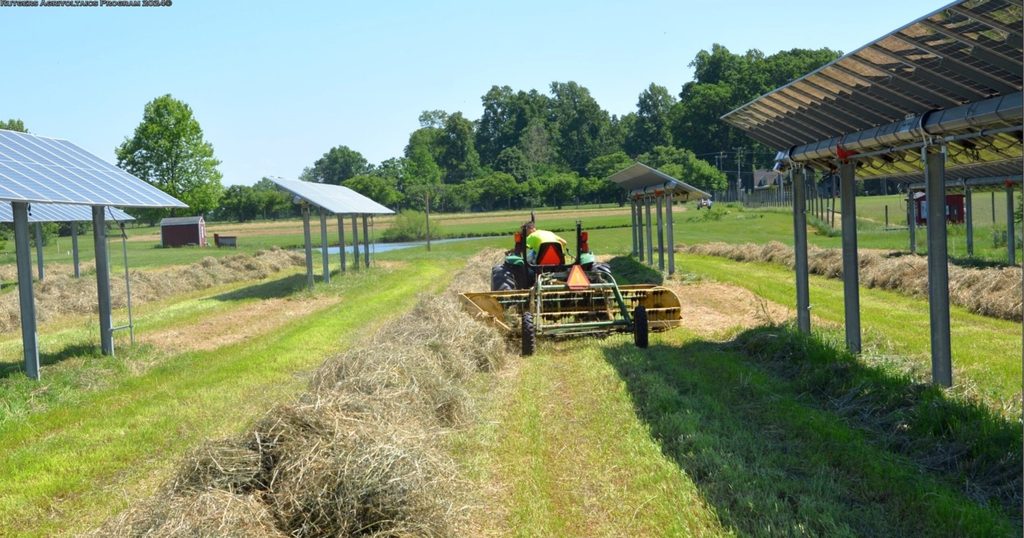
The Snyder Farm in Pittstown. Photo courtesy of the Rutgers Agrivoltaics Program, Rutgers University, New Jersey, USA
Hay and forage currently offer New Jersey’s strongest overall agrivoltaic model. They are established agricultural products, require fewer daily trips through an array than vegetables and can grow across a large share of the site.
At the 95-kilowatt Rutgers Snyder Farm array in Pittstown, panel rows are spaced to allow hay equipment to pass. Researchers completed three cuttings in 2024 and collected biomass from 24 subplots.
From May 2024 through April 2025, the Snyder array produced 1,573 kilowatt-hours of electricity for every kilowatt of installed capacity. That was slightly above the 1,564 kWh/kW predicted by the National Renewable Energy Laboratory’s PVWatts model.
Rutgers has not published a final multi-year comparison showing how shade affects total hay production, but the early results suggest that recognizable commercial farming and strong electricity generation can coexist without requiring the most expensive overhead structures.
That does not make the arrangement effortless. Panels must be spaced around cutting, raking and baling equipment; poorly timed construction can compact wet soil and damage the same farmland the project is intended to preserve. A successful design must begin with the machinery and farming practices that will remain on the property.
2. Greater agricultural potential usually means more complicated operations
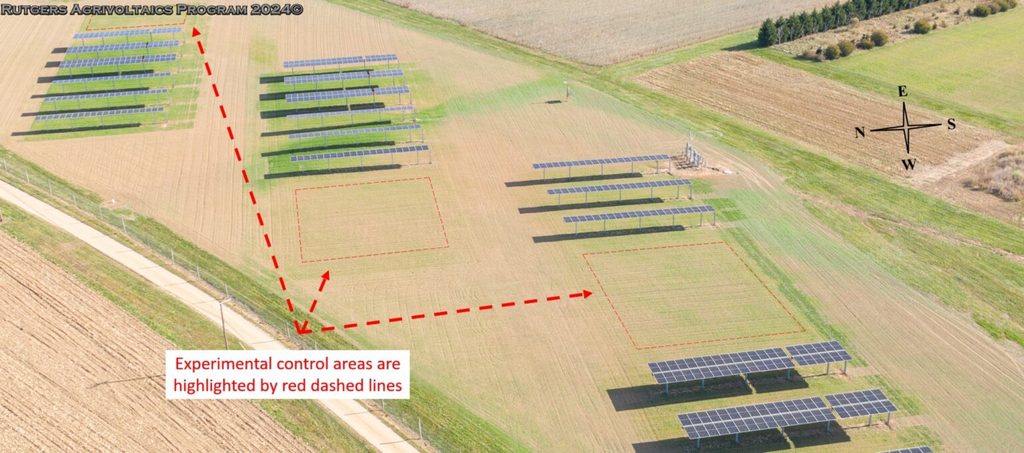
The RAREC farm in Cumberland County. Photo courtesy of the Rutgers Agrivoltaics Program, Rutgers University, New Jersey, USA.
Specialty crops may produce considerably more value per acre than hay. Partial shade could also protect some crops from extreme heat and water stress, giving vegetable production some of the greatest agricultural potential among the models Rutgers is studying.
Rutgers’ 255-kilowatt array in Cumberland County compares tomatoes, bell peppers, eggplant, spinach and soybeans under single-panel rows, double-panel rows and a no-panel control. Solar rows are spaced 34 feet apart.
In 2025, Rutgers reported that five plastic-covered planting beds could fit between the panel rows, leaving approximately two feet between the outside beds and the support posts. Researchers sometimes stop the moving panels near solar noon to provide enough clearance for tractors.
The Bridgeton array recorded 1,700 kWh/kW during its first full reporting year, the highest production of Rutgers’ three sites and approximately 8 percent more than the Pittstown array. Its southern location receives more sunlight, so that difference cannot be attributed solely to the design. Still, the results show that an array can leave meaningful growing space while maintaining strong electricity production.
The challenge is making the entire agricultural operation work around moving panels, support posts and electrical equipment. Irrigation, tractors, workers and repeated harvests all need access. This model may work well for high-value produce, but the additional labor and infrastructure could make it difficult to scale cheaply across hundreds of acres.
3. A farm-friendly solar design may produce less electricity
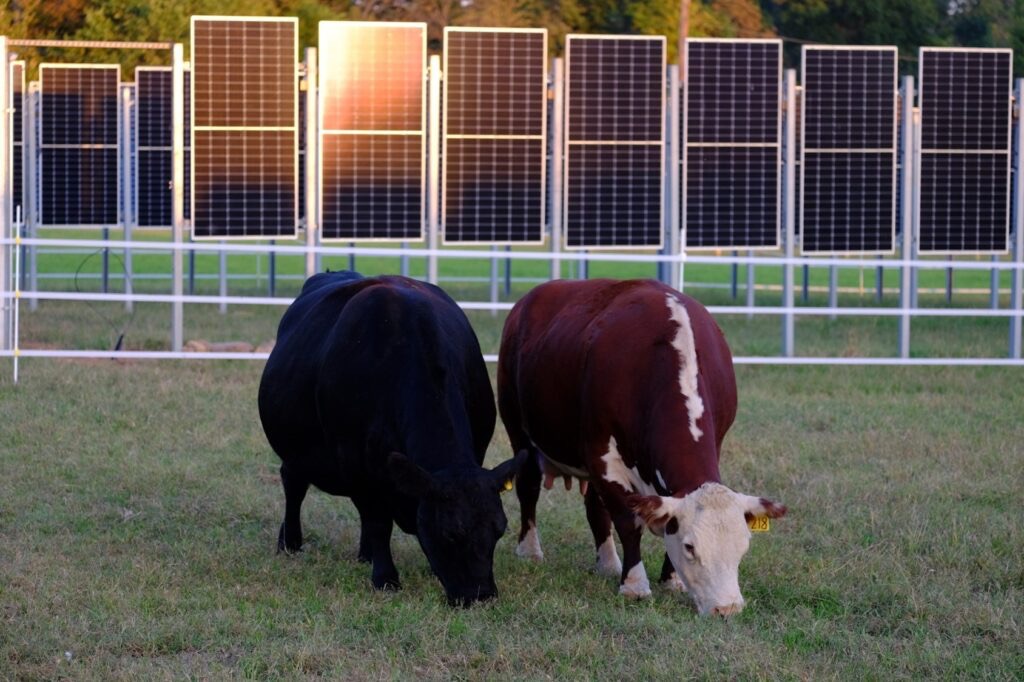
The Animal Farm in New Brunswick, New Jersey. Photo courtesy of the Rutgers Agrivoltaics Program, Rutgers University, New Jersey, USA
Agrivoltaic systems are often designed to create more space for animals, machinery or crops. That additional access can come at a cost to energy production.
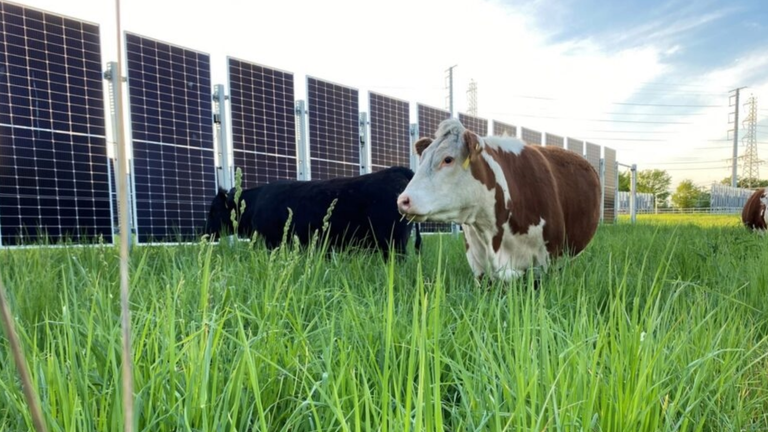
Rutgers is testing beef cattle at its 170-kilowatt Animal Farm array in New Brunswick. Vertical bifacial panels stand 20 or 40 feet apart with either two or four feet of clearance. Cameras take photographs every five minutes to track cattle behavior; researchers are also measuring forage growth and quality.
The open arrangement provides space for grazing, but the vertical array produced 1,116 kWh/kW from May 2024 through April 2025. The tracking array in Pittstown, located at nearly the same latitude, produced 1,573 kWh/kW. Rutgers calculated that the vertical system generated approximately 71 percent as much electricity per unit of installed capacity.
That does not mean grazing is a poor use of solar land. Livestock grazing is already one of the most commercially mature forms of agrivoltaics in the United States, particularly with sheep. Animals control vegetation that a solar company would otherwise pay to mow; farmers can earn grazing fees in addition to revenue from meat, wool or breeding stock.
The type of livestock matters. Sheep can graze beneath relatively conventional solar panels and may provide the lowest-cost path to dual use. Cattle require stronger equipment, greater clearance, water and fencing. Rutgers’ study is too new to determine whether the agricultural benefits of the vertical cattle system offset its lower electricity production.
4. One promising growing season is not enough to guide statewide policy
Rutgers’ first soybean trial produced one of the program’s most encouraging results. Soybean yields under both the single- and double-panel arrangements were significantly higher than yields in the open control field. Tests also found no significant differences in protein, oil or moisture.
That result could make broadacre crops appear to be an easy fit for agrivoltaics, but the growing conditions matter. Southern New Jersey experienced an unusually dry late summer and early fall in 2024. Shade from the panels may have helped the soil retain moisture; the same advantage may not appear during a wetter year.
Rutgers has cautioned that the findings are preliminary. International studies summarized by the university have also found yield reductions for some full-sun crops, including potatoes and wheat, although different designs and climates cannot directly predict what will happen in New Jersey.
Economics present another challenge. Soybeans and other field crops cover large areas, but their lower value per acre leaves less room to absorb additional labor, specialized machinery or planting space lost to foundations and electrical equipment.
Multi-year local data will be needed to determine whether the soybean results represent a durable agricultural benefit or an unusually successful response to one dry season. New Jersey’s pilot should be long enough to capture that variation before the state decides which designs deserve permanent incentives.
5. New Jersey needs an honest definition of agriculture
Pollinator vegetation can improve habitat, control erosion and reduce some maintenance needs around solar panels. When paired with managed beehives and commercial honey production, it can also support a legitimate agricultural product.
Pollinator seed alone, however, is the weakest form of agrivoltaics. It does not necessarily keep a farmer on the land, produce food or preserve access for agricultural equipment.
The USDA has reported that native grass and pollinator vegetation account for most identified agrivoltaic sites in the United States, while fewer than 5 percent include crops. That prevalence reflects how easily pollinator planting can be added to a solar project; it does not prove that it is the strongest form of dual-use agriculture. This distinction will matter as New Jersey evaluates projects competing for limited space and financial incentives. A solar field does not become a farm simply because grass or flowers grow beneath its panels.
Sources:
Birnie, D. P., III, Both, A. J., & Rutgers Agrivoltaics Program. (2025, October). Energy generation data for three agrivoltaics sites in New Jersey. Rutgers University. https://agrivoltaics.rutgers.edu/wp-content/uploads/2026/03/Energy-Generation-Data-for-Three-Agrivoltaics-Sites-in-New-Jersey.pdf
Maguire, K. (2024, April 22). Common ground for agriculture and solar energy: Federal funding supports research and development in agrivoltaics. U.S. Department of Agriculture, Economic Research Service. https://www.ers.usda.gov/amber-waves/2024/april/common-ground-for-agriculture-and-solar-energy-federal-funding-supports-research-and-development-in-agrivoltaics
New Jersey Board of Public Utilities. (2025, November 21). In the matter of the Dual-Use Solar Energy Pilot Program [Board order]. https://www.nj.gov/bpu/pdf/boardorders/2025/20251121/LSB%20ORDER%20Dual-Use%20Pilot%20Program.pdf
Rutgers Agrivoltaics Program. (n.d.). Rutgers Agrivoltaics Program. Rutgers University. https://agrivoltaics.rutgers.edu/
Sorrels, S., Burgher, C., & Mata, R. (2026, June 5). Grazing beef cattle within an agrivoltaics array at the Rutgers Animal Farm. Rutgers Agrivoltaics Program. https://agrivoltaics.rutgers.edu/2026/06/05/grazing-beef-cattle-within-an-agrivoltaics-array-at-the-rutgers-animal-farm/
Wyenandt, A., & Ward, D. (2025, June 9). Second year of specialty crop research begins at RAREC. Rutgers Agrivoltaics Program. https://agrivoltaics.rutgers.edu/2025/06/09/second-year-of-specialty-crop-research-begins-at-rarec/
Wyenandt, A., & Ward, D. (2025, July 9). 2024 agrivoltaics soybean harvest at RAREC in southern New Jersey. Rutgers Agrivoltaics Program. https://agrivoltaics.rutgers.edu/2025/07/09/2024-agrivoltaics-soybean-harvest-at-rarec-in-southern-new-jersey/