




New data centers in Georgia and Indiana will pay for grid upgrades and pay for electricity at rates that will save local residents up to $180 per year.
TLDR:
1. OpenAI’s Project Camellia data center will pay the full cost of the electric infrastructure and service required for its planned 3,200-megawatt Georgia campus.
2. Revenue from large-load customers is projected to save a typical Georgia Power residential customer approximately $180 annually beginning in 2029; OpenAI will also provide up to 1,000 megawatts of demand response during periods of grid stress.
3. New Jersey’s new data center laws follow a similar model by requiring large facilities to pay their attributable costs and publicly report their energy and water use.
Data centers are raising concerns that households will be forced to pay for the power plants, substations and transmission lines needed to serve them. In Georgia, Indiana, and soon in New Jersey, data centers and other large-load customers pay their own infrastructure costs, providing utilities with substantial new revenue and helping reduce the share of fixed system expenses carried by residential customers.
In Georgia, Georgia Power projects that revenue from new large-load customers will save a typical residential customer approximately $180 annually beginning in 2029. Indiana Michigan Power, meanwhile, has proposed $59 million in 2027 bill reductions that could save a typical Indiana household about $100 per year. Both states have developed special rates, long-term contracts and financial guarantees for large energy users.
Georgia turns a massive new load into projected savings
The Georgia Public Service Commission recently approved an electric service agreement between Georgia Power and OpenAI for Project Camellia, a planned data center campus in Effingham County. OpenAI expects to develop the facility in phases from 2028 through 2032, eventually requiring approximately 3,200 megawatts of electricity. That is roughly equal to the output of three nuclear reactors at Georgia’s Plant Vogtle.
Under the agreement, OpenAI will pay the full cost of the electric infrastructure and service required for the campus. Georgia Power projects that OpenAI and other new large-load customers will generate approximately $950 million annually in additional revenue, producing $2.847 billion in customer savings from 2029 through 2031.
For a typical residential customer using 1,000 kilowatt-hours per month, the utility estimates that large-load revenue will provide approximately $180 in annual savings beginning in 2029. The figure represents downward pressure on rates rather than a guarantee that the total bill will fall by exactly $180; fuel costs, storm recovery and other expenses can still affect what customers ultimately pay.
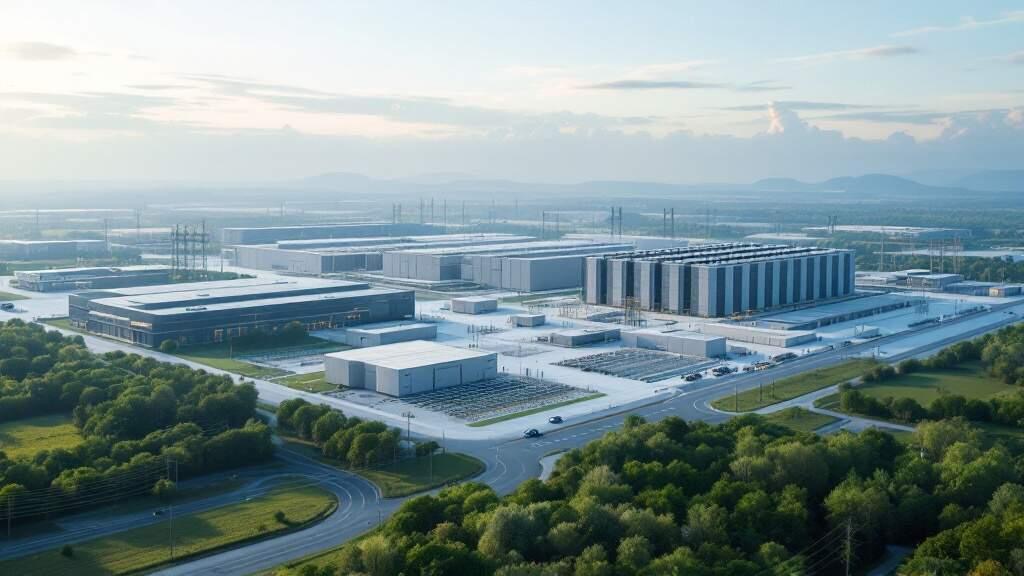
A conceptual rendering provided by OpenAI shows a preliminary vision for the proposed Project Camellia data center campus in Effingham County. Company officials said the design is not final and will continue to evolve as planning moves forward.
Georgia’s approach includes protections intended to prevent those savings from disappearing if a data center uses less electricity than expected or abandons a project. New customers expecting peak demand of at least 100 megawatts can be required to sign customized contracts with financial guarantees, minimum monthly payments, longer terms and early-termination charges. Contracts at or above the threshold must also be submitted to state regulators before execution.
OpenAI has made an additional commitment that could support grid reliability. Project Camellia will provide up to 1,000 megawatts of flexible demand response, allowing Georgia Power to reduce electricity delivered to the campus during periods of high demand or system stress. Because utilities build their systems to meet peak demand, the ability to shed such a large block of load can reduce emergency risks and limit the need for generation that may operate only during a small number of hours each year.
The arrangement is significant because Georgia is planning nearly 10,000 megawatts of new generation, approximately 80 percent of which is expected to serve data centers. Georgia Power carries a financial backstop for certain costs through 2031 if the anticipated large-load contracts do not materialize. Regulators can also suspend projects that have not started, end power-purchase agreements, retire other plants or direct the sale of excess electricity.
Indiana proposes $59 million in rate reductions
Indiana Michigan Power is pursuing a similar result through a different route. The utility has proposed approximately $59 million in bill reductions for Indiana customers in 2027, which it estimates would save a residential customer using 1,000 kilowatt-hours per month about $100 annually.
The plan would also freeze all rates on Indiana residential customers’ monthly bills for three consecutive years. Indiana Michigan Power explicitly attributed the proposal to load growth and increased revenue from large customers, including data centers.
As those customers purchase more electricity, the utility collects more revenue across a larger base. If the additional payments exceed the cost of serving the new demand, more of the system’s fixed costs can be assigned to the large customers and less must be recovered from households.
The Indiana proposal is not yet final. The Indiana Utility Regulatory Commission is expected to decide on the plan in June 2027; if approved on the proposed schedule, the savings would begin appearing on bills next summer.
Large-load protections are becoming more common
The movement extends beyond Georgia and Indiana. In January, utility commissioners and staff from Arkansas, Florida, Iowa, Louisiana, Minnesota, Oregon, Texas, Vermont, Virginia and Washington participated in a National Association of Regulatory Utility Commissioners discussion focused on large-load and data center tariffs.
Some of those states already have approved tariffs. Others are developing their first requirements. Regulators are increasingly considering minimum-demand payments, long-term contracts, exit fees, financial collateral and upfront infrastructure payments to protect customers when proposed data center demand fails to materialize.
Louisiana requires large loads to separately finance the infrastructure associated with their projects. Virginia’s approved tariff includes minimum payment requirements tied to transmission, distribution and generation costs. Minnesota has adopted a policy requiring some large customers to pay 100 percent of distribution line-extension costs upfront.
The issue has also reached the federal level. In June, the Federal Energy Regulatory Commission directed all six regional grid operators under its jurisdiction, including PJM, to justify or reform the rules governing how data centers and other large users connect to the transmission system. FERC identified preventing cost shifts, increasing transparency and creating new transmission services for flexible large loads among the principal areas requiring attention.
These actions show a growing consensus that conventional commercial rates may be inadequate for facilities capable of consuming as much electricity as a city, particularly when utilities must commit billions of dollars before knowing whether every announced project will be built.
New Jersey’s new framework
New Jersey is working to create the conditions that allow large-load growth to benefit customers, like those in Georgia and potentially Indiana. In July, Gov. Mikie Sherrill signed the Data Center Fair Share law, S731/A796, requiring electric utilities to establish a separate tariff for data centers requesting at least 100 megawatts of peak load.
The law states that large data centers must commit to taking at least 85 percent of the electricity they request for a minimum of 10 years. It also directs the New Jersey Board of Public Utilities to ensure that costs attributable to large data centers are assigned to those facilities, not other customers.
The BPU can adjust those requirements when a facility provides sufficient operating flexibility or brings additional energy and capacity onto the grid. This flexibility could allow New Jersey data centers to follow the Project Camellia model by reducing demand before residential customers are affected during periods of grid stress.
This could also become invaluable during severe storms and power outages; by curtailing their load or switching to on-site backup generation, data centers can free up critical capacity and keep residential neighborhoods powered through peak emergency events.
The provision could also encourage developers to finance new generation, battery storage, or other distributed energy resources that add resilient backup capacity to the local grid instead of merely consuming it.
Sherrill signed a second law in August requiring data center owners and operators to submit semiannual reports on their energy and water use. The reports must include total electricity consumption, energy used by information technology equipment and cooling systems, peak daily water use, water sources, and information about on-site and backup generation.
New Jersey’s framework does not guarantee an immediate rate reduction. Utilities must still develop their tariffs, the BPU must review the proposed terms and new generation must come online quickly enough to meet rising demand across the PJM region. The effectiveness of the law will depend on how regulators calculate costs, value flexible demand and enforce long-term financial commitments.
Georgia and Indiana nevertheless offer a clearer picture of what New Jersey is trying to achieve. Data centers can become a source of lower costs and greater reliability, but only when policy determines who pays, who carries the risk and what happens if the projected demand never arrives.
Sources:
Effingham County, Georgia. (2026). Project Camellia (OpenAI data center). https://www.effinghamcounty.org/902/Project-Camellia-OpenAI-Data-Center
Georgia Power. (2026, July 22). Georgia Power to serve OpenAI project in Effingham County. https://www.georgiapower.com/news-hub/press-releases/georgia-power-to-serve-openai-project-in-effingham-county.html
Georgia Public Service Commission. (2026, March). Data center fact sheet. https://psc.ga.gov/site/downloads/datacenterfactsheet.pdf
Indiana Michigan Power. (2026, August 26). Hoosiers expected to see savings as I&M advances one of the nation’s largest rate reduction plans. https://www.indianamichiganpower.com/company/news/view?releaseID=12207
New Jersey Legislature. (2026). Assembly Bill No. 796, fourth reprint. https://pub.njleg.state.nj.us/Bills/2026/A1000/796_R4.PDF
Office of Governor Mikie Sherrill. (2026, August 27). Governor Sherrill delivers all four pillars of data center plan, puts power back in the hands of communities. https://www.nj.gov/governor/news/2026/20260827a.shtml
OpenAI. (2026, July 22). Building AI infrastructure with the Effingham County community. https://openai.com/index/building-ai-infrastructure-with-the-effingham-county-community/


