


Northeast Supply Enhancement pipeline project will begin construction as last minute attempts by environmental opposition is rejected in court.
TLDR
1. The U.S. Court of Appeals for the Second Circuit rejected a challenge to New York’s water quality approval for the Northeast Supply Enhancement natural gas pipeline project.
2. The court found New York environmental regulators acted reasonably in approving the permits in 2025 despite having denied previous applications for the project.
3. The decision removes a significant legal challenge to a major regional energy infrastructure project already moving into construction, though separate legal challenges involving other permits remain.
A federal appeals court has upheld New York’s water quality permits for the Northeast Supply Enhancement pipeline, rejecting a challenge from environmental organizations seeking to overturn the state’s approval of the major regional energy infrastructure project.
The U.S. Court of Appeals for the Second Circuit issued a summary order Aug. 21 dismissing the challenge to permits granted by the New York State Department of Environmental Conservation to Transcontinental Gas Pipe Line Company, commonly known as Transco.
The Northeast Supply Enhancement project, or NESE, is an expansion of Williams’ existing Transco natural gas pipeline system through Pennsylvania, New Jersey and New York. The project is designed to increase natural gas capacity into New York City and Long Island.
Environmental organizations challenged New York’s decision to issue a Clean Water Act Section 401 Water Quality Certification and related permits in November 2025.
The challenge focused in part on DEC’s decision to approve the project after the agency had rejected previous permit applications in earlier years.
The appeals court, however, found that DEC acted reasonably when evaluating the latest application and rejected arguments that the agency’s change in position made its approval arbitrary or capricious.
The ruling leaves New York’s water quality certification in place.
“DEC subjects applications for environmental permits to a transparent and rigorous review process to protect public health and the environment,” DEC spokesperson Dana Ferine said following the ruling.
The agency said it will continue monitoring construction and compliance with permit requirements to protect New York waterways.
A project revived after years of permitting disputes
NESE has had a lengthy regulatory history in both New York and New Jersey.
The project appeared unlikely to move forward after environmental regulators denied earlier permit applications. Transco later returned with new applications, and the project ultimately received key state approvals in 2025.
New York DEC approved the latest application in November 2025 following another environmental review and public comment process.
The New York portion includes approximately 17.4 miles of a new 26-inch-diameter pipeline in state waters. The pipeline would connect to the existing Rockaway Delivery Lateral in Queens and provide additional natural gas capacity for National Grid customers in Brooklyn, Queens and Long Island.
The broader NESE project is expected to add approximately 400,000 dekatherms per day of capacity to the Transco system.
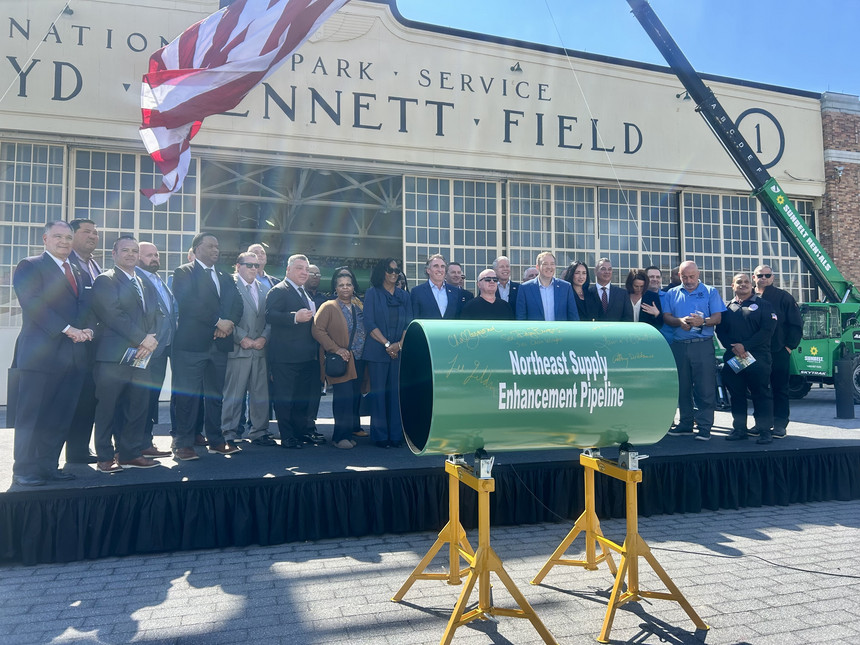
Federal regulators have also approved the project, and construction activities are underway.
The court decision is significant for a project that has faced years of regulatory and legal uncertainty. While the ruling does not resolve every legal challenge involving NESE, it removes an effort to overturn one of the major state approvals required for construction.
Balancing environmental review with delivering critical infrastructure
Environmental organizations opposing NESE have argued that construction could damage waterways and sensitive marine habitat while expanding the region’s reliance on natural gas.
Those concerns played a significant role in earlier permit denials and remained central to the groups’ challenge of the 2025 approval.
DEC has maintained that its latest decision followed a project-specific review under state and federal environmental requirements. The agency’s approval includes conditions governing construction and environmental protection, which regulators say they will monitor as work proceeds.
The dispute highlights a broader challenge facing major infrastructure projects throughout the Northeast: balancing environmental review and permitting requirements with the need to provide certainty once projects have completed those processes.
For contractors and construction workers, prolonged permitting and litigation can also have practical consequences. Major infrastructure projects require significant advance planning for workforce, equipment, scheduling and construction seasons, meaning uncertainty over whether work can proceed can extend beyond the project developer itself.
NESE is also moving forward as New York and New Jersey confront broader questions over energy reliability, affordability and future demand.
The Second Circuit ruling does not settle those larger debates. But on one key question — whether New York acted reasonably when it issued its latest water quality approval — the federal appeals court sided with the state.
For now, New York’s permits remain in place and construction on the Northeast Supply Enhancement project can continue.
Sources:
E&E News by POLITICO. (2026, August 24). Appeals court tosses case challenging New York permits for NESE pipeline.
New York State Department of Environmental Conservation. (2025, November 7). DEC statement on water quality certification for proposed Northeast Supply Enhancement Pipeline Project.
New York State Department of Environmental Conservation. (2025). Responsiveness summary: Northeast Supply Enhancement (NESE) Pipeline Project.
U.S. Department of Energy. (2026, April 14). Wright, Zeldin, and Burgum break ground on NESE Pipeline in New York City to deliver reliable, affordable natural gas to the Northeast.