



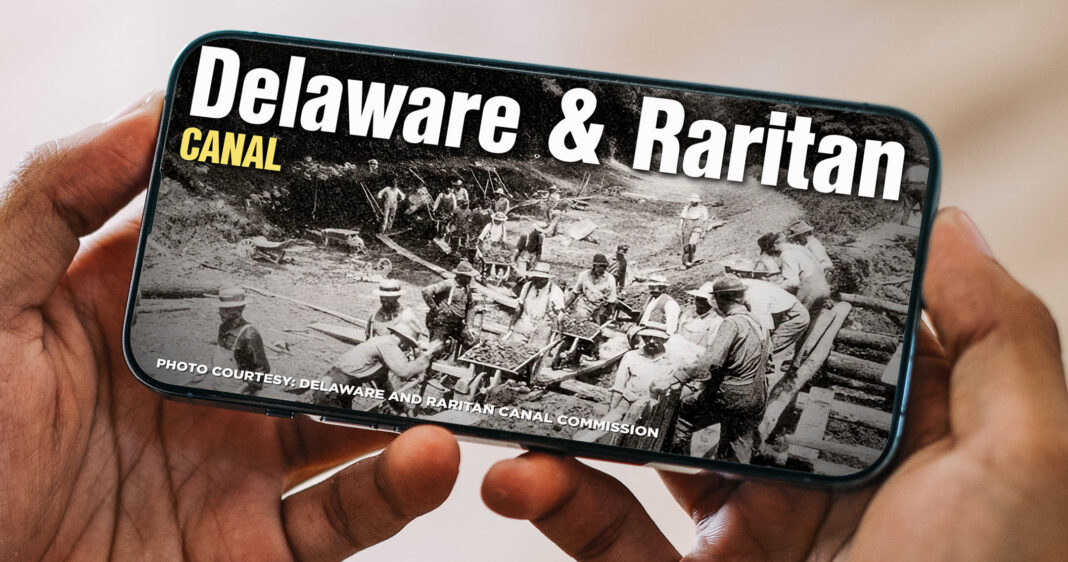
When we think about New Jersey infrastructure, we usually picture highways, rail lines, ports and pipelines. But long before route one or the Northeast Corridor Railroad, there was another transportation spine running quietly through the heart of the state. It was hand dug. It reshaped cities, and it still matters today. This is the story of the Delaware and Raritan Canal.
Transcript
1
00:00:00,417 –> 00:00:03,753
When we think about New Jersey infrastructure, we usually picture
2
00:00:03,753 –> 00:00:06,756
highways, rail lines, ports and pipelines.
3
00:00:06,923 –> 00:00:10,343
But long before route one or the Northeast Corridor Railroad,
4
00:00:10,593 –> 00:00:12,262
there was another transportation
5
00:00:12,262 –> 00:00:15,223
spine running quietly through the heart of the state.
6
00:00:15,265 –> 00:00:16,599
It was hand dug.
7
00:00:16,599 –> 00:00:20,020
It reshaped cities, and it still matters today.
8
00:00:20,437 –> 00:00:23,690
This is the story of the Delaware and Raritan Canal.
9
00:00:24,607 –> 00:00:26,609
The idea of cutting a canal across
10
00:00:26,609 –> 00:00:29,612
New Jersey is older than the United States itself.
11
00:00:29,696 –> 00:00:35,201
In 1676, William Penn, founder of Pennsylvania, proposed creating
12
00:00:35,201 –> 00:00:39,289
a water route across what he called the narrow waist of New Jersey.
13
00:00:39,873 –> 00:00:44,419
His goal was ambitious a protected inland passage connecting Philadelphia
14
00:00:44,419 –> 00:00:47,964
to New York Harbor, avoiding the dangerous Atlantic route.
15
00:00:48,423 –> 00:00:51,134
Penn even ordered a survey to see if it was possible
16
00:00:51,134 –> 00:00:54,220
to cut away across the country to Sandy Hook.
17
00:00:54,637 –> 00:00:59,434
No record survives that the survey ever happened, but the idea never disappeared.
18
00:00:59,976 –> 00:01:03,480
For the next hundred years, the concept slipped quietly
19
00:01:03,480 –> 00:01:07,567
while colonies grew, fought a revolution, and became a nation.
20
00:01:08,151 –> 00:01:11,654
But by the early 1800s, America turned its attention
21
00:01:11,654 –> 00:01:16,493
to internal improvements, and New Jersey found itself at the center of everything.
22
00:01:17,327 –> 00:01:20,622
By the 1820s, enthusiasm for a canal linking
23
00:01:20,622 –> 00:01:23,625
New York and Philadelphia reached a fever pitch.
24
00:01:24,000 –> 00:01:27,003
But there was a problem. Railroads.
25
00:01:27,295 –> 00:01:31,758
New Jersey lawmakers were split between canal supporters and railroad advocates.
26
00:01:32,175 –> 00:01:35,804
Each side was powerful, and each side blocked the other.
27
00:01:36,262 –> 00:01:40,517
The stalemate ended in 1830 with a uniquely New Jersey compromise.
28
00:01:41,142 –> 00:01:44,354
The legislature chartered both and then merged them,
29
00:01:44,521 –> 00:01:48,525
creating a canal rail partnership known as the Joint Companies.
30
00:01:48,983 –> 00:01:53,696
The Delaware and Raritan Canal Company and the Camden and Amboy Railroad.
31
00:01:54,030 –> 00:01:57,033
Construction on both began the same year.
32
00:01:57,117 –> 00:02:02,038
By 1833, the railroad was running from Bordentown to South Amboy.
33
00:02:02,539 –> 00:02:05,875
Parts of the canal opened at the same time, but the full canal
34
00:02:05,875 –> 00:02:08,878
wouldn’t be completed until 1834.
35
00:02:09,504 –> 00:02:13,508
On June 25th, 1834, the canal officially opened.
36
00:02:13,967 –> 00:02:17,512
Governor Peter Dumont’s room boarded a ceremonial barge
37
00:02:17,512 –> 00:02:19,848
for a two day journey across the state.
38
00:02:19,848 –> 00:02:22,851
At every lock and bridge, crowds cheered.
39
00:02:23,393 –> 00:02:26,354
In New Brunswick, he was greeted with a 24 gun
40
00:02:26,354 –> 00:02:29,357
salute and a brass band parade through the city.
41
00:02:29,691 –> 00:02:33,903
The canal itself formed a giant meandering “Y” across new Jersey,
42
00:02:34,487 –> 00:02:37,490
44 miles from Bordentown to New Brunswick,
43
00:02:38,074 –> 00:02:41,411
a 22 mile feeder canal from Raven Rock to Trenton.
44
00:02:42,078 –> 00:02:45,039
The engineering was remarkably sophisticated.
45
00:02:45,039 –> 00:02:48,209
The feeder canal was six feet deep and 50ft wide.
46
00:02:48,710 –> 00:02:50,753
The main canal was seven feet deep.
47
00:02:50,753 –> 00:02:54,090
Later expanded to eight and 75ft wide.
48
00:02:54,591 –> 00:02:57,552
Seven locks lifted boats up to Trenton.
49
00:02:57,552 –> 00:03:01,264
Seven more brought them back down to sea level at the Raritan River.
50
00:03:01,931 –> 00:03:04,934
Stone riprap lined the banks to prevent erosion.
51
00:03:05,393 –> 00:03:09,689
Swing bridges pivoted sideways so vessels of any mast height could pass.
52
00:03:10,106 –> 00:03:15,195
By 1868, even the locks were powered by steam, and once built,
53
00:03:15,361 –> 00:03:18,740
the canal barely needed modification for the next century.
54
00:03:19,616 –> 00:03:22,368
But this achievement came at a price.
55
00:03:22,368 –> 00:03:26,206
Most of the canal was dug by hand by Irish immigrant laborers.
56
00:03:26,748 –> 00:03:30,210
In 1832, cholera swept through the work camps.
57
00:03:30,543 –> 00:03:33,546
Dozens, possibly hundreds, died.
58
00:03:33,630 –> 00:03:36,049
They were buried in unmarked mass graves
59
00:03:36,049 –> 00:03:39,886
at Bull’s Island, Ten Mile Run and Griggstown.
60
00:03:40,929 –> 00:03:43,806
In 2003, a granite monument
61
00:03:43,806 –> 00:03:47,602
cut from a former canal lock was dedicated to their memory.
62
00:03:48,228 –> 00:03:51,648
It stands today as a reminder that infrastructure is built
63
00:03:51,814 –> 00:03:55,652
not just with money and materials, but with human lives.
64
00:03:57,153 –> 00:03:59,822
A canal journey from Bordentown to New Brunswick
65
00:03:59,822 –> 00:04:02,909
took nearly two days, but that was revolutionary.
66
00:04:03,451 –> 00:04:06,079
Before the canal, shipping goods from Philadelphia
67
00:04:06,079 –> 00:04:09,082
to New York by sea could take two weeks.
68
00:04:09,165 –> 00:04:12,168
The canal transformed cities at its ends.
69
00:04:12,418 –> 00:04:15,004
Trenton’s population quadrupled.
70
00:04:15,004 –> 00:04:19,300
Ironworks, ceramic factories and manufacturers surged in.
71
00:04:19,968 –> 00:04:23,930
But the canal’s greatest beneficiaries were New York and Pennsylvania.
72
00:04:24,514 –> 00:04:28,101
Pennsylvania anthracite coal destined for New York’s
73
00:04:28,101 –> 00:04:31,354
furnaces and homes became the canal’s lifeblood.
74
00:04:31,688 –> 00:04:35,525
At its peak in 1871, nearly 3 million
75
00:04:35,525 –> 00:04:39,696
tons of freight passed through the canal, more than the Erie Canal carried
76
00:04:39,696 –> 00:04:41,447
That same year.
77
00:04:41,447 –> 00:04:45,618
And it wasn’t just canal boats, sailboats, steam tugs, yachts,
78
00:04:45,952 –> 00:04:49,038
and even naval vessels passed through this narrow waterway.
79
00:04:49,956 –> 00:04:52,041
Ironically, the canal’s decline
80
00:04:52,041 –> 00:04:55,461
began with its own partner in 1871.
81
00:04:55,545 –> 00:04:59,299
The Pennsylvania Railroad leased the canal and its rail connection
82
00:04:59,549 –> 00:05:02,552
for 999 years.
83
00:05:02,552 –> 00:05:05,888
From that moment on, canal traffic steadily fell.
84
00:05:06,514 –> 00:05:08,141
Railroads were faster.
85
00:05:08,141 –> 00:05:09,559
They ran day and night.
86
00:05:09,559 –> 00:05:11,561
They didn’t freeze in the winter.
87
00:05:11,561 –> 00:05:16,733
By 1893, the canal was operating at a loss and never recovered.
88
00:05:17,233 –> 00:05:20,653
Some historians believe the railroad intentionally starved
89
00:05:20,653 –> 00:05:24,574
the canal of maintenance while favoring rail shipments with lower rates.
90
00:05:25,158 –> 00:05:28,411
In 1933, the canal closed for the winter.
91
00:05:28,828 –> 00:05:30,580
It never reopened.
92
00:05:30,580 –> 00:05:34,250
Four years later, ownership reverted to the state of New Jersey.
93
00:05:35,585 –> 00:05:37,920
Yet the canal wasn’t finished.
94
00:05:37,920 –> 00:05:40,923
As industry spread out in the 1930s and 40s.
95
00:05:41,090 –> 00:05:45,261
They needed water and the canal could provide it cheaper than wells.
96
00:05:45,762 –> 00:05:49,390
So the canal reinvented itself, not as a transportation
97
00:05:49,390 –> 00:05:52,393
corridor, but as a water supply system.
98
00:05:52,602 –> 00:05:56,773
Parts were filled in, including a section in Trenton that became route one.
99
00:05:57,357 –> 00:06:00,360
Other sections were modernized with concrete structures,
100
00:06:00,401 –> 00:06:03,404
steel gates, and improved flow systems.
101
00:06:03,404 –> 00:06:08,576
In 1973, the canal was listed on the National Register of Historic Places.
102
00:06:09,035 –> 00:06:12,622
One year later, Citizen Advocacy helped create the Delaware
103
00:06:12,622 –> 00:06:15,625
and Raritan Canal State Park.
104
00:06:15,792 –> 00:06:19,295
Today, more than a million people visit the canal each year.
105
00:06:19,754 –> 00:06:23,091
It’s a recreational corridor, a conservation link,
106
00:06:23,591 –> 00:06:28,554
a historic landmark, and it still supplies water to industry.
107
00:06:28,596 –> 00:06:30,056
Agriculture and drinking
108
00:06:30,056 –> 00:06:33,810
water systems serving nearly 1 million New Jersey residents.
109
00:06:34,477 –> 00:06:37,480
This canal helped build city’s power industry
110
00:06:37,647 –> 00:06:40,149
and shaped the economy of an entire region.
111
00:06:41,150 –> 00:06:43,820
The Delaware and Raritan Canal reminds us
112
00:06:43,820 –> 00:06:47,782
that infrastructure doesn’t disappear when its original purpose ends.
113
00:06:48,157 –> 00:06:51,619
When we preserve it, adapt it, and understand its history.
114
00:06:51,828 –> 00:06:55,748
It continues to serve us in ways its builders could never have imagined.
115
00:06:56,249 –> 00:06:59,669
And that’s why our infrastructure matters.