
Our Infrastructure Matters Ad
Home Blog Page 4

The 10 largest colleges in New Jersey

New Jersey’s largest colleges educate tens of thousands of students across campuses that range from sprawling public research universities to community colleges and primarily online institutions. Together, they support the state’s workforce, research economy and communities while offering students markedly different paths to a degree.

How the rankings were determined

This list ranks New Jersey colleges by reported student enrollment for the 2023–2024 academic year, or the most recent year available. Each entry also highlights the institution’s campus, programs and published tuition to show how size translates into educational reach across the state.

10. Brookdale Community College

“The Donald D. Warner Student Life Center at Brookdale Community College, Lincroft, New Jersey,” photo by Zeete, licensed under CC-BY-SA 4.0.

Type: Public community college

Enrollment: 9,921

Campus: Brookdale’s 220-acre main campus is in Lincroft, near the Jersey Shore.

Other locations: Higher Education Centers in Freehold, Long Branch, Neptune and at Fort Monmouth in Wall extend Brookdale’s reach across Monmouth County. A partnership with Rutgers University also brings bachelor’s degree programs to the Lincroft and Freehold campuses.

Programs: Brookdale’s offerings include culinary arts, jewelry design and automotive technology. Culinary students gain hands-on experience through an on-campus restaurant.

Tuition: In-county tuition is about $5,100 per year. Out-of-county students generally pay about twice that amount, although regional rates may apply in neighboring counties.

Notable fact: Bruce Springsteen’s band performed at Brookdale’s “Nothing’s Festival” in 1971. Springsteen later took a photography course at the college.

9. Seton Hall University 

Photo: Google Earth

Type: Private Catholic university

Enrollment: 9,529

Campus: Seton Hall’s 58-acre main campus in South Orange combines Collegiate Gothic buildings with a suburban setting.

Other locations: Seton Hall Law is based in Newark, while the Interprofessional Health Sciences campus in Nutley houses the College of Nursing and School of Health and Medical Sciences.

Programs: The School of Diplomacy and International Relations gives students access to diplomats, policymakers and global leaders. The university is also known for law, nursing and health sciences.

Tuition: Published tuition is about $50,000 per year, although the university reports that more than 98 percent of students receive grants or scholarships. Merit awards can substantially reduce the advertised price for qualifying students.

Notable fact: Seton Hall competes in NCAA Division I and is best known nationally for its men’s basketball program.

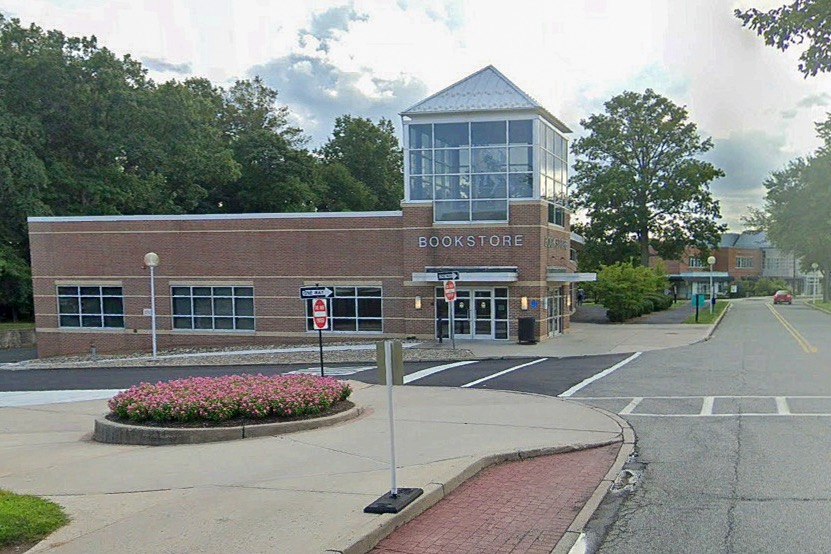
8. Middlesex College (formerly Middlesex County College)
Type: Public community college

Enrollment: 11,471

Campus: Middlesex College’s main campus covers more than 200 acres in Edison.

Other locations: Centers in New Brunswick and Perth Amboy offer evening and weekend classes, expanding access beyond the main campus.

Programs: Middlesex offers career-focused and transfer programs, including a nursing program whose 2023 graduates achieved a 100 percent first-time pass rate on the NCLEX-RN. In 2020, the institution dropped “County” from its name as part of a broader repositioning effort.

Tuition: In-county tuition is about $4,800 per year. Out-of-county residents generally pay about twice the per-credit rate.

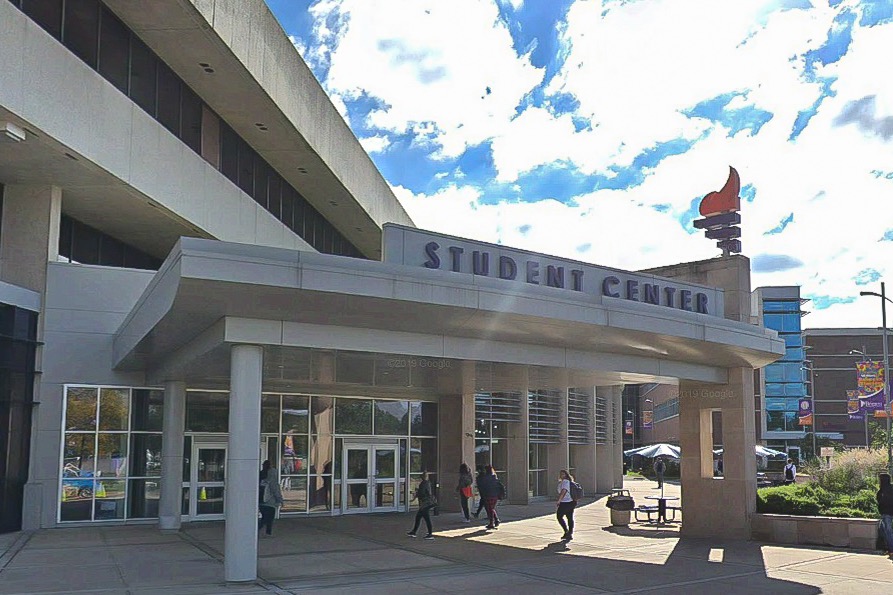
7. Bergen Community College
Type: Public community college

Enrollment: 11,803

Campus: Bergen Community College’s 167-acre main campus is in Paramus.

Other locations: The Meadowlands campus in Lyndhurst and the Ciarco Learning Center in Hackensack expand access across Bergen County. The Hackensack center focuses on adult education and English-language learning.

Programs: Bergen offers associate degrees and certificates in health professions, technology, computer science and culinary arts. Many students use those programs as a path to employment or transfer to a four-year university.

Tuition: In-county tuition is about $5,300 per year. Out-of-county students generally pay about twice that amount.

Notable fact: Bergen is among New Jersey’s largest community colleges, giving it an important role in the state’s transfer and workforce-development systems.

6. New Jersey Institute of Technology (NJIT)
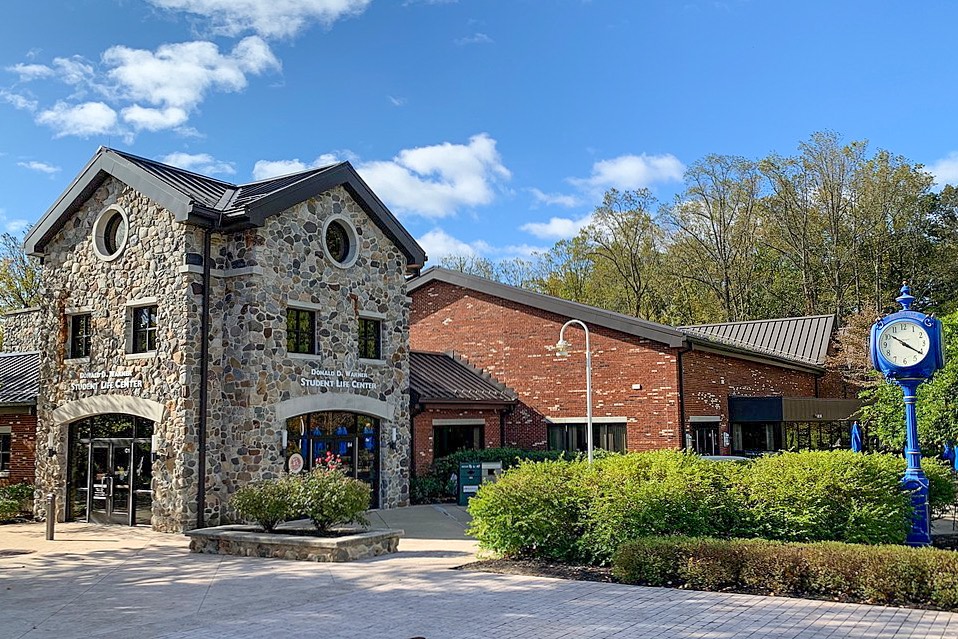
“NJIT Eberhardt Hall, Newark, New Jersey” by Andrew nyr, licensed under CC BY-SA 4.0.

Type: Public polytechnic research university

Enrollment: 12,332

Campus: NJIT’s 45-acre campus is in Newark’s University Heights district, near Rutgers–Newark and Essex County College.

Other locations: NJIT operates a graduate site in Jersey City, offers programs through partnerships in Camden and maintains a substantial online presence.

Programs: NJIT specializes in science, technology, engineering and mathematics. Its offerings also include architecture, computing and video game design.

Tuition: Annual tuition is about $21,162 for New Jersey residents and $39,912 for out-of-state students.

Notable fact: Enrollment has grown by nearly 20 percent over the past decade, reflecting rising demand for technology-focused education.

5. Thomas Edison State University (TESU)
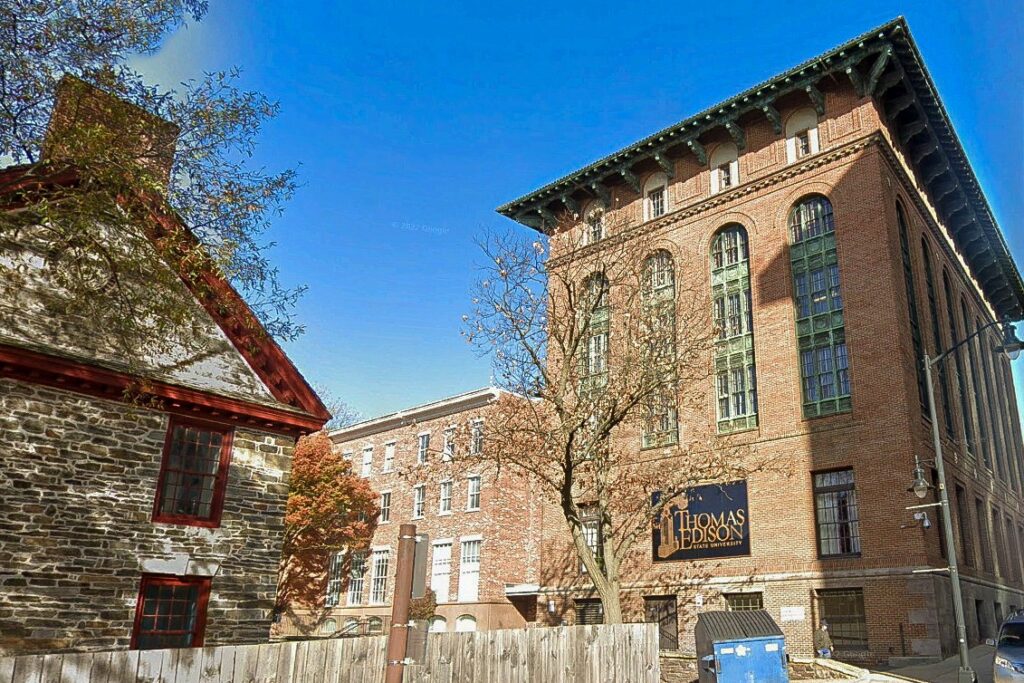
Type: Public university focused on online and adult education

Enrollment: 12,829

Campus: Thomas Edison State University operates primarily online rather than through a traditional residential campus. Four historic buildings in Trenton’s Capital District serve mainly as administrative facilities.

Programs: TESU is New Jersey’s statewide institution for adult learners, with programs built around flexible degree completion. Students may earn credit for professional training, standardized exams and demonstrated prior learning, making the university an important option for working adults.

Tuition: New Jersey residents pay $399 per credit or $7,926 annually for full-time study, while out-of-state tuition is $519 per credit. Active-duty military students pay $250 per credit.

Notable fact: TESU has built a national profile for serving military and veteran students. Its prior-learning policies can translate eligible military training into college credit.

4. Kean University
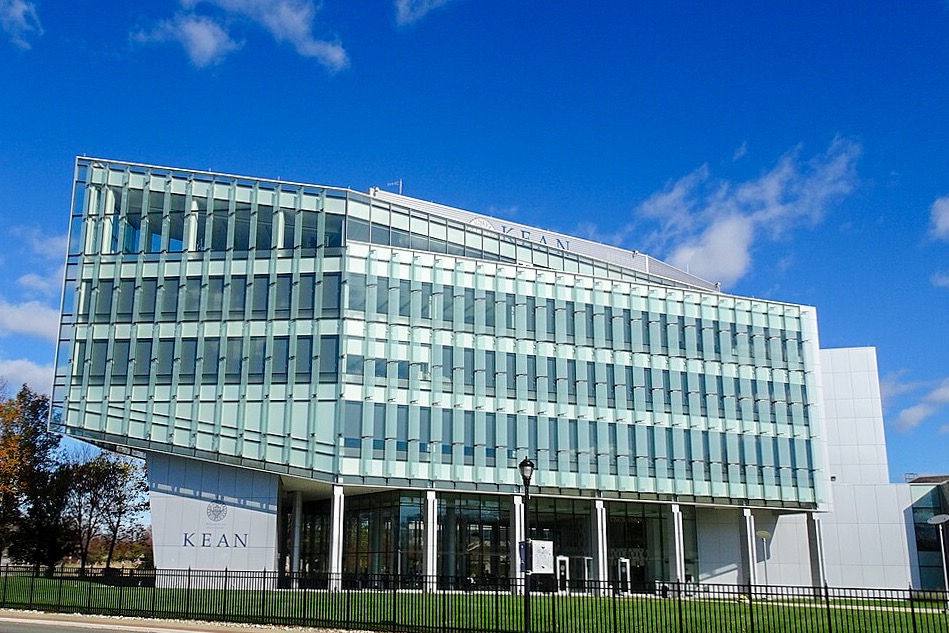
“STEM Building, Kean University” by Zeete, licensed under Creative Commons Attribution-ShareAlike 4.0 International (CC BY-SA 4.0). 

Type: Public university

Enrollment: 15,023

Campus: Kean’s main campus covers 121.5 acres in Union Township and Hillside.

Other locations: Wenzhou-Kean University in China is a full branch campus that enrolled roughly 4,500 students in 2023. Kean also offers degree programs at Kean Ocean in Toms River and operates the 40-acre Kean Skylands environmental campus in Jefferson.

Programs: Kean is one of the few public universities in the United States with a full campus abroad. Courses at Wenzhou-Kean are taught in English, and eligible students from New Jersey can study there without paying additional tuition.

Tuition: Annual tuition is about $12,972 for New Jersey residents and $20,364 for out-of-state students.

Notable fact: Kean’s main campus occupies part of the former estate of William Livingston, New Jersey’s first governor.

3. Rowan University
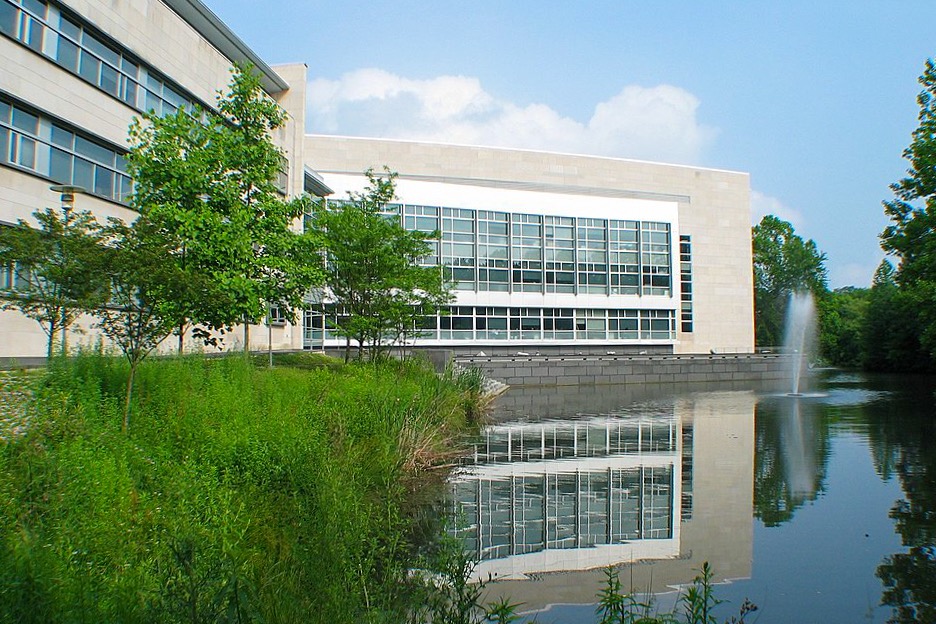
“Rowan Hall West2.JPG” by Drhamso, licensed under Creative Commons Attribution 2.5 Generic (CC BY 2.5). 

Type: Public research university

Enrollment: 22,903

Campus: Rowan’s main campus covers about 800 acres in Glassboro. Expansion west of Route 55 supports research, athletics and the university’s Technology Park.

Other locations: Rowan operates extension programs and Cooper Medical School in Camden, while the Rowan-Virtua School of Osteopathic Medicine is based in Stratford.

Programs: Rowan has expanded from its teacher-training roots into a comprehensive research university. Its engineering and medical programs are central to that growth and to the institution’s role in South Jersey’s economy.

Tuition: Annual tuition is about $12,300 for New Jersey residents and $23,200 for out-of-state students.

Notable fact: Rowan’s Glassboro campus hosted the 1967 Hollybush Summit between President Lyndon B. Johnson and Soviet Premier Alexei Kosygin.

2. Montclair State University
Type: Public research university

Enrollment: About 22,570

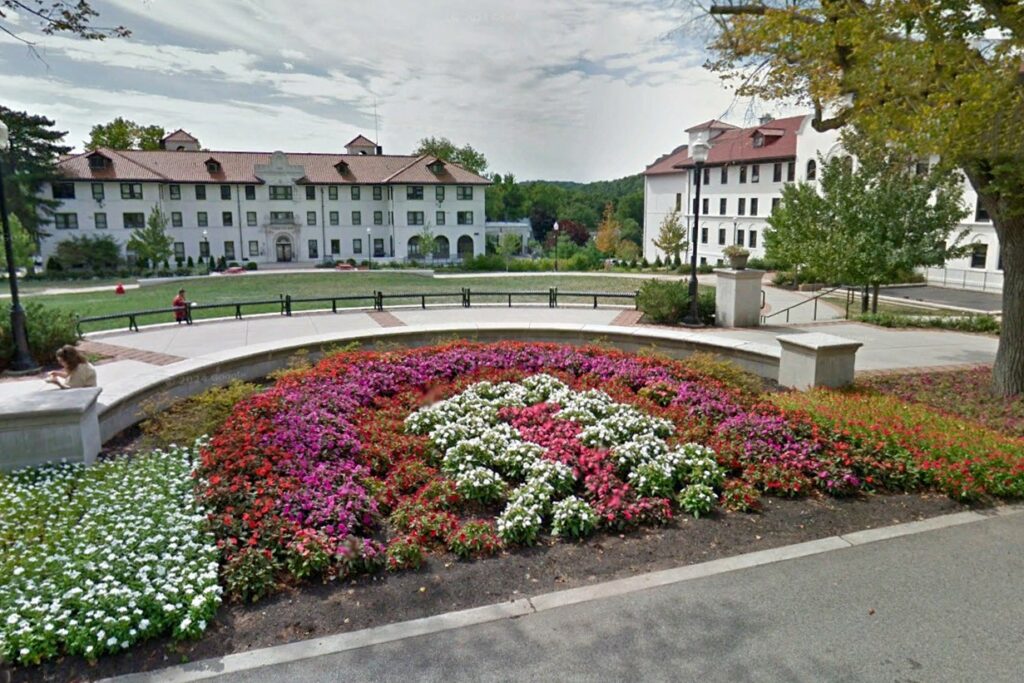
Campus: Montclair State’s 486-acre main campus spans Montclair, Little Falls and Clifton. The John J. Cali School of Music also operates an instructional site in Newark near the New Jersey Performing Arts Center.

Programs: Montclair State began as a teachers college and remains known for education, arts and communication programs. In 1927, it became the first U.S. college to offer a four-year teaching degree.

Tuition: Annual tuition is about $13,000 for New Jersey residents and $21,000 for out-of-state students, although costs vary by program.

Notable fact: Two NJ Transit stations, Montclair Heights and Montclair State University, connect the campus to the regional rail network and support its large commuter population.

1. Rutgers University
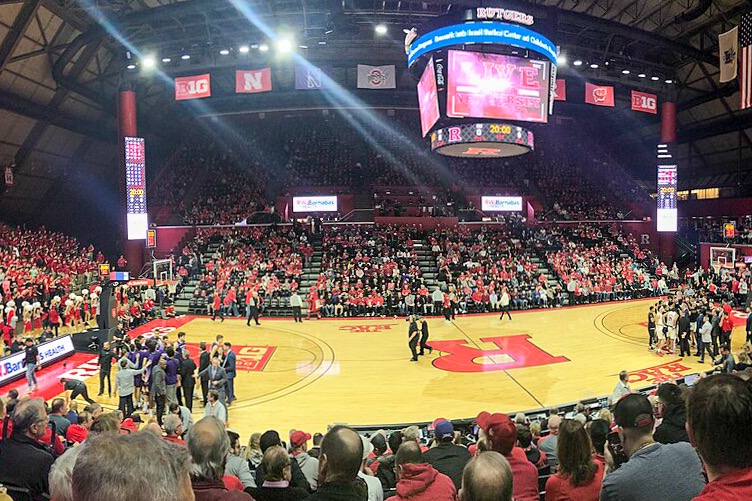
“Rutgers Athletic Center (Northwestern vs. Rutgers – February 9, 2020).jpg” by GATORFAN2525, licensed under Creative Commons Attribution-ShareAlike 4.0 International (CC BY-SA 4.0).

Type: Public research university

Enrollment: About 69,000

Campus: Rutgers’ flagship New Brunswick–Piscataway campus covers 2,685 acres across several subcampuses connected by an internal bus network.

Other locations: Rutgers also operates major campuses in Newark and Camden, giving the state university a presence across North, Central and South Jersey.

Programs: Rutgers offers more than 100 undergraduate majors and a broad range of graduate and professional programs. Its research enterprise and programs in fields including pharmacy and philosophy contribute to the university’s national profile.

Tuition: Annual tuition is about $14,900 for New Jersey residents and $35,700 for out-of-state students.

Notable fact: Rutgers hosted Princeton in the first intercollegiate football game in 1869. The event helped establish the university’s claim as the birthplace of college football.

At a glance

RankInstitutionTypeEnrollmentMain campusTuition (in-state / out-of-state)
10Brookdale Community CollegePublic community college9,921Lincroft (Monmouth County)~$5,100 / ~$10,200
9Seton Hall UniversityPrivate Catholic university9,529South Orange (Essex County)~$50,000 
8Middlesex CollegePublic community college11,471Edison (Middlesex County)~$4,800 / ~$9,600
7Bergen Community CollegePublic community college11,803Paramus (Bergen County)~$5,300 / ~$10,600
6New Jersey Institute of Technology (NJIT)Public polytechnic (R1)12,332Newark (Essex County)~$21,162 / ~$39,912
5Thomas Edison State University (TESU)Public university (adult/online)12,829Trenton (Mercer County)~$399 per credit ($7,926 flat) / ~$519 per credit
4Kean UniversityPublic university15,023Union & Hillside (Union County)~$12,972 / ~$20,364
3Rowan UniversityPublic research university22,903Glassboro (Gloucester County)~$12,300 / ~$23,200
2Montclair State UniversityPublic research university22,570Montclair, Little Falls & Clifton (Essex/Passaic Counties)~$13,000 / ~$21,000
1Rutgers UniversityPublic research university (AAU)69,000New Brunswick & Piscataway (Middlesex County)~$14,900 / ~$35,700

Sherrill’s first 6 months: energy scorecard

0

How has Sherrill managed skyrocketing energy costs and demand?

When Governor Mikie Sherrill took office in January 2026, she inherited an energy landscape defined by rising electricity costs, stalled offshore‑wind development, aging natural‑gas infrastructure, and intensifying pressure from data‑center growth. In her first six months, Sherrill has moved to reshape New Jersey’s energy strategy around affordability, reliability, and a broad “all‑of‑the‑above” portfolio that includes nuclear, solar, storage, and modernized grid infrastructure. Her early actions represent one of the most aggressive energy pivots in recent New Jersey history.

A day‑one rate hike freeze

Sherrill’s first major energy action came within hours of taking office. Through Executive Orders 1 and 2, Sherrill froze pending electric rate increases and directed state agencies to accelerate new power generation. The freeze was framed as an emergency measure to protect households and small businesses from rising electricity costs driven by PJM capacity prices, natural‑gas volatility, and utility capital spending. The freeze set the tone for her administration: energy policy would be evaluated first through the lens of affordability. It also signaled a shift away from the Murphy administration’s offshore‑wind‑first strategy toward a more diversified approach.

Critics argue that the Day‑One rate freeze only locks in the cost of wholesale electricity, leaving delivery charges and long‑term system costs untouched, and that the freeze could delay essential grid‑modernization work by preventing utilities from recovering needed investment. And because it doesn’t address New Jersey’s underlying energy shortfall, the freeze risks masking deeper supply‑capacity problems rather than solving them.

Three major affordability laws

Within her first six months, Governor Sherrill signed three major energy affordability laws aimed at saving New Jersey ratepayers over $1 billion annually. The ROE adder repeal (S1673/A2757) removes utility bonus incentives, directing investment toward grid modernization rather than legacy infrastructure. Meanwhile, the Advanced Grid Technologies Act (S4411/A5188) tightens utility spending oversight and accelerates deployment of modern automation and monitoring tools essential for integrating solar, storage, and nuclear power. Lastly, the Data Center Fair Share Act (S731/A796) ensures surging data centers pay their true energy and infrastructure costs, preventing unfair cost shifts onto local households and small businesses.

While politically popular, some noted that this trio of bills would have the unintended consequences of slowing down investment in substations and critical grid infrastructure, delaying approval of grid modernization projects, and discouraging large-scale digital infrastructure investment.  

Direct bill credits for residents

Sherrill paired structural reforms with immediate relief. Her administration delivered:

  • $25 Residential Universal Bill Credit (RUBC) for all 3.6 million ratepayers
  • $150 REAP credit for low‑ and moderate‑income households

These credits were designed to offset winter and early‑spring energy costs while longer‑term reforms take effect.

Solar: The first new generation to come online

The only new generation that has officially come online during Sherrill’s first six months is solar. The Board of Public Utilities announced that 12 Murphy-era solar projects, a mix of community solar, commercial rooftop installations, and distributed solar arrays, were energized statewide. Together, they produce enough electricity to power approximately 45,000 homes.

Nuclear: A central pillar of reliability

One of the most notable shifts under Governor Mikie Sherrill is her explicit embrace of nuclear energy as a core component of New Jersey’s future energy mix. While Governor Phil Murphy focused on offshore wind, Sherrill has positioned nuclear as essential for reliability, affordability, and carbon-free baseload power.

Backed by landmark 2026 legislation – specifically S3870, which removed legacy CAFRA permitting roadblocks for nuclear sites, and A4881 / the Power NJ Act, which established an advanced nuclear procurement and Reliable Capacity Certificate framework – the Sherrill administration has:

  • Directed the BPU to evaluate next-generation reactors and small modular reactors (SMRs)
  • Reaffirmed support for the continued operation of Salem and Hope Creek
  • Integrated nuclear into PJM reliability modeling discussions
  • Established the regulatory and market pathways for future advanced nuclear procurement

While no new reactors have begun construction, the Sherrill administration and Legislature have formally dismantled New Jersey’s decades-long nuclear moratorium and established the statutory machinery for expansion.

Battery storage: Safety first, expansion later

Sherrill’s approach to battery energy storage systems (BESS) has been cautious but forward‑looking. With lithium‑ion fires drawing national attention, she launched New Jersey’s first statewide BESS safety and siting review. Her directives require:

  • Thermal‑runaway prevention standards
  • Emergency‑response coordination with local fire departments
  • Environmental‑impact disclosures
  • Mandatory incident reporting
  • A full audit of existing and proposed BESS sites

Sherrill supports storage as essential for solar integration and peak‑shaving, but she has made clear that safety and transparency must come first. Her administration has also expressed interest in long‑duration storage technologies such as iron‑air and flow batteries.

Natural gas: No new expansion, but no rapid phase‑out

Sherrill’s stance on natural gas is pragmatic. She has not proposed bans or shutdowns. And while natural gas is currently responsible for nearly half of the state’s electricity generation, Sherrill has not committed to new gas pipelines or new gas‑fired power plants.

Her administration has:

  • Ordered a review of the existing gas‑generation fleet
  • Tightened oversight of methane‑leak detection and pipeline safety
  • Increased environmental‑justice scrutiny of gas peaker plants
  • Froze rate hikes tied partly to gas‑price volatility

Storm resiliency: A strong bulk grid, weak distribution links

During several severe winter and spring storms, New Jersey’s bulk power grid performed well. PJM reported no statewide reliability emergencies, and nuclear and natural‑gas plants maintained stable baseload output during periods of low solar generation. Outages that did occur were almost entirely distribution‑level—caused by downed wires, flooded substations, and damaged transformers. Sherrill’s grid‑modernization agenda, including advanced monitoring and automation, helped utilities isolate faults more quickly. The storms highlighted a key vulnerability: while the transmission system remains strong, aging distribution infrastructure continues to be the primary source of outages.

Public reaction: appreciation, confusion, and frustration

Public reaction to Sherrill’s energy agenda has been mixed. Many residents welcomed the rate freeze and bill credits, but frustration remains high because overall bills have not fallen. Most households do not distinguish between state‑controlled utility rates and federally regulated PJM wholesale costs, leading to confusion about why bills continue rising. Small businesses, facing steep capacity‑driven increases, have been especially vocal. Environmental groups are split—some praise her nuclear openness and grid modernization, while others argue she is too cautious on offshore wind and electrification. Ratepayer advocates generally support her affordability measures but emphasize that PJM’s market conditions remain the dominant driver of high bills.

Impact on New Jersey rates: High prices for years to come

The most recent PJM capacity auction, released in July 2026, underscored the challenges facing New Jersey and the broader region. The auction cleared at $325/MW‑day, the maximum allowed under PJM’s temporary price collar. It also failed to meet PJM’s reliability requirement, falling short by 6.8 GW—the second consecutive year PJM has missed its one‑in‑ten reliability standard. New generation remains insufficient, with only a few hundred megawatts of new capacity clearing despite rapidly rising load driven by data‑center growth. The results confirm that PJM is entering a multi‑year period of tight supply and elevated costs.

Even with Sherrill’s freeze on utility‑proposed rate increases, PJM‑driven wholesale costs will continue to push New Jersey electricity prices higher. Capacity charges alone are expected to add 2–4 cents per kWh to commercial bills and 1.5–5% to residential bills. For many businesses, total supply costs may rise 18–25%. These increases are structural, not temporary: until PJM brings significant new generation online or curbs explosive load growth, New Jersey ratepayers will face sustained upward pressure. Sherrill’s affordability laws soften the impact, but they cannot override wholesale market dynamics.

Household energy spending: among the highest in the country

New Jersey households spend more on energy than most of the country. The average household pays:

  • $150–$175/month for electricity
  • $900–$1,200/year for natural gas
  • $2,000–$2,800/year for gasoline
  • $1,800–$4,000/year for heating oil or propane (for the ~10% of households that use them)

Total annual energy spending typically ranges from $4,700–$6,100, and can exceed $8,000 for heating‑oil households. And while many households spend 6–8% of income on energy, the burden is higher for lower-income families. Households under $50,000 spend 10-15% of their income on energy. Households under $30,000 spend even more, 15-25% and 30% during winter cold snaps. High electricity rates, older housing stock, and limited access to efficiency upgrades amplify the burden.

A future of increased energy demand

New Jersey faces an unprecedented surge in electricity demand, primarily driven by explosive regional data-center growth. In key service territories like PSE&G, data-center power requirements are projected to jump from under 400 MW to over 3,000 MW. Compounding this pressure is the statewide shift toward electrification, as more residents adopt electric vehicles and transition to electric heating systems. Beyond technology hubs and residential trends, expanding commercial operations and overall economic expansion further strain the grid. This rapid load growth severely tightens regional supply margins, elevating wholesale energy costs across New Jersey. How Sherrill balances the

Continuing challenges

Sherrill’s greatest energy challenges lie at the intersection of surging electricity demand and regional supply deficits. Explosive data-center expansion is rapidly increasing grid loads just as legacy power plants retire, deepening regional capacity shortfalls and driving up ratepayer costs.

To ensure long-term grid stability and affordability, Sherrill must work to secure clean, reliable baseload generation. While solar rapid-deployment helps, New Jersey must expand nuclear capacity and battery storage to guarantee uninterrupted power when renewables dip. Concurrently, modernizing fragile local distribution networks remains critical to withstand severe weather.

Sources:

Energy CX Intelligence. (2026, July 21). PJM capacity auction results: What businesses should know. https://www.energycx.com/blog/what-businesses-should-know-about-the-recent-pjm-capacity-auction

Energy Changemakers. (2026, July 15). New Jersey data center law opens way for distributed energy. https://energychangemakers.com/new-jersey-data-center-law/

Jersey Vindicator. (2026, January 20). What Gov. Mikie Sherrill’s first executive order does to address soaring electric bills in New Jersey. https://jerseyvindicator.org/2026/01/20/what-gov-mikie-sherrills-first-executive-order-does-to-address-soaring-electric-bills-in-new-jersey/

LegiScan. (2026, July 7). New Jersey Senate Bill 1673 / Assembly Bill 2757. https://legiscan.com/NJ/bill/S1673/2026

LegiScan. (2026, July 7). New Jersey Senate Bill 4411. https://legiscan.com/NJ/bill/S4411/2026

Morris Focus. (2026, July 7). Governor Sherrill signs energy legislation, announces ratepayer bill credits. https://morrisfocus.com/2026/07/07/governor-sherrill-signs-energy-legislation-announces-ratepayer-bill-credits/

Natural Resources Defense Council. (2026, January 20). Governor Mikie Sherrill jump-starts clean energy progress with Executive Orders. https://www.nrdc.org/press-releases/governor-mikie-sherrill-jump-starts-clean-energy-progress-executive-orders

Natural Resources Defense Council. (2026, July 1). New Jersey passes trailblazing data center legislation. https://www.nrdc.org/press-releases/new-jersey-passes-trailblazing-data-center-legislation-governor-sherrill-expected

New Jersey Policy Perspective. (2026, July 7). New Jersey will hold data centers accountable for cost increases. https://www.njpp.org/media/statement/new-jersey-will-hold-data-centers-accountable-for-cost-increases/

New Jersey State Legislature. (2026, July 7). Assembly Bill 5188 / Senate Bill 4411 text & analysis. https://www.njleg.gov/bill-search/2026/A5188/bill-text?f=A5500&n=5188_R1

PA Environment Digest. (2026, July 14). PJM data center-driven power auction prices limited by $325/MW-day cap; missed reliability target by 6,831 MW. http://paenvironmentdaily.blogspot.com/2026/07/pjm-data-center-driven-power-auction.html

State of New Jersey. (2026, January 20). Gov. Sherrill Executive Orders No. 1 & No. 2 official text. https://dspace.njstatelib.org/bitstreams/d1ee01cb-1515-4c6c-9b9d-20b640de5a4e/download

Sys-O Technologies. (2026, July 16). PJM’s 2028/2029 BRA results: Reliability shortfall, capped prices. https://www.sysotechnologies.com/2026/07/16/pjm-2028-2029-bra-results/

Trustwave. (2026, June 2). New Jersey strategy on energy infrastructure & battery storage integration. https://support.trustwave.com/first-dry/New-Jersey-Governor-Sherrill-Proposes-Plan-to-Shield-Residents-From-Data-Center-Energy-Costs-29-8030

Utility Dive. (2026, January 21). New Jersey governor orders electric bill credits, development of VPP program. https://www.utilitydive.com/news/new-jersey-gov-sherrill-orders-electric-bill-credits-development-of-vpp-p/810085/

Utility Dive. (2026, August 4). Battery-eligible New Jersey VPP program begins to take shape. https://www.utilitydive.com/news/battery-eligible-new-jersey-vpp-program-begins-to-take-shape/826969/

WRNJ Radio. (2026, July 8). Gov. Sherrill signs energy bills, announces utility bill credits expected to save New Jerseyans $1 billion annually. https://wrnjradio.com/gov-sherrill-signs-energy-bills-announces-utility-bill-credits-expected-to-save-new-jerseyans-1-billion-annually/

Infrastructure Update – Week of August 24, 2026

0

All the news that’s fit to email, and more! The latest headlines from the energy, environment, water, and transportation spaces.

Energy

The New Jersey Board of Public Utilities (NJBPU) issues straw proposal for a 150 MW residential battery storage incentive program.

The NJBPU introduced performance-based incentives under Phase 2, Block 1 of the Garden State Energy Storage Program to encourage homeowners to install behind-the-meter battery systems. The initiative aims to enhance residential grid resilience during severe weather events and reduce strain during peak demand periods.

Read more:
https://www.nj.gov/bpu/newsroom/2026/approved/20260819.html

Jersey Central Power & Light balances rugged terrain, storm risks, and customer rate pushback.

Jersey Central Power & Light continues to manage aggressive vegetation growth, challenging regional terrain, and severe weather vulnerabilities across its distribution footprint. Concurrently, the utility faces public scrutiny over proposed rate adjustments intended to finance long-term grid hardening and system modernizations.

Read more:
https://binje.com/sectors/energy/the-terrain-the-trees-the-storms-inside-jcpls-daily-balancing-act/

The Small Business Administration unveils a 90% loan guarantee for clean energy and grid supply chain manufacturers.

The U.S. Small Business Administration launched an expanded 90% loan guarantee through its International Trade Loan program. The program is designed to mobilize private capital for domestic small businesses manufacturing power generation equipment, grid modernization hardware, and energy supply components.

Read more:
https://www.roi-nj.com/2026/08/18/industry/energy-utilities/sba-announces-90-loan-guarantee-for-supply-chain-businesses-in-energy-sector/

Mounting national blackout risks straining the electric grid amid rising demand and baseload retirements.

A national investigation highlighted systemic vulnerabilities across the U.S. transmission network, where extreme heat waves and unprecedented electricity demand are converging with the retirement of traditional baseload power plants to elevate the risk of major blackout events.

Read more:
https://www.nytimes.com/2026/08/18/magazine/national-blackout-power-electricity-outage.html


Water

New Jersey secures judicial approval for a landmark $2.5 billion PFAS contamination settlement.

State environmental regulators received formal court approval for a $2.5 billion settlement with 3M and DuPont-related entities. The settlement funds statewide drinking water filtration systems, municipal treatment facility upgrades, and environmental remediation at four contaminated industrial sites.

Read more:
https://www.waterworld.com/drinking-water-treatment/pfas/news/55397495/new-jersey-approves-25b-pfas-settlements-with-dupont-3m

Mega-merger between American Water and Essential Utilities clears its mandatory federal antitrust waiting period.

American Water and Essential Utilities cleared the required waiting period under the Hart-Scott-Rodino Antitrust Improvements Act. This development paves the way toward an anticipated early 2027 close that will consolidate major regional drinking water and wastewater operations.

Read more:
https://www.roi-nj.com/2026/08/18/industry/energy-utilities/american-water-essential-utilities-merger-advances-as-hart-scott-rodino-waiting-period-expires/

Federal and state regulators file suit against the Passaic Valley Water Commission over uncovered drinking water reservoirs.

The U.S. Department of Justice and the State of New Jersey initiated a Safe Drinking Water Act lawsuit against the Passaic Valley Water Commission. The legal action seeks to compel the utility to enclose three open finished-water reservoirs that supply nearly one million North Jersey residents.

Read more:
https://newjerseymonitor.com/briefs/nj-feds-sue-commission-to-protect-drinking-water-from-contamination/

Impending wave of operator retirements is creating a severe workforce gap across New Jersey’s water sector.

State licensing records indicate an acute demographic imbalance in utility operations, with more than 500 active licensed operators in their 50s compared to fewer than 70 operators in their 20s. Industry advocates stress that rapid workforce development and apprenticeships are required to execute federally funded capital projects.

Read more:
https://tristateinfrastructurenews.com/the-water-workforce-gap/


Environment

Remediation efforts continue across contaminated soil and waterways at South Plainfield’s Cornell-Dubilier Superfund site.

Extensive environmental remediation remains active at the historic Cornell-Dubilier Electronics site in South Plainfield. Federal and state teams are managing long-term containment and cleanup operations targeting extensive legacy PCB and industrial solvent contamination in local soil and nearby streams.

Read more:
https://tristateinfrastructurenews.com/whats-happening-at-the-cornell-dubliner-superfund-site-in-south-plainfield

Statewide flood resilience requires regional coordination beyond municipal borders, an op-ed argues.

Following severe storm events across the region, planning advocates argue that New Jersey’s municipal-level zoning approach is inadequate for managing flood risks, urging lawmakers to mandate coordinated, watershed-scale infrastructure planning.

Read more:
https://www.nj.com/opinion/2026/08/to-combat-flooding-nj-must-think-beyond-municipal-boundaries-opinion.html

Jersey City leaders rallies for “Make Polluters Pay” climate legislation as counter-protesters raised property tax concerns.

Elected officials gathered in Jersey City to urge state lawmakers to enact dedicated climate superfund legislation to fund local flood protection and stormwater infrastructure. A counter-protest gathered simultaneously to express frustration over rising municipal and property tax burdens.

Read more:
https://hudsoncountyview.com/in-jersey-city-solomon-leads-polluters-pay-rally-while-counter-protest-laments-tax-hike/


Transportation

Amtrak officially reopens Sandy-damaged East River Tunnel line after a $1.6 billion reconstruction.

Amtrak completed major rehabilitation work on Line 2 of the 116-year-old East River Tunnel, restoring the tube to service. The comprehensive $1.6 billion project replaced bench walls, upgraded power traction systems, and modernized drainage infrastructure damaged during Superstorm Sandy.

Read more:
https://abc7ny.com/post/amtrak-reopens-east-river-tunnel-line-damaged-superstorm-sandy/19690971/


Policy

Vineland approves next phase of AI data center despite intense community pushback.

Local officials moved a major artificial intelligence data center project forward after a contentious municipal hearing. Surrounding residents strongly protested the decision, citing excessive localized electricity consumption, high water cooling demands, and continuous operational noise.

Read more:
https://www.nj.com/business/2026/08/you-sold-us-out-nj-town-approves-next-phase-of-massive-ai-data-center-as-residents-erupt.html

New study highlights project labor agreements as tool for New Jersey public construction

A new study is taking a closer look at how project labor agreements can help public owners manage one of the industry’s biggest challenges: finding enough skilled workers to get projects built.

The 2026 white paper, Project Labor Agreements in New Jersey: Skilled Labor, Apprenticeship Investment, and Evidence on Construction Costs, was authored by University of Utah economics professor Peter Philips and labor economist Kevin Conner and commissioned by the Engineers Labor-Employer Cooperative (ELEC 825).

The research examines construction costs, apprenticeship investment and workforce availability in New Jersey, while revisiting longstanding arguments over whether project labor agreements, commonly known as PLAs, make public construction more expensive.

A PLA is a pre-hire agreement that establishes wages, benefits, work rules, training standards and procedures for resolving labor disputes before construction begins. They can also include no-strike and no-work-stoppage provisions intended to provide greater predictability over the life of a project. Recent changes in New Jersey law have given municipalities, counties and school districts greater access to PLAs as an optional project-delivery tool.

For Mark Longo, Director of ELEC 825, that makes understanding how PLAs actually perform increasingly important for public officials deciding how to deliver major construction projects.

“Giving municipalities greater access to project labor agreements gives them another tool to consider when they are planning complex public construction,” Longo said. “A PLA is not mandatory and it is not necessarily the right fit for every project. But when communities are making major investments of taxpayer dollars, they should have the ability to look at the evidence, evaluate the needs of the project and determine whether a PLA can help them deliver it more efficiently.”

A growing skilled workforce challenge

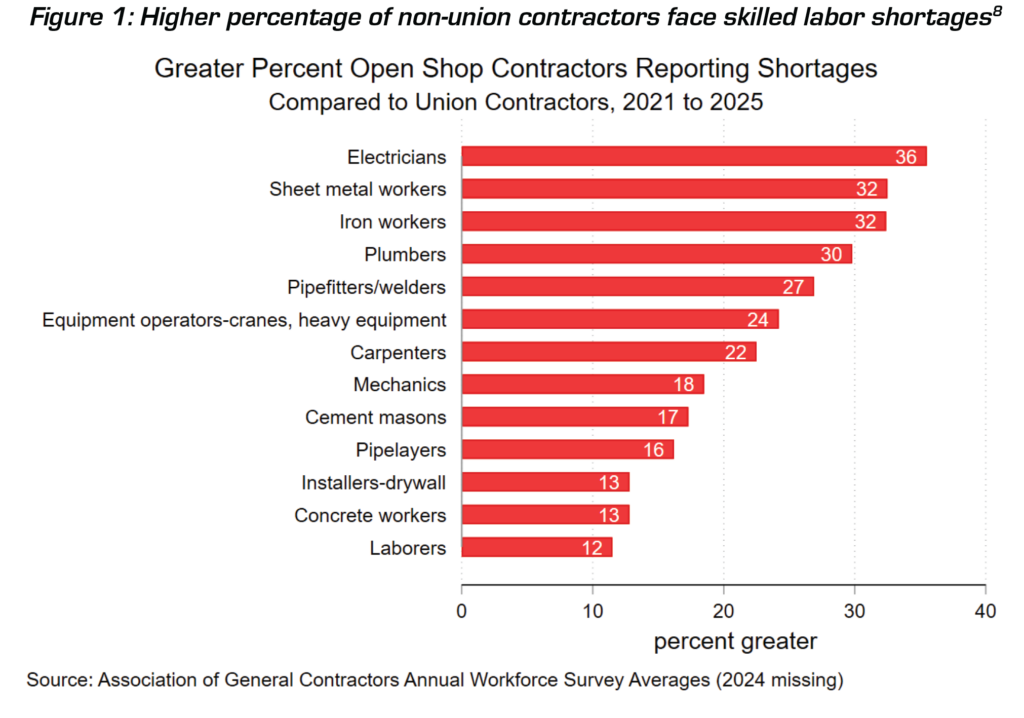
The study comes as New Jersey’s construction industry faces a significant shortage of skilled workers. According to the report, 73 percent of New Jersey contractors surveyed in 2025 reported severe difficulty finding qualified workers, while filling an open position took an average of 71 days.

Researchers found meaningful differences between contractors participating in union apprenticeship systems and those that do not. The study points to New Jersey’s union apprenticeship network as a major source of long-term workforce investment and a potential advantage on projects requiring large numbers of skilled workers.

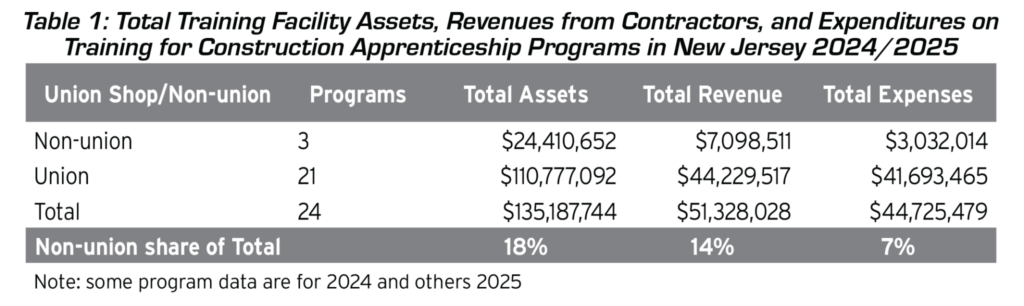
The report examined 24 registered construction apprenticeship programs, representing approximately $135 million in training-facility assets. Twenty-one union programs account for approximately 82 percent of the value of those facilities and the overwhelming majority of reported apprenticeship expenditures.

“The skilled workforce gap is real, and it is only going to become more important as New Jersey builds more transportation, water, energy and public infrastructure,” Longo said. “One of the strengths of a PLA is the ability to tap into a deep pool of trained workers and apprenticeship programs. When a project needs qualified people at the right time, having access to that workforce can make a major difference.”

PLAs can provide participating contractors with access to union hiring halls and trained workers when additional manpower is needed. The study also notes that non-union contractors are not necessarily excluded from PLA projects. They can compete for the work, bring key employees to the project and use union hiring halls to supplement their workforce.

For a municipality or other public owner, researchers argue that arrangement can combine contractor competition with access to workers from a broader segment of the construction industry.

Looking beyond the initial bid

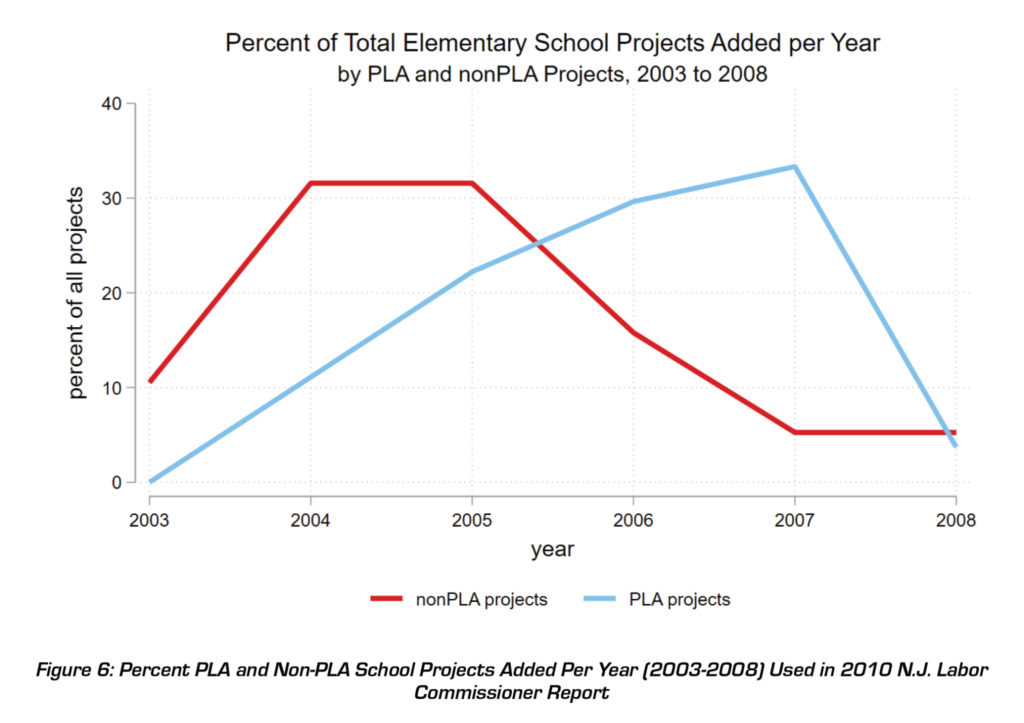
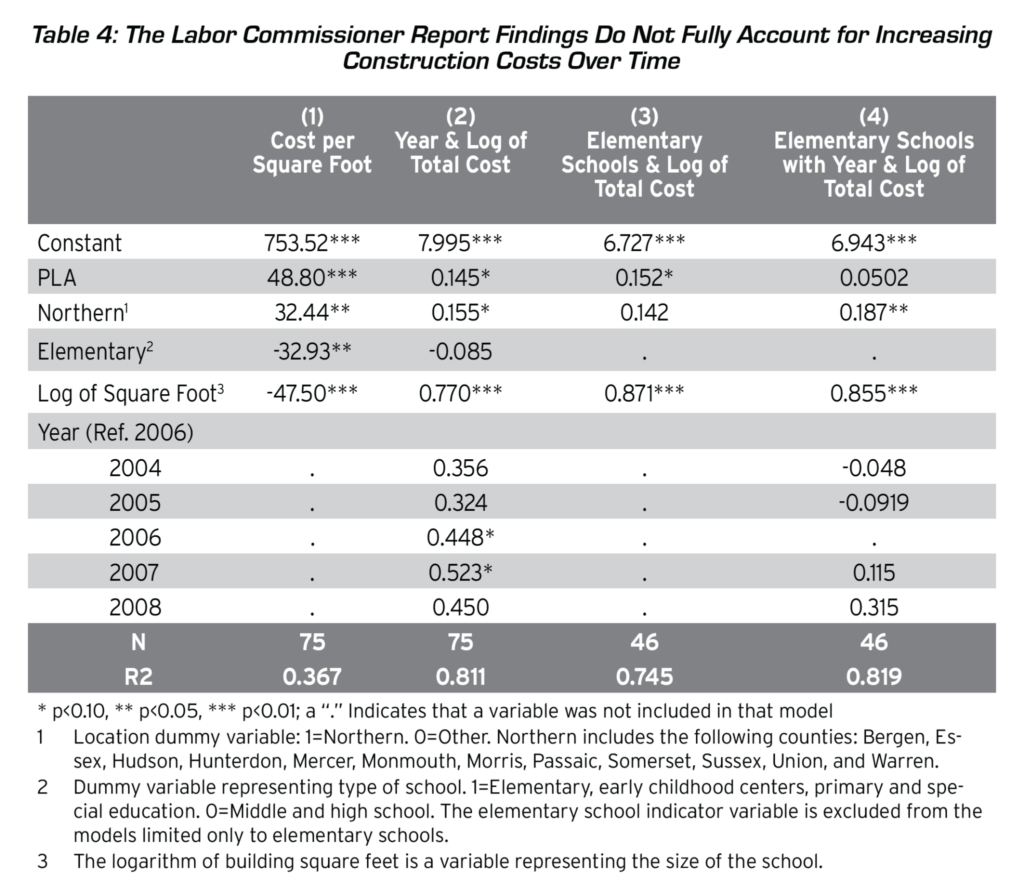
The study also revisits one of the most persistent criticisms of PLAs: that they increase the cost of public construction. For years, people have cited a 2010 New Jersey Department of Labor analysis that found school projects using PLAs appeared to cost approximately 19 percent more per square foot.

Philips and Conner found significant methodological limitations in that analysis, including differences in when PLA and non-PLA projects were constructed during a period of rapidly rising construction costs.

After researchers adjusted the analysis to better account for timing and project characteristics, the estimated cost difference became substantially smaller. Among the most comparable elementary school projects, the estimated PLA cost effect was not statistically significant.

The study argues that project owners should also consider more than the initial bid when evaluating construction costs. Worker shortages can delay critical portions of a project, creating additional expenses through extended project management, financing, inflation, change orders and delayed use of the completed facility. Standardized work rules, dispute-resolution procedures and reliable access to trained workers can therefore have economic value even when those benefits do not appear in the original bid price.

The broader research reviewed in the white paper also found that PLA projects tend to be completed faster than comparable non-PLA projects and that PLAs do not necessarily reduce the number of bidders competing for work.For New Jersey’s municipalities and other public entities, the takeaway is not that every construction project should use a PLA. Instead, the research suggests PLAs can be one option for managing workforce availability, scheduling and project-delivery risk.

As New Jersey confronts both a shortage of skilled construction workers and a major pipeline of infrastructure investment, those considerations are likely to become increasingly important.

“The point is to give public owners options,” Longo said. “Municipalities know their projects and their communities. If a project labor agreement can provide workforce certainty, reduce the risk of disruptions and help get an important project completed on schedule, they should have the opportunity to use it.”

NJ Biz recently spoke with study co-author Kevin Conner about the research, New Jersey’s skilled workforce shortage and what the findings mean for public construction.

Source:

Philips, P., & Conner, K. (2026). Project Labor Agreements in New Jersey: Skilled labor, apprenticeship investment, and evidence on construction costs. Engineers Labor-Employer Cooperative (ELEC 825). https://elec825.org/project-labor-agreements-in-new-jersey/

As misinformation about data centers swirls around the internet, Holmdel developer seeks to provide clarity to community

0

Court says law is ‘simply ‘beyond the limits of state law’

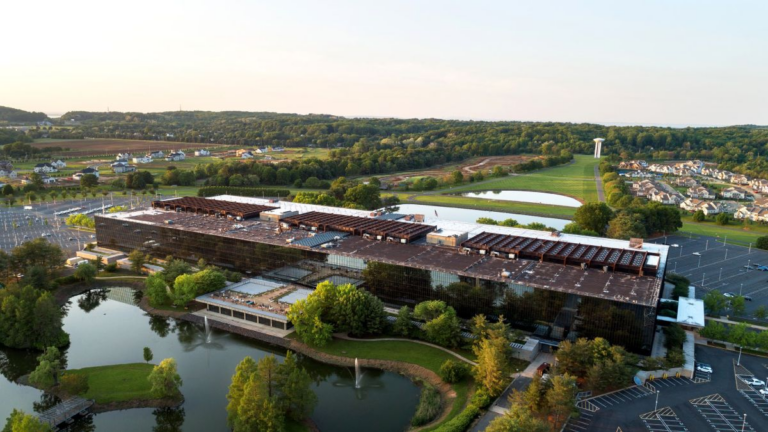
HOLMDEL, NJ — As debate over a proposed data center at Bell Works intensifies, so too has a flood of information — and misinformation — circulating online about what the project would mean for Holmdel.

With residents raising questions about electricity use, water consumption, noise, traffic, property values and the potential involvement of artificial intelligence, Bell Works owner and developer Ralph Zucker is urging the community to separate the proposed project from the much larger hyperscale data centers that have become the focus of national attention.

The proposal calls for a roughly 108,000-square-foot, two-story data center in an existing area of the Bell Works campus. The facility would have a maximum electrical load of approximately 40 megawatts. According to Zucker, that figure is significantly smaller than the 300- to 500-plus-megawatt hyperscale facilities increasingly being developed to support large-scale AI and cloud-computing operations.  

“The public conversation around data centers has largely been driven by enormous hyperscale facilities,” Zucker said in information provided to the community. “That is not what is being proposed at Bell Works.”

Water: A key point of confusion

Water consumption has emerged as one of the most frequently cited concerns surrounding the project.

Zucker says the proposed Bell Works facility would use a closed-loop cooling system, meaning water would circulate within the system rather than being continuously consumed for cooling. The water would be recirculated through heat exchangers as part of the cooling process.

That distinction is important because some of the largest data centers being proposed around the country rely on cooling technologies that can consume substantial quantities of water.

Critics of the Bell Works proposal, however, have questioned whether the application provides enough engineering information about the cooling system and its ultimate water requirements. Those questions are expected to be addressed as the project moves through the Planning Board review process.  

A facility set away from the main bell works campus

Another point that has generated discussion is where the data center would actually be located.

The proposed facility would replace an existing two-story structure in a less visible portion of the Bell Works property, southwest of the main Bell Works building. The developer says the location was specifically selected because it is separated from the primary campus and surrounding residential areas.  

Zucker has emphasized that the building would not be positioned along the prominent portions of the Bell Works campus that residents and visitors regularly see.

The application also calls for 34 parking spaces and two loading docks, reflecting the relatively limited number of employees expected to be associated with the facility compared with a conventional office or commercial building.  

Electricity use is significant — but different from the numbers circulating online

The project’s proposed 40-megawatt electrical load is unquestionably substantial, and it is one of the issues receiving the most attention from residents.

But the developer argues that comparisons circulating online between the Bell Works proposal and the country’s largest AI data centers are misleading.

A 40-megawatt facility is considerably smaller than the hyperscale campuses now being developed in other parts of the country, some of which are planned at several hundred megawatts or more.  

The project nevertheless will require significant electrical infrastructure, and questions about how that power will be delivered remain part of the technical review. Publicly available application materials indicate that utility and engineering issues will need to be addressed as the review proceeds.  

The project was proposed before Holmdel’s data center ban

Perhaps the biggest source of confusion is the relationship between the proposed facility and Holmdel’s recently adopted prohibition on data centers.

Holmdel Township introduced its data-center ordinance on July 21 and ultimately approved it on Aug. 11. Somerset Development submitted its Bell Works application on July 24 — after the ordinance was introduced but before it was finally adopted.  

Township Attorney Michael Collins has said the application is entitled to be considered under the zoning regulations that were in effect when it was submitted. That does not, however, mean the project has been approved.

The proposal still must undergo the Planning Board’s site-plan review, including consideration of the project’s technical and engineering requirements. The Township Committee has also stressed that it cannot prejudge the Planning Board’s decision.  

Developer says community will have a say

The current debate is less about whether residents should have questions and more about ensuring that those questions are answered with information specific to the Bell Works proposal rather than assumptions based on other data centers.

“Bell Works has always been a place where innovation, technology and economic opportunity come together,” Zucker said. “We’re working closely with local officials and the community to ensure that each phase of planning, construction and operation is approached thoughtfully and responsibly.”  

The developer has established an online FAQ containing project information and says it will continue to update the material as the application advances.

That effort comes as the proposal faces increasingly organized opposition from residents and community groups, who have raised questions about electricity demand, noise, water, emergency services, infrastructure and potential impacts on nearby neighborhoods.  

For Holmdel residents, the coming Planning Board process will therefore be an important distinction between what is being proposed, what is technically required, and what is merely being discussed online.

The project has not yet been approved, and many of the technical questions raised by both supporters and opponents will ultimately be subject to professional review and public hearings.

In the meantime, Zucker’s message to the community is straightforward: look at the facts of the Bell Works proposal rather than assuming it is the same as the massive data centers making headlines elsewhere.

Sources:

https://www.tapinto.net/towns/holmdel-and-colts-neck/sections/community/articles/bell-works-owner-ralph-zucker-addresses-holmdel-data-center-proposal-provides-facts-and-clarity

https://patch.com/new-jersey/holmdel-hazlet/amp/34689685/data-center-proposed-at-bell-works-see-details?utm_source

https://nj1015.com/holmdel-data-center-bell-works

https://www.aol.com/articles/see-plans-proposed-data-center-092724000.html

N.J. zoning ruling could create another hurdle for needed housing

0

State Supreme Court gives Montville and other municipalities greater authority to reject public-serving developments that conflict with local plans.

A New Jersey Supreme Court decision has given municipalities greater power to reject development proposals that conflict with local zoning plans. The unanimous decision in Monarch Communities, LLC v. Township of Montville changes the process used to evaluate variance applications for schools, hospitals, senior housing and other projects classified as “inherently beneficial uses.” Developers must now demonstrate that a proposed projectwill not substantially impair the intent of a municipality’s zoning plan and ordinance before a zoning board weighs the project’s public benefits against its potential drawbacks.

The decision reinforces the importance of local planning, but it also creates another potential barrier to construction in a state already struggling to produce enough housing. A municipality’s zoning plan may reflect legitimate concerns about traffic, drainage and infrastructure capacity; it may also preserve low-density development patterns that leave few realistic places for senior, affordable or multifamily housing.

A senior housing proposal in Montville

The case grew out of a proposal to build a 165-unit senior living community on an eight-acre property at 205-207 Change Bridge Road in Montville Township. The site, which contains a farm and a small single-family home, is zoned for residential use and is located near homes, townhouses, a childcare facility, a gas station, a bus depot and Montville’s municipal complex.

The proposed three-story development included 81 congregate apartments, 58 assisted-living units and 26 memory-care units. Fifteen percent of the units would have been reserved as affordable housing.

Senior housing is considered an inherently beneficial use under New Jersey’s Municipal Land Use Law. The designation recognizes that certain developments serve the public welfare and should receive special consideration when local zoning does not already permit them.

Montville had identified a need for additional senior housing in its planning documents, but it selected other properties for a senior housing overlay zone. The Change Bridge Road property was excluded after residents raised concerns about farmland preservation, open space and wetlands. A petition asking the township to preserve or acquire the property as open space received more than 600 signatures.

The developer nevertheless applied for a use variance that would allow the senior community to be built on the site. Montville’s Zoning Board of Adjustment denied the application after seven days of hearings. The board acknowledged the public benefit of senior housing but found that the proposed density, impervious coverage, drainage, traffic and parking impacts outweighed those benefits. It also determined that locating the facility on a property deliberately excluded from the senior housing overlay would substantially undermine the township’s zoning plan.

A trial court overturned the denial and directed the board to consider conditions under which the project could proceed. The Appellate Division upheld that ruling, but the Supreme Court reversed it and sent the case back for reconsideration under the newly revised standard. The Supreme Court did not decide whether the development should be approved. The case will return to the Appellate Division, where the Montville application will be evaluated under the new test.

Revising a 34-year-old zoning test

For more than three decades, zoning boards have relied on a four-step test established by the Supreme Court’s 1992 decision in Sica v. Board of Adjustment of Wall. Under the test, a board identified the public interest served by a proposed use, considered its detrimental effects, determined whether conditions could reduce those effects, and then balanced the benefits against the drawbacks.

The Legislature amended the Municipal Land Use Law five years later. The 1997 amendment clarified that all variance applicants, including those proposing inherently beneficial uses, must show that a project will not substantially harm the public good or impair the intent and purpose of the local zoning plan.

The Sica test addressed the first requirement but did not expressly incorporate the second. In its July 13 decision, the Supreme Court revised the fourth step to bring the test into line with the amended law. A zoning board must now determine whether the applicant has shown that the variance will not substantially impair the zoning plan before balancing the proposal’s positive and negative effects. A developer cannot satisfy that requirement simply by pointing to the value of senior housing, a school, a hospital or another beneficial use; it must provide a project-specific analysis of how the development would affect the municipality’s planning objectives.

This gives municipalities a stronger basis for rejecting applications before their public benefits are fully balanced against their impacts. It may also increase the amount of planning testimony, legal work and documentation required from developers, adding cost and uncertainty to an approval process that can already take years.

Stronger plans or stronger barriers?

The decision places greater importance on municipal master plans and development regulations. State law requires master plans to be reexamined at least once every 10 years. This process is intended to account for changing housing needs, environmental conditions, infrastructure capacity and development patterns.

However, a master plan can also become a stronger legal defense for restrictive zoning. If a municipality designates only a small number of properties for higher-density or public-serving development, applicants may have difficulty proving that a project proposed elsewhere does not undermine the local plan. Land may technically be available for housing while remaining poorly located, environmentally constrained or financially impractical to develop.

The new ruling, therefore, creates responsibilities on both sides. Developers will need more detailed evidence showing that a project fits within local land-use objectives; municipalities should be expected to show that those objectives realistically accommodate the housing and public facilities their communities need.

Supporters of the decision argue that towns can accommodate growth by proactively zoning suitable land for senior and affordable housing. The risk is that some municipalities will use the ruling to defend plans that protect the status quo without providing reasonable alternatives. As the Montville case returns to the lower court and zoning boards begin applying the revised test, the central question will be whether stronger municipal authority produces better-planned development or simply makes needed housing more difficult to build.

Sources:

Bergeron, P. (2026, July 22). N.J. Supreme Court gives more power to municipalities, puts more onus on developers. BINJE. https://binje.com/sectors/politics/n-j-supreme-court-gives-more-power-to-municipalities-puts-more-onus-on-developers/

Monarch Communities, LLC v. Township of Montville, 090407 (N.J. 2026). https://www.njcourts.gov/system/files/court-opinions/2026/a_70_24.pdf

New Jersey State League of Municipalities. (2026, July 15). NJ Supreme Court reconsiders use variance standard. https://www.njlm.org/m/newsflash/home/detail/3908

The water workforce gap

Who will run the system when today’s operators retire?

New Jersey’s drinking water and wastewater systems need an estimated $24 billion in investment, according to the American Society of Civil Engineers’ 2025 state fact sheet. The consequences of that need are already visible: in 21 municipalities with combined sewer systems, heavy rain can overwhelm aging pipes and send untreated sewage into streets and waterways.

New Jersey is preparing to spend billions of dollars replacing lead service lines, treating emerging contaminants and upgrading aging water and wastewater systems. But the success of those investments will depend on something funding alone cannot provide: enough qualified people to operate and maintain them.

The state’s water sector is approaching a generational turnover. Experienced operators, mechanics, electricians and technicians are retiring faster than utilities can replace them; the training pipeline is growing, but it remains too small and fragmented to meet the industry’s long-term needs.

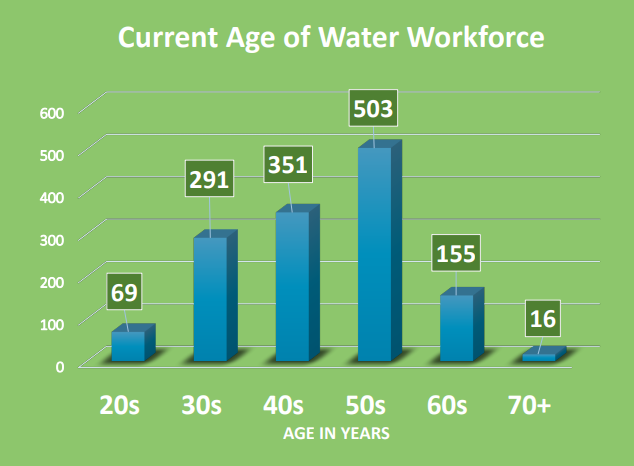
The clearest evidence comes from the state’s own workforce data. A late-2024 survey by the New Jersey Department of Environmental Protection was sent to 3,625 licensed operators who collectively held 6,261 licenses. NJDEP’s 2025 analysis found that the largest concentration of operators was in their 50s, with 503 people represented in that age group. Only 69 were in their 20s.

SOURCE: NJDEP. 

The imbalance is creating a succession problem at precisely the wrong time. New Jersey is planning some of the largest water infrastructure investments in its history, but the workforce responsible for running those systems is steadily approaching retirement.

The problem extends well beyond New Jersey. The U.S. Environmental Protection Agency has estimated that nearly one-third of the nation’s water utility workforce will become eligible for retirement within a decade. The American Water Works Association has projected that approximately half of utility employees nationwide could retire over the same period.

More work, fewer workers

The retirements are arriving as demand for skilled water workers continues to grow. The Bipartisan Infrastructure Law allocated more than $50 billion nationally for drinking water and wastewater improvements. New Jersey is receiving hundreds of millions of dollars through its State Revolving Funds and related federal programs.

Utilities across the state are replacing lead service lines, installing PFAS treatment systems, modernizing treatment plants and preparing facilities for more severe storms. Every project requires construction workers to build it, but the need does not end when construction is complete. New systems must be operated, tested, inspected, repaired and maintained for decades.

Without enough licensed operators, mechanics, electricians, instrumentation technicians and maintenance personnel, even fully funded infrastructure projects could face delays. Utilities may also struggle to operate increasingly complex systems or preserve the knowledge that experienced employees have accumulated over long careers.

A fragmented industry

New Jersey’s highly decentralized water sector makes workforce planning more difficult. According to Jersey WaterCheck, approximately 10 percent of residents rely on private wells and septic systems. The remaining population is served by hundreds of drinking water, wastewater and stormwater systems operating under municipal, county, regional or investor-owned structures.

Investor-owned utilities serve roughly 40 percent of the state’s water-system population. The other 60 percent depends largely on municipal, county, regional and other non-investor-owned providers, which range from large authorities to small local systems.

That structure places much of the recruiting, training and employment challenge on municipalities, counties and regional authorities. Larger providers may have the resources to build formal training programs, recruit across a wider area and offer clearer advancement opportunities. Smaller systems often cannot do so alone, even though the services they provide are no less essential.

Apprenticeships create a path forward

Registered apprenticeships offer one of the most practical responses to the shortage. Labor unions have long used apprenticeship programs to prepare workers for skilled careers in construction; the model can provide the same combination of structure, technical instruction and hands-on experience for water and wastewater workers.

Apprentices earn wages while completing classroom instruction and mentored on-the-job training, which makes the model particularly valuable for people seeking a stable career without following a traditional four-year college path.

Several New Jersey programs are already creating these entry points. The New Jersey Water Association’s registered apprenticeship program includes 4,000 hours of mentored on-the-job training and 288 hours of technical instruction over two years. Hudson County Community College’s Water Workforce Utility Program offers another route into the industry.

New Jersey American Water’s WATER UP! program combines classroom instruction, hands-on training and exposure to utility careers; participants may also receive a stipend and earn college credit. The Atlantic County Utilities Authority offers wastewater, electrician and instrumentation technician apprenticeships, along with internships that include wastewater operations.

The Future-Forward Water Workforce Initiative, led by Jersey Water Works, New Jersey Future, the Atlantic County Utilities Authority and the Atlantic City Municipal Utilities Authority, is helping current utility employees build technical and professional skills. The initiative enrolled 20 workers in courses ranging from wastewater operations and CDL training to data analysis and project management.

These efforts provide useful models, but they remain spread across numerous organizations and employers. Closing a statewide workforce gap will require stronger coordination, sustained funding and clearer routes from training to permanent employment.

Workforce investment is infrastructure investment

New Jersey has recognized the need to invest heavily in its physical water systems. NJDEP has estimated that the Water Bank will receive nearly $1 billion from the Bipartisan Infrastructure Law over five years. The state also allocated $300 million in federal pandemic recovery funding for water infrastructure improvements. Individual projects demonstrate the scale of the work to be completed. The Atlantic County Utilities Authority received $10 million through the New Jersey Infrastructure Bank for wastewater treatment improvements, including $2 million supported by the Bipartisan Infrastructure Law. The Atlantic City Municipal Utilities Authority received $19.8 million for lead service line replacement.

The growing project list is a sign of long-overdue progress. Safe drinking water and reliable wastewater treatment are essential public services; replacing deteriorating infrastructure and meeting new water-quality standards cannot be postponed indefinitely.

However, the same investment is intensifying competition for workers. PFAS treatment, lead service line replacement, brownfield redevelopment, environmental remediation and wastewater compliance projects often require overlapping skills. Utilities must compete with engineering firms, contractors and environmental companies for a limited pool of qualified labor.

Addressing the shortage will require more than recruiting people to fill existing vacancies. New Jersey needs clearer career pathways from high schools, vocational programs and community colleges into permanent utility jobs, along with more paid opportunities for workers entering the field. Smaller systems must also have dependable access to qualified employees, whether by strengthening their own workforce, sharing personnel and training resources with neighboring utilities or integrating with larger regional systems. Experienced workers must have opportunities to pass along the technical knowledge that cannot be learned from a manual.

Sources:

American Water Works Association. Developing the next generation of water professionals. https://www.awwa.org/AWWA-Articles/developing-the-next-generation-of-water-professionals/

Atlantic County Utilities Authority. Internship opportunities. https://www.acua.com/About/Careers/Internships.aspx

Hudson County Community College. Water Workforce Utility Program. https://su.hccc.edu/programs-courses/workforce-development/water-workforce-utility-program/index.html

Jersey Water Works. Understanding how the water sector is organized in New Jersey. https://www.njwatercheck.com/Content/documents/Understanding%20How%20the%20Water%20Sector%20is%20Organized%20in%20NJ.pdf

Jersey Water Works. Partners for Places: Jobs and Inclusive Infrastructure Initiative. https://www.jerseywaterworks.org/latest-news/partners-for-places-jobs-and-inclusive-infrastructure-initiative/

New Jersey American Water. Water UP! Water Utility Pipeline Program. https://www.amwater.com/njaw/About-Us/Workforce-Development/water-up

New Jersey Department of Environmental Protection. NJDEP commissioner LaTourette, EPA administrator Regan and I-Bank officials mark billion-dollar water infrastructure milestone. https://dep.nj.gov/newsrel/24_0029/

New Jersey Department of Environmental Protection. Licensed operator program update [Conference presentation]. Association of Environmental Authorities of New Jersey Annual Conference. https://www.aeanj.org/wp-content/uploads/DEP-Licensed-Operator-Program-Update.pdf

New Jersey Water Association. Apprenticeship program: Water and wastewater operations specialists. https://www.njwater.org/docs/NJWA_AP_Guidance_1_2024.pdf

New Jersey Water Association. New Jersey’s water workforce: Strategies for strengthening recruitment, retention, and succession planning [Workshop agenda]. https://www.njwater.org/docs/NJ-Workforce_Agenda-SU-EFC_CC_NJWA_Flyer.pdf

U.S. Environmental Protection Agency. Interagency Water Workforce Working Group report to Congress. https://www.epa.gov/system/files/documents/2024-09/interagency-water-workforce-working-group-report-to-congress_august-2024-508-compliant.pdf

U.S. Environmental Protection Agency. Fact sheet: EPA and the Bipartisan Infrastructure Law. https://www.epa.gov/infrastructure/fact-sheet-epa-bipartisan-infrastructure-law

American Society of Civil Engineers. 2025 New Jersey infrastructure facts.

Tri-State Infrastructure News Network. Raw sewage in the streets: New Jersey’s dirty little secret. https://tristateinfrastructurenews.com/raw-sewage-in-the-streets-new-jerseys-dirty-little-secret/ 

Infrastructure Update – Week of August 17, 2026

0

A week dominated by drinking‑water safety, PFAS accountability, grid reform, data‑center power debates, and long‑running Superfund remediation. Here’s your curated summary.

New Jersey secures $2.5 billion in PFAS settlements

New Jersey has won $2.5 billion in settlements with DuPont, 3M, and other chemical manufacturers over decades of PFAS contamination. The agreements resolve claims that “forever chemicals” polluted drinking‑water systems, rivers, and groundwater statewide. The funds will support treatment upgrades, cleanup projects, and long‑term monitoring across dozens of affected communities.

The state argued that PFAS contamination imposed massive public‑health and infrastructure burdens, forcing utilities to install costly filtration systems. The settlement – one of the largest PFAS agreements in the country – signals a new era of accountability for manufacturers and gives New Jersey significant resources to accelerate remediation.

Read more: https://www.reuters.com/legal/litigation/new-jerseys-25-billion-forever-chemicals-settlements-with-dupont-3m-others-win-2026-08-07

How Philadelphia turns river water into tap water

A detailed walkthrough of Philadelphia’s water‑treatment process shows how the city transforms Delaware and Schuylkill River water into safe drinking water for more than 1.5 million people. The system relies on a multi‑stage process: coagulation, sedimentation, filtration, disinfection, and continuous monitoring.

The piece highlights the scale of the operation – massive intake stations, chemical‑dosing systems, and filtration beds – and underscores how river‑based systems must constantly adapt to upstream pollution, stormwater surges, and aging infrastructure. Despite challenges, Philadelphia’s treatment plants consistently meet federal standards, demonstrating how large cities can maintain safe water supplies even with complex river conditions.

Read more: https://tristateinfrastructurenews.com/how-philadelphia-turns-delaware-and-schuylkill-river-water-into-tap-water

America’s drinking water and the Iran conflict

A recent episode of The Daily explores how geopolitical conflict – in this case, war with Iran – could affect America’s drinking‑water systems. The discussion examines vulnerabilities in water‑treatment plants, chemical supply chains, and cyber‑security defenses. Many utilities rely on imported treatment chemicals, specialized equipment, and global manufacturing networks that could be disrupted during international crises.

The episode also highlights how water systems have become targets for cyberattacks, with hostile actors probing operational networks. The takeaway: America’s drinking‑water infrastructure is deeply interconnected with global stability, and conflict abroad can have direct consequences for water safety at home.

Read more: https://www.nytimes.com/2026/08/07/podcasts/the-daily/america-drinking-water-iran-war.html

Gas dominates PJM’s reformed interconnection queue

Inside Climate News reports that natural gas continues to dominate PJM’s interconnection queue even after reforms intended to accelerate renewable‑energy projects. While solar and storage proposals remain abundant, gas projects are advancing more quickly due to shorter permitting timelines, easier siting, and fewer transmission constraints.

The analysis warns that PJM’s grid‑transition goals may be undermined if gas continues to outpace renewables in actual approvals. Transmission bottlenecks, local opposition, and slow regulatory processes remain major obstacles for clean‑energy developers, even as demand from data centers and electrification surges.

Read more: https://insideclimatenews.org/news/08082026/gas-dominates-pjm-interconnections-reformed-grid-queue/

Vineland data center hearing highlights power‑generation concerns

A proposed data‑center project in Vineland has sparked debate over how much on‑site generation should be allowed. Developers argue they need dedicated power to ensure reliability for AI workloads and high‑density computing. Local officials and residents worry about emissions, noise, and whether the facility would rely on fossil‑fuel backup plants.


The hearing reflects a growing statewide tension: data centers are expanding rapidly, but the grid is struggling to meet their enormous electricity demands. Communities are increasingly scrutinizing whether these projects should be required to fund new clean‑energy generation rather than relying on local peaker plants.

Read more: https://whyy.org/articles/vineland-data-center-hearing-power-generation

Cornell‑Dubliner Superfund site moves into new cleanup phase

The Cornell‑Dubliner Superfund site in South Plainfield – contaminated by decades of industrial chemical use – is entering a new phase of remediation. Recent work includes soil removal, groundwater treatment, and long‑term monitoring to address solvents and other hazardous contaminants. The site has been under federal oversight for years, and the latest update outlines progress toward eventual redevelopment.

The report emphasizes how legacy industrial sites continue to pose complex cleanup challenges, requiring multi‑year remediation plans and coordination between EPA, state regulators, and local officials.

Read more: https://tristateinfrastructurenews.com/whats-happening-at-the-cornell-dubliner-superfund-site-in-south-plainfield/

10 largest renewable power plants in New Jersey

0

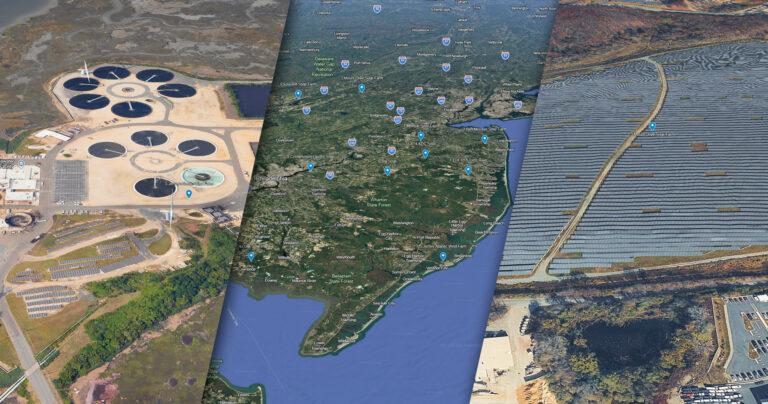
Renewable energy (solar and wind) account for ~10% of the state’s electric generation. New Jersey ranks 28th nationally in net annual generation, 17th in solar and 41st in wind generation. Here are the largest renewable power plants at the time of publication – nine solar and one wind.

10 Largest renewable power plants in New Jersey

RankNameAnnual Generation (GWh)LocationYear in Service
10NJ Oak Solar Plant16.1Bridgetown, Cumberland County2011
9Cinnaminson Landfill Solar16.4Cinnaminson, Burlington County2019
8Foul Rift Solar Farm16.9White Twp., Warren County2025
7Monroe Solar Farm18.6Monroe Township, Middlesex County2020
6Dix Solar19.0Browns Mills, Burlington County2017
5Jersey-Atlantic Wind Farm20.3Atlantic City, Atlantic County2006
4KDC Solar27.7Six Flags, Jackson, Ocean County2019
3Mount Olive Solar Farm31.5Mount Olive Township, Morris County2023
2Ben Moreell Solar Farm34.6Tinton Falls, Monmouth County2020
1EDF Ph1 Toms River36.5Toms River, Ocean County2021

Map

Video

The rise of bottled water is really a story about infrastructure

0

America’s bottled water boom reveals as much about public confidence as it does about consumer preference.

Walk through any supermarket, gas station or airport in the tri-state area and you’ll find entire aisles dedicated to bottled water. Americans now drink more bottled water than any other packaged beverage, consuming billions of gallons every year. Yet for most residents of New Jersey, New York and Connecticut, turning on the kitchen faucet provides water that has already undergone rigorous treatment, continuous testing and around-the-clock monitoring. So why are we paying for something we already have? The answer has less to do with water than with infrastructure.

The remarkable rise in bottled water reflects changing public confidence in the systems that deliver one of life’s most essential resources. Its story is shaped by engineering, public investment, aging infrastructure, environmental challenges and decades of very successful marketing campaigns. Nowhere is the story more relevant than in the Northeast, where some of America’s oldest and most sophisticated drinking water systems serve millions of people every day.

The original public utility

Before bottled water became a household staple, drinking water was considered one of the government’s greatest responsibilities. Throughout the nineteenth and twentieth centuries, cities across the Northeast invested heavily in reservoirs, aqueducts, pumping stations and treatment plants. These projects transformed public health. Diseases like cholera and typhoid, once common in growing cities, declined dramatically after filtration and chlorination became widespread. Few engineering achievements have saved more lives than modern drinking water systems.

New York City’s water supply remains one of the world’s most impressive examples. More than one billion gallons of water travel each day from protected watersheds in the Catskill and Delaware Mountains through a network of reservoirs, tunnels and aqueducts stretching more than 100 miles. Because those watersheds have been carefully protected for generations, New York has largely avoided constructing a massive filtration plant that many other major cities require. And many consider New York’s water as the magic ingredient in the city’s bagels and pizza.

New Jersey’s system is equally remarkable, though often overlooked. Hundreds of public water systems draw from reservoirs, rivers and aquifers before treating water through increasingly sophisticated processes designed to remove everything from bacteria to industrial contaminants. Connecticut and the rest of the Northeast have made similar investments over decades. The water reaching most homes today has traveled through some of the most carefully regulated infrastructure systems in the country.

Selling confidence instead of water

Ironically, bottled water became popular during an era when municipal water had never been safer. When Perrier entered the American market during the late 1970s, it wasn’t responding to widespread concerns about drinking water quality. Instead, it sold an image. Imported water was fashionable. Drinking bottled water conveyed sophistication, health and an active lifestyle. American companies quickly recognized the opportunity.

Brands such as Poland Spring, Deer Park, Aquafina and Dasani followed, each building a unique identity despite selling what is, fundamentally, water. The industry’s greatest accomplishment wasn’t finding better water; it was convincing consumers that water itself could have a brand.

Over time, advertising subtly contrasted pristine mountain streams with municipal infrastructure. Crystal-clear springs, forests and untouched landscapes became central themes, even though many bottled water brands originate from municipal water systems that undergo additional treatment before bottling. Consumers weren’t buying hydration, they were buying reassurance.

Taste is also a factor. Many people say they prefer bottled water because tap water has a distinctive flavor. In most cases, that taste is not a sign that the water is unsafe. The minerals that occur naturally in groundwater, the chlorine or chloramine used to disinfect drinking water, the age of a building’s internal plumbing or even the temperature of the water can all affect how it tastes. Water drawn from different sources, such as reservoirs, rivers or aquifers, naturally has different mineral compositions, meaning two neighboring communities may notice subtle differences despite both meeting the same rigorous safety standards. Bottled water, by contrast, is produced to deliver a consistent flavor. Many brands use tightly controlled purification processes, such as reverse osmosis, followed by carefully adding back specific minerals or blending water sources to create the same taste from bottle to bottle. The consistency is one reason many consumers prefer it. 

Infrastructure is most visible when it fails

One of the greatest challenges facing the Northeast is that much of its drinking water infrastructure is invisible. Unlike a bridge or highway, underground water mains rarely attract attention unless something goes wrong. When they do, the effects are immediate and public confidence can take years to restore. 

Flint, Michigan, became the national symbol of that risk after the city changed its water source in 2014 without implementing adequate corrosion control. The more corrosive water caused lead to leach from aging pipes and service lines, exposing residents and demonstrating how failures in treatment, regulation and oversight can turn hidden infrastructure into a public health crisis. The episode also focused national attention on the millions of lead service lines still connecting water mains to homes across the country. 

Newark confronted its own lead crisis several years later. In 2017, routine testing found elevated lead levels in drinking water at some Newark homes served by aging lead service lines. Two years later, the U.S. Environmental Protection Agency determined that faucet filters alone were not providing adequate protection. The city raced to replace roughly 18,000 lead service lines in two years and distributed bottled water to approximately 15,000 affected households. Newark’s rapid response became a national model, but the crisis underscored how quickly aging infrastructure can undermine trust in an otherwise safe water system. 

Lead service line replacement now extends across New Jersey. A 2021 state law requires community water systems to identify and replace all lead and galvanized service lines by July 2031, generally at an average rate of at least 10% per year. Trenton Water Works has already invested approximately $70 million and replaced more than 11,000 lines across Trenton, Hamilton, Ewing and Lawrence; approximately 19,000 remain within its service area. Water systems throughout the state must maintain inventories, report their progress annually and continue replacing lines as funding and construction schedules allow. 

Other risks require different investments. Concerns over PFAS contamination have prompted water systems across New Jersey to invest hundreds of millions of dollars in advanced treatment technologies to meet some of the nation’s strictest drinking water standards. These investments are largely preventive, but they are essential to maintaining safe, reliable drinking water.

Sometimes the challenge is not water quality, but the infrastructure itself. In August 2025, a rupture in a roughly 140-year-old transmission main serving Paterson left nearly 200,000 without water or with dangerously low water pressure for several days. Because the pressure loss created the possibility of contaminants entering the distribution system, officials issued a boil-water advisory until repairs were completed and laboratory testing confirmed the water was safe to drink again.

Events like these are uncommon compared with the billions of gallons of drinking water delivered safely every year, but they leave consumers scared and distrustful.

Gallup’s 2026 Environment Poll found that 56 percent of Americans worry “a great deal” about pollution of drinking water, making it the highest-ranked environmental concern among the eight issues tested.

Another 53 percent expressed the same level of concern about maintaining the nation’s freshwater supply for household needs, while 50 percent said they worry a great deal about pollution in rivers, lakes and reservoirs. Those findings suggest that for many Americans, safe drinking water is not an abstract infrastructure issue; it is a daily concern shaped by headlines, personal experience and confidence in the systems that deliver it. 

Many water mains throughout New Jersey and New York are more than 75 years old, and some have been in service for over a century. Ratepayers rarely celebrate the replacement of a buried transmission main or improvements to a treatment facility, yet those investments determine whether residents continue trusting what comes from their faucets. The greatest success of drinking water infrastructure is that, on most days, the public never has to think about it at all.

The convenience economy

Trust alone does not explain bottled water’s success. Modern life rewards convenience. Disposable plastic bottles fit easily into cars, backpacks and gym bags. Airports, sporting events and convenience stores made bottled water available almost everywhere. Public drinking fountains, meanwhile, gradually disappeared or fell into disrepair. Unless, of course, they have a water-bottle refill station built in.

Consumers increasingly chose portability over permanence. The irony is difficult to ignore. At a time when PFAS contamination has become one of the public’s greatest drinking water concerns, many consumers respond by purchasing water packaged in single-use plastic bottles while standing only a few feet from a drinking fountain connected to the same municipal system. 

The convenience also comes with a significant environmental cost. Producing plastic bottles requires petroleum and natural gas, while bottling, refrigerating and transporting water consumes additional energy. Only 29.1% of PET bottles and jars were recycled in the United States in 2018; most were landfilled, incinerated or discarded into the environment, where they can persist for generations and break down into microplastics. 

Investing in confidence

The success of bottled water should not be viewed as a failure of public water systems; as much as anything, it’s a success of marketing. Because every day, utilities across the tri-state region deliver billions of gallons of safe drinking water through reservoirs, treatment plants, pumping stations and thousands of miles of underground pipe. Most people never think about that until something goes wrong.

Rebuilding this confidence requires continuous investment. Utilities are replacing aging lead service lines, upgrading treatment plants, removing emerging contaminants such as PFAS and strengthening systems against increasingly frequent floods, droughts and other extreme weather.  In the end, the future of public water depends not on convincing people to buy fewer bottles, but on continuing to earn their trust.

Sources:

Beverage Marketing Corporation. Bottled water in the U.S. https://www.beveragemarketing.com/ 

Newark Department of Water and Sewer Utilities. (n.d.). Lead service line replacement program. https://www.newarkleadserviceline.com/ 

New York City Department of Environmental Protection. New York City’s water supply system. https://www.nyc.gov/site/dep/water/water-supply.page 

U.S. Environmental Protection Agency. Consumer’s guide to the history of drinking water treatment. https://archive.epa.gov/water/archive/web/pdf/2001_11_15_consumer_hist.pdf