
Our Infrastructure Matters Ad
Home Blog Page 5

What’s happening at the Cornell-Dubliner Superfund site in South Plainfield?

0

An overview of the federal Superfund program

New Jersey’s long industrial history helped build the state’s economy, but it also left behind contaminated factories, landfills, waterways and industrial properties. The federal Superfund program is responsible for addressing the most serious of those sites.

Created by Congress in 1980, Superfund gives the U.S. Environmental Protection Agency broad authority to investigate releases of hazardous substances, require responsible parties to perform or pay for cleanup and use federal money when a viable responsible party cannot be found. The work can involve demolishing buildings, excavating contaminated soil, dredging waterways, treating groundwater or restricting how a property may be used.

At the former Cornell-Dubilier Electronics site in South Plainfield, the cleanup has required nearly all of those approaches. Electronics components were manufactured at the 26-acre facility from 1936 to 1962. PCBs and industrial solvents used in production contaminated buildings, soil, groundwater, nearby properties and Bound Brook. The EPA added the site to the National Priorities List in 1998; cleanup work has continued in phases for more than two decades.

The scale and duration of the work illustrate an important point: Superfund cleanup is not a single construction project. It is a combination of environmental investigation, engineering, public-health protection, enforcement and long-term monitoring that can continue for years even after the most visible work is finished.

How a site enters the Superfund program

A contaminated property does not automatically become a Superfund site. EPA first conducts a site inspection, reviewing historical records and collecting information about possible releases. The agency considers the toxicity and quantity of the contaminants, the likelihood that they could move through soil, air, groundwater or surface water and the number of people or sensitive environments that could be exposed.

Sites are then evaluated through EPA’s Hazard Ranking System. Those presenting the most serious potential risks may be proposed for the National Priorities List, which identifies contaminated sites eligible for long-term federal remedial action.

An immediate danger does not have to wait for that process. EPA can undertake a removal action to respond quickly to a chemical spill, contaminated drinking water, an unstable waste pile or another urgent threat. These actions may include removing hazardous materials, installing fencing, supplying clean water or temporarily relocating residents.

Long-term remedial work follows a more extensive process. EPA conducts a remedial investigation to determine what is contaminated, how far that contamination has spread and how people or ecosystems could come into contact with it. A feasibility study then compares potential cleanup methods, including their effectiveness, reliability, environmental impact and cost.

EPA presents a preferred alternative to the public before issuing a Record of Decision that establishes the selected remedy. Engineers then translate that decision into plans, specifications and construction requirements during remedial design. Remedial action is the phase in which the cleanup is physically built and implemented.

That sequence can be lengthy, but it serves an important purpose. Digging into a contaminated property without understanding how pollutants move can spread the problem, expose workers or leave the primary source of contamination untouched.

Different contaminants require different solutions

There is no universal technique for cleaning a Superfund site. The appropriate remedy depends on the contaminant, the depth and concentration of the pollution, the type of soil, groundwater conditions, nearby development and the property’s likely future use.

Excavation is one of the most visible approaches. Contaminated soil or sediment is dug up, loaded into trucks and transported to a facility legally permitted to accept it. Clean material may then be brought in to restore the excavated area.

This approach permanently removes contaminated material from a community, but it can require years of heavy construction and thousands of truck trips. Crews must control dust, stormwater and the movement of equipment to keep contamination from spreading during the work.

At the former Cornell-Dubilier site, EPA removed PCB-contaminated soil from 34 nearby residential properties during an early phase of the cleanup. The agency later demolished 18 contaminated buildings, transported approximately 26,400 tons of building debris for disposal and excavated another 21,000 tons of contaminated soil and debris from the former industrial property.

EPA is now addressing PCB-contaminated sediment and floodplain soil along Bound Brook. The brook is being divided into reaches so that crews can work progressively downstream. Surface water must be redirected before contaminated sediment and soil can be excavated, staged in covered areas and transported to permitted disposal facilities. EPA expects the current work in the Bound Brook area to continue for approximately five years.

Removal is not always the best or only option. A cap can isolate contaminated material beneath layers of clean soil, pavement, clay or engineered synthetic barriers. Caps prevent people from contacting the waste and reduce the amount of rainwater passing through it, which can slow the movement of contamination into groundwater. They require inspection and maintenance; future excavation or development may also be restricted.

Some contaminated soil can be treated instead of removed. At the Cornell-Dubilier site, EPA used thermal treatment on part of the former facility property. The soil was heated so that contaminants would vaporize and could be extracted and captured. Material that could not be treated effectively was transported off-site.

Other treatment technologies use chemical reactions or microorganisms to break contaminants down, reduce their toxicity or make them less mobile. The objective is not merely to move contaminated material somewhere else, but to reduce the danger it presents whenever practical.

Groundwater can extend the cleanup for decades
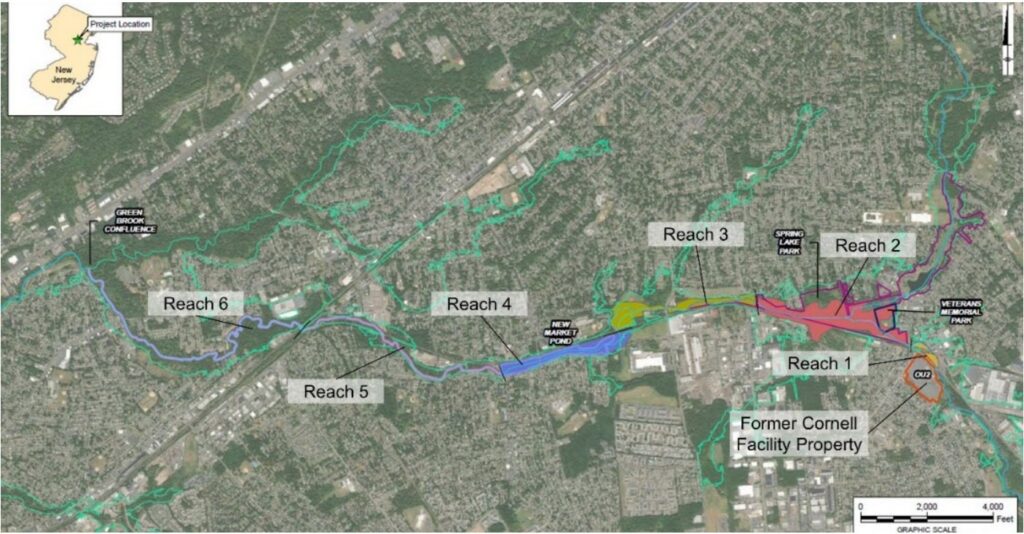
The cleanup of the Bound Brook was divided into 6 reaches to be able to better manage the work. Reach 1 was completed in 2023. EPA is currently cleaning up reach 2. Graphic courtesy of the U.S. Environmental Protection Agency, Cornell-Dubilier Electronics Superfund Site Community Update, Winter 2025–2026. 

Groundwater is among the most difficult parts of many Superfund cleanups. Contaminants can migrate underground beyond the original property, and pollution trapped in soil or fractured rock can continue feeding a groundwater plume long after the original release ends.

EPA reports that groundwater contamination has been addressed at approximately 85 percent of National Priorities List sites where a remedy has been selected. Common strategies include treating the source, preventing the plume from spreading and restoring the groundwater where that is technically feasible.

Pump-and-treat systems use wells to draw contaminated groundwater from beneath a site. The water is sent through an above-ground treatment plant before it is discharged or returned to the ground. Pumping can also control the direction of groundwater flow, preventing contaminants from reaching drinking-water wells, wetlands, streams or other sensitive areas.

Cornell-Dubilier now has a groundwater extraction and treatment facility that captures groundwater contaminated with trichloroethylene, commonly known as TCE, before it can migrate into Bound Brook. Such systems may operate for years after their construction is complete because groundwater moves slowly and contamination can be difficult to remove from underground formations.

Other sites may use in-place treatment. Chemicals, nutrients or other materials can be injected underground to destroy contaminants or convert them into less harmful forms. Permeable reactive barriers allow groundwater to pass through a treatment material, while underground slurry or sheet-pile walls can contain a plume and keep it from spreading.

Where complete groundwater restoration is not technically practical, the remedy may combine containment, monitoring and restrictions on well installation or groundwater use. Those legal and administrative restrictions are known as institutional controls.

Cleanup also means controlling exposure

Protection begins by interrupting the ways people could be exposed. Contaminated soil can be removed, treated, capped or fenced off. Polluted groundwater can be captured before it reaches a drinking-water supply. Vapor monitoring can determine whether volatile chemicals are moving from groundwater or soil into buildings. Fishing advisories can prevent people from consuming fish that have accumulated contaminants from polluted sediment.

At Cornell-Dubilier, EPA has combined these protections. The public water supply is routinely tested; groundwater restrictions prevent the use of untreated groundwater for drinking. EPA has also conducted sampling to determine whether vapors from contaminated groundwater are entering nearby buildings.

During the Bound Brook work, crews are redirecting water, covering staged soil and controlling runoff. EPA plans to monitor the air for dust, maintain fencing and barriers around work zones and coordinate truck traffic with South Plainfield, Piscataway and Middlesex County. Signs warn anglers not to eat fish from Bound Brook and New Market Pond because of PCB contamination.

These measures matter because cleanup itself can temporarily disturb contaminated material. The work must protect construction workers, nearby residents and recreational users while still removing the pollution that created the long-term risk.

Who pays for Superfund cleanup?

The name “Superfund” can create the impression that every cleanup is paid entirely by the federal government. The funding system is actually more complicated.

Under the Comprehensive Environmental Response, Compensation and Liability Act, EPA can pursue current and former property owners, facility operators, companies that generated hazardous waste and parties that arranged for its transportation or disposal. These potentially responsible parties may agree to investigate and clean a site under EPA oversight, reimburse the government for work it already performed or pay into a settlement.

EPA describes this as an “enforcement first” approach. Money recovered from responsible parties is used before federal construction funding whenever possible; doing so preserves public funds for abandoned sites and cases in which the responsible companies no longer exist or cannot afford the work.

In 2015, EPA announced the recovery of $22 million from D.S.C. of Newark Enterprises and its sole shareholder for cleanup costs and natural-resource damages connected to Cornell-Dubilier. EPA received $16.2 million of that settlement, while New Jersey and federal natural-resource trustees received the remainder. At that time, EPA reported that its cleanup costs at the site had already exceeded $180 million.

That gap demonstrates one of Superfund’s central challenges. The company responsible for pollution may have closed, reorganized, sold the property or lack the resources to pay for a cleanup whose cost was never anticipated when the contamination occurred.

When responsible-party funding is unavailable or insufficient, EPA can finance work through congressional appropriations and the Superfund trust fund. The 2021 Infrastructure Investment and Jobs Act provided $3.5 billion for National Priorities List remediation and reinstated federal excise taxes on certain chemicals and imported chemical substances.

Cornell-Dubilier received infrastructure funding to continue excavating PCB-contaminated soil and sediment along Bound Brook. EPA estimated that portion of the project alone would cost $152 million. The federal funding allowed work to continue without waiting for another viable responsible party or a future annual appropriation.

Construction completion is not necessarily the end

EPA may declare a site’s construction complete even though treatment and monitoring are still underway. The designation means that the physical components of the remedy have been built, not necessarily that every cleanup standard has already been achieved.

A groundwater treatment plant, for example, may be fully constructed but need to operate for decades. A capped area may require regular inspection, while deed restrictions must remain enforceable. Sampling may continue to confirm that a contaminant plume is stable and that exposure pathways remain controlled.

When hazardous substances remain above levels that allow unlimited use and unrestricted exposure, EPA generally conducts a review at least every five years. The review evaluates whether the remedy is operating as intended, whether land-use restrictions are effective and whether new information has changed the understanding of the site’s risks.

Only after cleanup goals have been achieved and the site is considered protective of human health and the environment can it be deleted from the National Priorities List. Even then, some sites continue to require maintenance or restrictions.

The long-term responsibility is part of what Superfund status provides. The program does not simply remove visible waste and move on; it establishes a system for investigating contamination, controlling exposure, constructing a remedy and verifying that the protection lasts.

For communities near New Jersey’s former factories, landfills and industrial waterways, a successful cleanup can protect drinking water, restore waterways, return contaminated land to productive use and prevent another generation from inheriting the same risk. Cornell-Dubilier also shows why progress can take decades: the contamination extends across buildings, residential properties, groundwater, floodplains and miles of sediment, and every part requires a different engineering response.

The work now moving downstream along Bound Brook is one phase of that larger effort. Its success will depend not only on removing contaminated material, but on maintaining treatment systems, monitoring exposure pathways and ensuring sufficient funding remains available until the full remedy is complete.

Sources:

U.S. Environmental Protection Agency. Cornell-Dubilier Electronics Superfund site community update: Winter 2025–2026. https://semspub.epa.gov/work/02/766027.pdf

U.S. Environmental Protection Agency. Finding potentially responsible parties. https://www.epa.gov/enforcement/finding-potentially-responsible-parties-prp

U.S. Environmental Protection Agency. How Superfund addresses groundwater contamination. https://www.epa.gov/superfund/how-superfund-addresses-groundwater-contamination

U.S. Environmental Protection Agency. Superfund: CERCLA overview. https://www.epa.gov/superfund/superfund-cercla-overview

U.S. Environmental Protection Agency. Superfund cleanup process. https://www.epa.gov/superfund/superfund-cleanup-process

U.S. Environmental Protection Agency. Superfund five-year reviews. https://www.epa.gov/superfund/superfund-five-year-reviews

U.S. Environmental Protection Agency. $22 million paid for cleanup costs and natural resource damages at the Cornell-Dubilier Electronics site in South Plainfield, NJ. https://www.epa.gov/archive/epa/newsreleases/22-million-paid-cleanup-costs-and-natural-resource-damages-cornell-dubilier-electronics.htm

Infrastructure Update – Week of August 10, 2026

0

This {waves hand at map of New Jersey} doesn’t maintain itself. It’s been a packed week across utilities, coastal resilience, nuclear policy, cyber risk, dredging, and clean‑energy transmission. Take five minutes to stay up to date.

JCP&L rate case uses offsets to hold bills flat until 2028

JCP&L has filed a rate case that would normally raise residential bills, but the utility is proposing an unusual structure: using accumulated credits and offsets to keep customer charges flat until January 2028. The filing seeks recovery of storm‑response costs and grid‑modernization investments under EnergizeNJ, while delaying the impact on households for nearly two years. Once offsets expire, typical residential bills would rise about 8.8%, or roughly $14 per month for an average user. The approach reflects growing pressure to balance affordability with reliability upgrades.

Read more: https://binje.com/sectors/energy/jcpl-files-unique-rate-case-utilizing-offsets-to-cover-cost-to-consumers-until-2028/

Federal funding secured for Monmouth County beach replenishment

New federal dollars are headed to Monmouth County for another round of beach replenishment, supporting dune reinforcement and sand placement along erosion‑prone stretches of the Shore. The funding, championed by Rep. Frank Pallone, aims to protect homes, tourism assets, and critical infrastructure from increasingly severe coastal storms. While replenishment remains controversial due to cost and long‑term sustainability concerns, local officials argue it is essential for both safety and economic stability.

Read more: https://www.app.com/story/news/local/land-environment/2026/08/06/federal-tax-dollars-landed-for-beach-replenishment-in-monmouth-congresssman-frank-pallone/91174014007/

Jefferson Township receives PFAS treatment funding for Moosepac Wells

Jefferson Township has secured financing for a permanent polyfluoroalkyl substances (PFAS) filtration system for its Moosepac Wells. The township received approval from the New Jersey Infrastructure Bank to fund the project intended to ensure continued delivery of safe and reliable drinking water and meet state and federal requirements. Construction for the project is expected to begin in the fall.

Read more: https://morrisfocus.com/2026/08/04/jefferson-township-gets-nj-funding-for-moosepac-wells-pfas-treatment-project/

Cyber vulnerabilities put NJ water systems at risk

New Jersey’s water utilities, especially smaller systems, remain vulnerable to cyberattacks due to outdated SCADA systems, weak passwords, and limited network segmentation. Recent national incidents have shown hackers can manipulate chemical dosing or disable pumps, raising concerns about public‑health risks. Cybersecurity must be treated as core infrastructure, not an IT side project, as water systems become increasingly digital.

Read more: https://tristateinfrastructurenews.com/could-hackers-shut-down-new-jerseys-water-systems/

Oyster Creek moves forward with license termination

The Nuclear Regulatory Commission has approved Oyster Creek’s plan to terminate its operating license, advancing the long‑running decommissioning of the former New Jersey nuclear plant. The approval clears a major regulatory hurdle and shifts the site fully into restoration and redevelopment planning, while spent‑fuel management and radiological cleanup continue.

Read more: https://www.roi-nj.com/2026/08/04/industry/energy-utilities/oyster-creeks-plan-to-terminate-license-approved-by-nuclear-regulatory-commission/

Legacy nuclear site prepares for four SMR‑300 reactors

A 49‑year‑old U.S. nuclear site is preparing to host four SMR‑300 small modular reactors, positioning itself as a next‑generation clean‑energy hub. Existing infrastructure – grid interconnections, cooling systems, and community familiarity – makes legacy nuclear campuses ideal for modular reactor deployment. If built, the SMRs would provide firm, zero‑carbon power to support data centers, industrial loads, and regional decarbonization goals.

Read more: https://interestingengineering.com/energy/49-year-u-s-nuclear-power-site-prepares-for-future-with-four-smr-300-reactors

Canadian hydropower now flowing into New York City via CHPE

The Champlain Hudson Power Express (CHPE) transmission line is now delivering Canadian hydropower directly into New York City through a buried HVDC cable running under Lake Champlain and the Hudson River. The project supplies up to 1,250 MW of firm, low‑carbon electricity, helping New York meet clean‑energy mandates and reduce reliance on in‑city fossil plants.

Read more: https://tristateinfrastructurenews.com/chpe-brings-canadian-hydropower-to-ny/

Bridge outage to cause major disruptions for Amtrak and NJ Transit

A critical Northeast Corridor bridge outage in New Jersey has forced Amtrak and NJ Transit to reroute trains and reduce capacity through one of the system’s busiest segments. Riders are experiencing delays and schedule changes that could last weeks, underscoring the fragility of aging rail infrastructure and the urgency of Gateway‑related upgrades.

Read more: https://www.nj.com/news/2026/08/nj-bridge-outage-will-have-a-major-impact-on-amtrak-and-nj-transit-riders.html

Nantucket blade wash‑ups highlight offshore wind maintenance gaps

A series of turbine‑blade wash‑ups near Nantucket—66 of 72 blades from offshore operations—has sparked questions about maintenance standards and retrieval protocols. Rather than framing the incident as a failure of offshore wind itself, the report emphasizes the need for stronger oversight of equipment integrity, better storm‑damage monitoring, and clearer rules for recovering debris to protect coastal ecosystems.

Read more: https://www.ecoportal.net/en/turbine-blade-nantucket-beaches-66-of-72-blades/31027/

Ocean county waterways set for $8.4m dredging project

An $8.4 million dredging program will deepen key Ocean County waterways, improving navigation for commercial operators, recreational boaters, and emergency responders. The project will remove shoaling that has built up over years, supporting tourism and fishing while requiring careful environmental management of dredged material.

Read more: https://patch.com/new-jersey/barnegat-manahawkin/ocean-county-waterways-set-8-4m-dredging-project

Faces of infrastructure: Ben Hertz‑Shargel

A profile of Ben Hertz‑Shargel explores his work on grid modernization, virtual power plants, and policies that push large energy users to invest in their own generation and grid upgrades. His career reflects how individual experts are shaping the rules of the emerging AI‑era energy system.

Read more: https://tristateinfrastructurenews.com/faces-of-infrastructure-ben-hertz-shargel/

Have a good week!

How Philadelphia turns Delaware and Schuylkill River water into tap water

0

Three treatment plants, hundreds of millions of gallons and a round-the-clock process keep safe drinking water flowing across the city.

A tale of two rivers

Philadelphia’s drinking water begins in the Delaware and Schuylkill Rivers. Before it reaches a faucet, it must pass through a closely controlled sequence of settling, chemical treatment, filtration, disinfection and testing.  Water treatment is not a single step that removes everything unwanted from a water supply. It is a sequence of physical and chemical processes; each stage targets different particles, microorganisms or contaminants, and the effectiveness of one stage can determine how well the next performs.

Philadelphia provides a clear example of what that process requires. Water drawn from two working urban rivers must be treated for changing conditions caused by storms, runoff, seasonal temperatures, industrial activity and other pressures before it can safely enter the city’s distribution system. The city operates three drinking-water treatment plants that collectively treat more than 300 million gallons on an average day. The Baxter plant draws from the Delaware River, while the Queen Lane and Belmont plants use the Schuylkill River; once treated, the water travels through approximately 3,100 miles of water mains before reaching customers. 

Protecting the source

Treatment begins before water enters a plant. Utilities monitor rivers, reservoirs and surrounding watersheds for runoff, industrial discharges, algal growth, spills and other conditions that could affect water quality. Understanding what is entering the source allows operators to adjust treatment before a problem reaches the distribution system.

Philadelphia’s source watershed begins in New York State and extends approximately 330 miles to the Delaware Bay. The city monitors waterways throughout that watershed, tracks water levels and flow, samples for contaminants and participates in programs intended to reduce stormwater and agricultural runoff. Protecting a source does not eliminate the need for treatment; it reduces the amount and complexity of contamination a treatment plant must manage.

Intake and initial settling

Raw water is drawn from the Delaware or Schuylkill River through an intake and pumped to the treatment plants. Screens and other intake structures keep large debris from entering the system. Once inside, the water is held long enough for sand, silt and other heavy material to settle naturally.

Philadelphia also adds potassium permanganate during this early stage. The chemical is commonly used to control taste and odor compounds and oxidize substances such as iron and manganese. The amount and combination of chemicals can be adjusted as river conditions change. Flexibility is important in this process because surface-water quality is not constant. Heavy rain can wash sediment, organic matter, road pollutants and other material into a river. Drought can reduce flow and concentrate certain contaminants, while warmer temperatures can contribute to algal growth and taste or odor problems. Treatment plants must be designed for changing conditions rather than an average.

Coagulation and flocculation

Many of the particles suspended in river water are too small to settle on their own. Some carry electrical charges that cause them to repel one another. Even when the water appears relatively clear, these microscopic particles can remain suspended.

During coagulation, Philadelphia adds ferric chloride to neutralize those charges. Lime is also used to adjust acidity and create the chemical conditions needed for treatment. Operators must continually monitor the water because the effective dose can change with temperature, turbidity and source-water chemistry.

The water then moves into flocculation basins, where it is mixed gently rather than rapidly. As the suspended material collides, it begins forming larger clusters called floc. The process turns material that would otherwise pass through the plant into particles large and heavy enough to remove.

Coagulation and flocculation illustrate why tap water cannot be treated through a simple filter alone. The plant must first change the physical behavior of particles in the water; only then can settling and filtration remove them efficiently.

Sedimentation

After flocculation, the water enters sedimentation basins where the newly formed particles settle to the bottom. The settled material must be collected and removed; managing those residual solids is another operating responsibility that requires equipment, labor and proper disposal.

Sedimentation reduces the burden on the filters that follow. If too much material reaches the filtration stage, filters can clog more quickly or become less effective; operators therefore measure turbidity, or water cloudiness, throughout the treatment process to confirm that particles are being removed as intended.

Filtration

The clarified water then passes through filters that capture smaller particles left behind after sedimentation. Treatment plants commonly use layers of materials such as sand, gravel or activated carbon; the exact design depends on the source water and the contaminants the utility needs to address.

Filters do not operate indefinitely without attention. They must be monitored, cleaned through a process called backwashing and eventually rehabilitated or replaced. Pumps, valves, instrumentation and control systems must also be maintained to keep water moving at the correct rate.

Disinfection

Once most particles have been removed, the water is disinfected to destroy organisms that could cause disease. Philadelphia uses sodium hypochlorite, a form of chlorine. The city then adds ammonia to create a longer-lasting disinfectant residual that continues protecting the water as it moves through the distribution system.

The disinfectant dose must be carefully controlled. Too little can leave the water vulnerable to microorganisms; excessive amounts can affect taste and contribute to the formation of regulated disinfection byproducts when chlorine reacts with naturally occurring organic matter. Operators must balance immediate microbial protection with the chemistry that develops as water travels through the system.

Philadelphia is also adding ultraviolet disinfection at the Baxter Water Treatment Plant. UV light deactivates bacteria, viruses and parasites without relying on additional chemical disinfectant. It does not replace the plant’s existing treatment process, but provides another protective barrier. 

Preparing water for the pipes

Treatment does not end when water is clear and disinfected. Utilities must also manage its chemistry so it does not corrode pipes, dissolve metals or damage the distribution system. Water that meets standards when leaving a plant can still develop problems if it reacts with aging service lines or household plumbing.

Philadelphia adds zinc orthophosphate to form a protective coating inside pipes and reduce corrosion. The city also adjusts fluoride levels for dental health; before water leaves the plant, laboratories test it for approximately 100 regulated contaminants, including microorganisms, metals, nitrates and organic chemicals.

Monitoring continues after the water enters the distribution system. Philadelphia conducts more than 400 tests each month at locations throughout the city to confirm that adequate disinfection remains in the water; operators also watch pressure, flow and real-time water-quality data around the clock.

New contaminants require new treatment

Conventional treatment is highly effective, but it was not designed to remove every modern contaminant. PFAS, for example, can require advanced technologies such as granular activated carbon, ion exchange or high-pressure membrane systems. Installing those systems may require new buildings, pumps, tanks, electrical capacity and equipment for handling spent treatment material.

Philadelphia is testing advanced processes and planning plant upgrades to meet new federal PFAS requirements. This is one reason the cost of water treatment does not remain static. When scientific knowledge improves or regulators establish stricter limits, utilities must add capabilities to plants that may have been designed decades earlier.

The city’s Water Revitalization Plan identified approximately 400 projects involving existing facilities, new facilities and other drinking-water improvements. When developed in 2019, the program carried an estimated cost of $2.5 billion over 25 years. The figure demonstrates how maintaining water quality requires continuing investment rather than the one-time construction of a treatment plant. 

Why Philadelphia’s river sources matter 

The treatment required by a city depends heavily on where its water originates. Source-water quality, watershed development, geology and federal requirements all influence what a utility must build and operate.
Philadelphia draws from rivers that pass through developed and industrialized areas, making extensive treatment essential. New York City, by comparison, receives much of its water from heavily protected Catskill and Delaware watersheds that are permitted to operate without conventional filtration. Its Croton supply, which serves portions of the Bronx and Manhattan, requires filtration and is treated at a $3.2 billion underground plant capable of processing as much as 290 million gallons per day.
The comparison illustrates why Philadelphia’s treatment system is so important. Water taken from a river serving a densely populated region must pass through several protective barriers before it is ready to enter homes, schools, hospitals and businesses.

Paying for Philadelphia’s water system

The water itself comes from the Delaware and Schuylkill rivers, but treating and delivering it carries a substantial cost. Philadelphia water bills support treatment chemicals, electricity, laboratory testing and the operators, engineers and mechanics who keep the system running around the clock. Rates also pay for water main repairs, pumping equipment, hydrants, meters, service-line replacements and the long-term improvements required to meet new drinking-water standards.

Those rates are not set by the Philadelphia Water Department alone. The department calculates how much revenue it needs to operate, maintain and improve the water, wastewater and stormwater systems, then submits a formal request supported by financial and engineering data. The independent Philadelphia Water, Sewer and Storm Water Rate Board reviews that request and may approve, modify or reject it based on standards established by City Council. Its five members are appointed by the mayor, and the process includes public hearings, technical review and opportunities for customers to comment.

Residential and small-business customers are also represented by a Public Advocate during rate proceedings. Once rates are approved, the Philadelphia Water Revenue Bureau handles billing and collection; assistance programs, including the Tiered Assistance Program, reduce bills for qualifying households based on income.

This oversight does not eliminate the pressure created by rising construction costs, aging infrastructure or new treatment requirements. It does require Philadelphia to document what the system needs, defend its proposed rates in a public process and balance continued investment with affordability. As the city begins upgrading plants and preparing for contaminants such as PFAS, that balance will become increasingly important to keeping safe water both reliable and accessible.

Source:

Philadelphia Water Department. (n.d.). 2024 drinking water quality report. https://water.phila.gov/drops/2024-drinking-water-quality-report/ 

Philadelphia Water Department. (n.d.). Baxter Water Treatment Plant upgrades. https://water.phila.gov/projects/baxter-water-treatment-plant-upgrades/ 

Philadelphia Water Department. (n.d.). Water Revitalization Plan. https://water.phila.gov/wp-content/uploads/files/pwd-water-revitalization-plan.pdf

New Jersey’s Aviation Legacy

Within just a few dozen miles, millions of passengers move through the state’s airports every year, connecting the New York and Philadelphia metropolitan region to cities across the United States and around the world. But New Jersey’s airport network didn’t appear overnight. Here’s the story of Teterboro Airport, Newark Airport, and other airports throughout the state.

Transcript

1

01:01:02,325 –> 01:01:05,128

Planes come in and out of New Jersey constantly because

2

01:01:05,128 –> 01:01:07,930

we sit at the center of New York City and Philadelphia.

3

01:01:08,531 –> 01:01:11,167

Within just a few dozen miles, millions of

4

01:01:11,167 –> 01:01:13,903

passengers move through the state’s airports every year,

5

01:01:14,437 –> 01:01:16,839

connecting the New York and Philadelphia metropolitan

6

01:01:16,839 –> 01:01:20,710

region to cities across the United States and around the world.

7

01:01:21,277 –> 01:01:24,280

But New Jersey’s airport network didn’t appear overnight.

8

01:01:24,814 –> 01:01:28,751

It developed over more than a century through early aviation experimentation,

9

01:01:29,719 –> 01:01:33,289

wartime mobilization, the rise of commercial jet travel,

10

01:01:33,623 –> 01:01:36,993

and billions of dollars in modern infrastructure expansion.

11

01:01:37,827 –> 01:01:41,864

Building and expanding these airports required enormous engineering effort,

12

01:01:42,398 –> 01:01:45,068

draining wetlands, pouring miles of concrete

13

01:01:45,068 –> 01:01:48,971

runways, erecting terminals, installing navigation systems,

14

01:01:49,272 –> 01:01:53,342

and constantly rebuilding to accommodate new generations of aircraft.

15

01:01:54,010 –> 01:02:00,049

And behind much of that work were union tradespeople, ironworkers, electricians, carpenters,

16

01:02:00,450 –> 01:02:04,487

operating engineers, and laborers whose skills helped construct and

17

01:02:04,487 –> 01:02:08,624

modernize the aviation infrastructure that serves the region today.

18

01:02:09,492 –> 01:02:12,195

This is the story of how New Jersey’s airport network

19

01:02:12,195 –> 01:02:16,365

was created and the role union labor played in shaping it.

20

01:02:17,467 –> 01:02:20,770

In the early 1900s, planes were brand new to us.

21

01:02:20,937 –> 01:02:23,306

Early aircrafts needed very little infrastructure,

22

01:02:23,840 –> 01:02:26,909

just open land where pilots could take off and land.

23

01:02:27,610 –> 01:02:32,782

New Jersey quickly became an early hub for aviation activity because of its proximity to New

24

01:02:32,782 –> 01:02:36,285

York City and Philadelphia and its relatively flat terrain.

25

01:02:36,953 –> 01:02:39,755

One of the earliest and most important aviation facilities

26

01:02:39,755 –> 01:02:43,860

in the region was Teeterboro Airport, which opened in 1919.

27

01:02:44,660 –> 01:02:47,363

Developed by the Curtis Wright Corporation, Teeterboro

28

01:02:47,363 –> 01:02:50,500

became the first airport in the New York metropolitan region

29

01:02:50,767 –> 01:02:53,903

and one of the first in the United States designed specifically

30

01:02:53,903 –> 01:02:57,807

for airplanes rather than converted from racetracks or farmland.

31

01:02:58,608 –> 01:03:01,043

Construction crews cleared land, built early

32

01:03:01,043 –> 01:03:04,714

hangers, installed fuel systems, and graded landing fields.

33

01:03:05,248 –> 01:03:08,284

Even in these early years, skilled trades were essential.

34

01:03:08,818 –> 01:03:12,255

Building hangers required steel fabrication and structural assembly.

35

01:03:12,688 –> 01:03:17,093

Maintenance facilities required electrical wiring, plumbing, and machine shops.

36

01:03:17,760 –> 01:03:21,998

Many of these tradespeople performing this work were already members of emerging building

37

01:03:21,998 –> 01:03:25,034

trade unions that had begun organizing across the

38

01:03:25,034 –> 01:03:28,471

Northeast in the late 19th and early 20th centuries.

39

01:03:29,005 –> 01:03:31,841

As aviation technology improved, these simple

40

01:03:31,841 –> 01:03:34,744

airfields quickly became inadequate and outdated.

41

01:03:35,411 –> 01:03:39,315

Runways had to be longer, surfaces stronger, and facilities larger.

42

01:03:39,982 –> 01:03:42,852

The stage was set for a much bigger project.

43

01:03:43,586 –> 01:03:49,125

That project arrived in 1928 with the construction of Newark Liberty International Airport.

44

01:03:49,625 –> 01:03:52,261

At the time, Newark Airport was considered one of

45

01:03:52,261 –> 01:03:54,964

the most ambitious aviation projects in the country.

46

01:03:55,565 –> 01:04:00,069

The site chosen for the airport was a large stretch of marshland along Newark Bay.

47

01:04:00,703 –> 01:04:02,672

Turning wetlands into a functioning airport

48

01:04:02,672 –> 01:04:05,741

required massive earth moving and engineering work.

49

01:04:06,275 –> 01:04:11,013

Construction crews filled and stabilized the marsh using thousands of tons of material.

50

01:04:11,614 –> 01:04:16,219

Drainage systems had to be installed to keep the land dry enough to support aircrafts,

51

01:04:16,219 –> 01:04:20,022

traffic, and the terminals and businesses inside the airport itself.

52

01:04:20,790 –> 01:04:23,492

Once the land was stabilized, workers began building

53

01:04:23,492 –> 01:04:27,263

runways, taxiways, hangers, and administrative buildings.

54

01:04:27,864 –> 01:04:29,865

Iron workers assembled steel frameworks.

55

01:04:30,466 –> 01:04:33,402

Carpenters built structural supports and interior spaces.

56

01:04:33,970 –> 01:04:36,038

Laborers moved and compacted earth.

57

01:04:36,839 –> 01:04:39,909

Operating engineers ran bulldozers, dredges, and cranes.

58

01:04:40,676 –> 01:04:43,613

Unions such as the Laborers International Union of North

59

01:04:43,613 –> 01:04:46,716

America, the International Union of Operating Engineers,

60

01:04:47,049 –> 01:04:51,587

and the International Brotherhood of Electrical Workers represented many of the skilled

61

01:04:51,587 –> 01:04:54,790

trades involved in these large infrastructure projects.

62

01:04:55,191 –> 01:04:58,327

By the early 1930s, Newark Airport had become one

63

01:04:58,327 –> 01:05:00,830

of the busiest commercial airports

in the world.

64

01:05:01,364 –> 01:05:04,667

But the aviation industry was still evolving rapidly and

65

01:05:04,667 –> 01:05:07,703

the infrastructure would soon face even greater demands.

66

01:05:08,638 –> 01:05:10,806

During the Great Depression, the federal government

67

01:05:10,806 –> 01:05:14,310

dramatically increased investment in public infrastructure.

68

01:05:15,144 –> 01:05:17,680

Programs like the Works Progress Administration funded

69

01:05:17,680 –> 01:05:21,484

construction projects across the United States, including airports.

70

01:05:22,151 –> 01:05:25,021

These projects helped modernize aviation facilities

71

01:05:25,021 –> 01:05:27,657

while providing employment for thousands of workers.

72

01:05:28,190 –> 01:05:33,162

At airports throughout the region, runways were paved with concrete or asphalt, lighting

73

01:05:33,162 –> 01:05:37,767

systems were installed for night operations, and large terminals were constructed.

74

01:05:38,467 –> 01:05:41,103

Union labor played an important role in these programs.

75

01:05:41,737 –> 01:05:44,473

Many building trades had already established apprenticeship

76

01:05:44,473 –> 01:05:47,910

systems that trained workers in specialized construction skills.

77

01:05:48,344 –> 01:05:53,549

This training allowed infrastructure projects, including airports, to expand quickly while

78

01:05:53,549 –> 01:05:55,952

maintaining consistent construction standards.

79

01:05:56,552 –> 01:06:01,857

By the end of the 1930s, aviation infrastructure across the region had grown far more

80

01:06:01,857 –> 01:06:05,494

sophisticated than the simple airfields of the 1900s.

81

01:06:06,128 –> 01:06:09,465

The next major transformation came during World War II.

82

01:06:10,066 –> 01:06:13,269

Aviation became essential to the war effort, and airports

83

01:06:13,269 –> 01:06:17,640

across the United States were expanded or adapted for military use.

84

01:06:18,174 –> 01:06:21,510

In New Jersey, existing airfields were upgraded to handle

85

01:06:21,510 –> 01:06:25,081

military aircraft, cargo operations, and pilot training.

86

01:06:25,715 –> 01:06:29,452

Runways had to be lengthened and reinforced to support heavier planes.

87

01:06:30,086 –> 01:06:32,488

New hangers and maintenance facilities were built

88

01:06:32,488 –> 01:06:35,491

quickly to support wartime production and logistics.

89

01:06:36,225 –> 01:06:40,363

Union construction crews were heavily involved in these rapid expansion efforts.

90

01:06:41,130 –> 01:06:46,202

Skilled trades worked long hours to meet strict military deadlines, building infrastructure

91

01:06:46,202 –> 01:06:50,106

capable of supporting aircraft production, testing, and deployment.

92

01:06:50,673 –> 01:06:53,642

The wartime construction boom left a lasting legacy.

93

01:06:54,176 –> 01:06:56,946

Many of the improvements made during this period later

94

01:06:56,946 –> 01:07:00,883

supported the rapid expansion of commercial air travel after the war.

95

01:07:01,650 –> 01:07:07,056

A major shift occurred in 1948, when Port Authority of New York and New Jersey took over

96

01:07:07,056 –> 01:07:11,427

control of Newark Airport from the city of Newark and the United States Air Force.

97

01:07:11,827 –> 01:07:14,530

The agency began planning large-scale modernization

98

01:07:14,530 –> 01:07:17,867

projects to prepare for the future of commercial aviation.

99

01:07:18,467 –> 01:07:24,840

In the 1950s and 1960s, the introduction of jet aircraft dramatically increased passenger

100

01:07:24,840 –> 01:07:29,779

capacity and required even larger runways, terminals, and support infrastructure.

101

01:07:30,846 –> 01:07:33,282

Newark underwent multiple waves of reconstruction.

102

01:07:34,150 –> 01:07:35,918

Runways were lengthened and strengthened.

103

01:07:36,585 –> 01:07:37,653

Terminals were expanded.

104

01:07:38,487 –> 01:07:39,688

Cargo facilities were added.

105

01:07:40,523 –> 01:07:44,527

Road and rail connections were improved to handle increasing passenger traffic.

106

01:07:45,194 –> 01:07:49,665

Each expansion required coordinated construction by multiple building trades.

107

01:07:50,433 –> 01:07:53,269

Union agreements helped standardize wages, safety

108

01:07:53,269 –> 01:07:57,072

procedures, and training across large infrastructure projects.

109

01:07:57,540 –> 01:08:01,310

As passenger demand grew through the late 20th century, Newark

110

01:08:01,310 –> 01:08:04,914

evolved into one of the country’s busiest international gateways.

111

01:08:05,648 –> 01:08:08,551

While Newark dominates commercial aviation in the state,

112

01:08:08,984 –> 01:08:11,987

several other airports form an important regional network.

113

01:08:12,521 –> 01:08:18,027

Atlantic City International Airport began as a naval air station during World War II, before

114

01:08:18,027 –> 01:08:21,530

transitioning into a civilian airport serving southern New Jersey.

115

01:08:22,298 –> 01:08:27,570

Further north, Trenton Mercer Airport grew from a small municipal airfield into a regional

116

01:08:27,570 –> 01:08:30,639

passenger airport with scheduled commercial service.

117

01:08:31,073 –> 01:08:33,509

And Teeterboro Airport evolved into one of the

118

01:08:33,509 –> 01:08:36,812

busiest business aviation airports in the United States.

119

01:08:37,413 –> 01:08:40,015

Each of these airports has undergone decades of runway

120

01:08:40,015 –> 01:08:43,986

improvements, terminal renovations, and infrastructure upgrades.

121

01:08:44,553 –> 01:08:48,157

Many completed through projects involving union construction trades.

122

01:08:49,091 –> 01:08:51,193

Airport construction continues today.

123

01:08:51,794 –> 01:08:56,966

One of the largest recent projects was the new Newark Liberty International Airport Terminal

124

01:08:56,966 –> 01:09:01,804

A, which opened in 2023 after a multi-billion-dollar redevelopment.

125

01:09:02,471 –> 01:09:07,576

The project involved thousands of construction workers across dozens of trades, installing

126

01:09:07,576 –> 01:09:11,146

structural steel, electrical systems, advanced baggage

127

01:09:11,146 –> 01:09:14,517

handling technology, and modern passenger facilities.

128

01:09:15,117 –> 01:09:19,889

Many of these projects operate under project labor agreements that coordinate union trades

129

01:09:19,889 –> 01:09:22,925

and ensure access to a highly skilled workforce.

130

01:09:23,726 –> 01:09:26,462

From early airfields carved out of farmland to

131

01:09:26,462 –> 01:09:29,665

massive modern terminals serving millions of passengers,

132

01:09:30,232 –> 01:09:34,904

New Jersey’s airport network reflects nearly a century of construction and expansion.

133

01:09:35,671 –> 01:09:41,143

And behind that infrastructure is the work of generations of builders, many of them union

134

01:09:41,143 –> 01:09:46,048

tradesmen, who helped shape one of the busiest aviation systems in the world.

Could hackers shut down New Jersey’s water systems? 

0

Recent attacks on water systems in seven states expose vulnerabilities.

For several hours in late July, Braham, Minnesota could not draw or treat new drinking water. The city’s well and water treatment plant had gone offline, leaving the community of roughly 1,700 people dependent on the water already stored in its tower. Residents were asked to minimize water use while workers investigated the outage. The problem was not a broken pump, an electrical failure or a damaged water main; hackers had gained access to the technology used to control the system and shut down its operations.

Thankfully, water quality was not affected; operators restored the plant before the city exhausted its stored supply. However, the incident demonstrated how quickly an invisible threat can become a physical infrastructure problem. Had the outage continued, the city could have lost the ability to maintain adequate water pressure and meet demand.

Braham was not alone. More than 30 Minnesota water systems were targeted during a coordinated series of cyberattacks. In Plymouth, a city of approximately 80,000 people, the attack interrupted communications within the water system before service was restored. Other affected utilities switched to manual operations or relied on local workers to isolate compromised equipment.

Days later, Michigan reported similar activity affecting nine water systems. State officials said the systems continued operating safely and that operators addressed the problems without creating a public-health risk.

The FBI is investigating recent attacks on water systems in seven states and has not publicly identified who was responsible. The incidents occurred amid federal warnings that Iran-affiliated hackers were targeting operational technology used by water, wastewater and other critical infrastructure systems. An internal water-industry memo obtained by WIRED reportedly linked the Minnesota incidents to that campaign, although federal authorities have not formally attributed the attacks to Iran.

The attacks exposed a vulnerability; much of the equipment that collects, treats and distributes drinking water is now monitored or controlled through computer networks. And those networks can be hacked.

For New Jersey’s mix of large utilities, municipal departments and smaller community water systems, the question is no longer whether a cyberattack could reach water infrastructure. It is whether utilities have the technology, staffing and emergency plans needed to stop an intrusion from becoming a threat to the water supply.

When software controls physical infrastructure

Cyberattacks are commonly associated with stolen passwords or exposed personal information. Water utilities face those risks, but they also face another threat. An attacker who gains access to operational technology may be able to interfere with the machinery that treats and distributes drinking water.

Water systems increasingly rely on computers to monitor wells, pumps, tanks, valves, pressure and treatment equipment. Supervisory control and data acquisition systems, commonly known as SCADA systems, allow operators to observe conditions throughout a water network and make adjustments from a central location.

That technology makes complicated systems easier and more efficient to operate. It can also create an entry point if equipment is connected to the internet, protected by weak passwords or accessed through outdated remote-management software.

An attacker does not need to poison a water supply to create an emergency. Shutting down a pump could reduce pressure or leave a storage tank unable to refill. Disabling alarms could prevent operators from immediately recognizing that something is wrong. In a more serious incident, an attacker could attempt to change the amount of disinfectant or another chemical used during treatment. The U.S. Environmental Protection Agency has warned that a successful attack could disrupt water treatment, storage and distribution.

Physical safeguards, water-quality monitoring and trained operators make those outcomes more difficult to achieve. The Minnesota attacks nevertheless show that even a limited intrusion can force a utility to operate manually, depend on stored water or ask residents to conserve while the problem is investigated.

The lesson of Stuxnet

The ability of malicious software to damage physical infrastructure is not new. One of the earliest and most significant examples was Stuxnet, a sophisticated computer worm discovered in 2010 after it targeted industrial control systems associated with Iran’s nuclear program.

Stuxnet was designed to manipulate the operation of centrifuges used to enrich uranium while sending normal-looking information back to the people monitoring them. The malware reportedly caused centrifuges to operate at damaging speeds without immediately revealing that the equipment had been compromised.

Stuxnet demonstrated that malware could reach beyond files and computer screens to manipulate machinery in the physical world. Modern water plants use many of the same broad categories of industrial technology found in power plants, manufacturing facilities and other critical infrastructure. Systems originally designed to keep machinery operating reliably are now connected to networks that expose them to threats their designers may never have anticipated.

Water systems present a difficult target to defend

Protecting water infrastructure is particularly difficult because the sector is highly decentralized. Large investor-owned utilities may have dedicated cybersecurity teams and substantial technology budgets. A small municipal system may have only a handful of employees responsible for treatment, maintenance, testing, regulatory compliance and emergency response.

Many utilities also operate equipment that remains in service for decades. Replacing a working industrial controller is more complicated than updating a laptop. New equipment must be compatible with pumps, sensors and treatment processes. The installation may require temporarily taking part of a water system out of service.

Some of the most dangerous weaknesses are also among the simplest. EPA inspectors have found water systems using unchanged default passwords, shared logins and accounts belonging to former employees. Other systems lacked complete inventories of the technology connected to their networks.

More than 70 percent of the water systems inspected by EPA beginning in September 2023 were not fully complying with federal risk-assessment and emergency-response planning requirements. 

Bottled water and drinks also at risk

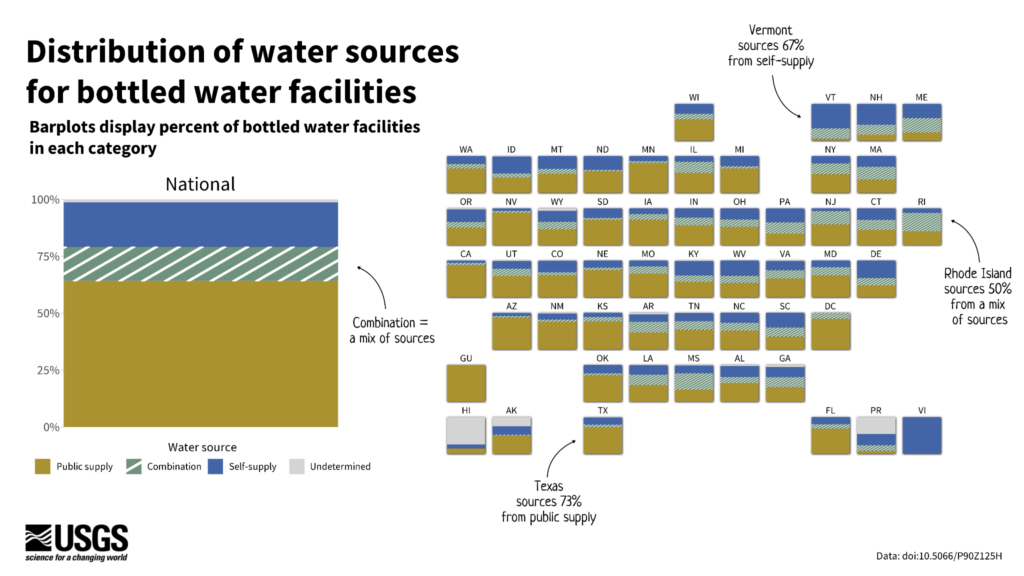
According to the U.S. Geological Survey, approximately 50% of the water in bottled water comes from the public water supply. In New Jersey, that percentage is even higher. Aquafina (Piscataway), Dasani (Carlstadt), Pure Life (Stanhope) and others have bottling facilities that draw from public water for not only their bottled water but other bottled drinks. Coca-Cola, Molson Coors, and Arizona Beverages, and others have been the target of cybersecurity attacks as well.

New Jersey has established cybersecurity requirements

New Jersey has taken steps to address the threat. Amendments to the state Water Quality Accountability Act require public community water systems with more than 500 service connections to develop cybersecurity programs based on recognized industry standards. Systems must also report cybersecurity incidents promptly to the New Jersey Cybersecurity and Communications Integration Cell and maintain cybersecurity insurance.

The 2021 amendments removed an earlier exemption for systems that did not have internet-connected control equipment. All public community water systems exceeding the 500-connection threshold must maintain a cybersecurity program, regardless of whether their operational controls are connected to the internet. Responsible officials must certify compliance annually, and those certifications must include the cybersecurity program. NJDEP is required to audit a portion of the certifications submitted each year.

These requirements give New Jersey a framework for identifying risks and preparing for an incident, but they do not make the systems invulnerable. A written cybersecurity plan is only as effective as the practices behind it. Utilities must know what equipment is connected to their networks, remove unnecessary internet access, change default passwords, control vendor accounts, back up critical systems and practice operating without normal automated controls. Cybersecurity must also be incorporated into capital planning because some risks cannot be corrected without replacing outdated equipment.

The 500-connection threshold raises additional questions about the state’s smallest systems. Small utilities may have fewer customers, but they often have the least money and technical support available for cybersecurity. Their size also does not make them uninteresting to attackers; poorly protected systems can be attractive precisely because they are easier to reach.

Operators remain the final line of defense

Automation has changed how drinking water systems operate, but it has not eliminated the need for experienced people who understand the physical system. When technology fails, operators must be able to recognize abnormal conditions, isolate compromised equipment and keep water moving safely.

Cybersecurity therefore cannot remain solely the responsibility of an information-technology department. Engineers, operators, maintenance workers, equipment vendors and public officials all have a role in protecting the system. The Minnesota and Michigan attacks did not produce widespread water outages or contamination. Local operators and existing safeguards limited the consequences, but the incidents exposed what can happen when attackers reach the systems controlling physical infrastructure. When a computer intrusion can shut down a well or treatment plant, protecting the digital system becomes inseparable from protecting the water itself.

Sources:
American Water Works Company, Inc. (2024, October 7). Current report (Form 8-K). U.S. Securities and Exchange Commission. https://www.sec.gov/Archives/edgar/data/1410636/000119312524233300/d869346d8k.htm

Associated Press. (2026, August 1). FBI investigates as Michigan joins Minnesota in reporting cyberattacks on its water systems. https://apnews.com/article/77d52a1d7356e608500a1ddb0ec373a6

Cybersecurity and Infrastructure Security Agency. (n.d.). Stuxnet malware mitigation (Update B). https://www.cisa.gov/news-events/ics-advisories/icsa-10-238-01b

Greenberg, A. (2026, July 30). A leaked memo ties cyberattacks on Minnesota water utilities to Iran. WIRED. https://www.wired.com/story/a-leaked-memo-ties-cyberattacks-on-minnesota-water-utilities-to-iran/

New Jersey Department of Environmental Protection. (2021). Water Quality Accountability Act amendments guidance. https://www.nj.gov/dep/watersupply/pdf/wqaa-amendments-guidance-2021.pdf

U.S. Environmental Protection Agency. (2024, May). Enforcement alert: Drinking water systems to address cybersecurity vulnerabilities. https://www.epa.gov/enforcement/enforcement-alert-drinking-water-systems-address-cybersecurity-vulnerabilities

U.S. Government Accountability Office. (2024). Critical infrastructure: EPA urgently needs a strategy to address cybersecurity risks to water and wastewater systems (GAO-24-106744). https://www.gao.gov/products/gao-24-106744

U.S. Geological Survey. (2023, November). Proportions of bottled water facilities using different water sources in U.S. states and selected territories. https://www.usgs.gov/media/images/proportions-bottled-water-facilities-using-different-water-sources-us-states-and

Just-Drinks.com. (2024, September). Modern supply chains open up cybersecurity weak spots. https://www.just-drinks.com/features/drinks-industry-modern-supply-chains-open-up-cybersecurity-weak-spots/

Governor Sherrill Signs Power NJ Act, Launching Process for New Nuclear Energy Development

0

State officials and lawmakers say the measure positions New Jersey to meet growing electricity demand while supporting economic growth and infrastructure investment.

Governor Mikie Sherrill has signed the Power NJ Act, officially launching New Jersey’s procurement process for a new generation of nuclear power facilities as the state seeks to meet rising electricity demand while strengthening grid reliability.

The legislation, which passed both houses of the Legislature unanimously, directs the New Jersey Board of Public Utilities (NJBPU) and the New Jersey Economic Development Authority (NJEDA) to jointly administer a competitive process to procure at least 1,100 megawatts of new nuclear generation.

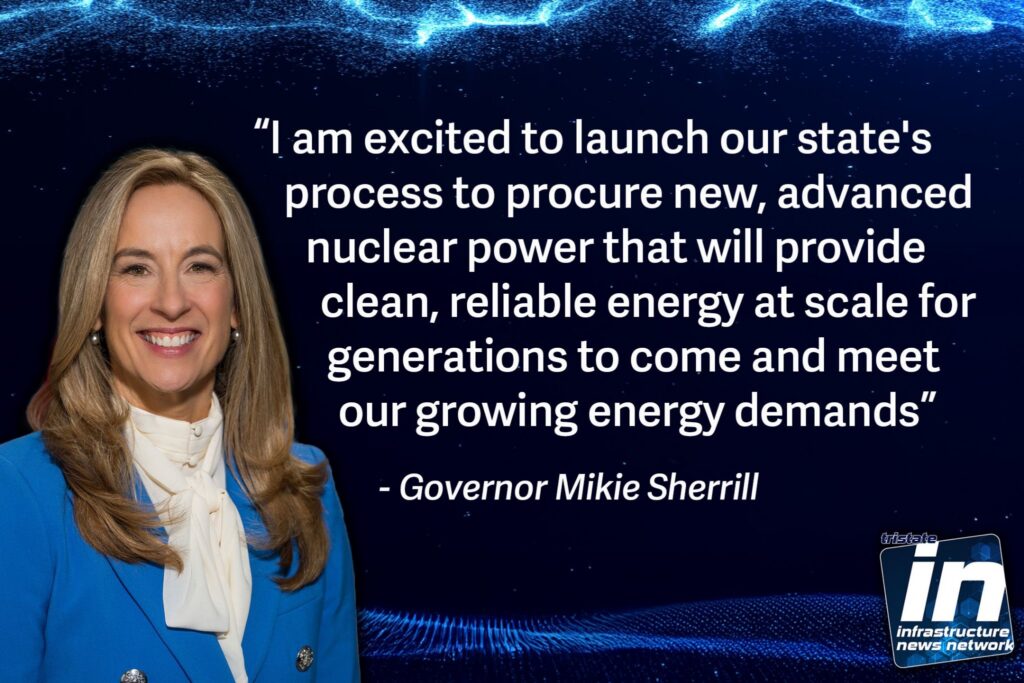
“The decisions we make today will determine the future we leave our kids, so we are putting New Jersey on a path to an affordable and secure energy future,” Governor Sherrill said. “I am excited to launch our state’s process to procure new, advanced nuclear power that will provide clean, reliable energy at scale for generations to come and meet our growing energy demands.”

Unlike traditional project financing models, the legislation includes several provisions intended to protect ratepayers. Customers will not bear construction costs, nor will they be responsible for project cost overruns. Developers must also secure federal financing before receiving final approval, and the NJBPU must determine that any selected project provides a net benefit to ratepayers before construction can proceed.

The legislation was sponsored by Senate President Nicholas Scutari (D-Union), Senator Bob Smith (D-Middlesex), Senator John Burzichelli (D-Gloucester), Assemblyman Wayne DeAngelo (D-Mercer, Middlesex), Assemblyman David Bailey Jr. (D-Gloucester, Salem, Cumberland), and Assemblyman Robert Karabinchak (D-Middlesex), with additional bipartisan co-sponsorship from lawmakers including Senator Latham Tiver (R-Burlington), underscoring the broad legislative support behind the measure.

“As New Jersey strives to meet growing energy demands, we need to be proactive in pursuing reliable and forward-looking solutions,” said Assemblyman Wayne DeAngelo (D-Mercer, Middlesex). “Advanced nuclear technology has the potential to strengthen our energy infrastructure, support good-paying jobs, and provide a stable source of power that can meet future needs.

“This bill is about building a strong energy future while making sure we are creating opportunities and protecting ratepayers.”

“The Power NJ Act is now law, marking a major step toward a more reliable, affordable energy future for New Jersey,” Tiver said. “I was proud to support this bipartisan legislation because our state needs more dependable power generation, stronger grid capacity, and good-paying union construction jobs. Advanced nuclear energy can help meet growing demand while providing reliable, around-the-clock electricity for families, businesses, schools, and hospitals.”

Tiver also noted that the new law builds on legislation enacted earlier this year that removed New Jersey’s longstanding permitting barrier to new nuclear development.

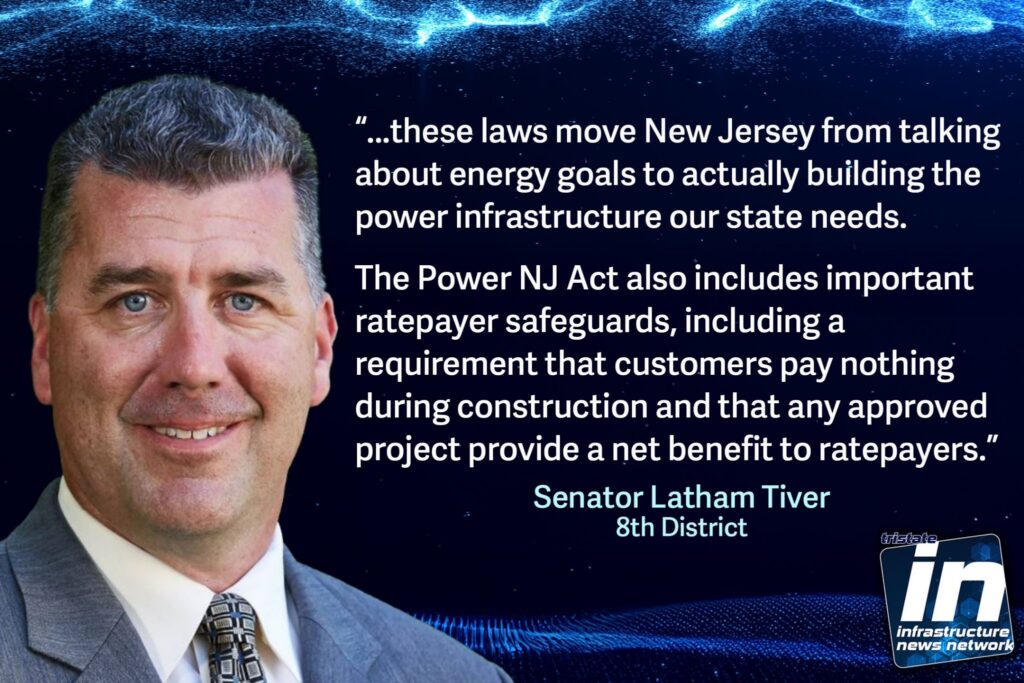
“This progress would not have been possible without first removing New Jersey’s outdated permitting barrier on new nuclear development,” Tiver said. “Together, these laws move New Jersey from talking about energy goals to actually building the power infrastructure our state needs.”

The legislation establishes a multi-year procurement process beginning with a Request for Expressions of Interest expected to be issued within 180 days. Qualified developers will then enter negotiations with the NJBPU and NJEDA before the Board determines whether a proposed project meets the law’s financial, regulatory, and public interest requirements.

Nuclear energy already plays a significant role in New Jersey’s electric grid, providing more than 40 percent of the state’s electricity and more than 80 percent of its carbon-free electricity generation.

Supporters argue that expanding nuclear generation will help address growing electricity demand driven by economic development, electrification, artificial intelligence, and data center expansion while improving long-term grid reliability.

Business organizations across the state praised the legislation following its signing.

The New Jersey Business & Industry Association called the bill “an important step” toward increasing affordable, reliable, and abundant energy, while the New Jersey Chamber of Commerce said expanding advanced nuclear generation would strengthen the state’s long-term economic competitiveness.

If the procurement timeline remains on schedule, the NJBPU is expected to begin accepting developer proposals by early 2027, with final project approvals potentially occurring in 2028.

Source:

Governor’s Office, State of New Jersey. (2026, July 13). Governor Sherrill signs legislation launching procurement process for new nuclear energy and setting strong safeguards to protect ratepayers from costs.

New Jersey Legislature. (2026). Power NJ Act (A4881/S4296).

Infrastructure Update – Week of August 3, 2026

A consequential week across transportation, energy markets, land‑use policy, and regional development. Here is your curated weekly summary of the stories shaping New Jersey and the broader grid transition.

Amtrak & NJ Transit Commit $242M to Fix Vital Rail Bridge

A major Northeast Corridor chokepoint is finally getting long‑overdue attention. Amtrak and NJ Transit will spend $242 million to rehabilitate the century‑old Dock Bridge between Newark and Harrison — a structure that carries more than 400 daily trains and has become increasingly unreliable. The work will address mechanical failures, aging electrical systems, and the bridge’s problematic lift span, which has caused repeated service disruptions. Officials say the repairs are essential to stabilizing operations ahead of larger Gateway Program construction, ensuring the corridor can handle rising ridership and future tunnel‑boring activity.

Read more: https://www.nj.com/news/2026/07/amtrak-nj-transit-to-spend-242m-to-fix-this-vital-bridge.html?outputType=amp

America’s Electricity Mix Has Transformed Over 75 Years

A sweeping visualization of U.S. electricity generation shows how dramatically the grid has evolved since 1949. Coal once dominated with more than 50% of national output; today it has fallen below 20%. Natural gas surged beginning in the 2000s and now supplies roughly 40% of U.S. electricity. Nuclear stabilized at around 18–20%, while renewables — especially wind and solar — have grown from statistical rounding errors to more than 20% of generation. The long‑term trend is unmistakable: fossil fuels are declining, renewables are accelerating, and the grid is becoming more diversified, though still heavily dependent on gas.

Read more: https://www.visualcapitalist.com/75-years-americas-electricity-transition/

Perth Amboy Breaks Ground on 18.6‑Acre Gateway Redevelopment

Perth Amboy has launched one of its most ambitious redevelopment efforts in decades: an 18.6‑acre mixed‑use district designed to reshape the city’s waterfront gateway. The project will include housing, commercial space, public amenities, and new infrastructure intended to reconnect neighborhoods long separated by industrial land. Officials say the redevelopment will boost tax revenue, attract private investment, and create a more walkable, transit‑connected urban core. The groundbreaking marks a major milestone for a city seeking to modernize while preserving its historic character.

Read more: https://binje.com/sectors/real-estate/perth-amboy-breaks-ground-on-gateway-project-18-6-acres-dedicated-to-future-of-city/

Virtual Power Plants Surge as AI Demand Reshapes the Grid

Virtual power plants (VPPs) — networks of distributed energy resources coordinated through software — are rapidly expanding as data‑center growth and AI workloads strain the grid. The analysis highlights how battery storage, smart thermostats, EV chargers, and rooftop solar can be aggregated to provide peak‑shaving, frequency regulation, and emergency support. Utilities increasingly view VPPs as a cost‑effective alternative to building new gas peaker plants. With AI‑driven electricity demand rising faster than expected, VPPs are becoming a central tool for maintaining reliability without massive new fossil‑fuel investment.

Read more: https://tristateinfrastructurenews.com/virtual-power-plants-surge-as-ai-demand-reshapes-the-energy-grid/

NJ Town Must Build Affordable Housing Despite Lacking Sewers

A New Jersey municipality argued it could not meet its affordable‑housing obligations because it lacks sewer capacity — but a court rejected the claim. The ruling states that infrastructure limitations do not exempt towns from state‑mandated housing requirements. Instead, municipalities must work with utilities, counties, or developers to find solutions, whether through extensions, upgrades, or alternative systems. The decision reinforces New Jersey’s long‑standing doctrine that towns cannot use infrastructure constraints to avoid building affordable units.

Read more: https://www.nj.com/realestate-news/2026/07/lack-of-sewers-wont-get-nj-town-out-of-its-obligation-to-build-affordable-housing.html

New Jersey American Water Adds 15,300 Customers Through Acquisition

New Jersey American Water has completed its acquisition of the Gordons Corner Water Company, adding 15,300 customers across Manalapan and Marlboro. The deal brings aging infrastructure under a larger utility with more capital resources, enabling upgrades to treatment systems, pipes, and storage facilities. Customers are expected to benefit from improved reliability and long‑term investment, though rate adjustments may follow as the utility integrates the system.

Read more: https://binje.com/sectors/energy/new-jersey-american-water-completes-acquisition-of-gordons-corner-water-company-adding-15300-customers/

Preserved Farmland Could Host Renewable Energy Under Bipartisan Bill

A bipartisan proposal would allow preserved farmland to host small‑scale renewable energy installations that serve neighboring properties. The bill aims to support rural electrification, reduce energy costs for farmers, and expand distributed solar without undermining agricultural productivity. The measure reflects growing interest in dual‑use land strategies that balance food production with clean‑energy deployment.

Read more: https://tristateinfrastructurenews.com/preserved-farmland-could-generate-renewable-energy-for-neighboring-properties-under-bipartisan-bill/

New Jersey Is Ninth Most Expensive State for Utility Costs

A new report ranks New Jersey as the 9th most expensive state for household utility spending. High electricity rates, water costs, and broadband prices contribute to the burden. The analysis notes that rising data‑center demand, aging infrastructure, and limited in‑state generation capacity all play roles in pushing costs upward. The ranking underscores the state’s ongoing challenge of balancing reliability, affordability, and clean‑energy goals.

Read more: https://www.roi-nj.com/2026/07/30/industry/energy-utilities/n-j-is-ninth-most-expensive-state-for-utilities-spending-according-to-a-report/

Have a good week and be sure to share this with associates and friends.

CHPE Brings Canadian Hydropower to NY

The new transmission line will supply enough clean energy to meet up to 20% of New York City’s electricity needs.

Champlain Hudson Power Express begins delivering clean energy to New York City

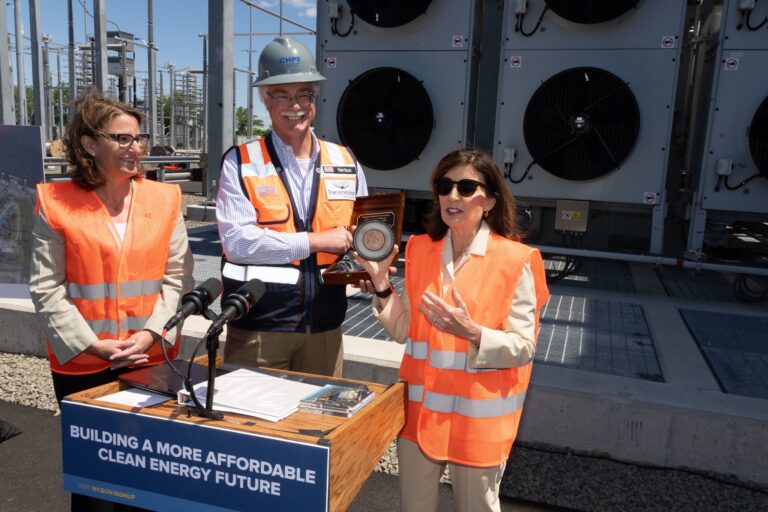
The Champlain Hudson Power Express (CHPE), a 339-mile high-voltage transmission line capable of supplying up to 20 percent of New York City’s annual electricity demand, is now fully operational. The project delivers renewable hydropower from Hydro-Québec directly to New York City, completing an energy infrastructure investment that took more than a decade to develop and construct.

Hydro-Québec’s long-term contract with the New York State Energy Research and Development Authority (NYSERDA) officially began June 1. The utility can now supply electricity through the state’s Tier 4 renewable energy program and participate in the New York Independent System Operator’s wholesale energy and capacity markets after completing testing ahead of schedule.

“We can place transactions based on market dynamics,” said Peter Rose, senior director for stakeholder relations at Hydro-Québec. “Depending on the prices for New York City, if they support the transaction, we will bid.”

Hydro-Québec intends to participate in New York’s summer capacity markets, when electricity demand in New York City typically reaches its highest levels. “The good thing with being done early is we can provide capacity to New York City when it needs it most,” Rose said.

Building a new path for clean energy

Buried underground and beneath waterways for nearly its entire route, CHPE stretches from the Canadian border through Lake Champlain and the Hudson River before terminating in Astoria, Queens. The project includes more than 25 miles of underground transmission line along U.S. Route 9W in Rockland County.

The line can deliver 1,250 megawatts of renewable electricity to the nation’s largest city. State officials estimate CHPE will provide approximately 10.4 terawatt-hours of electricity each year, reducing New York City’s reliance on fossil fuel-fired generation and cutting greenhouse gas emissions over the coming decades.

The project also adds a major new source of electricity at a time when New York’s power needs are growing. As millions of residents rely on air conditioning during periods of extreme heat, CHPE can help strengthen reliability by delivering steady, carbon-free electricity directly into New York City’s constrained electric grid.

That need became particularly clear this summer when statewide demand climbed above 32,000 megawatts and the New York Independent System Operator issued an Energy Watch. Bringing CHPE online ahead of schedule allowed the project to begin contributing during one of the most demanding periods of the year.

Years of work before construction began

Although CHPE had already received federal approval, the project still needed support from state and local governments, community leaders and residents along its route. The Engineers Labor-Employer Cooperative (ELEC825) worked closely with the project’s community outreach team for several years to build consensus and explain the project’s economic, workforce and energy benefits.

Much of that work occurred before construction began. Daniel Ortega, Community Affairs Director for ELEC825, submitted letters of support to county and state agencies, testified at in-person and virtual public hearings and met with elected officials at every level of government to advocate for the project.

“Projects like CHPE don’t move forward on engineering alone,” Ortega said. “They require years of community engagement, conversations with local officials and helping residents understand why the project matters.”

Governor Kathy Hochul and NYSERDA played central roles in advancing CHPE as part of New York’s clean energy strategy. Their support helped move one of the state’s largest energy infrastructure investments from the approval process into construction and, ultimately, operation.

Thousands of union jobs

CHPE’s impact extends beyond the electricity it will deliver. Construction created more than 1,400 direct jobs for members of Operating Engineers Local 825, the Laborers, IBEW and other union trades while generating more than $400 million in wages and benefits.

The project also supported an estimated 3,200 indirect and induced jobs throughout the construction period. Billions of dollars were invested in the project, while host communities benefited from new tax revenue and the economic activity generated by construction.

These investments were especially important as New York emerged from the economic disruption caused by the COVID-19 pandemic. CHPE demonstrated how major infrastructure projects can support immediate employment while building energy systems intended to serve residents and businesses for decades.

Operating Engineers Local 825 supported CHPE because the project combined reliable energy infrastructure with family-sustaining union careers and investment in local communities. Its construction also demonstrated the range of skilled workers required to build a modern transmission system across hundreds of miles of varied terrain.

Investing in the clean energy workforce

CHPE also created a $40 million Green Economy Fund to expand access to careers in New York’s clean energy economy. The fund partners with existing training programs to support workforce development and prepare New Yorkers for employment in growing energy and infrastructure sectors.

That investment aligns with Local 825’s longstanding emphasis on apprenticeship, training and continuing education. Modernizing the electric grid will require not only new generation and transmission infrastructure, but also a workforce trained to build, operate and maintain increasingly complex energy systems.

CHPE provides a model for how environmental, economic and workforce goals can be pursued through the same infrastructure investment. The project is now delivering renewable electricity to New York City; its longer-term impact will be measured through improved grid reliability, sustained benefits for local communities and the skilled careers created by the transition to a cleaner energy system.

Source:

Hydro-Québec. (2026). Champlain Hudson Power Express enters commercial operation. https://www.hydroquebec.com/

New York Independent System Operator. (2026). Energy Watch and grid operations updates. https://www.nyiso.com/

New York State Energy Research and Development Authority. (2026, June 16). Governor Hochul celebrates completion of Champlain Hudson Power Express project. https://www.nyserda.ny.gov/About/Newsroom/2026-Announcements/2026-06-16-Governor-Hochul-Celebrates-Completion-Of-Champlain-Hudson-Power-Express-Project

The new arms race: USA and China rush towards AGI

A survey of expert analysis from Brookings, RAND, and MIT Technology Review

The competition between the United States and China over artificial intelligence is reshaping global power, economic strategy, and military capability. As AI becomes the backbone of national security, industrial productivity, and digital governance, the stakes of this rivalry extend far beyond technology companies or research labs. They influence how nations project influence, how alliances form, and how emerging markets choose their digital infrastructure. Understanding these dynamics requires clear, credible, analysis from institutions that study geopolitics, defense, and global governance with rigor. The following reading list brings together authoritative articles from Brookings, RAND, and MIT Technology Review. Together, they offer an overview of how AI is transforming the U.S.–China relationship — and what it could mean for global stability, economic leadership, and the future of democratic versus authoritarian digital systems.

“Competing AI strategies for the US and China”

Brookings

In testimony before the U.S. House Select Committee on Strategic Competition Between the United States and the Chinese Communist Party in April, Brookings research fellow Kyle Chan testified that the United States and China are pursuing fundamentally different pathways to AI power. The U.S. strategy is driven by frontier model breakthroughs, massive private‑sector investment, and leadership in cutting‑edge research. China, by contrast, is focused on “full-stack”, rapid, nationwide deployment of AI across manufacturing, logistics, public services, and governance, aiming to embed AI deeply into its economic and administrative systems. These divergent approaches create a strategic competition over which nation can translate AI into real‑world influence fastest and most effectively. The stakes extend beyond technology: whoever leads shapes global digital norms, standards, and governance models. Chan warns that if the U.S. falls behind, China could gain long‑term geopolitical leverage through AI‑enhanced military capabilities, digital infrastructure exports, and influence in emerging markets. The future balance of global power may hinge on how each country aligns AI development with national strategy. 

https://www.brookings.edu/articles/competing-ai-strategies-for-the-us-and-china

“The Artificial General Intelligence Race and International Security”

RAND Corporation

The emerging race toward artificial general intelligence (AGI) is reshaping international security, especially within the broader strategic competition between the United States and China. Expert analyses commissioned by Perry World House and RAND’s Geopolitics of AGI Initiative, explores whether the greatest risks arise during the ambiguous pre‑AGI period or from a rapid, competitive sprint toward AGI itself. Contributors debate whether AGI will fundamentally alter nuclear stability or instead democratize access to destructive capabilities. Several argue that traditional arms‑control frameworks are inadequate for AGI, proposing new governance models such as an “AI cartel” to separate military and civilian development. Across the papers, a set of strategic dilemmas emerges — speed versus caution, perception versus reality, and competition versus cooperation — all of which require deliberate choices to ensure AGI strengthens rather than destabilizes global security. 

https://www.rand.org/pubs/perspectives/PEA4155-1.html

“China’s open-source bet”

MIT Technology Review

China’s leading AI labs are reshaping global competition by releasing powerful “open‑weight” models that developers can download, modify, and run locally. This strategy took off after DeepSeek open‑sourced its R1 reasoning model in 2025, matching top U.S. systems at far lower cost. Chinese labs—including Z.ai, Moonshot, Alibaba’s Qwen, and MiniMax—now dominate global model downloads and user‑generated variants, surpassing U.S. firms on Hugging Face. Open‑weight access lets developers experiment cheaply and customize models without relying on American APIs, driving adoption across the Global South. Countries like Singapore and Malaysia are building sovereign AI ecosystems on Chinese foundations. The approach isn’t purely idealistic: open‑source accelerates feedback loops and compensates for China’s limited access to advanced chips. Despite concerns about content controls and alleged distillation misuse, China’s open‑source momentum is making the AI landscape more multipolar—and increasingly difficult for Silicon Valley to contain. 

https://www.technologyreview.com/2023/11/14/1083480/china-ai-strategy-global-power

What the July storms revealed about New Jersey’s Infrastructure

0

Hundreds of thousands lost power, roads flooded, transit slowed and sewer systems were put to the test. The numbers tell a story that extends well beyond a single week of severe weather.

For one week in July, nearly every infrastructure system in New Jersey was tested by a series of severe storms that exposed just how interconnected the state’s water, transportation and energy networks have become. The storms were extraordinary, but many of the challenges that followed were anything but unexpected. Aging infrastructure, increasingly intense rainfall and decades-long capital improvement programs combined to create a cascade of disruptions that reached every corner of the state.

A grid pushed to its limits

Perhaps no system illustrates the scale of the storm better than New Jersey’s electric grid. Public Service Electric & Gas (PSE&G) described the response as one of the ten largest restoration efforts in the company’s history. Between July 1 and July 8, crews restored power to more than 380,000 customers following a combination of extreme heat and severe thunderstorms that battered much of the state.

Crews repaired or replaced approximately 700 utility poles, removed roughly 1,500 fallen trees, deployed 170 tree crews and 165 specialized utility crews, completed more than 7,000 air conditioner repairs, replaced 110 air conditioning systems, and sent more than 10 million text messages and emails to customers throughout the restoration effort.Jersey Central Power & Light (JCP&L) restored power to more than 300,000 customers. 

Some communities were hit especially hard. In Point Pleasant, nearly 2,800 of the borough’s 9,930 electric customers lost power, leaving almost 30 percent of the community without electricity during a peak tourism time, America’s 250th birthday. The borough responded by opening Town Hall as a cooling center while temperatures remained dangerously high.

The widespread outages left New Jerseyans wondering how utilities prioritize restoration. Atlantic City Electric’s restoration plan explains. Downed energized lines and other life-threatening hazards are addressed before moving to high-voltage transmission facilities that restore service to the greatest number of customers. Critical facilities such as hospitals, police departments, fire stations and water treatment plants come next, followed by major distribution circuits and, finally, individual neighborhoods and homes. The approach maximizes the number of customers restored as quickly as possible, even if some neighborhoods must wait longer than others.

Transportation grinds to a halt

Transportation systems quickly became another point of failure. As flooding spread across the state, the New Jersey Department of Transportation activated its Emergency Operations Center and shifted personnel away from routine maintenance and construction work to clearing flooded highways, removing downed trees, inspecting bridges and reopening roads. At the local level, public works departments made similar shifts.  Emergency responders were called upon not only for rescues, but also to clear drainage systems so floodwaters could recede. In Glendora, Camden County, firefighters fought back as floodwaters entered Tony Morelli’s Market by clearing clogged storm drains outside the business so water could begin draining away. 

NJ Transit experienced service disruptions as flooding and fallen trees affected rail infrastructure, while weather-related delays rippled through Newark Liberty International Airport and other regional transportation hubs.

Unlike the electric grid, however, there is no comprehensive statewide database documenting flood-related road closures. Drivers instead relied on whatever information that could access, like county emergency alerts, municipal police departments, social media pages and google maps and to navigate what roads to travel.

Water system fails quietly

Unlike the electric grid, New Jersey’s drinking water systems generally remained operational throughout the storms. But the same cannot be said for the state’s wastewater infrastructure.

New Jersey still has 21 municipalities served by combined sewer systems, where stormwater and sanitary sewage share the same pipes. During intense rainfall, those systems are designed to release excess flows directly into nearby rivers, waterways and in some cases neighborhood streets through combined sewer overflow (CSO) outfalls rather than allowing wastewater to back up into homes and businesses.

What happened during the July storms should have made CSOs a major public conversation. Instead, one of the most striking aspects of the event is how little information is publicly available. Despite one of the state’s largest rainfall events in recent years, there is no centralized, publicly accessible system showing whether combined sewer overflows occurred, where they occurred, how long they lasted or how much untreated wastewater entered New Jersey’s waterways.

Residents could easily track power outages in real time. They could monitor road closures, weather alerts and restoration estimates. Yet there was no equivalent statewide dashboard allowing the public to determine whether untreated sewage had been discharged into their communities and rivers.

That lack of transparency is particularly notable given the enormous public investment already underway. New Jersey’s Long Term Control Plans for combined sewer communities are expected to cost billions of dollars. The projects include separating stormwater and sanitary sewer lines where practical, expanding wastewater treatment capacity, constructing storage facilities, rehabilitating aging infrastructure and installing green infrastructure designed to reduce stormwater entering the system.

The absence of timely reporting makes it difficult for residents, researchers and policymakers to evaluate how these systems actually performed during one of the state’s most significant storm events.

The cost of aging infrastructure

The July storms also underscored a broader reality: much of New Jersey’s infrastructure was built for a different climate and a smaller population.

When New Jersey’s older sewer systems were constructed in the late nineteenth and early twentieth centuries, cities were dramatically smaller and far less paved. Today, decades of development have replaced forests, wetlands and open fields with rooftops, roads and parking lots that rapidly channel stormwater into drainage systems. The result is a dramatic increase in runoff entering infrastructure that was never designed for today’s rainfall intensity.

The same challenge exists throughout the transportation network. Many roads that flooded during July are familiar trouble spots because storm drains and culverts simply cannot move water quickly enough during extreme rain events. Repeated flooding in the same locations suggests that these are no longer isolated weather emergencies. These are recurring infrastructure challenges that will not get better without upgrades. 

Where New Jersey could improve

The July floods point toward several opportunities to strengthen the state’s resilience before the next major storm arrives.

For wastewater systems, accelerating implementation of Long Term Control Plans would reduce the frequency and volume of CSOs. Equally important would be improving transparency. New Jersey should have a statewide, real-time public dashboard reporting when CSOs occur, where they occur, how long they last and which communities are affected. 

Electric utilities have made significant investments in grid modernization that likely reduced both the number and duration of outages. Continued investment in vegetation management, substation flood protection and undergrounding where practical and microgrids serving critical facilities could further improve resilience.

Transportation agencies face a similar challenge. Replacing undersized culverts, expanding stormwater storage, modernizing drainage systems and elevating chronically flooded roadways will become increasingly important as rainfall intensity continues to increase.

Communication also deserves attention. PSE&G’s restoration effort included more than 10 million customer updates. By comparison, information about road closures, wastewater impacts and other infrastructure disruptions were lacking. A centralized statewide infrastructure dashboard combining transportation, utility and water system information could significantly improve public awareness during future emergencies.

More than a weather story

July 2026 was a large-scale stress test of New Jersey’s critical infrastructure. The state’s utilities demonstrated remarkable restoration capabilities, mobilizing thousands of workers and restoring hundreds of thousands of customers in just days. Transportation agencies reopened roads, municipalities cleared debris and emergency responders worked around the clock to keep residents safe.

But even with these tremendous efforts, the storms revealed real vulnerabilities. New Jersey can tell residents exactly how many utility poles were replaced, how many trees were removed and how many customers remain without power. It can publish interactive outage maps that update almost in real time.

It still cannot tell the public, in any meaningful or timely way, whether combined sewer overflows occurred during one of the largest storm events of the year, where untreated wastewater entered local waterways or how those systems performed under extreme conditions. For a state investing billions of dollars to modernize its infrastructure, that may be one of the most important lessons the July floods left behind.

Sources:

6abc Philadelphia. Heavy rain causes flash flooding on roadways in Philadelphia and New Jersey. https://6abc.com/post/heavy-rain-causes-flash-flooding-roadways-philadelphia-new-jersey/19458231/

ABC7 New York. New Jersey storms cause NJ Transit disruptions, massive power outages. https://abc7ny.com/post/new-jersey-storm-powerful-storms-cause-nj-transit-disruptions-suspensions-massive-power-outages-1-man-killed/19456389/

Atlantic City Electric. Restoration priorities. https://www.atlanticcityelectric.com/Outages/ExperiencingAnOutage/Pages/RestorationProcess.aspx

FirstEnergy. Jersey Central Power & Light news and storm updates. https://www.firstenergycorp.com/jersey_central_power_light.html

Governor of New Jersey. Governor Sherrill provides update on severe weather response. https://www.nj.gov/governor/news/2026/20260706a.shtml

New Jersey Department of Environmental Protection. Combined sewer overflow (CSO) program. https://dep.nj.gov/dwq/combined-sewer-overflow/

NJ.com. New Jersey power outage tracker. https://projects.nj.com/data/outagetracker/

NJ Patch. Wall, K. Almost 30% of Point Pleasant loses power after July 4 storms. https://patch.com/new-jersey/pointpleasant

Public Service Electric & Gas. PSE&G continues final phase of major storm restoration effort, restoring power to more than 380,000 customers. https://nj.pseg.com/newsroom/newsrelease497

Public Service Electric & Gas. PSE&G continues around-the-clock restoration following week of extreme heat and successive storms. https://nj.pseg.com/newsroom/newsrelease496