
Our Infrastructure Matters Ad
Home Blog Page 7

World Cup – crossed fingers and missed opportunities

Matches puts Meadowland and NJ Transit inadequacies on the world stage

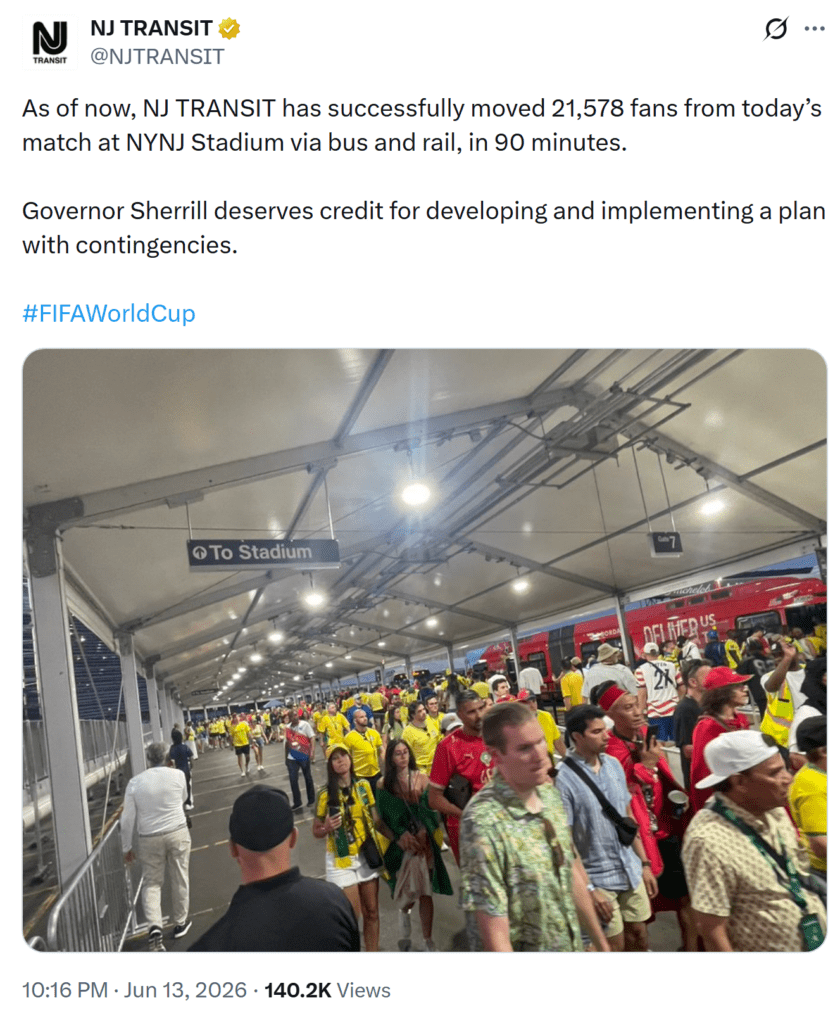
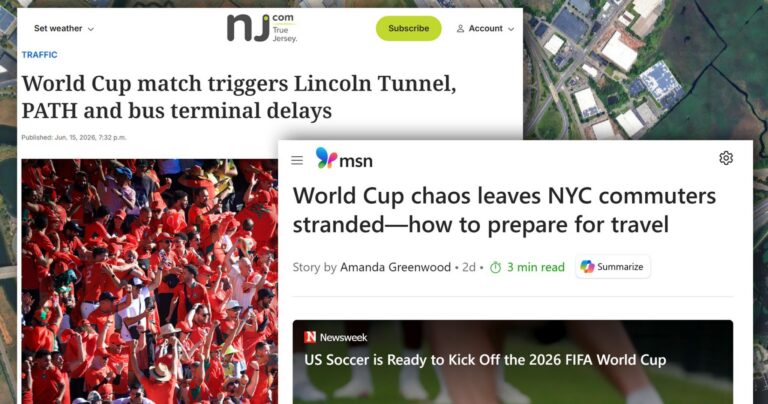
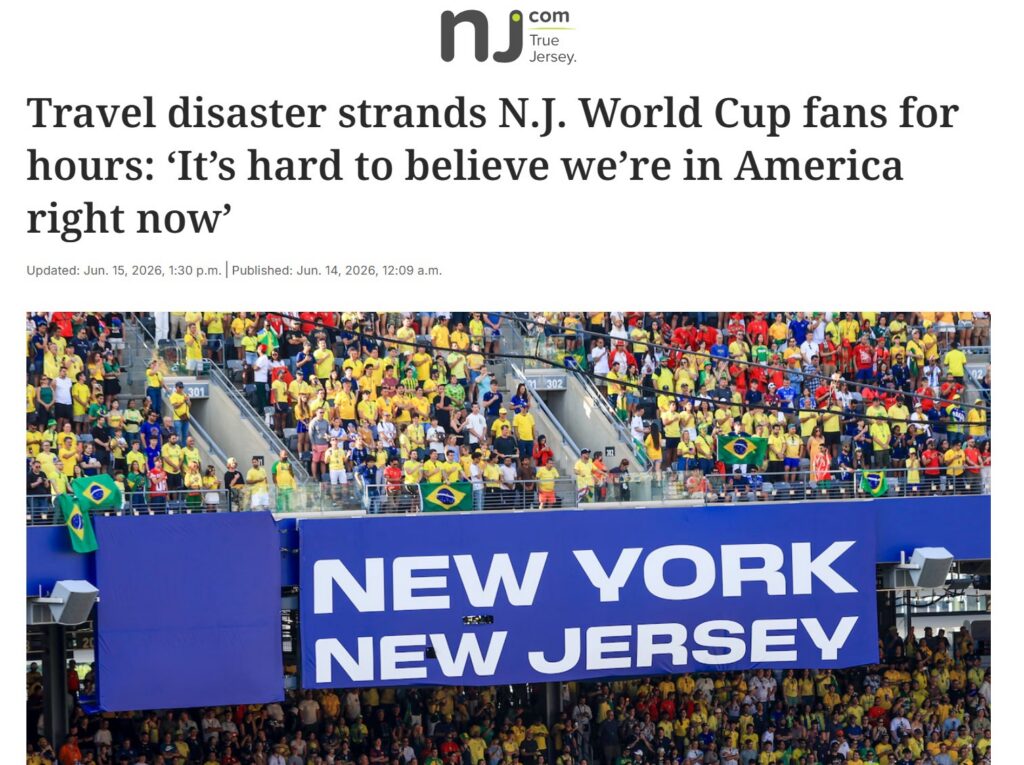
New Jersey Transit appeared to take a victory lap after the first World Cup match between Brazil and Morocco on June 13th at the Meadowlands. With soccer fans repping Brazil in yellow and green and Morocco in red, it certainly looked colorful and festive.

But it wasn’t long after the match ended that news reports of hours-long delays surfaced.

https://x.com/StevePoliti/status/2066025457095508040

Delays stretched for well over two hours as shuttle buses crawled through gridlock and fans waited in lines that wrapped around multiple city blocks. Some buses took 90 minutes just to reach the stadium, and post‑match queues moved so slowly that many fans needed two to three hours to get back to Manhattan.

You could have seen this potential for a transportationpocalypse from Exit 9a. Anyone who has ever tried to get in or out of the Meadowlands for a major event knows exactly what the rest of the world is discovering during the 2026 World Cup: the transportation system serving New Jersey’s premier entertainment complex is fundamentally broken.
We’ve heard this song before

The 2014 “Mass Transit Super Bowl” was supposed to showcase the region’s ability to move enormous crowds efficiently. Instead, it became a case study in what happens when you funnel tens of thousands of people through a single‑track rail spur and a single transfer station. Fans were stuck for hours at Secaucus Junction, packed shoulder‑to‑shoulder, chanting in frustration as trains backed up and platforms overflowed. Five years later, 2019’s WrestleMania 35 delivered a sequel no one asked for. A rain delay pushed the event late into the night, and NJ Transit was overwhelmed. Thousands of fans waited until 2 or 3 a.m. for trains. Some didn’t get home until nearly dawn. Once again, the Meadowlands made national news for all the wrong reasons.

Pick your artist, pick your year — the story is the same. Taylor Swift’s 2023 shows produced gridlock stretching miles down Route 3. Beyoncé’s concerts saw crushing crowds at Secaucus and long delays boarding trains. Even Bruce Springsteen, the patron saint of New Jersey, couldn’t escape the dysfunction: fans routinely waited more than an hour to leave the stadium.

These weren’t anomalies. They were symptoms. Ask any Jets or Giants season‑ticket holder. Leaving a Sunday game often means sitting in the parking lot for 45 minutes before you even reach the exit. Or inching along the Turnpike western spur. Or waiting in a snaking line for a train that can only move one direction at a time. But because this is our normal, we’ve adapted. Like frogs in a pot of slowly heating water, we’ve learned to live with the dysfunction. We joke about it. We plan around it. We accept it. That acceptance is exactly why nothing has changed.

Now, on the world stage

The problems we’re seeing during the World Cup aren’t surprising to anyone who has ever set foot in the Meadowlands. They were predictable and they were warned about repeatedly. New Jersey applied band‑aids (wristbands at Secaucus Junction, temporary 10-gate bus terminal, extra staff) to a problem that is much bigger than band‑aids. These measures help manage chaos. They do not eliminate it. They do not increase capacity. They do not fix the underlying structural constraints. They are clever workarounds for a system that was never designed to handle global‑scale events.

New Jersey has the region’s largest entertainment complex – the largest stadium hosting the biggest events – but not a world‑class one. Instead of being a crown jewel, the Meadowlands has become a global punchline. The stadium is world‑class. The events are world‑class. The transportation system is not. And that mismatch is costing New Jersey money, reputation, and opportunity.

The Meadowlands should be a source of pride – a place that attracts investment, tourism, and global attention. We deserve a world-class stadium district, a world-class convention center, and a world-class transportation network creating a world-class visitor experience. Instead, we have world‑class events sitting on top of what is essentially 1970s infrastructure.

Let’s fix this

There is no single solution, but there are several viable paths. Some are big, some are small, all are necessary.

1. Double‑track the Meadowlands rail spur

This is the most important fix.  A single‑track line can only move one train at a time. A second track would double capacity and eliminate the biggest bottleneck.

2. Build the Secaucus–Meadowlands Transitway

This bus rapid transit corridor would create a dedicated, high‑capacity link between Secaucus and the stadium. It’s the most realistic near‑term project.

3. Add a second platform at the stadium

Right now, trains can only load and unload from one side. A second platform would speed up operations and reduce dwell times.

4. Create a direct rail connection from the Northeast Corridor

A wye (a triangular track junction) or bypass would allow direct trains from New York, Newark, and Philadelphia without forcing everyone through Secaucus.

5. Expand pedestrian and micromobility access

Right now, you can’t walk or bike to the stadium. That’s absurd for a venue this large. Safe, separated pathways would reduce car dependency.

6. Build a true entertainment district

Restaurants, hotels, retail, and public spaces would spread out arrivals and departures — and generate revenue beyond event days.

7. Long‑term: Consider a PATH extension

Expensive, yes. Transformative, absolutely.

None of these are impossible. All of them are achievable. What’s missing is the will to treat the Meadowlands as the economic engine it truly is.

Jersey pride

With eight matches scheduled for the Meadowlands (including the final), the state is holding its collective breath during each match, crossing its fingers that an equipment issue that challenges commuters daily doesn’t happen while the whole world is watching. It does not have to be this way.

Major events bring hundreds of thousands of visitors who spend on hotels, restaurants, transportation, retail, and entertainment. Building a modern entertainment district would spur new hotels, restaurants, retail, and even new residential and commercial development. These improvements not only bring construction jobs, but also stadium jobs, hospitality jobs, media jobs. The World Cup alone is projected to support tens of thousands of jobs across the region.

Infrastructure investments pay for themselves through increased event hosting, higher tourism spending, greater economic activity, and long‑term regional growth. The Meadowlands can be an economic powerhouse – if we treat it like one. Hosting global events with a world class facility puts New Jersey on the world stage. That visibility attracts investment, business relocations, and future events. More visitors = more spending = more revenue for state and local governments.

New Jersey has everything it needs to build a world‑class entertainment complex. What we lack is the vision and the infrastructure to match. It’s time to stop accepting dysfunction as normal. It’s time to stop applying band‑aids to structural failures. Let’s turn the Meadowlands into a source of pride, not a punchline.

Sources:

Higgs, L. (2023, May 25). Taylor Swift N.J. concerts: How NJ Transit plans to avoid a repeat of Super Bowl, Wrestlemania. NJ.com. https://www.nj.com/news/2023/05/taylor-swift-nj-concerts-how-nj-transit-plans-to-avoid-a-repeat-of-super-bowl-wrestlemania.html

Wilson, C. (2026, June 3). What NJ Transit learned from 2014 Super Bowl to handle World Cup. NorthJersey.com / The Bergen Record (via Yahoo News).
https://news.yahoo.com/nj-transit-learned-2014-super-082800996.html

Rivard, R. (2024, February 10). NJ’s World Cup transit challenge: Replicate Taylor Swift success, avoid Super Bowl disaster. POLITICO.
https://www.politico.com/news/2024/02/10/nj-world-cup-transit-challenge-00140738

CBS New York. (2026, June 14). Fans face long delays leaving MetLife Stadium after World Cup opener. CBS News.  

https://www.cbsnews.com/newyork/world-cup-metlife-stadium-delays

NBC New York. (2026, June 13). World Cup kickoff brings traffic gridlock, long bus lines, and transit headaches across NYC and New Jersey. NBC 4 New York.  

https://www.nbcnewyork.com/news/local/world-cup-traffic-delays-metlife-stadium

ABC7 New York. (2026, June 14). Hours‑long waits for World Cup shuttle buses frustrate fans after MetLife match. ABC7 Eyewitness News.  

https://abc7ny.com/world-cup-metlife-stadium-bus-delays

NJ Advance Media. (2026, June 14). ‘A transportation nightmare’: Fans report 2‑hour delays after first World Cup match at MetLife. NJ.com.  

https://www.nj.com/news/2026/06/world-cup-metlife-stadium-transportation-delays.html
Raw Sewage in the streets – New Jersey’s dirty little secret

Heavy rain doesn’t just cause flooding. In many older cities, it can also force raw sewage onto streets and into nearby rivers, bays and streams. The problem lies beneath our feet. In communities served by combined sewer systems, the same underground pipes carry both stormwater and wastewater from homes, businesses and industries. Under normal conditions, everything flows to a wastewater treatment plant. But during intense rainfall, the volume of water can overwhelm the system.

To prevent sewage from backing up into homes and businesses, the excess flow is diverted through relief points known as combined sewer overflows, or CSOs. These emergency discharges can send a mixture of stormwater, untreated sewage, bacteria, floatable trash, industrial pollutants and debris either into local waterways or onto city streets. While the practice protects buildings and critical infrastructure from more severe flooding, it also creates significant public health and environmental concerns.

A system built for another century 

New Jersey’s CSO problem is the legacy of sewer systems built in the late nineteenth and early twentieth centuries, when growing industrial cities needed an efficient way to move wastewater and storm runoff away from homes and businesses. At the time, combined sewer systems were considered an engineering achievement. One network of pipes could carry everything away from densely populated urban centers, helping cities expand during a period of rapid growth.

What engineers could not have anticipated was how dramatically those cities would change. In the 1850’s, when Newark’s sewer system was built, it was home to about 50,000 residents. Today that number is closer to 325,000. As populations grow, open land is replaced with non-permeable structures, which makes flooding harder to avoid. All the while, climate patterns are shifting. Sewers designed more than a century ago for much simpler cities are now being asked to handle more intense weather than any of its original designers could have imagined. These aging systems are not unique to Newark. CSOs remain in service across 21 New Jersey municipalities. Most of them are older, densely developed communities that grew long after their underground infrastructure was built. Those municipalities are: 

  • Bayonne (Hudson County)
  • Camden (Camden County)
  • East Newark (Hudson County)
  • Elizabeth (Union County)
  • Fort Lee (Bergen County)
  • Gloucester City (Camden County)
  • Guttenberg (Hudson County)
  • Hackensack (Bergen County)
  • Harrison (Hudson County)
  • Hoboken (Hudson County)
  • Jersey City (Hudson County)
  • Kearny (Hudson County)
  • Newark (Essex County)
  • North Bergen (Hudson County)
  • Paterson (Passaic County)
  • Perth Amboy (Middlesex County)
  • Ridgefield Park (Bergen County)
  • Trenton (Mercer County)
  • Union City (Hudson County)
  • Weehawken (Hudson County)
  • West New York (Hudson County)

Source: New Jersey Department of Environmental Protection (NJDEP), Combined Sewer Overflow (CSO) Program.

A hidden problem measured in billions of gallons 

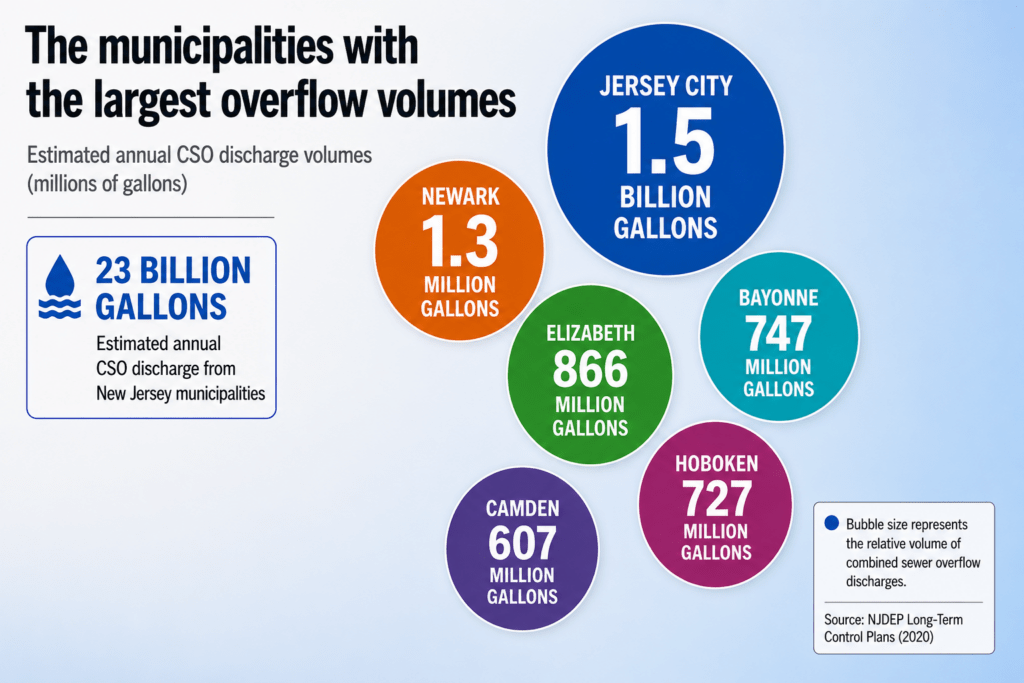
These 21 municipalities collectively discharge an estimated 23 billion gallons of untreated sewage and stormwater into waterways each year. That is enough water to fill tens of thousands of Olympic-sized swimming pools, all entering rivers, bays and streams that flow through some of the state’s most densely populated communities. 

The exact number of overflow events varies by year, location and rainfall intensity. A particularly wet summer can trigger significantly more overflows than a dry year. Yet despite the size of the problem, there is no single statewide record that allows residents to easily track every overflow event. Information is scattered across long-term control plans, permit fact sheets, utility reports, Jersey WaterCheck summaries, local dashboards and newer federal reporting systems. For the average resident trying to understand what is happening in a nearby river, finding reliable information can be surprisingly difficult. Still, publicly available reports can reveal the scope of the challenge. 

Streets to sewers

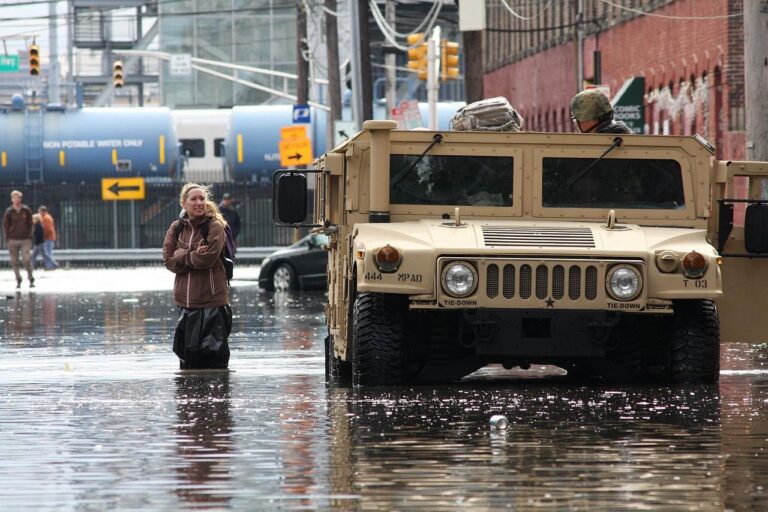
The most alarming consequence of CSOs is what happens on New Jersey’s streets. When intense rain overwhelms a combined sewer system, stormwater and untreated sewage can back up through manholes, storm drains and catch basins, flooding streets, sidewalks and, in some cases, basements with contaminated water. During major storms over the past decade, heavy rainfall has repeatedly inundated neighborhoods across North Jersey, leaving roads underwater and prompting health officials to warn residents to avoid contact with floodwaters because they may contain raw sewage.

During a CSO event, floodwater can contain disease-causing bacteria, viruses and parasites from untreated sewage, including pathogens such as E. coli, Salmonella, norovirus, Giardia and Cryptosporidium. Exposure can occur by walking through floodwaters, cleaning out a flooded basement or allowing children or pets to come into contact with contaminated water after a storm.

Even after floodwaters recede, bacteria levels in rivers, bays and tidal waterways can remain elevated for days following an overflow event, which is why public health agencies routinely advise people to avoid direct contact with urban waterways after heavy rainfall.

The environmental consequences extend beyond public health. Untreated sewage carries nutrients, organic waste and other pollutants that fuel algae growth, reduce dissolved oxygen and place additional stress on aquatic ecosystems already burdened by decades of industrial contamination. Waterways such as the Lower Passaic River, Newark Bay and portions of the Hudson River waterfront continue to receive combined sewer overflow discharges despite years of cleanup efforts.

Combined sewer overflows are often thought of as a water-quality issue. In reality, they are also a neighborhood issue, a transportation issue and a public health issue, affecting the streets people drive, walk and live on whenever aging sewer systems are overwhelmed by increasingly intense storms.

Falling behind

In 1994, the EPA established the National Combined Sewer Overflow (CSO) Control Policy, forcing cities to reduce raw sewage discharges from antiquated, single-pipe water systems. Phase I mandated immediate implementation of “Nine Minimum Controls” – low-cost fixes like clearing debris and optimizing system storage -alongside designing a Long-Term Control Plan (LTCP). Phase II requires executing the Long-Term Control Plan.

New Jersey has lagged years behind this federal timeline. The state missed the EPA’s strict July 2020 deadline to finalize its municipal Phase II permits. As of publication, all but one of the 21 CSO municipalities has a finalized LTCP; Perth Amboy is awaiting final permit issuance.

Executing these LTCPs will cost billions of dollars and take decades to complete. Some of the LTCPs include separating stormwater and sanitary sewer lines where practical. Others are expanding wastewater treatment capacity, constructing storage facilities to capture excess flows, rehabilitating aging sewer infrastructure or installing real-time monitoring systems that optimize existing capacity. Green infrastructure, including rain gardens, bioswales, tree trenches and permeable pavement, is also being deployed to reduce the amount of stormwater entering combined sewer systems before it reaches the pipes. 

Whether those efforts will be enough remains an open question. Climate change is producing more frequent and intense rainfall, placing additional pressure on infrastructure that, in many cases, was designed more than a century ago. Additoinally, many of these improvements depend on access to reliable and affordable electricity. Pump stations, treatment plants and advanced monitoring systems all require significant amounts of energy to operate, making adequate power supply a hurdle in modernizing wastewater systems. Time will tell if New Jersey can deliver the billions of dollars in infrastructure improvements needed to finally rid its streets and waterways from raw sewage before increasingly severe storms outpace the state’s progress.

Sources:

New Jersey Department of Environmental Protection. (n.d.). Combined sewer overflow (CSO) program. State of New Jersey. https://www.nj.gov/dep/dwq/cso.htm

New Jersey Department of Environmental Protection. (2015). New Jersey Pollutant Discharge Elimination System (NJPDES) permit requirements for combined sewer overflow permittees. State of New Jersey. https://www.nj.gov/dep/dwq/pdf/cso_permit_factsheet.pdf

New Jersey Future. (2025). Combined sewer overflows in New Jersey: Fact sheet. New Jersey Future. https://www.njfuture.org

Jersey Water Works. (n.d.). Combined sewer overflows. Jersey WaterCheck. https://jerseywatercheck.org

U.S. Environmental Protection Agency. (2024). Combined sewer overflows (CSOs). https://www.epa.gov/npdes/combined-sewer-overflows-csos

U.S. Environmental Protection Agency. (2025). Sewer overflow and bypass event reporting. https://echo.epa.gov

New Jersey Infrastructure Bank. (2025). Annual report 2025. New Jersey Infrastructure Bank. https://www.njib.gov

Can China cheat its way to AI supremacy? [BBC News]

0

“The race between America and China to lead the world in artificial intelligence is reshaping the global balance of power. But behind the headlines, a hidden conflict is unfolding.

Join AI Decoded as we examine the seizure of $13 million worth of advanced AI chips allegedly bound for China, and Anthropic’s claim that Alibaba carried out the largest known AI “distillation attack” in history.

As nations and tech giants compete for supremacy, the battle for AI is increasingly being fought in the shadows. Who will win the race for AI dominance—and how far will they go to get there?

Join Presenter Christian Fraser, former Pentagon AI Director Gregory Allen, Author and China expert Rana Mitter and AI Decoded co-host Stephanie Hare.”

Infrastructure Update – week of July 13, 2026

0

New Jersey’s transportation, energy, and technology landscape saw major developments this week, from long‑awaited rail upgrades to sweeping energy reforms and new warnings about AI‑related cyber threats. Here’s your full briefing.

Sawtooth Bridges Project Moves Ahead

NJ Transit and Amtrak executives say the Sawtooth Bridges Replacement Project is officially progressing, with enabling construction work underway. The Sawtooth Bridges — located between Newark Penn Station and Secaucus Junction — are among the oldest structures on the Northeast Corridor and a major source of delays. Replacing them is expected to improve reliability and increase train speeds through one of the busiest rail segments in the country. Officials emphasized that advancing this phase is essential to the broader Gateway Program, which depends on modernizing this chokepoint before larger elements can proceed. 

Read more:https://www.roi-nj.com/2026/06/29/transportation/nj-transit-amtrak-execs-say-the-two-agencies-are-moving-ahead-on-sawtooth-bridges-project/

China‑Linked Actors Expand AI Espionage Targeting U.S. Startups

Cybersecurity researchers report an increase in China‑linked cyber activity aimed at U.S. artificial intelligence companies. According to the article, attackers are broadening their focus beyond traditional hacking techniques and are increasingly attempting to exploit insider access and business‑process weaknesses. Analysts say these efforts reflect a push to obtain information that could accelerate China’s AI development, including model details, product plans, and strategic business data. Several incidents involving U.S. startups are highlighted, including allegations of insider manipulation of code. The reporting notes that smaller AI firms may be more exposed because they often lack the security resources of larger technology organizations. 

Read more:https://www.cnbc.com/2026/07/01/china-ai-cyberattacks-startups-insider-risks-espionage.html?utm_source=copilot.com

New Jersey’s Generation Gap

New Jersey produces significantly less electricity than it consumes, and the article outlines how this gap has widened over the past decade. Multiple natural‑gas projects stalled, nuclear units retired, and offshore wind projects were canceled or delayed, leaving the state without major new sources of generation. As demand continues to rise, New Jersey relies heavily on imported electricity from PJM. The article notes that the state assumed offshore wind would arrive on schedule, but with no offshore wind capacity built and several projects canceled, the shortfall has grown. This dynamic has contributed to higher capacity costs and increased pressure on the state’s long‑term energy planning. 

Read more:https://tristateinfrastructurenews.com/generation-gap/

Gov Sherrill signs energy reform bills into law 

A package of energy‑related bills has been sent to the governor for consideration. The legislation includes measures affecting nuclear development, solar access, renewable‑energy programs, and utility participation in regional energy markets. Supporters say the reforms are intended to broaden New Jersey’s electricity supply options and help address recent rate increases. The article notes that the bills align with the administration’s efforts to stabilize costs following last year’s significant rate spike. If enacted, the package would represent one of the most wide‑ranging energy policy updates in recent years. 

Read more:https://www.njspotlightnews.org/2026/07/energy-reform-bills-on-sherrills-desk/

Who Pays for New Jersey’s Roads?

The article explains how New Jersey’s road network is funded and maintained. Local governments own most of the state’s roadway mileage, meaning municipalities and counties are responsible for maintaining roads that carry substantial freight traffic. The piece outlines the major revenue sources that support road spending, including property taxes, the Transportation Trust Fund, federal highway funds, toll revenues, and bonding. It describes how these sources combine to support the state’s 39,000 lane‑mile network and details how funding responsibilities are distributed across local, county, state, federal, and toll‑road authorities.

Read more:https://tristateinfrastructurenews.com/who-pays-for-new-jerseys-roads/

Limiting access to top AI models in the U.S. could hand China an opening as capability gap narrows [CNBC TV]

0

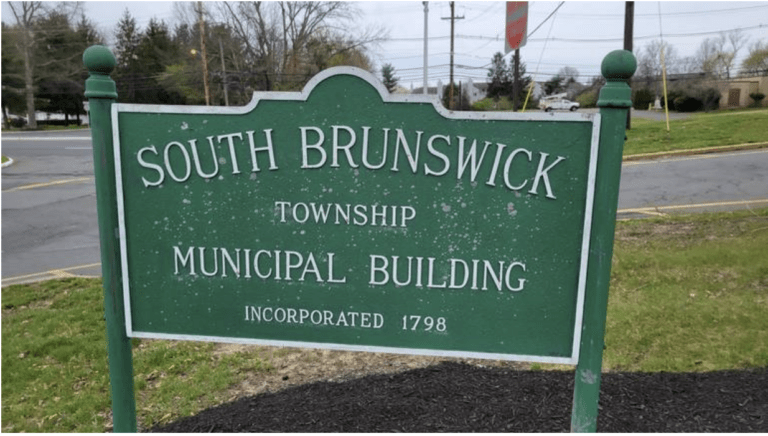
South Brunswick emerging as a hub for New Jersey’s digital economy

0

From brick manufacturing to the old Ford Edison assembly plant, the Route 1 corridor has long been an economic engine for Central New Jersey. But as manufacturing leaves (Ford closed in 2004) and as artificial intelligence, cloud computing, and digital services continue to expand, communities across the country are competing to attract the infrastructure powering the modern economy. Increasingly, South Brunswick is finding itself at the center of that conversation. 

With the Lumen datacenter on Route 1 and another facility being built just down the road, the township is quietly emerging as one of New Jersey’s most attractive locations for data center development, thanks to a combination of strategic location, access to major fiber networks, available industrial land, and proximity to critical power infrastructure.

Industry experts say demand for data center capacity is accelerating rapidly as businesses, governments, and consumers become increasingly reliant on digital technologies. Data centers operate behind the scenes, essential to nearly every aspect of modern life. Everything from streaming services and online banking to artificial intelligence platforms and cloud computing depends on facilities capable of storing, processing, and transmitting enormous amounts of digital information.

South Brunswick’s location offers several advantages for companies seeking to invest in that growth. Situated between New York City and Philadelphia, with access to major transportation corridors and robust telecommunications infrastructure, the township is well-positioned to support large-scale digital operations.

For local communities, data center investment can offer a different economic development model than traditional commercial projects. These facilities typically require substantial upfront construction activity and infrastructure investment while contributing significantly to the local tax base.

Supporters argue that attracting data infrastructure is increasingly similar to attracting railroads, ports, or industrial parks in previous generations — a long-term investment in the systems that power economic growth.

The rise of artificial intelligence is expected to further increase demand for computing capacity and electricity nationwide. As a result, states and municipalities are increasingly evaluating how to expand both digital infrastructure and the energy resources needed to support it. That challenge is particularly relevant in New Jersey, where growing electricity demand, grid reliability concerns, and discussions about future energy generation have become major policy issues.

As technology companies continue searching for locations capable of supporting the next generation of digital infrastructure, South Brunswick appears well-positioned to benefit from one of the fastest-growing sectors of the American economy.

Sources:

My Family Travels. (2026). This small town is secretly the data center capital of New Jersey. https://myfamilytravels.com/

New Jersey Business Magazine. (2025). Data centers and the future of New Jersey’s digital infrastructure. New Jersey Business Magazine.

U.S. Department of Energy. (2024). Electricity demand growth and the future of grid infrastructure. Office of Electricity.

Two years later: Gateway funding agreement continues to drive nation’s largest transit infrastructure project

0

On July 8, 2024, the Gateway Development Commission signed a Full Funding Grant Agreement (FFGA) with the Federal Transit Administration, securing the final funding needed to advance the Hudson Tunnel Project. Combined with federal financing through the U.S. Department of Transportation’s Build America Bureau, the agreement locked in the full $16 billion financial package required to construct the project.

The agreement represented the largest federal funding commitment ever made to a rail transportation project in modern U.S. history. It included a record-setting $6.88 billion Federal Transit Administration grant and more than $4 billion in low-interest federal financing, bringing the total federal commitment to approximately $12 billion.

For New Jersey commuters, the project addresses one of the nation’s most significant transportation bottlenecks.

The existing North River Tunnel, which opened in 1910 and suffered extensive damage during Superstorm Sandy in 2012, carries hundreds of thousands of Amtrak and NJ TRANSIT passengers every day. The Hudson Tunnel Project will construct two new rail tunnels beneath the Hudson River before rehabilitating the existing tunnels, providing long-term reliability and resiliency along the Northeast Corridor.

The funding agreement also marked what transportation leaders described as the project’s “point of no return.”

After decades of planning, political debate, and funding uncertainty, the financial commitments allowed major construction contracts to move forward and signaled that the nation’s largest passenger rail infrastructure investment was officially underway.

The economic impact extends well beyond rail service.

Project officials have estimated the Hudson Tunnel Project will support approximately 95,000 jobs while generating nearly $20 billion in economic activity during construction. Beyond the direct employment benefits, the project is expected to strengthen one of the nation’s busiest transportation corridors, which serves more than 200,000 passenger trips and approximately 450 trains each day.

Two years later, construction is progressing across multiple components of the broader Gateway Program, including work on the Hudson Tunnel Project, the Portal North Bridge replacement, and related infrastructure improvements. Tunnel boring operations are expected to begin as the project advances toward its anticipated 2035 completion.

For New Jersey, the Gateway Program represents more than a transportation project. It is a once-in-a-generation investment in infrastructure, economic competitiveness, and the long-term reliability of the Northeast Corridor—an essential rail network that supports both regional mobility and the national economy.

Sources:

Gateway Development Commission. (2024, July 8). Gateway Development Commission secures full funding for Hudson Tunnel Project. Gateway Development Commission press release

U.S. Department of Transportation. (2024, July 8). Investing in America: Biden-Harris Administration announces $11 billion in grants and financing for the Hudson River Tunnel project. U.S. Department of Transportation announcement

Hochul signs major reforms to New York Climate Leadership and Community Protection Act (CLCPA) law

CLCPA revised to consider energy affordability, reliability, and economic impacts

New York’s climate and energy policy took a significant turn this year as Governor Kathy Hochul and state lawmakers approved major amendments to the Climate Leadership and Community Protection Act (CLCPA), changes supporters say will help protect residents and businesses from rising energy costs while creating a more practical path to meeting the state’s long-term climate goals.

The reforms, included in the state budget, come amid growing concerns about energy affordability, electric system reliability and the state’s ability to build enough new generation to meet increasing demand. The changes are aimed at helping New Yorkers avoid higher energy bills as regulators attempt to meet emission mandates.

The legislation revises how greenhouse gas emissions are measured, extends key regulatory timelines and places greater emphasis on affordability, reliability and economic growth. Advocates say the changes will provide clearer market signals for investment in new in-state energy generation, including natural gas, nuclear and emerging low-emission technologies, helping address both near-term affordability concerns and the state’s longer-term energy supply challenges.

Among the most significant changes, the revised law moves from a 20-year greenhouse gas accounting framework to a 100-year standard, aligning New York with the methodology used by most other states. Emissions from biogenic sources, including vegetation and soils, will no longer be counted toward statewide emissions totals and will instead be reported separately. The law also removes emissions associated with the extraction and transmission of fossil fuels imported into New York from the state’s emissions calculations.

The legislation extends the timeline for developing regulations to reduce greenhouse gas emissions until 2028 and modifies the state’s interim emissions reduction target. Rather than requiring a 70 percent reduction by 2030, the updated law establishes a goal of reducing emissions 40 percent below 1990 levels by 2040, to the maximum extent feasible and cost-effective. The state’s statutory requirement of achieving an 85 percent reduction by 2050 remains unchanged.

7 myths about data centers

0

Public concerns about data centers are real, but many assumptions are based on outdated technology and misconceptions about how modern facilities operate.

A 2026 Pew Research Center survey found that Americans are more likely to view data centers negatively than positively when it comes to the environment, home energy costs and nearby quality of life. Thirty-nine percent said data centers are mostly bad for the environment, 38 percent said they are mostly bad for home energy costs and 30 percent said they are mostly bad for quality of life nearby.

Those concerns deserve to be taken seriously;data centers use large amounts of electricity, require cooling and can place pressure on local infrastructure. But many of the assumptions driving public opposition are based on older facilities, outdated cooling systems or worst-case examples that do not reflect how many modern projects are being designed today.

Data centers are not impact-free, but they are also not the environmental disaster some critics imagine. Modern facilities are designed to use less water, manage energy more efficiently, reduce emissions and, in some cases, develop their own power resources to reduce strain on the grid.

Myth 1: Data centers are extremely noisy


Fact:Modern data centers are designed to operate within local noise standards. At the property line, operational noise levels are typically around 55 to 60 decibels, roughly equivalent to a normal conversation. 

The loudest part of a data center is its backup generator, which can get up to 85-100 decibels (dB) from a distance of 23 feet away. This is similar to a motorcycle, chainsaw or busy construction site. However, that number is somewhat misleading because most residents are not standing 23 feet from the generator, and many facilities incorporate sound walls, acoustic enclosures, landscaping buffers and specialized equipment designed to reduce noise. 

Additionally, backup generators are not running continuously. In most cases, they operate only during power outages and brief testing periods. For most nearby residents, everyday sounds such as lawn equipment, traffic and construction activities generate more noticeable noise than a functioning data center.

Myth 2: Data centers lower property values

Fact: A 2025 George Mason University Center for Regional Analysis study examined home sales in Northern Virginia, the largest data center market in the world, and found that homes closer to data centers sold for higher prices than homes farther away.

That does not mean data centers always increase property values. Real estate markets are complicated, and local design, traffic, noise, tax impacts and neighborhood context all matter. 

Myth 3: Data centers collect and monitor personal information

Fact: The responsibility for managing customer information belongs to the companies providing those services, not the building housing the equipment. Data centers do not own or manage the personal information stored on their servers. They simply provide the physical infrastructure used by businesses, governments and organizations to store and process data.

Security measures such as fences, cameras and access controls exist to protect valuable equipment and critical infrastructure.

Myth 4: Data centers aren’t necessary

Fact: Most people interact with data centers dozens or even hundreds of times each day. In fact, you’re interacting with one now. Streaming movies, online shopping, social media, cloud storage, video conferencing, online banking and artificial intelligence applications all rely on data center infrastructure.As digital services continue expanding, demand for reliable computing capacity continues to grow alongside them.

Myth 5: Data centers consume insane amounts of water

Fact: Contemporary data center designs don’t use nearly as much water as they used to.  Many newer facilities use highly efficient cooling technologies, including closed-loop systems that recycle water, air-assisted cooling systems and designs that significantly reduce water consumption compared with older facilities. Many modern projects are specifically designed to minimize impacts on local water resources.

Myth 6: Data centers are major sources of air pollution

Fact: Unlike factories, refineries or manufacturing plants, data centers do not produce continuous industrial emissions as part of their day-to-day operations. There are no smokestacks releasing pollutants during normal computing activity. The primary air-quality concerns come from the electricity used to power the facility and the emergency backup generators that ensure uninterrupted service during outages.

Modern facilities are increasingly being built with advanced emissions-control systems. Diesel particulate filters can reduce particulate matter emissions by up to 95 percent, while selective catalytic reduction systems can reduce nitrogen oxide emissions by as much as 99 percent.

Myth 7: Data centers are the reason electric bills keep rising

Fact: It is true that data centers are large electricity users. In fact, they now account for more than 4 percent of total U.S. electricity consumption, and demand is expected to grow as cloud computing and artificial intelligence expand. This has raised legitimate questions about how utilities will meet future demand and who should pay for the infrastructure required to support it.

However, electricity prices are influenced by many factors beyond data centers, including fuel costs, inflation, transmission upgrades, extreme weather and aging infrastructure. In many regions, these factors play a much larger role in determining electric rates than any single category of customer.

The more important question is not how much electricity data centers are using, but how that electricity is generated and how the costs are allocated. Policymakers across the country are increasingly requiring large users to help pay for the grid upgrades needed to serve them, reducing the likelihood that those costs will be shifted onto residential customers. 

Should communities be worried?

Data centers are not impact-free. They use electricity, require infrastructure and can place demands on local resources. Residents are right to ask questions about power, water, emissions, traffic, tax agreements and how a project will fit into the character of their community.

At the same time, many of the concerns that dominate public discussions are rooted in assumptions about facilities built decades ago. Today’s data centers are generally quieter, more energy-efficient and less resource-intensive than previous generations, and the intensity of their usage should be compared with other potential uses for a particular site, i.e., industrial, commercial, warehouses. Many are incorporating advanced cooling systems, cleaner backup power technologies, battery storage and renewable energy sources that simply did not exist when many of the common criticisms first emerged. The conversation is often more complicated than either side admits. 

That does not mean every project deserves a free pass. The controversy surrounding xAI’s Memphis facility demonstrates that poorly planned projects can create legitimate air-quality concerns, particularly when temporary gas turbines or extensive backup generation are involved. Communities should continue asking questions about emissions permits, backup power systems and local air-quality impacts.

The question is not whether data centers should face scrutiny. The question is whether those discussions are based on current technology and project-specific facts rather than outdated perceptions.

Source:

Center for Regional Analysis. (2025, November). Study: Home prices are higher when a house is near a data center. George Mason University Schar School of Policy and Government. https://schar.gmu.edu/news/2025-11/study-home-prices-are-higher-when-house-near-data-center 

Gordon, K., & Gordon, N. Are data centers the villains in the battle over electricity? Carnegie Endowment for International Peace. https://carnegieendowment.org/emissary/2026/06/data-centers-electricity-energy-climate-villains 

Gordon, K., & Gordon, N. The compute coalition: How to build the future of AI in the free world. Carnegie Endowment for International Peace. https://carnegieendowment.org/research/2026/06/the-compute-coalition-how-to-build-the-future-of-ai-in-the-free-world 

Livio, S. K. 5 ways N.J. is trying to rein in AI data centers, including a ban on secret deals. NJ Advance Media for NJ.com. https://www.nj.com/politics/2026/04/5-ways-nj-is-trying-to-rein-in-ai-data-centers-including-a-ban-on-secret-deals.html 

Livio, S. K. N.J. just became the first state to propose a bold plan to rein in AI data centers. NJ Advance Media for NJ.com. https://www.nj.com/business/2026/05/nj-just-became-the-first-state-to-propose-a-bold-plan-to-rein-in-ai-data-centers.html 

Miller, R. (2025). Do data centers really boost property values? A closer look. Data Center Knowledge. https://www.datacenterknowledge.com/data-center-construction/do-data-centers-really-boost-property-values-a-closer-look 

Northwest Indiana Data Facts. (n.d.). How much sound do data centers create, and how is it regulated? https://nwidatafacts.nwiforum.org/faq/how-much-sound-do-data-centers-create-and-how-is-it-regulated

Newark Airport’s $10 Billion Transformation Is Actually Insane [The Only Nolan]

0