In an op-ed published in NorthJersey.com, PSEG CEO Ralph LaRossa urges Gov.-elect Mikie Sherrill to prioritize New Jersey energy policy by addressing rising utility costs, reliability risks, and a growing supply shortfall.
LaRossa argues that demand is increasing because of population growth and electrification while generation is shrinking, leaving New Jersey importing 40–50% of its power and facing a possible shortfall of up to 6,000 MW by 2030.
LaRossa says recent electricity price spikes reflect that imbalance and notes state law currently prevents regulated utilities from building or owning generation. It recommends an all-of-the-above strategy: create a New Jersey Power Plan (an integrated resource plan), immediately procure in-state generation (solar, storage, modernized gas, new nuclear), pursue PJM reforms to better incentivize long-term capacity, and expand efficiency, demand response, and customer bill-assistance programs.
Eos Energy Enterprises was founded in 2008 and is headquartered in the 3000 block of Park Avenue in Edison, according to its LinkedIn profile.
The company designs, develops and markets zinc-based energy storage systems rather than the more common lithium-ion batteries, which have been linked to multiple safety risks.
“Pennsylvania is investing $22 million into the move, which will create at least 735 new jobs and retain 265 current positions,” Shapiro said in a statement before a formal announcement planned for Wednesday.
The Gateway Tunnel Project, a $16 billion effort to build a new train tunnel under the Hudson River, recently hit a bureaucratic speed bump. Federal officials have paused funding while they review the project’s compliance with federal government rules. It’s been in the headlines, but the details aren’t always clear. This article dives into what the Federal Railroad Administration (FRA) review process is, and what it means for Gateway’s timeline.
Why Does the FRA Review Project Contracts?
When the FRA awards grants for big rail projects, it doesn’t just write a check and walk away. With billions of taxpayer dollars on the line, the agency is required to monitor how the money is spent from start to finish. Here’s how that oversight works.
The ground rules
When a project sponsor such as the Gateway Development Commission (GDC) accepts a federal grant, it signs an agreement promising to follow federal law. That includes environmental regulations, labor standards, Buy America rules that require the use of U.S. steel and manufactured products, and small-business contracting rules such as the Disadvantaged Business Enterprise (DBE) program for minority- and women-owned firms.
Competitive bidding
The FRA requires contracts to be awarded through open and fair competition. That means no favoritism, clear rules for bids and efforts to keep costs reasonable. The FRA may ask to see procurement documents or reports to confirm the process was aboveboards.
Reimbursement reviews
Federal transportation grants work on a reimbursement model. A project sponsor pays the contractors first, then requests repayment from the feds. Before approving reimbursement, the FRA checks whether the work performed and the costs billed meet federal rules. If something doesn’t, the FRA can withhold payment. That is the agency’s main enforcement power.
In short, contract reviews are how the FRA ensures projects stay on track, follow the law, and use public money responsibly.
Gateway in the Spotlight
default
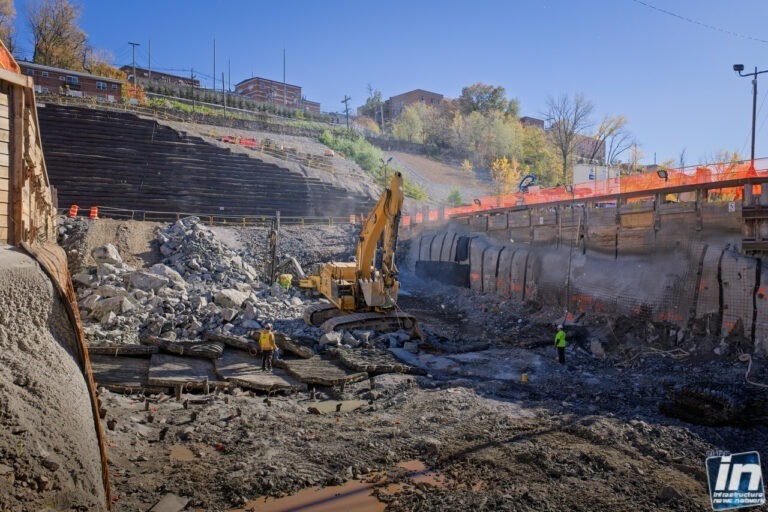
Construction on the Gateway project’s Tonnelle Avenue Bridge & Utility Relocation Project in North Bergen, NJ (November 2025). This early work is part of preparing the New Jersey side for the tunnel boring machines.
Gateway is one of the largest infrastructure projects in the United States. It will build a new two-track tunnel between New Jersey and New York, repair the existing 115-year-old tunnel damaged during Hurricane Sandy, and add rail capacity for Amtrak and NJ Transit. Because of its size and cost, Gateway is under especially close watch.
Why was funding paused?
In May 2025, the U.S. DOT filed a motion in federal court stating that the “race and sex-based presumptions” in the DBE program may no longer be constitutional. The court has not ruled yet, which created uncertainty for all federally funded transportation projects that rely on DBE rules written before the motion.
In fall 2025, the DOT paused reimbursements for Gateway while it reviewed whether the project’s contract language is consistent with the changing DBE rules. The GDC announced quickly after that it would pause enforcement of DBE participation goals in its active contracts. Contractors are still required to comply with nondiscrimination laws, but they no longer need to meet DBE percentage targets.
Even though the GDC is cooperating with federal reviewers, federal payments remain frozen until the review is complete. For a megaproject that depends heavily on federal disbursements to keep work moving, that creates scheduling pressure.
Then came the shutdown
The federal government shutdown in October 2025 added another layer of delay. The contract review is handled by civil rights staff at USDOT. But when the government shut down, those staff were furloughed and the review stalled. Even after a short-term budget deal allowed work to resume later that month, the delay underscored how vulnerable big infrastructure projects can be to federal disruptions.
What Happens Now?
Construction continues. The GDC has funding from New Jersey, New York and the Port Authority that can support near-term work. Crews are currently active at five sites on both sides of the Hudson River. But upcoming phases of the project, like tunneling, are far more expensive. If the reimbursement pause continues for too long, it could delay awards for the next round of contracts.
GDC CEO Tom Prendergast has said the team remains committed to keeping the project on scope, on schedule and on budget despite the funding pause.
The bottom line
The FRA contract review process may seem like paperwork, but it has real-world consequences. Reviews exist to protect taxpayers, ensure fairness, and keep projects accountable. But when rules change mid-stream, or when outside factors such as government shutdowns interrupt the process, major projects can slow down.
Gateway is still being built. The tunnel is still coming. But the next time a train line is delayed because of aging infrastructure, remember that even new tunnels depend on contracts, compliance, and federal approvals that are every bit as important as concrete and steel.
References
Federal Railroad Administration. (2020). Monitoring and Technical Assistance Program – Procedure 01: Administrative Conditions and Requirements. Washington, DC: FRA Office of Passenger and Freight Programs railroads.dot.govrailroads.dot.gov.
Gateway Development Commission. (2025, October 3). Disadvantaged Business Enterprise (DBE) Program – Important Notice gatewayprogram.orggatewayprogram.org.
Fazelpoor, M. (2025, October 27). Gateway Project faces new uncertainty amid government shutdown. NJBIZ njbiz.comnjbiz.com.
Kiefer, E. (2025, October 1). Trump Admin freezes Gateway Tunnel funds over DEI, government shutdown. Patch Media patch.compatch.com.
U.S. Department of Transportation. (2025, October 1). Statement on review of New York’s discriminatory, unconstitutional contracting processes [Press release] transportation.govtransportation.gov.
Across the world, bridge construction is testing the boundaries of technique and teamwork. From the world’s tallest span in China’s Huajiang Canyon to the Portal North Bridge close to home, each of these projects underscores how bridge-building is as much about precision lifting as it is about design and materials. With new methods, global coordination, and increasingly ambitious spans, engineers are creating the next generation of connections. Here’s a look at some of the world’s most impressive new bridges.
Despite uncertainty in Washington, work on the Gateway Tunnel moves forward. This $16 billion project is considered one of the most important rail infrastructure efforts in the nation. Work is underway at five construction sites that will ultimately deliver nine miles of new passenger rail connecting New Jersey and New York through a modern two-tube tunnel beneath the Hudson River.
”Sherrill will take office next year without any offshore wind projects operational or under construction along the state’s 130 miles of coastline. Another setback for the industry occurred earlier this month when Shell said it has officially ended its involvement in the Atlantic Shores wind project off the coast of New Jersey, marking the company’s withdrawal from the U.S. offshore wind sector.”
“In an interview Friday with NJ Spotlight News, Shawn LaTourette, commissioner of the Department of Environmental Protection, said his agency approved the project because the U.S. government has exclusive jurisdiction over pipelines that cross state lines.
The state, he said, has the power to approve or deny permits on a project’s impact to air or water. ‘We’re not approving a pipeline,’ LaTourette said. ‘We’re only evaluating its adverse environmental impacts and ensuring they are avoided or mitigated for.’
“Specifically, the pipeline would link Sayreville to the Rockaway peninsula in Queens. Williams proposed drilling 163 piles into the bay floor with mechanical hammers and pistons to ‘liquefy’ the earth below and mount the pipeline, which will be 26-inches in diameter.
The project also includes 3.6 miles of new pipeline to run through Middlesex County and about 10 miles of new pipeline in Lancaster County, Pennsylvania.”
“‘As demand continues to grow, especially in densely populated areas like Brooklyn, Queens, Staten Island, and Long Island, so too must the capacity to deliver reliable energy,’ Williams said in an overview of the project.”
“Environmental groups tore into the Murphy administration’s decision.
‘Governor Murphy’s unconscionably dangerous final approval of a polluting methane gas pipeline reverses decades of improvement in our state’s air and water quality, and reverses his own previous permit denial for this pipeline,’ Jeffrey Williams, legislative coordinator for the Jersey Shore chapter of the Surfrider Foundation, said, while Amy Goldsmith called the approval ‘despicable.'”
Bayonne, NJ — In a major boost to New Jersey’s creative economy, Paramount and Skydance Media have signed a 10-year lease at 1888 Studios, the $1 billion film and TV production campus. Governor Phil Murphy announced the deal in October, calling it a turning point that “solidifies New Jersey as a global powerhouse in the film industry.”
The lease gives Paramount-Skydance long-term access to what will be the largest purpose-built film studio complex in the Northeast, featuring 23 soundstages, post-production facilities, and waterfront views just minutes from Manhattan. Full opening is expected in 2026.
Water utilities across Delaware, Pennsylvania and New Jersey are stepping up efforts to remove “forever chemicals,” known as PFAS, from drinking water. These man-made compounds do not easily break down and can build up in the environment and human body over time. Recent testing has found some of the nation’s highest PFAS levels right here in the tristate area, prompting urgent investments in new treatment systems and tighter monitoring.



![PSEG encourages Governor-elect Sherrill to prioritize in-state power generation [NorthJersey.com]](https://tristateinfrastructurenews.com/wp-content/uploads/2025/11/TINN-Lede-Image-PSEG-Sherrill-768x512.jpg "PSEG encourages Governor-elect Sherrill to prioritize in-state power generation [NorthJersey.com]")
![Major battery maker leaving N.J. to bring 1,000 jobs to Pittsburgh in $352.9M move [NJ.com]](https://tristateinfrastructurenews.com/wp-content/uploads/2025/11/large-PBH2Z655BNECDJJSANQPUJHLPI-1-768x463.jpg "Major battery maker leaving N.J. to bring 1,000 jobs to Pittsburgh in $352.9M move [NJ.com]")

![A look at the rising momentum behind U.S. bridge infrastructure [Cranes Today]](https://tristateinfrastructurenews.com/wp-content/uploads/2025/11/Thumbnail-1-1-768x512.jpg "A look at the rising momentum behind U.S. bridge infrastructure [Cranes Today]")
![Gateway tunnel project moves ahead despite federal funding freeze [NJ BIZ]](https://tristateinfrastructurenews.com/wp-content/uploads/2025/11/gateway-lede-768x470.jpg "Gateway tunnel project moves ahead despite federal funding freeze [NJ BIZ]")
![Sherrill’s gubernatorial victory a boost to struggling offshore wind sector [ROI-NJ]](https://tristateinfrastructurenews.com/wp-content/uploads/2025/11/large-image-5-768x500.png "Sherrill’s gubernatorial victory a boost to struggling offshore wind sector [ROI-NJ]")
![How Coastal Erosion Works [Practical Engineering]](https://tristateinfrastructurenews.com/wp-content/uploads/2025/11/large-VIdeo-on-phone_v2-coastal-erosion-practical-engineering-768x512.jpg "How Coastal Erosion Works [Practical Engineering]")
![Murphy signs off on gas pipeline [NJ Spotlight]](https://tristateinfrastructurenews.com/wp-content/uploads/2025/11/image-2-768x432.png "Murphy signs off on gas pipeline [NJ Spotlight]")
![Paramount lease marks milestone in New Jersey’s studio infrastructure boom [NJ.com]](https://tristateinfrastructurenews.com/wp-content/uploads/2025/11/large-1888-nj-lede-768x431.jpg "Paramount lease marks milestone in New Jersey’s studio infrastructure boom [NJ.com]")
![How the tristate area is tackling forever chemicals in local water systems [NJ Spotlight News]](https://tristateinfrastructurenews.com/wp-content/uploads/2025/11/large-PFA-lede-768x511.jpg "How the tristate area is tackling forever chemicals in local water systems [NJ Spotlight News]")