Our Infrastructure Matters Ad
Home Blog Page 19

Controversial $2B N.J. rail project moving forward despite residents saying ‘no’ [NJ.com]


A controversial $2 billion light rail project in southern New Jersey, the Glassboro-Camden Line (GCL), is advancing despite significant local opposition. The proposed 18-mile line, designed to connect Rowan University in Glassboro to Camden and Philadelphia, aims to reduce traffic congestion and boost the regional economy. However, residents in several communities along the route, including Mantua, Wenonah, and Sewell, have voiced strong disapproval.

Opponents, often labeled “NIMBYs” (Not In My Backyard) by critics, argue the rail line will disrupt the quiet character of their towns, lower property values, and pose safety risks near schools and residential areas. Specific grievances include concerns over noise and the use of eminent domain to seize private property for the project’s right-of-way. In non-binding referendums, residents in towns like Mantua voted overwhelmingly against the proposal, with opposition reaching nearly 69%.

Despite these objections, NJ Transit and state officials are pushing the project forward, emphasizing the broader public benefit of improved transit infrastructure. Proponents argue the line will revitalize the region by linking major educational and medical hubs and providing a sustainable alternative to driving. The project’s advancement signals the state’s prioritization of regional connectivity over localized resistance.

Read the full story on NJ.com: https://www.nj.com/news/2025/12/controversial-2b-nj-rail-project-moving-forward-despite-residents-sa…

Electric Slide – Energy Issues Facing Governor‑Elect Mikie Sherrill

0


This is one of a series of articles on the infrastructure challenges that Governor-elect Mikie Sherrill will face.

Rapidly rising electricity rates was one of the main debate points during the 2025 gubernatorial campaign, with governor-elect Sherrill and Jack Ciattarelli offering contrasting views on how they would address this affordability crisis. The primary cause of the energy affordability crisis is electricity supply failing to keep up with growing demand. This fundamental imbalance must be addressed when Sherrill takes office in January, along with many other energy issues vying for her attention.

Supply Versus Demand

  • State currently has a shortfall of approximately 6.9 million megawatt-hours (MWh) electricity that it must import from the PJM grid
  • The new Energy Master Plan currently shows a 10GW shortage of firm capacity during multi-day winter cold snap
  • Electricity demand is expected to rise due to data centers and electrification of transportation (EVs) and buildings
  • In-state nuclear generating stations supply over ~40% of in-state electricity but will all be over 40 years old in 2026
  • The majority of in-state capacity in the PJM queue is in embattled offshore wind projects
  • Grid scale solar deployment constrained by land availability, land costs, and NIMBY fervor
  • Grid scale Battery Electric Storage Systems (BESS) will be challenged by costs and NIMBY fervor
  • Natural gas deployment constrained by pipeline capacity from Marcellus Shale and NIMBYism

Energy Affordability and Ratepayer Protection

  • Utility bills jumped ~20% in summer 2025, driven by PJM capacity auction costs and rising demand from data centers.
  • PJM forecasts that rates will continue to rise for the foreseeable future as demand continues to rise at the same time older generating stations are retired
  • Businesses report New Jersey is “worse than other states” at controlling energy costs, with 78% of NJBIA survey respondents citing affordability as their top concern.  

Offshore Wind Development

  • Offshore wind was central to Murphy’s clean energy plan, with a target of 11 GW by 2040.  
  • Projects have faced cancellations and investor withdrawals (Orsted, Shell, Atlantic Shores), leaving the industry “on life support”.  
  • Federal permitting uncertainty under Trump slowed progress, though a recent court ruling struck down the moratorium, reopening the path for projects.
  • Sherrill must decide whether or not to revive stalled projects

Solar Expansion and Energy Storage

  • The 2024 Energy Master Plan mandates 750 MW of new solar annually through 2026, split across rooftop, community, and grid‑scale projects.  
  • Community solar programs require 51% of capacity for low‑ and moderate‑income households, guaranteeing bill discounts.  
  • Legislation signed in 2025 expanded community solar by 3 GW and set a target of 2 GW of battery storage by 2030.
  • Sherrill must oversee rapid deployment while ensuring grid modernization to handle intermittent solar.
  • Growing NIMBY sentiment will pose siting challenges and may lengthen timelines and costs

Grid Reliability and PJM Reform

  • PJM, the regional grid operator, faces surging demand from AI data centers, projected to add 30 GW by 2030.  
  • Watchdogs warn PJM is approving loads it cannot reliably serve, risking blackouts.  
  • Governors across PJM states formed a collaborative to demand accountability and prioritize affordability.  
  • Sherrill will need to push for reforms in PJM’s interconnection queue, capacity market, and transmission planning.

Climate Resilience and Long‑Term Transition

  • New Jersey’s statutory goals: 100% clean electricity by 2035 and 80% GHG reduction by 2050.  
  • Rising sea levels and coastal flooding threaten infrastructure, requiring investment in resilient grids and coastal defenses.  
  • Balancing electrification (EVs, heat pumps) with reliability and affordability will be a defining challenge.  
  • Federal policy uncertainty—rollbacks of clean energy incentives—could undermine state targets.

Governor‑elect Sherrill inherits an energy landscape defined by skyrocketing costs, falling in-state electricity generation, stalled offshore wind, ambitious solar mandates, strained grid reliability, and rising NIMBY sentiment. Her leadership will be tested in balancing affordability with her aggressive clean energy targets.  

Sources

Associated Press. (2025, November 6). *Mikie Sherrill pledges emergency action on NJ energy costs after election win*. AP News. https://apnews.com/article/new-jersey-governor-sherrill-energy-costs-2025

New Jersey Business & Industry Association. (2025, October). *Energy costs top concern for NJ businesses in annual survey*. NJBIA. https://njbia.org/news/energy-costs-top-concern-nj-businesses-2025

New Jersey Board of Public Utilities. (2024, December). *2024 Energy Master Plan update*. NJBPU. https://www.nj.gov/bpu/energy/emp/

NJ Spotlight News. (2025, September 15). *Offshore wind industry in NJ faces setbacks as developers withdraw*. NJ Spotlight News. https://www.njspotlightnews.org/2025/09/offshore-wind-nj-setbacks-developers-withdraw/

U.S. District Court for the District of Columbia. (2025, October 20). *Decision striking down federal offshore wind moratorium*. CourtListener. https://www.courtlistener.com/opinion/2025/offshore-wind-moratorium-decision/

NJ.com. (2025, July 22). *Community solar expansion bill signed, adding 3 GW capacity*. NJ.com. https://www.nj.com/news/2025/07/community-solar-expansion-bill-signed.html

PJM Interconnection. (2025, August). *Data center growth and reliability challenges*. PJM Reports. https://www.pjm.com/library/reports/data-center-growth-reliability-2025

RTO Insider. (2025, September 30). *Governors demand PJM accountability on affordability and reliability*. RTO Insider. https://rtoinsider.com/articles/32545-governors-demand-pjm-accountability-2025

NJ American Water to buy Hopewell Borough water system in $6.4M deal [BINJE]

0

Hopewell Borough has signed a $6.4 million agreement to sell its municipal water system to New Jersey American Water following a November 2025 referendum in which roughly 58 percent of voters supported the sale. The transaction is expected to close in the first half of 2026 and will transfer responsibility for more than 880 customer connections to the regulated utility.

As part of the agreement, New Jersey American Water has committed to investing $7 million in infrastructure improvements over the first five years of ownership. Planned upgrades include replacement of lead and galvanized steel service lines and aging water mains. Additional improvements will be determined through a comprehensive system analysis after the transition.

Read the full story at BINJE.com: https://binje.com/hopewell-borough-enters-6-4m-agreement-to-sell-water-system-to-new-jersey-american-water/

Bridge Over Troubled Water – Water Priorities for Governor-Elect Sherrill


Governor Mikie Sherrill will be sworn in on January 20, 2026. The state’s aging drinking, waste, and storm water infrastructures will need her immediate attention.

This is one of a series of articles on the infrastructure challenges that Governor-elect Mikie Sherrill will face.

Drinking Water

New Jersey has more than 600 public drinking water systems serving 9.2 million residents, ranging from large, municipally-owned utilities to privately-owned public systems. All are subject to state and federal oversight. New Jersey’s drinking water challenges center on PFAS contamination, aging infrastructure, lead service lines, climate-driven droughts and saltwater intrusion, and inequities in access. Despite billions in federal investment, the state still faces systemic risks that threaten public health and trust.

Contamination: PFAS and Lead  

  • New Jersey became the first state to set enforceable Maximum Contaminant Levels (MCLs) for PFAS (“forever chemicals”) in 2018. Despite this leadership, contamination remains widespread, affecting 500,000 residents across 74 water systems.
  • The state faces some of the highest PFAS contamination levels in the nation
  • PFAS persist in groundwater, rivers, and reservoirs, particularly near industrial sites and military bases.  
  • Many cities, including Newark and Trenton, still rely on lead pipes. Federal funding has earmarked $44 million for lead and copper rule improvements in New Jersey, but full replacement will take years.
  • New Jersey’s industrial past left behind thousands of contaminated sites. The DEP continues to investigate and remediate these, but PFAS pose unique challenges due to their persistence and bioaccumulation.
  • Statewide replacement of Lead Service Lines is estimated to cost $3 Billion
$3 Billion estimate cost for statewide replacement of Lead Service Lines (LSLs)

Aging Infrastructure  

  • The American Society of Civil Engineers’ 2025 Infrastructure Report Card estimates New Jersey needs $8.6 billion in drinking water improvements over the next two decades.  
  • Trenton Water Works, serving 200,000 residents, faces chronic compliance issues and requires nearly $1 billion in upgrades.
  • Riverside’s water mains date from the early 1900s. 95% of Mount Ephraim Borough’s system is from the 1930s and 1940s.

Climate Change Impacts  

  • Rising sea levels threaten coastal aquifers with saltwater intrusion. 
  • Cape May pioneered desalination in 1996, but its plant now requires a $30 million upgrade.  
  • In 2025, the NJDEP declared a statewide drought watch after 13 of 15 months of below-average rainfall depleted reservoirs.
  • Flooding and storms can overwhelm treatment plants, while heat waves increase demand, stressing already fragile systems.

Regulatory and Governance Challenges  

  • Proposed legislation to require water suppliers to notify municipalities and schools of violations remains stalled.  
  • The Bipartisan Infrastructure Law (BIL) has delivered over $500 million to New Jersey, including $168 million in 2024 alone. These funds target PFAS treatment, lead line replacement, and emerging contaminants.  
  • Federal funding mandates that 40% of benefits flow to disadvantaged communities, addressing long-standing inequities.

Equity and Access  

  • Cities with older infrastructure face higher risks of contamination compared to wealthier suburbs.  
  • Lead contamination disproportionately affects low-income districts.  
  • Groups continue to push for stronger protections, emphasizing that marginalized communities bear the brunt of unsafe water.

New Jersey’s drinking water challenges are deeply interconnected contamination from PFAS and lead, aging infrastructure, climate change, and inequities in access all converge. While federal funding and state leadership on PFAS regulation mark progress, the scale of the problem demands sustained investment, stronger transparency laws, and community-driven solutions. Without decisive action, millions of residents risk continued exposure to unsafe water, undermining public health and confidence in essential infrastructure.

Wastewater and Stormwater

New Jersey’s wastewater and stormwater systems are among the oldest in the nation. Much of the infrastructure was built in the early 20th century, and many urban areas still rely on combined sewer systems that discharge untreated sewage into rivers and bays during heavy rainfall. 

New Jersey’s wastewater and stormwater systems face overlapping crises: aging infrastructure, combined sewer overflows, nutrient pollution, climate-driven flooding, and funding gaps. These challenges threaten public health, water quality, and resilience, requiring billions in investment and stronger regulatory frameworks. Climate change is intensifying these problems, with sea level rise, stronger storms, and more frequent flooding overwhelming outdated systems. At the same time, nutrient pollution and inequities in infrastructure investment exacerbate risks for vulnerable communities.  

Aging Infrastructure  

  • Many wastewater treatment plants and sewer lines were built decades ago, with some dating back to the 1900s.  
  • Leaking pipes allow groundwater infiltration, increasing treatment costs.  
  • Outdated treatment facilities struggle to meet modern standards for nutrient removal and PFAS filtration.  
  • Deferred maintenance has left municipalities with billions in backlogged needs.  
  • The EPA estimates New Jersey requires over $24 billion in wastewater and stormwater investment over the next 20 years.  

Combined Sewer Overflows (CSOs)  

  • About 21 municipalities in New Jersey still operate combined sewer systems, including Newark, Paterson, Camden, and Jersey City.  
  • During heavy rain, stormwater mixes with sewage, overwhelming treatment plants and discharging untreated waste into waterways.  
  • Public health risks from pathogens.  
  • Environmental damage to rivers like the Passaic, Hackensack, and Raritan.  
  • Economic costs from beach closures and degraded fisheries.  
  • Municipalities must submit long-term control plans to the NJDEP, but implementation costs run into billions.
  • Estimated costs to address Combined Sewer Overflows (CSOs) is $3-5 Billion over the next 20 years
$3-5 Billion estimated costs over the next 20 years to address Combined Sewer Overflows (CSOs)

Nutrient Pollution and Water Quality  

  • Excess nitrogen and phosphorus from wastewater treatment plants contribute to harmful algal blooms in lakes and reservoirs.  
  • Lake Hopatcong has faced repeated closures due to toxic blooms, linked to nutrient runoff and wastewater discharges.  
  • Many plants lack advanced nutrient removal technology, requiring costly upgrades.  

Climate Change Impacts

  • Coastal wastewater plants face increased inundation risks from flooding and sea level rise.
  • Facilities along the Delaware River and Raritan Bay are vulnerable to storm surges.  
  • Studies show precipitation in New Jersey is becoming more frequent and severe. This overwhelms stormwater systems, causing localized flooding.  
  • Rising seas threaten saltwater intrusion of coastal aquifers, complicating wastewater management.  

Stormwater Management Challenges  

  • Impervious surfaces in cities generate polluted stormwater that carries oil, heavy metals, and trash into waterways.  
  • New Jersey authorized municipalities to create stormwater utilities to fund improvements, but adoption has been slow due to political resistance.  
  • Rain gardens, permeable pavements, and bioswales are promoted as cost-effective solutions, but scaling them statewide remains a challenge.  
  • The Murphy administration launched a $20 million resilience program in 2024 to modernize stormwater infrastructure, but the scale of need far exceeds available funds.  

Governance and Regulatory Complexity  

  • Over 600 wastewater and stormwater entities operate in New Jersey, ranging from large utilities to small municipal departments.  
  • Special protections exist in the Highlands and Pinelands regions, but urban areas face the greatest infrastructure deficits.  
  • Low-income communities often lack resources to upgrade systems, leaving them more vulnerable to flooding and pollution.  

New Jersey’s drinking water, waste water and storm water challenges are deeply interconnected. Aging infrastructure, PFAS, lead service lines, combined sewer overflows, nutrient pollution, and climate change converge to create systemic risks. While recent funding and regulatory initiatives mark progress, the scale of investment needed is immense. Without decisive action from the incoming Sherrill administration, the state risks worsening public health crises, environmental degradation, and economic losses.  

$30 Billion needed in NJ over next 20 years to comply with Clean Water Act

Sources

Inside the $6.2 B Plan to Rebuild Terminal B at Newark Liberty [BINJE]

0


The Port Authority has put forward plans for a major transformation of Terminal B at Newark Liberty International Airport. The project would see the aging, 1970s-era Terminal B replaced with a modern, world-class facility as part of Newark’s long-term redevelopment strategy.

This initiative builds on the success of the recently completed new Terminal A, which opened in 2023. It is part of the Port Authority’s broader EWR Vision Plan to reimagine the airport with improved terminals, better airfield and roadway infrastructure, and upgraded passenger experience throughout the campus.

Read full story from BINJE here: https://binje.com/inside-ports-proposed-6-2-billion-transformation-of-terminal-b-at-newark-liberty/

Route 130: New Jersey’s Most Dangerous Highway – Why safety fixes have lagged for decades

0

Route 130 in Burlington County has become synonymous with danger, especially for pedestrians. The 23-mile stretch is a wide, high-speed corridor often lacking basic pedestrian infrastructure like continuous sidewalks, crosswalks, or refuge islands. Safety advocates and transportation researchers have repeatedly ranked it the most dangerous road for pedestrians in New Jersey. Since 2009, at least 16 people on foot have died trying to cross or walk along Route 130.

Unlike urban roads designed with multiple user types in mind, Route 130 was built for speed and car volume. It has multiple lanes, inconsistent pedestrian signals, and long crossing distances. Pedestrians often have to wait for long gaps in fast-moving traffic to cross, even at marked intersections. The New Jersey Bike & Walk Coalition has highlighted how simple safety fixes like reducing speed limits, adding visible crosswalks and completing sidewalk networks remain largely absent. This is not due to a lack of solutions but rather decades of political inertia. 

Small Improvements, Slow Progress

Through years of advocacy, Route 130 has seen incremental safety improvements. In 2016, the state passed “Antwan’s Law,” named after a Burlington City teen killed while crossing near his high school. The law reduced speed limits in school zones and required flashing signs near the School. 

Local lawmakers have pushed for more stringent penalties and targeted safety funds for dangerous state roads like Route 130. Law enforcement has periodically increased speed enforcement, but these efforts address symptoms rather than root causes.

In 2018, NJDOT funded a 3.5 million dollar overhaul of the five-legged intersection at Route 130, Columbus Road, and Jones Street. The project added ADA-compliant ramps and new pedestrian crossing signals. More recently, Burlington County secured funding to extend the Rancocas Creek Greenway Trail across Route 130 between Pennington Park and Rainbow Meadow Park. The 19 million dollar plan includes a new pedestrian and bike bridge over the highway and safer at-grade crossings. Senator Troy Singleton, a long-time advocate for Route 130 improvements, has called this project the county’s highest safety priority. However, the project is still in the planning and design phase and is expected to remain there for several more years.

What Still Needs to Change and Why It Hasn’t

Despite isolated upgrades, Route 130 continues to lack comprehensive safety infrastructure. Advocates have laid out a clear set of needed improvements:

  • Lower speed limits on commercial stretches between towns like Cinnaminson and Willingboro
  • High-visibility crosswalks and HAWK pedestrian signals at unsignalized crossings
  • Median refuge islands to help pedestrians cross in two stages
  • Sidewalk extensions to close dangerous gaps
  • Bike lanes or shared-use paths to safely connect bus stops and local businesses

These are fundamentals of safe street design, delayed not by difficulty but by red tape, tight budgets, and decades of car-first thinking. Pedestrian safety has paid the price.

A Vision Zero Future

In 2025, New Jersey took a major step by adopting a statewide Vision Zero strategy. Governor Murphy signed legislation establishing a 13-member Target Zero Commission tasked with eliminating traffic fatalities by 2040. The commission was created in response to alarming trends: in 2024, the state saw a 14 percent rise in total traffic deaths and a 32 percent increase in pedestrian fatalities.

The commission’s draft plan outlines 29 recommended laws and dozens of agency actions, all aligned with the “safe system” approach, a model that assumes human error will happen and seeks to design roads that prevent those errors from resulting in deaths. The plan identifies 140 high-injury corridors statewide that require redesign. 

Burlington County is already using a 400,000 dollar federal “Safe Streets for All” grant to map high-risk areas and plan safety improvements, with Route 130 near the top of the list. Transportation officials believe that Vision Zero’s emphasis on systemic change rather than isolated fixes will finally give Route 130 the attention and funding it needs.

From Painful Legacy to Safer Future

Route 130 illustrates how outdated roadway design and bureaucratic delays can lead to decades of preventable deaths. For too long, political hesitation and fragmented responsibility have blocked commonsense safety upgrades. But New Jersey’s new Vision Zero framework offers a hopeful turning point. If the state commits to redesigning its most dangerous corridors, Route 130 could become a model of transformation.

Sources

Delaware Valley Regional Planning Commission. Transportation Improvement Program actions for New Jersey (Board meeting minutes, March 22, 2018).

Hayes, M. Governor Murphy Signs Legislation Creating Target Zero Commission. NJTPA

New Jersey Governor’s Office. Governor Murphy Signs Legislation Creating Target Zero Commission. NJ.gov

New Jersey Bike & Walk Coalition. Empathy and Equity: Solving the Route 130 Pedestrian Crisis. NJBWC

Safe Routes New Jersey (Rutgers). Students Take the Lead as Governor Murphy Signs New Pedestrian and Bicyclist Safety. Safe Routes NJ.

Singleton, T. Route 130 Tops ‘Most Dangerous’ List for Fifth Consecutive Year troysingleton.comtroysingleton.com (TroySingleton.com).

Singleton, T. Route 130 Safety Study Could Give Burlington County Leverage to Fix Road troysingleton.comtroysingleton.com (TroySingleton.com).

Burlington County Board of Commissioners. Burlington County Receives $400,000 Grant to Identify Pedestrian and Bicycle Safety Improvements co.burlington.nj.us.

Burlington County Board of Commissioners. New Burlington County Trail Project Will Create Pedestrian-Friendly Crossing on Route 130 co.burlington.nj.usco.burlington.nj.us.

Waste to watts: New RNG facility opens in South Jersey


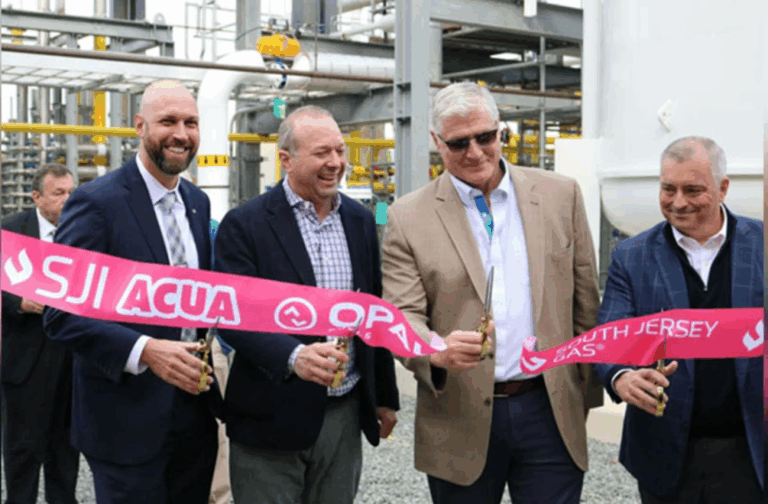
South Jersey Industries (SJI) and OPAL Fuels have cut the ribbon on a renewable natural gas (RNG) facility at the Atlantic County Utilities Authority (ACUA) landfill in Egg Harbor Township, New Jersey. The new plant processes landfill gas into RNG that will be injected directly into the pipelines of South Jersey Gas, marking the first time RNG will supply energy to homes and businesses in the utility’s territory. The facility is expected to produce more than 650,000 MMBtu of RNG annually, the equivalent of about 4.6 million gallons of gasoline. In doing so, it will significantly reduce methane emissions from the landfill and is projected to avoid roughly 346,000 metric tons of CO₂ each year.

Read the full story from Waste Today here: https://www.wastetodaymagazine.com/news/sji-and-opal-fuels-cut-ribbon-on-acua-rng-facility

34-Story Jersey City Tower to Replace Parking Lot with 360 Apartments, Including 90 Affordable Units [NJ.com]

0


A 34-story residential tower is planned for 701 Newark Avenue in Journal Square, Jersey City. The project will transform a long-underused municipal parking lot into a mixed-income community with 360 apartments, including 90 affordable units. The project will include ground-floor retail, a rooftop lounge, fitness center, bicycle storage and shared workspaces. Located just a few blocks from the Journal Square PATH Station, the tower will strengthen regional connectivity for residents. The development will also incorporate open space and neighborhood linkages while aligning with local planning goals for walkability and transit access.

Read full story at NJ.com: https://www.nj.com/hudson/2025/12/this-34-story-nj-tower-will-transform-a-parking-lot-into-360-apartments-with-90-affordable-units.html?outputType=amp

Why is Everyone So Wrong About AI Water Use?? [Hank Green]

0


“You might guess that I’m a little apprehensive about this one. Any amount of “actually this might not be the most important thing to focus on” can be interpreted these days as an unacceptable defense of AI or whatever, but I just felt like it was a good opportunity to talk about lifecycle and resources use analysis and how freaking tricky the are!!”

How Much Water and Energy do Data Centers Consume? A New Jersey Bill Demands Answers. [Inside Climate News]


New Jersey lawmakers have advanced a bill that would require data centers to publicly disclose their quarterly water and electricity consumption, marking one of the nation’s first attempts to regulate the industry’s resource use. The legislation, Senate Bill 4293 and Assembly Bill 5548, awaits Governor Phil Murphy’s signature. Supporters argue that data centers—critical to artificial intelligence, cloud computing, and e-commerce—operate continuously, consume vast amounts of electricity, and use millions of gallons of water for cooling, yet remain largely opaque to the public. Advocates say transparency is essential as New Jersey faces rising energy costs and growing strain on infrastructure. Business groups, however, oppose the measure, calling it redundant given existing environmental and utility regulations, and warning it could deter investment. If enacted, the law would set a precedent for other states considering similar oversight, positioning New Jersey as a test case in balancing AI-driven growth with environmental accountability. 

Read more at Inside Climate News: https://insideclimatenews.org/news/24092025/new-jersey-data-center-water-energy-consumption-bill/