Our Infrastructure Matters Ad
Home Blog Page 18

Trenton Water Works system fails again under ice, raising reliability concerns [The Jersey Vindicator]

0


Trenton Water Works’ filtration plant along the Delaware River was again disrupted by frazil ice, small ice crystals that clogged the intake pipe and forced a temporary shutdown. It marks the second frazil ice-related failure in less than a year and has renewed scrutiny of the utility’s winter preparedness and intake system maintenance.

Suburban mayors criticized Trenton Water Works leadership and described the repeated failures as evidence of deeper operational issues. Officials called for legislative changes to the Water Infrastructure Protection Act that would give the New Jersey Department of Environmental Protection greater authority to intervene. Some municipal leaders also raised the possibility of creating a separate regional water utility, citing ongoing service disruptions and repeated conservation advisories.

Read the full story at the Jersey Vindicator: https://jerseyvindicator.org/2025/12/18/bad-comedy-show-mayors-blast-trenton-water-works-as-ice-jams-cripple-plant-again

EXECUTIVE ORDER NO. 1

0


WHEREAS, the top priority of this Administration is to make New Jersey more affordable for all New Jersey residents, families, and businesses; and

WHEREAS, electricity is a critical resource for the health, safety, welfare, and prosperity of New Jerseyans, and fundamental to the State’s economic stability and growth; and

WHEREAS, the current cost of electricity has reached the point of crisis for many residents and families, and requires bold action to provide short-term relief and medium and long-term strategies and reforms to improve our energy system; and

WHEREAS, retail electricity rates have risen dramatically—both suddenly and substantially—in recent years, and, without serious intervention, prices will continue to rise at an extraordinary pace; and

WHEREAS, from June 2023 to June 2025 the average residential electricity price in the State rose by well over 33 percent, and the average electricity price for all customers in the State, including commercial customers, rose by nearly 30 percent, and prices are expected to continue to rise due to systemic issues within the federally-regulated regional power market in which New Jersey participates, which is administered by independent grid operator PJM; and

WHEREAS, the December 2025 PJM auction would have seen capacity prices climb 60 percent higher, if not for a temporary price cap instituted as a result of legal action against PJM; and

WHEREAS, electricity rates in New Jersey are among the highest in the continental United States and in the Mid-Atlantic region, and during the summer of 2025 New Jersey experienced some of the highest electricity price increases of all states that participate in the PJM regional power market; and

WHEREAS, New Jersey families are burdened by increasingly high costs across the board, from average food prices rising faster than overall inflation to housing costs, including median home prices and median gross rents in the State that are each 20 percent higher than the national median; and

WHEREAS, New Jersey homeowners rank fifth-highest in homeowner cost burden among all states, and recently published federal census data indicate that nearly one-third of New Jersey homeowners with a mortgage are considered “cost burdened” by housing in that they spend at least 30 percent of their income on housing costs, and more than half of renters in New Jersey are also cost burdened; and

WHEREAS, a recent analysis found that from 2024 to 2025, the amount of household income needed for a New Jersey family to live comfortably increased over 12 percent, which was the second highest such increase in the nation, and other data indicate that wage growth slowed meaningfully in the last year; and

WHEREAS, many of New Jersey’s low- and middle-income families struggle to afford basic necessities, from utilities to groceries to healthcare; and

WHEREAS, numerous businesses and enterprises throughout the State have been impacted by increased energy costs over the past year; and

WHEREAS, the recent rise in electricity bills in our State is due to several factors, including but not limited to the escalating cost of transmission and distribution infrastructure on which the grid relies, volatility in the price of natural gas, and the skyrocketing price of the future supply of reliable, wholesale electricity—also known as capacity—in the regional PJM market; and

WHEREAS, the PJM region, which spans 13 states and Washington D.C., has hit record-setting capacity prices in each of the last three market auctions, and saw capacity prices increase by over 800 percent in 2024; and

WHEREAS, the dramatic increase in PJM capacity prices, which is expected to continue over the coming years, is due to a number of factors, including peak electricity demand outpacing supply; the surge and anticipated spread of new customers like data centers that consume significant amounts of electricity; retirement of older, uneconomic generation sources like coal-fired power plants; PJM’s delay in interconnecting new, clean generation sources to the grid; and flaws in PJM’s market design that have failed to adequately produce new generation to meet growing demand; and

WHEREAS, regional capacity prices impact what most New Jersey electricity customers pay on their bills for electricity supply, and the forecast for regional capacity prices likely indicates that New Jerseyans’ electric bills will remain significantly elevated in at least the near- to mid-term; and

WHEREAS, the federal government’s recent tariffs on clean energy technology components and policies that hinder the development of solar and other renewable technologies will exacerbate the electricity supply shortage; and

WHEREAS, New Jersey’s four investor-owned electric distribution utilities pass through to customers the cost of electric supply and do not earn a profit on the provision of electric supply; and

WHEREAS, the electric distribution utilities earn a profit on, among other things, qualifying investments in transmission and distribution infrastructure, as they earn a return on those investments from electricity customers at rates approved by the Board of Public Utilities (“BPU”); and

WHEREAS, the electric distribution utilities pass through to customers operating and maintenance expenses as well as property depreciation, at rates approved by BPU; and WHEREAS, other major components of electric bills include the cost of electric distribution utilities’ investments in, and return on, energy efficiency programs, the cost of administering the State’s solar programs set by statute, and the Societal Benefits Charge (“SBC”), through which electric distribution utilities recover expenses and financially benefit from their involvement in energy efficiency and other societal benefit programs enumerated in N.J.S.A. 48:3-60, among other things; and 

WHEREAS, the State’s electric distribution utilities frequently submit requests to BPU seeking approval for requested rate increases or proposed cost recoveries; and

WHEREAS, under N.J.S.A. 48:2-13, subject to certain statutory exceptions, BPU has mandatory jurisdiction over “all services necessary for the transmission and distribution of electricity and gas, including but not limited to safety, reliability, metering, meter reading and billing”; and

WHEREAS, due to the myriad factors noted above, New Jerseyans’ residential electricity bills are unlikely to fall below June 2025 levels anytime in the near future and are expected to further increase absent meaningful action on several fronts; and 

WHEREAS, the ongoing electricity affordability crisis in our State constitutes a state of emergency that warrants decisive leadership and coordinated action, both to provide short-term relief and to initiate long-term reform; and

WHEREAS, it is therefore necessary to effectively freeze electricity supply rate increases charged to customers and to demand greater transparency and accountability from the State’s electric distribution utilities, in addition to taking steps to expand New Jersey’s power generation and to hold the regional grid operator, PJM, accountable; and

WHEREAS, BPU is located in but not of the Department of the Treasury and is part of the Executive Branch; and

WHEREAS, BPU has the authority to set just and reasonable public utility rates, to investigate any matter concerning any public utility, and to require any public utility to furnish safe, adequate, and proper service; and

WHEREAS, the emergency warrants BPU’s additional use of available funds to provide short-term rate relief to residential electricity customers, consistent with BPU’s recent practice;

NOW, THEREFORE, I, MIKIE SHERRILL, Governor of the State of New Jersey, by virtue of the authority vested in me by the Constitution and by the Statutes of this State, do hereby declare that an emergency exists throughout the State of New Jersey; and I hereby ORDER and DIRECT:

1. BPU shall:

a. Provide for Residential Universal Bill Credits (“RUBCs”) to offset increases in the cost of electricity supply due to take effect in 2026, relying on the same or similar sources of funding addressed in BPU’s order of August 13, 2025, that provided for RUBCs, among any others that are applicable; and

b. issue RUBCs, or an initial set of RUBCs, no later than July 1, 2026.

2. BPU, the Department of Environmental Protection, and the Economic Development Authority shall, within 30 days, confer about the use of Regional Greenhouse Gas Initiative (“RGGI”) proceeds for ratepayer relief and issue a public statement of their conclusions, as they did prior to BPU’s order of August 13, 2025, which shall include an explanation of how they intend to address ratepayer relief in the 2026-2028 RGGI Strategic Funding Plan consistent with the priorities and directives established in this Order, and of whether any amendment or addendum to that plan is needed, as well as an explanation of the most efficient and effective means to provide timely cost relief to low- and middle- income ratepayers.

3. BPU shall review all components of, and rationales for, the SBCs imposed on electric bills, as well as the budget of the Clean Energy Program administered by BPU, which consists in part of proceeds from SBCs.

4. BPU shall prioritize expediting revisions to the Clean Energy Program budget for Fiscal Year 2026 and, no later than May 1, 2026, issue a “true-up” budget based, in part, on actual expenses incurred during Fiscal Year 2025. The true-up budget shall also:

a. prioritize funding for direct ratepayer relief to offset increases in the cost of electricity supply borne by residential ratepayers, consistent with the priorities and directives of this Order; and

b. identify opportunities to increase support for, or investment in, energy efficiency programs for income-qualifying ratepayers to help lower those ratepayers’ energy bills.

5. BPU shall also consider opportunities to reduce the SBCs in effect for every electric distribution utility without compromising funding for direct energy assistance programs or income-qualifying ratepayers, including by directing available RGGI proceeds or other resources to those programs.

6. Given the extent of the affordability crisis, BPU shall consider pursuing a pause, abeyance, or modification of the schedule governing any proceedings in which electric distribution utilities seek approvals for rate increases or cost recoveries to the extent permitted by law.

7. Within 180 days, BPU shall complete and issue a study regarding modernization of the traditional electric distribution utility business model.

a. The study shall:

i. address the relationship between the traditional business model and recent trends affecting electricity affordability;

ii. identify potential policy pathways and opportunities for achieving long-term reductions to, and stabilization of, electric bills; and

iii. consider opportunities including, but not limited to, making utility revenue models less dependent on capital spending on infrastructure; expansion of performance-based ratemaking, whereby performance would include, among other things, the rate at which utilities approve the interconnection of new electricity generating facilities to the grid; multi-year rate plans; reductions in utilities’ return on equity; state review of supplemental transmission projects; least-cost resource testing requirements; greater use of asset securitization; and amendments to the regulations governing infrastructure investment programs.

b. BPU shall hold at least one public stakeholder session to inform the development of the study. 

c. If BPU seeks to procure the technical or professional services of a contractor to assist the completion of the study and address the affordability emergency in the State, BPU and the Division of Purchase and Property in the Department of Treasury shall:

i. prioritize this procurement with the aim of completing the procurement within 30 days; and

ii. conduct the procurement in the most time-efficient manner consistent with the applicable procurement statutes.

8. BPU shall exercise its discretion to determine necessary and appropriate steps to effectuate the relevant directives in this Order.

9. Nothing in this Order shall be construed to confer any legal rights upon entities whose activities are regulated by State entities; nothing shall be construed to create a private right of action on behalf of any such regulated entities or other persons; and nothing shall be used as a basis for legal challenges to rules, approvals, permits, licenses, or other action or inaction by a State entity. Nothing in this Order shall be construed to supersede any federal, State, or local law.

10. Should any part of this Order be declared to be invalid or unenforceable, or should the enforcement of or compliance with any part of this Order be suspended, restrained or barred by the final judgment of a court of competent jurisdiction, the remainder of this Order shall remain in full force and effect.

11. This Order shall take effect immediately.

GIVEN, under my hand and seal this 20th day of January, Two Thousand and Twenty-Six, and of the Independence of the United States, the Two Hundred and Fiftieth.

[seal]

Mikie Sherrill
Governor

Attest:
Timothy P. Lydon
Chief Counsel to the Governor

SOURCE: https://www.nj.gov/infobank/eo/057sherrill/pdf/EO-1.pdf

EXECUTIVE ORDER NO. 2

0


WHEREAS, through Executive Order No. 1, which I signed on January 20, 2026, I declared that the ongoing electricity affordability crisis in New Jersey constitutes an emergency that warrants decisive leadership and coordinated action, both to provide short-term relief and to initiate long-term reform; and

WHEREAS, through Executive Order No. 1, I directed the Board of Public Utilities (“BPU”) to take a number of actions to freeze electricity supply rate increases for residential electricity customers to ensure that electricity does not become an even greater financial burden for New Jersey’s residents, families, and economy in the near term, while steps are taken to lower rates in the long term; and

WHEREAS, through Executive Order No. 1, I directed BPU to lay the groundwork for lowering electricity rates in the long term by swiftly completing a study regarding the traditional electric distribution utility business model; and

WHEREAS, I recognized in Executive Order No. 1 that a significant driver of the electricity affordability crisis is that demand is exceeding supply; and

WHEREAS, the facts and circumstances of Executive Order No. 1 are incorporated by reference herein, including the facts and circumstances regarding the drivers of the electricity affordability crisis and especially the widening gap between supply and demand in the federally-regulated regional market for the future supply of reliable, wholesale electricity—also known as capacity—in which New Jersey participates; and

WHEREAS, electricity demand—also known as load—is rising across the nation for the first time in two decades in New Jersey; and

WHEREAS, peak electricity demand in the regional wholesale energy and capacity market operated by PJM is expected to continue rising to unprecedented levels over the coming years; and

WHEREAS, PJM anticipates peak load growth of approximately 20 percent by 2030 compared to 2024 levels, with the overwhelming majority of the growth stemming from data centers, which will only further expand the gap between supply and demand in the PJM region; and

WHEREAS, speculative interconnection requests from new sources of large electricity customers—“ghost load”—inflate the load forecasts submitted by electric distribution utilities to PJM, which PJM uses to develop plans for satisfying capacity requirements and ensuring the reliability of the power grid; and

WHEREAS, capacity prices impact what most New Jersey electricity customers pay on their bills for electricity supply, which is a substantial component of electric bills; and

WHEREAS, by way of illustration, the PJM capacity auction held in July 2025 resulted in $16.1 billion of new costs allocated to PJM ratepayers, including $2 billion of new costs to New Jersey families and businesses; and

WHEREAS, the PJM capacity auction held in December 2025 resulted in $16.4 billion of new costs allocated to PJM ratepayers, including over $2 billion of new costs to New Jersey families and businesses; and

WHEREAS, the December 2025 PJM capacity auction would have resulted in a significantly higher capacity price—approximately 60 percent higher—if not for a temporary price cap; and

WHEREAS, forthcoming PJM auctions are likely to result in ever higher capacity prices due to soaring electricity demand and a shortage of supply, which will continue to drive electric bills higher in our State; and

WHEREAS, the capacity shortage in PJM raises serious concerns not only about affordability, but also about the reliability and resiliency of the PJM grid; and

WHEREAS, by way of illustration, in the December 2025 capacity auction PJM failed— for the first time—to procure enough capacity to meet its own target amount of reserve electricity supply, which PJM sets at a level it determines is appropriate to ensure the regional power grid’s reliability; and

WHEREAS, the revised capacity shortfall from this most recent auction was 4.5 gigawatts, which is approximately equivalent to the electricity consumption of nearly all residential households in New Jersey, demonstrates that without the swift addition of new generation or a slowdown in demand growth within PJM the grid’s reliability will be threatened during peak times, which could potentially lead electric distribution utilities to deliberately restrict power to certain consumers of electricity during periods of high demand—otherwise known as “load shedding”—or cause brownouts and blackouts that could jeopardize public health, safety, and welfare; and

WHEREAS, blackouts and brownouts pose real and severe threats, as they can potentially, among other things, interrupt medical care; disrupt essential services such as delivery of water, heating, and telecommunications; make it difficult or infeasible to cool indoor spaces when temperatures are high; curtail emergency services; increase the risk of car accidents and mortality; and heighten the risk of carbon monoxide poisoning from unsafe use of generators and of house fires from unsafe use of candles; and

WHEREAS, numerous obstacles impede the development of new sources of electricity generation or otherwise contribute to the imbalance between supply and demand, as noted below; and

WHEREAS, rising demand for the equipment needed to construct and operate natural gas-fired power plants is contributing to longer lead times and higher costs in that sector; and

WHEREAS, backlogs for new gas-fired turbines are, at present, up to seven years; and

WHEREAS, some older, inefficient natural gas-fired power plants in New Jersey will likely retire in the coming years rather than invest in modernization; and

WHEREAS, building a new nuclear reactor for power generation can take a decade or more; and

WHEREAS, the federal government has recently restricted and disincentivized the development of various sources of clean energy; and

WHEREAS, given these impediments to new generation, the fact that solar energy and battery storage can be developed on shorter timelines—often, months rather than years—makes them particularly critical technologies to meeting the State’s and the region’s electricity supply shortage, among other forms of power generation with longer development timelines as well as demand response technology; and

WHEREAS, the availability of technology to aggregate distributed energy resources such as rooftop solar with battery storage, electric vehicles, and smart home and building controls into “virtual power plants” presents an opportunity to harness community power to reduce peak demand by 10 to 20 percent; and

WHEREAS, the development and installation of nimbler solar and storage generation resources can still face significant delays in permitting, siting, and interconnection processes; and

WHEREAS, delays in interconnection processes are caused not only by the management of PJM’s queue, but often by electric distribution utilities, as they are responsible for reviewing and approving applications from electricity generation facilities to interconnect to the power grid, including applications from renewable energy projects pursuant to BPU regulations, N.J.A.C. 14:8-5.1 to -5.12; and

WHEREAS, despite President Trump’s declaration of a national energy emergency and the Department of Energy’s recent finding that the Nation’s power grid will be unable to meet projected demand in the coming years, the federal government has aggressively pursued policies that are counterproductive to energy affordability and grid reliability, and hostile to particular energy generation technologies that can help meet rising demand, which have created significant instability and uncertainty in the energy sector; and

WHEREAS, by way of example, the Trump Administration has canceled or attempted to cancel billions of dollars in federal support for hundreds of energy projects, and its policies have also contributed to the cancellation of dozens of other projects, undermined billions of dollars of private investments, and compromised the potential to deliver tens of thousands of good-paying jobs; and

WHEREAS, federal legislation signed into law by President Trump on July 4, 2025, established sunset dates for federal tax credits for the production of, and investment in, qualifying solar projects, which have been integral to the success of the solar industry over decades, thereby jeopardizing solar projects currently in development and future investment in new projects; and

WHEREAS, in light of that legislation, qualifying solar projects must either begin construction by July 4, 2026, or be placed into service by December 31, 2027, to receive the federal production tax credit or investment tax credit; and

WHEREAS, the Constitution and statutes of the State of New Jersey, particularly the provisions of the Civilian Defense and Disaster Control Act (“DCA”), N.J.S.A. App. A:9–33, et seq., as well as N.J.S.A. 52:27f- 17, and all amendments and supplements thereto, confer upon the Governor of the State of New Jersey certain emergency powers; and

WHEREAS, the purpose of the DCA is “to provide for the health, safety and welfare of the people of the State of New Jersey and to aid in the prevention of damage to and the destruction of property during any emergency” as defined in the DCA, and “and to invest the Governor with all other power convenient or necessary to effectuate such purpose,” N.J.S.A. App. A:9-33; and

WHEREAS, as described above, the urgent need for more electricity generation to keep up with skyrocketing power demand from data centers is a major driver of the energy affordability crisis; and

WHEREAS, the sunset dates for the federal production tax credit and investment tax credit described above require urgent action to facilitate as many qualifying clean energy projects as possible to obtain those credits and thereby help alleviate the supply shortage, lower costs for New Jersey residents, and improve reliability in our State and in PJM; and

WHEREAS, as described above, the intertwined challenges of affordability and load growth demand bold leadership and solutions, and require that administrative agencies have the capacity and the flexibility to protect public health, safety, and resources in the face of these emergencies;

NOW, THEREFORE, I, MIKIE SHERRILL, Governor of the State of New Jersey, by virtue of the authority vested in me by the Constitution and by the Statutes of this State, and in order to protect the health, safety, welfare, property, and resources of the people of the State of New Jersey DO DECLARE and PROCLAIM that a State of Emergency exists throughout the State of New Jersey, effective immediately; and I hereby Order and DIRECT the following:

1. BPU shall accelerate the development of distributed and utility-scale solar electricity generation by:

a. within 45 days, initiating a solicitation for qualifying solar facilities or solar facilities in combination with storage under the Competitive Solar Incentive (CSI) program, pursuant to N.J.A.C. 14:8-11.1 to -11.10, including N.J.A.C. 14:8-11.10(l); and

b. no later than 270 days after initiating the solicitation, issuing project awards.

2. BPU shall, within 45 days, implement P.L.2025, c.135, as codified at N.J.S.A. 48:3-87.11(f)(2)(B), by opening for registration 3,000 megawatts of capacity under the Community Solar Energy Program and endeavoring to expedite the registration process by any necessary and appropriate means.

3. BPU shall accelerate the development of transmission-scale battery storage through the Garden State Energy Storage Program, which is described in BPU’s order of June 18, 2025, in Docket number QO22080540, by:

a. within 45 days, initiating a solicitation as part of Tranche 2 of the Program; and

b. within 90 days, launching Phase 2 of Program and thereafter establishing a specific tranche of capacity for electric distribution utilities to develop to support interconnection of distributed energy resources and grid stability.

4. BPU shall, within 180 days, commence the development of a “virtual power plant” program in the State to be administered by electric distribution utilities and third-party suppliers to drive down peak demand by aggregating behind-the-meter distributed energy resources. In particular, by the 180-day deadline BPU shall:

a. build on and advance existing programs, including but not limited to by completing the Third Triennium Regulatory Framework for Utility Energy Efficiency and Peak Demand Reduction Programs;

b. identify other opportunities to facilitate greater competitiveness of third-party electricity suppliers that promote or aggregate distributed energy resources and generate customer savings; and

c. assess and, as appropriate, effectuate any operational and policy changes needed to enable aggregated distributed energy resources in New Jersey to participate in the PJM capacity market to the fullest extent possible.

5. To accelerate the development of all classes of electricity generation and grid stabilization projects, all relevant State entities shall take the following measures:

a. For purposes of this directive, “State entity” shall mean any of the principal departments in the Executive Branch of State government as well as BPU;

b. Within 45 days, all State entities involved in the permitting or siting of electricity generation and grid stabilization projects, including but not limited to the Department of Environmental Protection (“DEP”), the Department of Agriculture, the Department of Community Affairs, and the Department of Transportation, shall:

i. transmit to the Governor a memorandum that identifies all rules, regulations, and statutes administered by the State entity that are implicated in the permitting or siting of such projects and for which the waiver of compliance would, in the State entity’s determination, expedite the permitting or siting process and the deployment of electricity generation or grid stabilization projects without unduly compromising public health, public safety, or environmental protection; and

ii. initiate all steps that, in the State entity’s determination, are necessary and appropriate to prospectively and liberally waive compliance with any of the above rules or regulations to the extent consistent with this Order, federal law, and other state law.

c. The Governor will thereafter review the above memoranda and consider issuing an order waiving compliance with relevant rules, regulations, or statutes pursuant to the Governor’s authority under the DCA.

6. To modernize the natural gas-fired power plants already operating in New Jersey and better enable those plants to generate electricity more efficiently, with less carbon output, and at their maximum capacity, DEP shall take the following measures:

a. DEP shall take all steps that, in its determination, are necessary and appropriate to expedite the permitting processes applicable to existing gas-fired power plants seeking to increase generation capacity, reduce emissions, and improve efficiency, to the extent consistent with this Order, federal law, and other state law, and provided that the plants co-locate distributed energy resources; and

b. Within 45 days, DEP shall transmit to the Governor a memorandum that identifies all rules, regulations, and statutes administered by DEP that are implicated in these permitting processes for which the waiver of compliance would expedite the relevant improvements to natural gas fired-power plants without unduly compromising public health, public safety, or environmental protection. This memorandum may be consolidated with the memorandum DEP shall be required to produce under the fifth directive in this Order.

7. BPU shall, within 14 days, direct electric distribution utilities to submit, within 30 days thereafter, memoranda or filings that:

a. address how the electric distribution utilities are endeavoring to achieve complete compliance with BPU regulations governing interconnection of renewable energy projects to the electricity distribution grid, including N.J.A.C. 14:8-5.1 to -5.12, and to avoid sanctions BPU is authorized to impose under N.J.A.C. 14:8-1.3;

b. identify opportunities to modify or waive the existing regulations governing interconnection to improve the efficiency and speed of interconnection of new projects;

c. address how the electric distribution utilities should improve hosting capacity maps and ensure that clean energy projects are consistently allowed to interconnect to 34.5 kilovolt distribution lines;

d. identify constrained circuits within each utility’s service territory that should be upgraded to expedite and support the interconnection of distributed energy resources; and

e. address other means of supporting the development of distributed energy resources in constrained circuits.

8. BPU shall, within 45 days, take appropriate steps to formulate policies, proposals, or requests for information or reports regarding interconnections of large consumers of electricity, also known as “large load,” and in particular, to facilitate the monitoring of duplicative interconnection requests across multiple utility service territories and thereby help reduce “ghost load,” which may be artificially inflating utility demand projections and tightening electricity supply.

9. BPU shall consider whether, pursuant to N.J.A.C. 7:27F-2.5(h), to notify DEP that an extension of the June 1, 2027 compliance deadline for new emissions requirements applicable to covered electrical generating units that have not yet modernized or upgraded their facilities in anticipation of the deadline “is necessary to ensure reliability of the electric transmission or distribution system in the State.”

a. BPU shall issue the notification, if it elects to do so, within 60 days.

b. If BPU elects to issue the notification, then DEP “will extend the applicable compliance date for the term specified in the BPU notice,” in accordance with N.J.A.C. 7:27F-2.5(h).

10. The interagency Nuclear Power Task Force is hereby established to coordinate the efforts of Executive Branch departments and agencies to formulate and implement a strategy for the development of new nuclear generation facilities in the State, including coordination with the federal government and other states, as needed.

a. The agency heads of BPU, DEP, the Economic Development Authority, the Department of Military Affairs, and the Department of the Treasury shall serve as members of the Nuclear Task Force, along with one or more designees of the Governor’s Office.

b. The Governor may, as determined to be appropriate, appoint additional members to the Nuclear Task Force, who shall serve at the pleasure of the Governor, including but not limited to representatives of other agencies, industry groups, organized labor, environmental organizations, and academia.

c. The BPU President and a designee of the Governor shall serve as co-Chairs.

d. The Nuclear Power Task Force is authorized to establish appropriate rules of procedure for its meetings and sharing of information; may establish committees, as necessary, to perform its functions; and may solicit input and advice, as appropriate, from other agencies, authorities, and units of the Executive Branch and from external experts and stakeholders.

e. The Nuclear Power Task Force members shall designate personnel from their respective agencies to provide staff support.

f. The Nuclear Power Task Force shall facilitate the planning and advancement of new advanced nuclear generation in New Jersey, assess financing options, and explore opportunities with the federal government, as well as any opportunities to coordinate with other states and jurisdictions on a variety of issues, including but not limited to supply chain.

11. BPU shall exercise its discretion to determine necessary and appropriate steps to effectuate the relevant directives in this Order.

12. Nothing in this Order shall be construed to confer any legal rights upon entities whose activities are regulated by State entities; nothing shall be construed to create a private right of action on behalf of any such regulated entities or other persons; and nothing shall be used as a basis for legal challenges to rules, approvals, permits, licenses, or other action or inaction by a State entity.

13. Should any part of this Order be declared to be invalid or unenforceable, or should the enforcement of or compliance with any part of this Order be suspended, restrained or barred by the final judgment of a court of competent jurisdiction, the remainder of this Order shall remain in full force and effect.

14. This Order shall take effect immediately.

GIVEN, under my hand and seal this 20 th day of January, Two Thousand and Twenty-Six, and of the Independence of the United States, the Two Hundred and Fiftieth.

[seal]

Mikie Sherrill
Governor

Attest:
/s/ Timothy P. Lydon
Chief Counsel to the Governor

SOURCE: https://www.nj.gov/infobank/eo/057sherrill/pdf/EO-2.pdf

New Jersey tolls, transit fares and bike-share prices rising in 2026 [nj.com]


Starting in early 2026 commuters and riders across New Jersey and the surrounding region will face a range of cost increases for travel and transit. Tolls on major highways and bridges. are being raised for the new year. The New Jersey Turnpike, Garden State Parkway and other tolled routes will see higher rates as part of scheduled adjustments designed to support maintenance, operations and infrastructure funding. Similar increases will affect toll bridges between Pennsylvania and New Jersey.

Public transit users and cyclists also will pay more. Bike share pricing under programs like Citi Bike is being updated, with per-minute charges for ebikes and classic bikes increasing in New Jersey starting in January. Annual membership fees are set to climb, and new fee caps on rides will go into effect later in the month, reflecting rising operating costs and network expansions.

Read the full story at NJ.com: https://www.nj.com/news/2025/12/tolls-fares-and-even-bike-share-rates-increasing-in-2026-heres-what-youll-pay.html

After 3 years without nuclear power, Germany is changing its mind. Why? [Deseret News]

0


“To mainstream renewable energy, Germany shut down its last three nuclear power plants in 2023. Just three years later, German Chancellor Friedrich Merz told business leaders it was a ‘serious strategic mistake,’ and the country will rebuild nuclear production….Germany’s energy-production decline accelerated in 2000, as the country began dropping its coal and oil production. By 2024, renewables made up around 65% of the country’s domestic energy…And while their carbon emissions have dropped at least 32% since 2000, Germany ‘simply doesn’t have enough energy-generation capacity,’ Merz said.”

Read the full story on Deseret News: www.deseret.com/u-s-world/2026/01/15/germany-nuclear-power-production-to-restart-friedrich-merz

The Long and Winding Road: Transportation Challenges for Governor Sherrill


New Jersey enters 2026 with an unprecedented convergence of megaproject delivery, aging infrastructure, climate pressures, and affordability concerns. Federal IIJA funding has created a once‑in‑a‑generation investment window, yet the state faces structural funding gaps, regional disparities, and capacity constraints. Incoming governor Mikie Sherrill will be faced with a number of transportation challenges shaping mobility, economic competitiveness, and quality of life across the state.

Gateway Program Funding Exposure and Delivery Risk

The Gateway Program remains New Jersey’s most critical infrastructure challenge. The $16.1 billion Hudson Tunnel Project and the rehabilitation of the existing 1910 tunnel are advancing, but the project’s scale and reliance on federal reimbursements create ongoing risk. Any delay threatens the Northeast Corridor, which carries more than 200,000 daily riders.

Portal North Bridge Completion

The $1.9 billion Portal North Bridge replacement is expected to open in 2026. While it removes a major bottleneck, full benefits depend on the new Hudson tunnel’s completion. Integration challenges and corridor constraints remain.

NJ Transit’s Structural Operating Deficit

NJ Transit faces a $917.8 million FY2026 operating deficit, rising labor costs, and declining farebox recovery. The agency’s multi‑year fare increases (3% annually) underscore the absence of a stable revenue source. Without long‑term funding reform, service reliability and capital planning remain vulnerable.

Congestion Pricing Impacts on NJ Commuters

New York’s congestion pricing plan imposes a $9 peak fee for vehicles entering Manhattan below 60th Street. New Jersey argues the program imposes disproportionate costs on its residents without mitigation. The unresolved legal and political conflict complicates cross‑Hudson planning and threatens to reshape commuter behavior.

Turnpike and Parkway Toll Escalation

The New Jersey Turnpike Authority continues its annual 3% toll increases, tied to long‑term capital commitments, including the Turnpike widening. Combined with the 4¢ gas tax increase in 2026, affordability concerns are rising for commuters and freight operators.

South Jersey Turnpike Widening (Exits 1–4)

The $2.0 billion widening project across Gloucester, Salem, and Camden counties is one of South Jersey’s largest investments in decades. It supports freight mobility and port access but faces opposition. Balancing regional economic benefits with local impacts remains a challenge.

Aging Bridges and Local Infrastructure Backlogs

New Jersey has more than 500 structurally deficient bridges, with many concentrated in freight‑heavy counties. Local governments—especially in South Jersey—lack the tax base to maintain these assets. NJDOT’s FY2026 capital program includes $1.7 billion for bridge rehabilitation, but statewide needs exceed available resources.

Newark AirTrain Replacement

The $3.5 billion AirTrain replacement is underway, but construction disruptions and cost escalation pose challenges. The project is essential for airport competitiveness, yet its long timeline delays benefits for travelers and airlines.

Port Authority Bus Terminal Reconstruction

The $10 billion reconstruction of the world’s busiest bus terminal begins major construction in 2026. While transformative, the project will cause years of disruption for the 200,000+ daily New Jersey commuters who rely on it.

Climate Resilience and Coastal Vulnerability

Coastal and riverine transportation assets—especially in Cape May, Atlantic, and Cumberland counties—face increasing flood risk. Chronic inundation threatens access to jobs, tourism, and emergency services. Resilience upgrades lag behind the pace of climate impacts, and funding remains fragmented.

Freight Corridor Stress and Local Road Damage

New Jersey’s logistics boom has intensified truck traffic on local roads. The state’s Local Freight Impact Fund (LFIF) provides ~$28 million annually, but demand far exceeds available funding. Municipalities struggle to maintain roads that serve regional freight needs but rely on local tax bases.

Bus Fleet Electrification and Depot Upgrades

NJ Transit’s transition to zero‑emission buses requires major capital investment. The agency’s Bus Garage Modernization Program is estimated at $5–6 billion over multiple phases. Electrification requires new substations, depot retrofits, and workforce training—each a significant challenge.

Pavement Rehabilitation Funding Gaps

NJDOT’s FY2026 capital program includes $389 million for pavement rehabilitation, but statewide pavement conditions continue to deteriorate. South Jersey’s rural counties face particular challenges due to heavy freight traffic and limited local revenue.

Airport Access and Multimodal Connectivity

The $160 million Newark Airport Rail Station Access Project aims to improve transit access for Newark’s South Ward. However, broader multimodal integration remains uneven statewide. South Jersey airports—especially Atlantic City International—lack the transit connectivity needed to support growth.

Newark Bay Bridge

Opened in 1956, the Newark Bay Bridge stretches 9,560 feet with a 1,270‑foot main span and provides 135 feet of clearance for ships accessing Port Newark. The bridge is a critical freight and commuter link, carrying roughly 65,000 vehicles per day. Due to age and heavy truck loads, the New Jersey Turnpike Authority plans to replace it with two new twin bridges beginning in 2026 as part of a larger extension reconstruction program.

New Jersey’s 2026 transportation landscape is defined by both opportunity and strain. Federal infrastructure funding has created a historic investment window, but the state must navigate megaproject delivery, affordability pressures, climate threats, and regional inequities. North Jersey’s challenges center on capacity, congestion, and megaproject execution, while South Jersey’s revolve around freight impacts, rural connectivity, and chronic underinvestment. The next two years will determine whether New Jersey can leverage federal funding to build a more resilient, equitable, and economically competitive transportation system.

Sources

Federal Transit Administration. (2024). Capital Investment Grants Program: Project profiles. https://www.transit.dot.gov

Gateway Development Commission. (2024). Hudson Tunnel Project financial plan. https://www.gatewayprogram.org

New Jersey Department of Transportation. (2025). FY2026 Capital Program. https://www.state.nj.us/transportation

New Jersey Turnpike Authority. (2025). Annual financial report and capital plan. https://www.njta.com

NJ Transit. (2025). Proposed FY2026 operating and capital budgets. https://www.njtransit.com

Port Authority of New York and New Jersey. (2024). 2024–2030 Capital Plan. https://www.panynj.gov

U.S. Department of Transportation. (2024). Infrastructure Investment and Jobs Act funding allocations. https://www.transportation.gov

New Jersey Turnpike Authority. (2025). Project 1 – Newark Bay Hudson County Extension Improvements Program. https://nbhce.njta.gov/project-1/

NEWS RELEASE: New Jersey Labor Unions Announce New Coalition Dedicated to Climate Action, Affordability, and Union Jobs

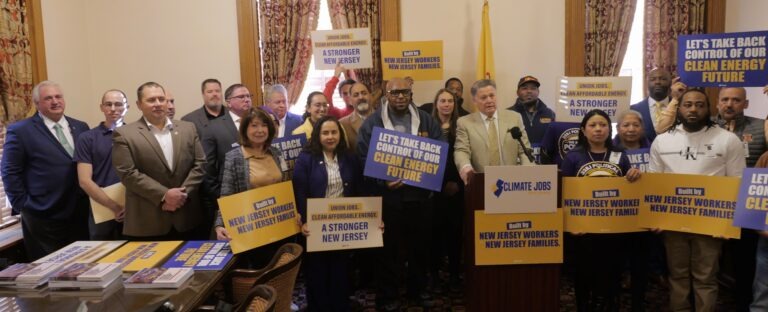
Climate Jobs New Jersey launched with an ambitious legislative agenda to tackle the energy affordability crisis and help New Jersey take back control of its energy future by creating good union jobs and building more clean energy in the state.

Workers from across New Jersey gathered in Trenton today to announce the formation of Climate Jobs New Jersey, a coalition of unions united to power New Jersey’s clean energy economy with union jobs and tackle the energy affordability crisis with a plan that works for every working family.

At the press conference, speakers unveiled the coalition’s priorities heading into the 2026 state legislative session. These include:

  1. Launch a statewide solar and storage program to quickly deploy vast amounts of rooftop solar and battery storage so New Jersey can meet rising energy demand with in-state resources and do so in a way that creates new union jobs.
  1. Take back control of our energy system by putting the state in charge of planning and purchasing energy, allowing New Jersey to actually plan for our energy needs by spurring in-state clean energy generation, and guaranteeing that workers benefit from every new project.

At the press conference, Cornell University’s Climate Jobs Institute unveiled a new report that offers a long-term roadmap and science-backed recommendations developed with input from New Jersey unions aimed at building a clean energy economy, creating good union jobs, advancing affordability and equity, and tackling the climate crisis.

“New Jersey has a long history of building and innovating, but when it comes to building our own energy, we have lost our way. We import far too much of our energy from out of state, which exacerbates high prices and sends jobs in the energy industry away. With this new agenda from Climate Jobs New Jersey, we can take control of our energy future and get back to building our own energy. This will create local union jobs, bring economic growth to our communities, and give us the clean energy we need to meet rising energy demand and confront the climate crisis,” said Charlie Wowkanech, President of New Jersey AFL-CIO and President of Climate Jobs NJ.


“As demand for energy continues to grow, New Jersey faces some critical supply and demand challenges that won’t improve by ignoring them,” said LIUNA Vice President and Regional Manager and Climate Jobs NJ Secretary Mike Hellstrom. “Without smart and decisive action, our energy problems will only get worse. Climate Jobs New Jersey is an organization comprised of union trades workers who understand energy markets and infrastructure because they are the skilled, safe, and productive workforce who actually builds that energy infrastructure. We are interested in pursuing smart, practical, and science-backed solutions that benefit our residents and businesses by generating more clean, reliable, and affordable energy–in New Jersey and for New Jersey–while also creating good, family sustaining, middle class jobs.”

“When union labor leads, everyone succeeds. If New Jersey is serious about lowering energy bills and meeting skyrocketing demand, we must start building energy here, and we must start now,” said Greg Lalavee, Business Manager of Operating Engineers Local 825. “Through Climate Jobs New Jersey, we are laying out a simple plan: build energy here, store it here, and put New Jersey back in charge of its own energy future.”

“Thousands of DC21 members are ready to get to work and build the facilities that create home-grown energy for families across the state,” said IUPAT District Council 21 Business Manager/Secretary-Treasurer Bernie Snyder. “Our members have the training and skills to build this necessary infrastructure safely and efficiently.”

“Members of the IUPAT have been on the forefront of green energy work all over the country, and are ready to get to work in New Jersey. Homegrown energy will be a boon to working families in the state, including our members,” said Paul Canning, General Vice President (Eastern Region) of the International Union of Painters and Allied Trades.

“Our members are investing countless hours in clean energy training because we know this industry’s future is strong,” said Anthony Abrantes, Assistant Executive Secretary-Treasurer for the Eastern Atlantic State Regional Council of Carpenters. “Through state-of-the-art union training programs, we are building a clean energy economy that delivers more than temporary jobs—it creates lifelong, family-sustaining union careers. Now New Jersey must step up, invest in clean energy built here at home, and put union workers to work building our shared future.”

“Electricity bills are rising faster in New Jersey than just about anywhere else in the country. Much of our energy comes from out of state, which sends job opportunities away and leaves us tied to volatile prices. We need to take back our destiny and set New Jersey on a path to a secure and affordable clean energy future–and do it in a way that’s good for every working family,” said Shaun Sullivan, President of the New Jersey Pipe Trades and Business Manager of UA Local 475. “The men and women of the New Jersey Pipe Trades are fully trained and eager for opportunities to help produce clean energy for the state, and are proud to be part of this new coalition.”

“New Jersey’s union workers have been building and maintaining energy infrastructure for generations. We are the best-equipped workforce to get clean energy built right, so that it benefits the economies and health of all New Jersey communities,” said Joe Checkley, President & Business Manager of IBEW Local 94. “Climate Jobs New Jersey is bringing together working people who know how to get the job done. Together, we can build a reliable clean energy industry that brings down costs for consumers and generates good union jobs.”

“With labor at the helm, we can build the clean energy and infrastructure the climate crisis demands while lowering energy costs and creating high-quality, family-sustaining careers. A cleaner, more resilient future will generate thousands of good jobs—and we must ensure they come with strong wages and benefits for New Jerseyans. This is what real climate action looks like for working people,” said Ana Maria Hill, Vice President and New Jersey State Director of 32BJ SEIU. “32BJ members see the climate crisis firsthand, which is why we’re helping building service workers cut energy use and create cleaner, healthier buildings.”

“The Climate Jobs Institute at Cornell University’s ILR School was proud to work with and learn from New Jersey’s labor unions. Together, we have developed a bold, multi-sectoral, and science-backed plan to tackle the dual crises of climate change and inequality while creating high-quality union jobs and driving affordability for New Jersey residents in the face of historic energy price increases,” said Lara Skinner, Founding Executive Director of Cornell University’s Climate Jobs Institute. “Building a reliable, affordable, and abundant clean energy future for New Jersey will require massive investments in clean energy and infrastructure upgrades across the state. All of these investments have the potential to generate significant numbers of high-quality, family-sustaining, local union careers.”

Pictures and videos can be downloaded here.

$20M NJ AI Hub fund launched to boost state’s AI startups [NJBIZ]


The New Jersey Economic Development Authority (NJEDA) and CoreWeave have launched a $20 million New Jersey AI Hub Fund to support artificial intelligence startups affiliated with the NJ AI Hub Strategic Innovation Center in West Windsor. The NJEDA board approved a $10 million investment that will be matched dollar for dollar by CoreWeave and affiliated investors, creating capital access for AI companies looking to put down roots in New Jersey. 

Read the full story at NJBIZ.com: https://njbiz.com/njeda-coreweave-launch-new-jersey-ai-hub-fund/

Microplastic removal pilot launches at Atlantic City wastewater plant [TAPinto]

0


A New Jersey startup with roots in Princeton is developing new technology designed to remove microplastics from wastewater before it is released into rivers and streams. PolyGone Systems was founded by Princeton University alumni Nathaniel Banks and Yidian Liu. The company is testing a filtration system designed to capture tiny plastic particles that often pass through conventional treatment processes.

The technology uses artificial materials designed to mimic plant roots, which naturally trap small particles in water. As wastewater flows through the system, microplastics attach to the root-like structures and are removed before discharge. Early testing shows the system can capture large amounts of microplastics, offering utilities a potential new tool to reduce pollution and improve water quality across New Jersey.

Read the full story at TAPinto: https://www.tapinto.net/towns/princeton/sections/business-and-finance/articles/princeton-roots-state…

PSEG readies electric grid for FIFA World Cup events [BINJE]


As New Jersey and the New York metropolitan region prepare to host eight matches of the 2026 FIFA World Cup, including the tournament final at MetLife Stadium, Public Service Enterprise Group (PSE&G) has announced its plan to support the region’s power needs during the global event. 

PSEG’s involvement focuses on ensuring reliable electrical service across its territory as millions of visitors travel through the region. The World Cup is expected to place unprecedented demand on infrastructure. Utilities will play a central role behind the scenes, supporting everything from transit hubs and security systems to hospitality venues and surrounding communities.

Read the full story at BINJE: https://binje.com/pseg-ready-to-power-fifa-world-cup/