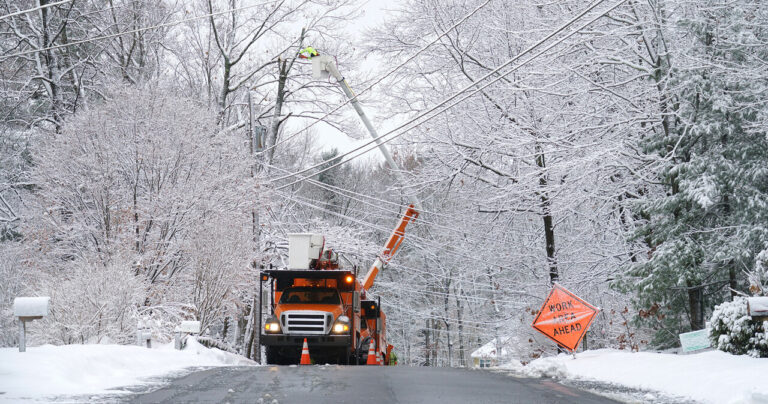
With winter weather and the chance of snowstorms in full swing, New Jersey American Water and The Watershed Institute are reminding residents, businesses and municipalities to use road salt responsibly. Excessive salt runoff can harm drinking water sources, aquatic ecosystems and infrastructure long after the snow melts.
Tips include shoveling snow before it turns to ice, using only the amount of salt needed, spreading granules efficiently and switching to liquid brine.
New Jersey lawmakers are considering legislation that would increase the fees homeowners must pay to challenge their property tax assessments, a process handled by county tax boards. The proposed changes would update filing fees that have remained largely unchanged for decades, with increases ranging from tens to hundreds of dollars depending on a property’s assessed value. Supporters argue the higher fees are necessary to reflect inflation and help county tax boards cover administrative costs as appeal volumes grow. Critics, however, warn that raising the cost to file an appeal could discourage homeowners from contesting assessments they believe are inaccurate, effectively limiting access to a system meant to provide oversight and fairness in local taxation.
State officials announced more than $265 million in grants to support water quality and infrastructure projects throughout New York State. Funding will help reduce flooding, protect drinking water, update aging systems, and improve resiliency to extreme weather. In Westchester, multiple communities including Yonkers, Sleepy Hollow, and Mamaroneck will receive support for culvert replacements and watershed work.
Plans to create a dedicated transit connection between Secaucus Junction, the Meadowlands Sports and Entertainment Complex, and Jersey City are moving forward. The Secaucus-Meadowlands Transitway is designed to support high-capacity, zero-emission transit vehicles and improve access to jobs, events, and regional transportation hubs in one of North Jersey’s busiest corridors.
“In late November, EPA released the Federal Fiscal Year 2025 (FFY25) Drinking Water State Revolving Fund (DWSRF) Lead Service Line Replacement (LSLR) state allotments and made some important changes to how lead pipe funds are allocated and used. This fourth of five annual funding rounds under the Infrastructure Investment and Jobs Act (IIJA), which provided a total of $15 billion for LSL identification and replacement, includes reallotments of unspent funds from prior years.
This blog breaks down what changed, what didn’t, and why it matters for a faster and more efficient distribution of lead pipe funding nationwide.”
Read the full story on the Environmental Policy Innovation Center website:
Governor Mikie Sherrill’s nomination of Ed Potosnak to serve as Commissioner of the Department of Environmental Protection has quickly emerged as one of the more contentious cabinet picks in her incoming administration, underscoring the tension between aggressive climate policy and growing concerns about affordability across New Jersey.
Potosnak, a longtime environmental advocate and Democratic activist, would assume leadership of an agency whose regulatory reach touches nearly every sector of the state’s economy — from housing construction and energy development to transportation projects and industrial permitting.
An Advocate Steps Into a Regulatory Role
Potosnak has spent more than a decade as Executive Director of the New Jersey League of Conservation Voters, where he built a profile as a vocal proponent of stronger environmental regulations, climate-focused land use policy and clean energy mandates. His work earned him strong backing from progressive environmental groups and party-aligned advocacy organizations.
He also serves as a Franklin Township councilman in Somerset County and has participated in regional planning bodies focused on watershed protection and sustainability.
Supporters describe Potosnak as mission-driven and deeply committed to environmental protection. Critics, however, question whether a career rooted largely in advocacy adequately prepares him to run a large, technically complex regulatory agency with sweeping authority over permitting, enforcement and economic development.
Claims of Contractor Experience
Potosnak has frequently cited his past experience as a licensed contractor to counter concerns that his background is limited to advocacy. Business records show he has been associated with Absolutely Fabulous Construction LLC, a New Jersey-registered company, a fact he has pointed to as evidence of firsthand exposure to construction rules and permitting requirements.
Industry observers note, however, that Potosnak has not overseen large-scale infrastructure projects, managed a statewide regulatory workforce, or administered a multibillion-dollar agency budget — responsibilities central to the DEP commissioner role.
“That’s a very different job than pushing policy from the outside,” said one business lobbyist tracking the nomination. “DEP commissioners have to balance — not just advocate.”
A Flashpoint on Affordability
The nomination lands as affordability dominates political discourse in New Jersey, with housing costs, energy prices and infrastructure expenses top-of-mind for voters.
Some critics have raised concerns that Potosnak’s policy record signals a continuation — or expansion — of regulatory approaches they argue have driven up construction costs and slowed development. Flood hazard rules, stormwater standards and extended environmental reviews have become particular flashpoints in the housing debate.
Those concerns are compounded by fears that DEP, under Potosnak’s leadership, could prioritize climate and land-use goals at the expense of accelerating housing supply and capital investment.
Administration’s Confidence
Governor Sherrill, announcing the nomination, emphasized flood resilience, PFAS remediation and clean water protections, while also pledging to streamline permitting and reduce bureaucratic delays.
Potosnak has echoed that message, arguing that environmental protection and economic growth are not mutually exclusive and pointing to his local government experience and contractor credentials as evidence he understands development pressures.
Still, skepticism remains among industry leaders and some local officials who say DEP leadership must be especially attuned to cost impacts at a time when affordability has become a political third rail.
High-Stakes Test Ahead
If confirmed, Potosnak will face immediate pressure on several fronts:
Implementing climate resilience rules without stalling development
Addressing PFAS and legacy contamination
Reforming DEP’s permitting process
Managing an agency whose decisions directly influence housing, energy and infrastructure costs
His tenure will test whether an advocate-turned-administrator can recalibrate from movement politics to regulatory balance.
A Signal Appointment
Potosnak’s nomination sends a clear signal about the Sherrill administration’s environmental priorities — and sets up an early test of how the new governor intends to reconcile climate ambition with economic and affordability concerns.
Whether he can make that transition — and reassure skeptics that DEP will function as a regulator rather than an advocacy platform — may ultimately define both his confirmation fight and his effectiveness at the helm of one of Trenton’s most powerful agencies.
As New Jersey begins a new chapter in infrastructure planning and execution under the Sherrill Administration, a fresh leadership figure is poised to shape how the state moves people and goods across highways, bridges, and transit corridors. Priya Jain, a civil engineer and seasoned infrastructure executive, has been nominated to serve as the next Commissioner of the New Jersey Department of Transportation (NJDOT) — a role that will place her at the center of statewide efforts to modernize the transportation network.
Engineering a Path to Leadership
Jain’s nomination marks her transition from the private sector into a key public service position. A Morris County resident with global experience, she most recently served as President of Americas for Mace Consult, where she led strategic growth and operational excellence for major engineering and infrastructure projects across the region.
Prior to her time at Mace Consult, Jain held senior leadership roles at several prominent firms, including Atlas Technical Consultants, Atkins and CH2M, where she was responsible for expanding business operations, guiding strategic initiatives, and delivering complex client programs. Early in her career, she also worked as an engineer on the original Access to the Region’s Core (ARC) Tunnel project, gaining firsthand experience with major transportation infrastructure planning and environmental permitting.
Her academic credentials include a Bachelor’s Degree in Civil Engineering, a Master’s in Physics from the Birla Institute of Technology & Science in India, and a Master’s Degree in Environmental Engineering from the University at Buffalo — a strong technical foundation for leading one of the state’s most critical agencies.
A Mandate for Modernization
Sherrill’s announcement emphasized Jain’s role in reducing commute times, enhancing roadway safety, and “cutting through red tape” in permitting and project delivery — reforms aimed at accelerating infrastructure improvements and reducing unnecessary delays and costs.
Jain said she was “honored to be nominated,” and pledged to focus on ramping up safety, improving access to transit, and advancing major projects across the state. “New Jerseyans rely on our transit systems each and every day,” she said, emphasizing her commitment to collaborative leadership and efficient project execution.
Her nomination comes at a moment when New Jersey faces high-stakes infrastructure demands, including preparation for the upcoming FIFA World Cup, continued progress on the long-anticipated Gateway Project, and broader efforts to expand transit access and repair aging roads and bridges.
Championing Progress and Project Delivery
Transportation advocates and industry leaders have welcomed Jain’s background in large-scale project delivery and organizational transformation. Her experience working across engineering, planning, and consulting sectors — both domestically and internationally — positions her to bring new perspectives to a department long focused on regulatory oversight and traditional capital programs.
Additionally, Jain has engaged in professional and academic advisory roles, including service on the Advisory Board for Civil Engineering at the City College of New York and previously on the board of the International Bridge, Tunnel & Turnpike Association — roles that reflect her broader engagement with engineering leadership and infrastructure policy.
Challenges on the Horizon
If confirmed by the New Jersey State Senate, Jain will inherit a department facing several persistent and emerging challenges:
Infrastructure Renewal: New Jersey’s roads, bridges, and transit facilities are among the oldest in the nation, requiring sustained investment and innovative maintenance strategies to improve safety and reliability.
Permitting and Project Delays: Sherrill’s platform highlights the need to reform permitting processes to speed project delivery — a priority that will demand close coordination across agencies, stakeholders, and local communities.
Climate Resilience: With increasing climate-related stresses — from intense storms to sea-level rise — NJDOT must integrate resilience planning into project development and asset management.
Equity and Access: Expanding equitable transportation options, particularly in underserved urban and rural communities, will test the department’s ability to balance competing needs within tight fiscal constraints.
A New Era for Transportation in New Jersey
Priya Jain’s appointment represents a notable shift toward executive leadership grounded in engineering expertise and strategic growth experience — qualities that many see as critical for tackling the state’s complex transportation challenges. If confirmed, her leadership could usher in a more agile, project-oriented era for NJDOT as New Jersey prepares for major global events and long-term infrastructure modernization.
As she steps into the role, Jain’s blend of technical knowledge, private-sector insights, and commitment to public service may well define the next chapter of transportation leadership in the Garden State.
As New Jersey embarks on an ambitious new era of infrastructure modernization and transportation reform, one person has been tapped to shape both the transit and highway strategies across the Garden State – Kris Kolluri, President and CEO of NJ Transit and Executive Director of the New Jersey Turnpike Authority
From Federal Projects to Statewide Transit Leader
Kris Kolluri’s journey to the helm of NJ Transit reflects a long career in public service and infrastructure leadership. Appointed President and CEO in early 2025, Kolluri oversees the nation’s largest statewide public transportation system, with more than 11,000 employees and nearly one million weekday passenger trips across bus, rail, and light rail networks.
Before leading NJ Transit, Kolluri served as CEO of the Gateway Development Commission, the bi-state agency responsible for the monumental Hudson Tunnel Project — a $16.1 billion effort to build new rail tunnels under the Hudson River, securing the largest federal investment ever in a U.S. mass transit project, and launching construction that had been decades in the making.
His background also includes service as Commissioner of the New Jersey Department of Transportation and leadership positions with community and economic development organizations — experiences that grounded his approach in both big-picture infrastructure strategy and the real needs of local communities.
Early Achievements at NJ Transit
In his first year leading NJ Transit, Kolluri has focused on stabilizing core operations while laying groundwork for long-term transformation:
Service reliability and modernization: Under Kolluri’s oversight, NJ Transit has accelerated infrastructure upgrades, from replacing train windows across its multilevel fleet to planning major station renovations that improve safety and accessibility.
Innovative revenue strategies: The agency unveiled The LAND Plan, a roadmap to unlock up to $1.9 billion in non-farebox revenue over the next three decades through transit-oriented development and asset optimization.
Union negotiations and strike management: In May 2025, Kolluri played a central role in negotiating a tentative agreement with the Brotherhood of Locomotive Engineers & Trainmen after a brief rail service stoppage, maintaining service continuity for commuters and financial balance for the agency.
Safety and rider experience: NJ Transit earned recognition from the U.S. Department of Transportation for its anti-human trafficking campaign, highlighting a commitment to rider safety and community partnerships under Kolluri’s leadership.
Expanding the Role: Transit Meets Highways
In a significant move, Governor Mikie Sherrill announced in January 2026 that Kolluri will retain his role at NJ Transit while also serving as Executive Director of the New Jersey Turnpike Authority. This dual appointment aims to break down traditional silos between transit and highway planning, offering a more unified approach to moving people and goods across the state’s transportation networks — particularly as New Jersey prepares to host major global events like the upcoming FIFA World Cup.
Challenges Ahead
Kolluri faces a host of ongoing and emerging challenges:
System reliability: Riders continue to grapple with service disruptions linked to aging infrastructure and operational complexity, placing pressure on the agency to deliver tangible improvements in on-time performance.
Capital needs: Modernizing NJ Transit’s aging fleet and infrastructure will require sustained investment, strategic prioritization, and coordination with federal, state, and regional partners.
Climate and resilience: Extreme weather events — such as recent winter storms prompting service adjustments — underscore the vulnerability of transportation networks and the need for resilient planning and emergency response.
Public expectations: With fare increases and broader economic pressures, balancing affordability with financial sustainability remains a sensitive policy tightrope.
A Leader for a Transformative Era
Kris Kolluri’s leadership at NJ Transit reflects both continuity and change. His deep experience with large-scale infrastructure projects and civic institutions positions him to guide New Jersey through a critical period of transformation — one that demands innovation, collaboration, and an unwavering focus on reliability and equity.
As NJ Transit and the Turnpike Authority move forward together under his stewardship, all eyes will be on how Kolluri turns strategic vision into everyday improvements for commuters and communities across the state.
In 2025, the New Jersey Department of Transportation awarded hundreds of millions of dollars in contracts to repair aging infrastructure, improve safety, and keep traffic moving across the state. The ten largest projects range from drainage and pavement preservation to major bridge reconstruction and traffic technology upgrades, reflecting the wide scope of work required to maintain one of the nation’s busiest transportation networks.
10. Smart Moves 2021 North ($14.7 million) Location: Various municipalities across northern New Jersey. Contractor: Daidone Electric, Inc. Why it matters: Traffic cameras, message signs, and fiber-optic systems help NJDOT respond faster to crashes and congestion, improving safety and travel times.
9. Hanover Avenue (CR 650) bridge over I-287 ($17.5 million) Location: Morris Township and Hanover Township, Morris County. Contractor: Ritacco Construction, Inc. Why it matters: Replacing the bridge deck improves safety for drivers on the local road and the interstate below while reducing long-term maintenance needs.
8. Pavement preservation South Contract-2 ($19.0 million) Location: Various municipalities across Atlantic, Burlington, Cumberland, Gloucester, and Salem counties. Contractor: Asphalt Paving Systems, Inc. of Hammonton, New Jersey. Why it matters: Pavement preservation extends the life of existing roadways at a fraction of the cost of full reconstruction. This contract helps keep South Jersey roads safer and smoother while reducing long-term maintenance expenses for taxpayers.
7. 2026 World Cup ITS improvements ($20.6 million) Location: Various locations across Bergen, Hudson, Essex, and Passaic counties. Contractor: Tiffany Electric, Inc. of Parsippany, New Jersey. Why it matters: These Intelligent Transportation Systems upgrades support travel ahead of the 2026 FIFA World Cup by improving traffic monitoring, communications, and real-time information across key corridors. The work helps manage increased travel demand while strengthening the region’s long-term traffic operations beyond the event.
6. Route 287 southbound resurfacing, Burnt Mills Road to Bailey’s Mill Road ($20.6 million) Location: Bedminster and Bernards townships, Borough of Far Hills in Somerset County, and Harding Township in Morris County. Contractor: Della Pello Paving, Inc. of Union, New Jersey. Why it matters: Interstate 287 is one of North Jersey’s most heavily traveled corridors. Resurfacing this stretch improves ride quality, enhances safety, and helps extend the life of the roadway for commuters and commercial traffic moving between Morris and Somerset counties.
5. Route 46 bridge over Paulins Kill ($21.5 million) Location:Township of Knowlton, Warren County. Contractor: Sparwick Contracting, Inc. of Lafayette, New Jersey. Why it matters: Route 46 is a key east–west corridor in northwest New Jersey. Replacing the bridge over Paulins Kill improves safety, protects a critical river crossing, and ensures long-term reliability for commuters, freight traffic, and emergency vehicles in a largely rural region.
4. Liberty State Park and Emergency Evacuation Terminal ($22.3 million) Location: Liberty State Park, City of Jersey City, Hudson County. Contractor: PKF-Mark III, Inc. of Newtown, Pennsylvania. Why it matters: Liberty State Park serves as a critical public space and emergency evacuation point for Jersey City and surrounding areas. Improvements to the emergency evacuation terminal strengthen the region’s ability to move people safely and efficiently during emergencies while supporting long-term resilience along the Hudson River waterfront.
3. Route 15 northbound bridge over abandoned Mt. Hope Mineral Railroad ($23.2 million) Location: Wharton Borough and Rockaway Township, Morris County. Contractor: Union Paving & Construction Co., Inc. Why it matters: Route 15 is a key commuter and freight route. Strengthening this bridge improves safety and reliability in an area with limited detour options.
2. Route 30, Cooper Street to Grove Street ($49.6 million) Location: Camden, Pennsauken, Collingswood, Oaklyn, Audubon, Haddon Heights, Camden County. Contractor: South State, Inc. Why it matters: Route 30 is a heavily traveled corridor. Resurfacing improves safety, supports local businesses, and benefits commuters, buses, and pedestrians.
1.Route 4 Hackensack River Bridge ($154.4 million) Location: Hackensack and Teaneck, Bergen County. Contractor: IEW Construction Group, Inc. Why it matters: The Hackensack River Bridge is the largest project awarded in 2025, exceeding the next largest contract by more than $100 million. The bridge carries traffic through one of North Jersey’s most congested corridors and will be replaced with a new structure, representing a long-term investment in safety, reliability, and regional mobility.
What the Data Shows
[Editor’s Note: A previous version of this chart had incorrect percentages. The pie chart has been corrected.]
New construction accounted for nearly 70 percent of spending among NJDOT’s ten largest projects in 2025, driven largely by major bridge and technology investments, while maintenance and preservation made up the remaining 31 percent. Notably, more than 60 percent of new construction spending is tied to a single project. The Route 4 Hackensack River Bridge is a critical link in one of North Jersey’s most congested corridors and a cornerstone investment in regional mobility.
Bridge projects accounted for 60 percent of spending among NJDOT’s ten largest awards in 2025, reflecting the scale and cost of replacing aging structures, while road resurfacing, traffic systems, and climate resilience projects made up the remainder.
Sources:
New Jersey Department of Transportation. (2024). Route 4 Hackensack River Bridge contract documents and bid tabulations. Trenton, NJ.
New Jersey Department of Transportation. (2024). Route 30 resurfacing, Cooper Street to Grove Street: Notice to contractors. Trenton, NJ.
New Jersey Department of Transportation. (2024). Route 15 northbound bridge over abandoned Mt. Hope Mineral Railroad: Project specifications. Trenton, NJ.
New Jersey Department of Transportation. (2024). Pavement preservation South Contract-2, FY 2024: Bid documents. Trenton, NJ.
New Jersey Department of Transportation. (2024). Hanover Avenue (CR 650) bridge over I-287: Construction plans and specifications. Trenton, NJ.
New Jersey Department of Transportation. (2024). Smart Moves 2021 North: Intelligent Transportation Systems program documentation. Trenton, NJ.
New Jersey Department of Transportation. (2024). Maintenance concrete structural repair contract, North Region: Notice to contractors. Trenton, NJ.
New Jersey Department of Transportation. (2024). Route 295 noise barrier construction, Lawrence Township: Project bid documents. Trenton, NJ.
New Jersey Department of Transportation. (2024). Route 202 and First Avenue intersection improvements: Construction specifications. Trenton, NJ.
New Jersey Department of Transportation. (2024). Drainage restoration contract, North Region (I-78 and I-80): Bid tabulations and scope of work. Trenton, NJ.



![Salt smarter not harder this winter [centraljersey.com]](https://tristateinfrastructurenews.com/wp-content/uploads/2026/02/large-image-21.png "Salt smarter not harder this winter [centraljersey.com]")
![Homeowners may pay more to appeal property tax assessments in NJ [NJ Spotlight News]](https://tristateinfrastructurenews.com/wp-content/uploads/2026/02/large-image-22-768x433.png "Homeowners may pay more to appeal property tax assessments in NJ [NJ Spotlight News]")
![Westchester watersheds to benefit from new resilient infrastructure grants [News 12]](https://tristateinfrastructurenews.com/wp-content/uploads/2026/02/large-TINN-Lede-v26-2-Recovered-768x404.png "Westchester watersheds to benefit from new resilient infrastructure grants [News 12]")
![Transitway project advances with $22M contract for Secaucus to Jersey City segment [ROI-NJ]](https://tristateinfrastructurenews.com/wp-content/uploads/2026/02/large-image-20-768x500.png "Transitway project advances with $22M contract for Secaucus to Jersey City segment [ROI-NJ]")
![2025 Lead Pipe Funding: The Good, the Bad, and the Big Opportunities Ahead [Environmental Policy Innovation Center]](https://tristateinfrastructurenews.com/wp-content/uploads/2026/02/large-TINN-H2O-rusted-pipe-768x404.jpg "2025 Lead Pipe Funding: The Good, the Bad, and the Big Opportunities Ahead [Environmental Policy Innovation Center]")