
Our Infrastructure Matters Ad
Home Blog Page 39

Op-Ed: The best route to safety and sustainability in the Hudson Valley

When faced with a challenge, leaders act. Problems require solutions – they seldom resolve themselves – and if ignored, usually worsen over time. Case in point: Route 17, a major corridor in the Hudson Valley region.

Efforts are underway to improve mobility on Route 17 in Orange and Sullivan counties by adding a third lane east and west, and making other necessary upgrades to convert the corridor to Interstate 86. Enhancing safety on Route 17 is of paramount importance, and we cannot afford further delays to this long-overdue project. It’s time to set the record straight and move this critical project forward.

The New York State Department of Transportation (NYSDOT) on January 17, 2024 hosted two public information sessions on the Route 17 enhancement project. The NYSDOT has been very responsive to local concerns and has addressed considerations ranging from safety, the environment, quality-of-life and projected financial costs.

The need for an additional travel lane has been confirmed by two separate NYSDOT studies and has bipartisan support at all levels of government. The project has long been supported by U.S. Senator Chuck Schumer, and Governor Kathy Hochul last year announced the start of an environmental review of Route 17 – a key step forward to convert the corridor to Interstate 86. The launch of the study follows the inclusion of up to $1 billion in the state budget to accelerate the conversion – funding for which our 17-Forward-86 Coalition had been advocating.

17-Forward-86 members are vocal proponents of this project. Yes, we are stakeholders – we live here, work here and travel on Route 17. The stakes are high. Why is this project so important? First and foremost is safety. An additional lane will improve mobility and provide critical access for first responders – police, fire and ambulance services. It will make the corridor safer for all of us traveling on it each and every day, whether to the office, or medical appointments, or to take our children to school or the baseball field.

An additional lane will also alleviate traffic, particularly on weekends, to our many tourist destinations. It will help local businesses that depend on deliveries and transports by allowing vehicles to move more efficiently, thus reducing traffic jams. Less traffic means less idling – and fewer emissions polluting our environment.

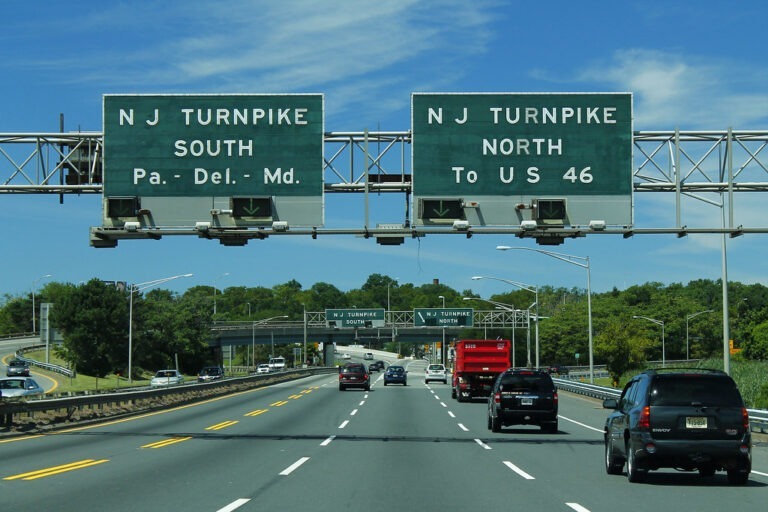
Widening Route 17 will not draw more traffic – it will facilitate the existing level moving through the area more expeditiously. It’s common sense. In fall 2014, the New Jersey Turnpike opened its much anticipated newly widened highway in central New Jersey. The region, similar to the Hudson Valley, had seen an increase in population and jobs amid expansions from companies in the logistics and distribution sectors. And, similar to Route 17, the roadway had reached capacity resulting in a chronically congested 35-mile stretch. The turnpike expansion resulted in reduced traffic and idling emissions, fewer accidents and fatalities, and renewed economic development opportunities.

If we build another lane, will more people come? The fact is, they’re already here. Our region has seen a dramatic rise in population, fueled in part by the Covid-19 pandemic. Orange County has the fourth-fastest growing population in the state, increasing at a rate of more than 9 percent between 2010 and 2023. Census data shows Sullivan County as one of the fastest-growing counties in the state. Many of these residents commute on Route 17. Tourism is booming, as well. Some 6 million people visit Orange County alone each year – Legoland itself draws more than 1 million. The Sullivan Catskills draws upward of 4 million visitors. They travel along Route 17.

Route 17 reaches beyond Orange and Sullivan counties. It is a key transportation corridor in New York State and a primary link for commercial and noncommercial traffic between New York City, Northern New Jersey, Pennsylvania and regions within our state (Hudson Valley, Catskills and the Southern Tier). In addition to interstate transportation, Route 17 serves as an intrastate transportation corridor for commuters and the movement of goods and services. It also is the main corridor for students traveling to institutions of higher learning, such as Cornell, Syracuse, Binghamton, Rochester Institute of Technology, and all of the larger SUNY schools in that region.

Investment in public transportation is an important part of the long-term sustainability for our region, and a one-seat ride into midtown Manhattan from Port Jervis or Middletown should be part of that plan. However, we also know vehicles – cars and trucks, electric or internal combustion – will continue to be part of our everyday lives. We cannot ignore facts.

The Route 17 enhancement project also will go a long way toward the sustainability of our communities and local economies. Infrastructure upgrades are investments in our future. It has been proved – over the course of a century of American life and economic growth – that each $1 billion invested in infrastructure yields thousands of direct jobs and a multiplier of that in indirect jobs. The construction phase of the Route 17 project will create upward of 500 direct jobs, employing local labor. Contractors, suppliers and related industries will also benefit from an increased demand for materials and services. Consider the $4 billion Gov. Mario M. Cuomo Bridge, which generated more than 6,600 living-wage jobs and tens of thousands of indirect jobs in the region.

The numbers speak for themselves. Our region is growing and we must ensure our infrastructure can safely handle the current and future capacity. Enhancing mobility on Route 17 is the responsible thing to do for our residents, visitors, environment and region.

Daniel Ortega is a founding member of 17-Forward-86, a broad-based coalition of industry, trade and civic representatives who share a common vision for expanding the capacity of Route 17 to ensure the safety and economic well-being of the Hudson Valley and Sullivan Catskills. He also serves as the Community Affairs Chief for Engineers Labor-Employer Cooperative Local 825. 

Originally appeared: https://17forward86.org/2024/03/03/op-ed-the-best-route-to-safety-and-sustainability-in-the-hudson-valley/
Pennsylvania’s Ambitious Hydrogen Energy Plans

0

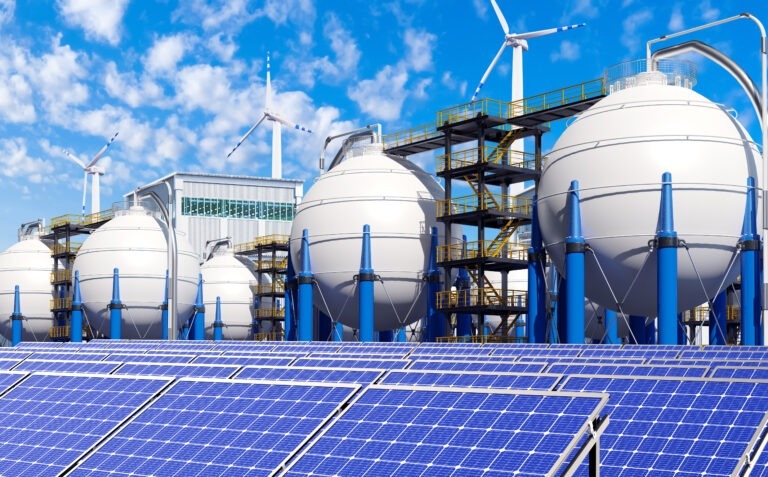
Pennsylvania is positioning itself as a leader in the clean energy revolution with its ambitious hydrogen energy plans. The state has secured two regional clean hydrogen hub projects, making it the only state in the country to achieve this feat. These projects are part of the U.S. Department of Energy’s (DOE) Regional Clean Hydrogen Hubs program, which aims to create a network of hydrogen production, storage, and transportation infrastructure across the United States.

The Hydrogen Hubs

The two hydrogen hubs are the Mid-Atlantic Clean Hydrogen Hub (MACH2) in Philadelphia and the Appalachian Regional Clean Hydrogen Hub (ARCH2) on the Pennsylvania/West Virginia border. The federal government is investing over $2 billion in these projects, with $750 million allocated to the MACH2 hub and $750 million to the ARCH2 hub. These investments are expected to create more than 41,000 good-paying jobs, with a particular focus on union jobs. The hubs will produce clean-burning hydrogen fuel and feedstock for critical industries that are currently dependent on fossil fuels.

Environmental and Economic Impact

Governor Josh Shapiro has emphasized the potential of these hydrogen hubs to position Pennsylvania as a leader in the clean energy future. The projects are expected to significantly reduce carbon emissions and help combat climate change. The Shapiro Administration is committed to ensuring that the hydrogen hubs are developed in an environmentally responsible manner and has pledged to work closely with organized labor, industry partners, and neighboring states to ensure that the projects benefit all stakeholders. The Pennsylvania Department of Environmental Protection (DEP) has been involved in the planning process, with a particular focus on environmental justice and community benefits.

Future Prospects

The hydrogen hubs in Pennsylvania are part of a broader effort by the Biden Administration to promote clean energy and reduce carbon emissions. The DOE’s Regional Clean Hydrogen Hubs program is allocating $7 billion to fund up to ten hydrogen hubs across the country. Pennsylvania’s success in securing two of these hubs highlights the state’s potential to become a major player in the clean energy sector. With the right approach, Pennsylvania can set a model for other states to follow in the pursuit of sustainable and equitable clean energy solutions.

Sources:

AI Boom Is Driving a Surprise Resurgence of US Gas-Fired Power [Bloomberg]

“From Florida to Oregon, utilities are racing to meet a surge in demand from power-hungry AI data centers, manufacturing facilities and electric vehicles. The staying power of gas, which in 2016 overtook coal as the No. 1 US source of electricity, has surprised some experts who not so long ago had projected the era of frenzied domestic demand growth for the fuel might soon come to an end.

…

Gas plants are also attractive to grids trying to help back up the deluge of intermittent wind and solar power coming online. ‘Natural gas is an essential partner for maintaining grid reliability and deploying more renewables,’ said Dan Brouillette, president of Edison Electric Institute, which represents investor-owned utilities.”

Read the full article here: https://www.bloomberg.com/news/articles/2024-09-16/us-natural-gas-power-plants-just-keep-coming-to-meet-ai-ev-electricity-demand?embedded-checkout=true

Nuclear Energy Renaissance

0

In the early 2000s, the Energy Policy Act of 2005 provided significant incentives for nuclear power, including loan guarantees and cost-overrun support. But momentum was stymied by several factors, including the availability of cheap natural gas, slow electricity demand growth, and safety concerns following the Fukushima disaster in 2011. Driven by the need for clean, reliable power to meet climate goals and growing energy demands, the landscape has shifted. 

Both the Trump and Biden administrations have recognized the importance of nuclear energy in achieving energy security and climate goals. The U.S. has joined over 20 other nations in pledging to triple nuclear energy capacity globally by 2050. This commitment includes supporting the development and construction of new reactors, mobilizing investments, and promoting resilient supply chains. Preliminary research indicates that a substantial portion of this new capacity could come from existing and recently retired nuclear power plant sites. Legislation has been passed to increase subsidies for new and existing nuclear plants, further bolstering the industry’s growth.

The Bipartisan Infrastructure Law and the Inflation Reduction Act have provided substantial federal funding, loan authority, and new tax incentives to extend reactor operations, increase capacity, and restart retired reactors. The Department of Energy (DOE) has also released updated reports to accelerate the deployment of advanced nuclear technologies and estimates that the U.S. will need an additional 700 to 900 gigawatts (GW) of clean firm power to reach net-zero emissions.

Nuclear energy is also uniquely positioned to meet the increasing energy requirements of data centers and high-performance computing thanks to its ability to provide reliable, around-the-clock power. One of the most promising developments is the focus on small modular reactors (SMRs). These reactors are designed to be more cost-effective and quicker to build compared to traditional large reactors. NuScale Power, for instance, has received regulatory approval for its SMR design, marking a significant milestone in the commercialization of advanced nuclear technologies.

Nuclear Energy in New Jersey

New Jersey is home to three nuclear power plants: Salem, Hope Creek, and Oyster Creek. The Salem and Hope Creek plants, located in Salem County, produce nearly 40% of the state’s electricity and 90% of its carbon-free energy. Oyster Creek, located in Ocean County, is currently being decommissioned. The state is actively seeking to extend the licenses of its operating plants for another 20 years to ensure a stable energy supply.

Nuclear Energy in New York

New York’s nuclear energy landscape has seen significant changes. The state shuttered its primary nuclear power plant, Indian Point, in 2021, leading to a spike in fossil fuel emissions. However, Governor Kathy Hochul is now pushing for the adoption of advanced nuclear technologies to help meet the state’s climate goals. New York’s remaining nuclear plants, Ginna, Nine Mile Point, and FitzPatrick, continue to provide a significant portion of the state’s carbon-free power.

Nuclear Energy in Connecticut, Pennsylvania, Delaware, and Maryland

Connecticut’s Millstone Power Station is the state’s only nuclear plant, providing nearly half of the state’s electricity and supporting over 3,900 jobs. Pennsylvania, a historical hub for nuclear power, hosts four active reactors that produce almost 25% of the state’s energy. And Microsoft is working with Consellation Energy to restart Three Mile Island to power Microsoft’s data centers. Delaware does not have any operating nuclear reactors, but Maryland’s Calvert Cliffs Nuclear Power Plant generates about 40% of the state’s electricity and 82% of its carbon-free energy.

The nuclear energy renaissance in the United States is a multifaceted effort involving technological innovation, supportive policies, and significant investment. As the nation strives to meet its climate goals and growing energy demands, nuclear power is poised to play a crucial role in providing clean, reliable energy for the future.

Sources:

How would Micron’s electricity-hogging plant here live with NY’s war on fossil fuels? [Syracuse.com]

0

Micron Technology’s planned semiconductor plant in Clay, New York, will consume more electricity than the entire state of Vermont, using 640 million kilowatt-hours per month. The $100 billion investment is expected to create 9,000 direct jobs and 40,000 support positions over 20 years, significantly boosting the Central New York economy.

Micron has pledged to use 100% renewable energy for its electricity needs, aligning with New York’s goal of an emission-free electric grid by 2040. However, meeting this commitment will be challenging without significant new wind and solar projects.

The state faces challenges in adding the necessary renewable capacity to meet its ambitious energy goals, with concerns about the pace of project deployment and the need for new transmission lines.

Read the full story here: https://www.syracuse.com/news/2023/02/how-would-microns-electricity-hogging-plant-here-live-with-nys-war-on-fossil-fuels.html

The NJ Turnpike Interchange 6 to 9 Widening Program – 10 Years After

The NJ Turnpike Interchange 6 to 9 Widening Program was a significant infrastructure project aimed at addressing the increasing traffic congestion on a critical stretch of the New Jersey Turnpike. The idea for this project was conceived in response to the steady rise in traffic volume and the anticipated growth in population and employment in central New Jersey. By 2032, northbound traffic volume was expected to increase by nearly 68%, and southbound traffic was forecasted to increase by 92%.

The project officially began in 2009, with the goal of widening approximately 35 miles of the Turnpike from Interchange 6 in Mansfield Township, Burlington County, to just south of Interchange 9 in East Brunswick Township, Middlesex County. The mainline was to be expanded from six lanes to twelve lanes from a point approximately two miles south of Interchange 6 to the existing ten-lane dual-dual roadway south of Interchange 8A. This required adding a new three-lane roadway in each direction for a 25-mile section of the Turnpike. Additionally, a third lane was added to the “cars/trucks/buses” lanes (outer roadways) of the ten-lane dual-dual roadway between Interchanges 8A and 9.

The project was one of the largest ongoing roadway projects in the Western Hemisphere at its peak, employing around 1,000 workers daily. The construction involved significant resources, including 140,000 cubic yards of concrete, 2.4 million tons of asphalt, 123 miles of guardrail, four miles of noise barriers, 17 miles of relocated pipeline, and 140 new over-the-road signs. More than 120,000 new trees were planted in the Turnpike right of way or on public lands in towns along the widening corridor.

The total cost of the project was approximately $2.5 billion. Despite its massive scale, the project was completed on schedule and more than $200 million under budget. The northbound lanes opened on October 27, 2014, and the southbound lanes opened on November 3, 2014.

Before the widening, the Turnpike experienced frequent congestion, particularly during peak travel times. Traffic studies conducted as part of the project’s planning phase indicated that the existing roadway would not be able to accommodate the projected increase in traffic volume. The studies forecasted significant growth in traffic due to expansions at the Port of NY/NJ, growth at Newark Liberty International Airport, and regional employment and population growth.

“Despite its massive scale, the project was completed on schedule and more than $200 million under budget.”

After the completion of the widening program, the Turnpike’s capacity was effectively doubled on the 35-mile stretch between Interchanges 6 and 8A, and increased by one lane in each direction between Interchanges 8A and 9. This has significantly alleviated congestion and improved traffic flow. The improved roadway is expected to accommodate traffic needs through the year 2032.

Theories of induced demand suggest that increasing road capacity leads to more traffic, as the improved infrastructure encourages more people to drive, ultimately negating the benefits of the expansion. However, in the case of the NJ Turnpike Interchange 6 to 9 Widening Program, these theories did not fully apply. The primary reason is that the project was designed to address existing and forecasted traffic demands rather than creating new demand. The traffic studies conducted before the project indicated that the existing roadway would not be able to handle the projected increase in traffic volume due to regional growth and expansions at key transportation hubs.

Moreover, the project included measures to manage traffic flow and reduce congestion, such as adding lanes to the “cars/trucks/buses” lanes and implementing advanced traffic management systems. These measures helped to ensure that the additional capacity was used efficiently and did not lead to the rapid re-congestion often associated with induced demand.

Overall, the NJ Turnpike Interchange 6 to 9 Widening Program stands as a testament to effective large-scale infrastructure planning and execution, addressing both current and future transportation needs in New Jersey without falling prey to the pitfalls of induced demand.

Sources

Is New Jersey Ready for Another Superstorm?

New Jersey has taken significant steps to prepare for future hurricanes since the devastating impact of Superstorm Sandy in 2012. The state has implemented a range of measures to enhance its resilience and ensure the safety of its residents.

Infrastructure Improvements

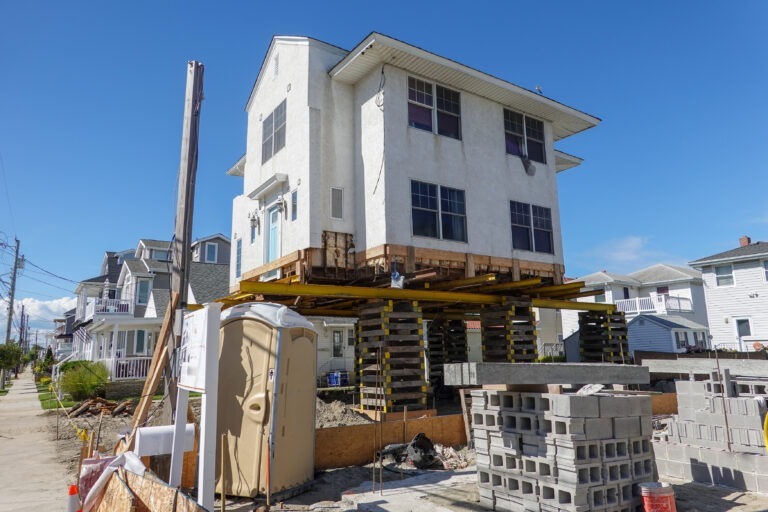
One of the key areas of focus has been infrastructure. New Jersey has invested billions of dollars in upgrading its coastal protection systems. This includes the construction of sand dunes, seawalls, and other barriers to protect against storm surges and flooding. Additionally, the state has elevated thousands of homes in flood-prone areas to reduce the risk of damage from future storms.

Utility Upgrades

The state has also made significant improvements to its utility infrastructure. After Sandy, over two million households lost power, highlighting the need for a more resilient power grid. New Jersey has since upgraded its utility systems to reduce the likelihood of widespread outages. This includes the installation of more robust power lines and the implementation of advanced technologies to quickly identify and address power disruptions.

Emergency Preparedness Plans

New Jersey has developed comprehensive emergency preparedness plans to ensure a coordinated response to future hurricanes. The New Jersey Office of Emergency Management (NJOEM) has created a detailed Hurricane Survival Guide that provides residents with essential information on how to prepare for and respond to hurricanes. The guide includes steps for creating an emergency kit, developing a family communication plan, and understanding evacuation routes.

Federal and State Funding

In the aftermath of Sandy, the federal government allocated $26 billion to support recovery efforts in New Jersey. This funding has been used to rebuild damaged infrastructure, support community recovery programs, and enhance the state’s overall resilience to future storms. Additionally, over $13 billion from Congress’ infrastructure bill has been set aside to help New Jersey prepare for future climate disasters.

Community Engagement and Education

New Jersey has also emphasized the importance of community engagement and education in its hurricane preparedness efforts. The state encourages residents to stay informed about potential hazards through credible sources such as the National Weather Service and the National Hurricane Center. Public awareness campaigns and community workshops are regularly conducted to educate residents on the importance of preparedness and the steps they can take to protect themselves and their families.

Environmental Restoration

To further enhance its resilience, New Jersey has undertaken extensive environmental restoration projects. This includes the restoration of natural habitats in flood-prone areas by buying and demolishing hundreds of homes. These efforts help to absorb floodwaters and reduce the impact of storm surges on communities.

Lessons Learned

The experience of Superstorm Sandy has provided valuable lessons for New Jersey. The state has recognized the importance of proactive planning and investment in resilience measures. While the recovery from Sandy was uneven, with some communities facing greater challenges than others, the overall response has strengthened New Jersey’s ability to withstand future hurricanes.

Areas of Incomplete Preparation

Despite these efforts, there are areas where New Jersey has fallen short in its hurricane preparedness. Some critical flood control projects, such as those in Hoboken, were only recently started, more than a decade after Sandy. Additionally, about 700 of the 7,400 participants in the state’s main post-Sandy rebuilding project have yet to complete the program. The uneven recovery has left some communities, particularly those with fewer resources, more vulnerable to future storms. Furthermore, the state has faced challenges in fully addressing energy infrastructure vulnerabilities, with ongoing issues related to power loss and gas shortages during major storms. The Passaic Valley Sewerage Commission (PVSC) has also struggled with preparedness, as it was knocked offline for almost three days during Sandy, causing over 840,000,000 gallons of untreated sewage to flow into the Passaic River, Newark Bay, and surrounding waters.While PVSC has made strides in recovery and resiliency, some planned projects, such as the construction of permanent flood walls and upgrades to the stormwater collection system, are still in progress.

In conclusion, New Jersey has made significant strides in preparing for future hurricanes through infrastructure improvements, utility upgrades, comprehensive emergency plans, federal and state funding, community engagement, and environmental restoration. However, the state still faces challenges in completing critical projects and ensuring an equitable recovery for all communities.

Sources:

FEMA Provides $10 Million to New Jersey for Climate Resilience Projects …. https://www.fema.gov/press-release/20221201/fema-provides-10-million-new-jersey-climate-resilience-projects-communities

Hurricane Ida Recovery One Year Later: New Jersey | FEMA.gov. https://www.fema.gov/fact-sheet/hurricane-ida-recovery-one-year-later-new-jersey

Passaic Valley Sewerage Commission. https://www.nj.gov/pvsc/

Five Years After Sandy PVSC Is The Model Of Resiliency And Recovery. https://www.nj.gov/pvsc/news/sandy/pdf/5%20_Years_After_Sandy_Fast_Facts.pdf

Two Months into Recovery, Federal Funding Tops $518 Million for New Jersey. https://www.fema.gov/press-release/20211112/two-months-recovery-federal-funding-tops-518-million-new-jersey

A Decade After Sandy, PVSC’s Quest For Maximum Preparedness Continues. https://www.nj.gov/pvsc/home/forms/pdf/2022_10YearsAfterSandy.pdf

Passaic Valley Sewerage Commission | Newsroom – The Official Web Site …. https://www.nj.gov/pvsc/news/sandy/

New Jersey: Newark Ironbound Resiliency Hub – FEMA.gov. https://www.fema.gov/case-study/newark-new-jerseyNR Storm Preparation and Emergency Planning – NJ Green Building Manual. https://greenmanual.rutgers.edu/nr-storm-preparation-and-emergency-planning/

Potential Impact of NJ PACT and REAL on Property Values and Affordable Housing

The NJ PACT (Protecting Against Climate Threats) and REAL (Resilient Environment And Landscape) legislation are initiatives by the New Jersey Department of Environmental Protection (DEP) aimed at addressing climate change and enhancing resilience. These proposals, currently under review, have sparked significant debate among stakeholders regarding their potential impacts on property values and affordable housing initiatives.

Impact on Property Values

One of the most contentious aspects of the NJ PACT/REAL legislation is its potential to reduce property values, particularly in coastal and urban areas. The legislation includes provisions that assume a 5-foot sea level rise by 2100 and apply this standard today. This assumption leads to the creation of “no build” zones on barrier islands and coastal communities, including urban areas like Hoboken, Long Branch, and Asbury Park. These restrictions are expected to:

  • Reduce Property Values: Properties in these areas may see a decline in value due to the increased risk of flooding and the limitations on development.
  • Increase Insurance Costs: Homeowners may be forced to purchase expensive flood insurance, even in areas that have never flooded and are unlikely to do so.
  • Loss of Local Tax Revenue: As property values decline, local governments may experience a reduction in tax revenue, which could impact public services and infrastructure.

Impact on Homeowners in “No Build” Zones

Homeowners living in the “no build” zones face significant challenges. They may find it difficult to sell their properties due to the restrictions on development and the perceived risk of flooding. Additionally, these homeowners might have to invest in costly flood mitigation measures to comply with the new regulations. The uncertainty and potential financial burden can lead to stress and anxiety for affected homeowners.

Impact on Affordable Housing Initiatives

The NJ PACT/REAL legislation also poses challenges for affordable housing initiatives. The restrictions on development in certain areas could limit the availability of land for new affordable housing projects. This is particularly concerning given New Jersey’s ongoing struggle to meet affordable housing needs.

  • Reduced Availability of Land: The creation of “no build” zones and other restrictions could limit the amount of land available for affordable housing development.
  • Increased Costs for Developers: Developers may face higher costs due to the need to comply with new regulations and the potential for increased insurance premiums.
  • Impact on Redevelopment Efforts: Urban areas that are targeted for redevelopment may face additional hurdles, making it more difficult to create affordable housing in these regions.

Balancing Environmental and Housing Goals

While the NJ PACT/REAL legislation aims to address critical environmental concerns, it is essential to balance these goals with the need for affordable housing. Governor Murphy’s administration has made strides in affordable housing reform, with new legislation aimed at clarifying housing obligations and jump-starting construction. However, the success of these initiatives will depend on how well they can be integrated with the new environmental regulations.

  • Certainty for Stakeholders: The new affordable housing laws provide more certainty for advocates, municipalities, and developers, potentially reducing litigation and focusing efforts on creating affordable homes.
  • Collaboration and Adaptation: It will be crucial for state and municipal legislators to collaborate and adapt their approaches to ensure that both environmental and housing goals can be met.

Advocacy organizations have been trying to make local government aware of their concerns and allow people to voice those questions. Their efforts are here.

In conclusion, the NJ PACT/REAL legislation presents both challenges and opportunities for New Jersey. While it aims to protect against climate threats, it also has significant implications for property values and affordable housing initiatives. Balancing these priorities will require careful planning and collaboration among all stakeholders to ensure a sustainable and equitable future for the state.

Sources:

NJPACT REAL Myths and Facts – New Jersey Department of Environmental …. https://dep.nj.gov/njreal/facts

Help Oppose the PACT REAL Rule – NJBA. https://njba.org/2024/09/11/realrule

Real Impact NJ. https://realimpactnj.com

NJBIA: DEP’s Proposed Land Use Rules Will Force Retreat from NJ Shore https://njbia.org/njbia-deps-proposed-land-use-rules-will-force-retreat-from-nj-shore/

Analysis: How Hospitals in North Carolina and Tennessee Managed Power Outages During Hurricane Helene

Hurricane Helene recently swept through the southeastern United States, leaving a trail of destruction in its wake. Among the hardest-hit areas were North Carolina and Tennessee, where hospitals faced significant challenges due to power outages and flooding.

In North Carolina, the western part of the state saw 22 acute care hospitals affected by the storm. While most hospitals managed to stay open and provide essential care, they were not unscathed. Grid power was restored to all but two hospitals, which had to rely on backup generators to maintain critical operations. Some hospitals had to rely on backup power for several days, highlighting the severity of the situation. The state Health and Human Services chief, Kody Kinsley, reported that the hospitals were working tirelessly to ensure patient safety and continuity of care.

In eastern Tennessee, the situation was equally dire. Ballad Health, a major hospital chain in the region, had to evacuate patients and staff from its Sycamore Shoals Hospital due to rising floodwaters. The evacuation was a precautionary measure to ensure the safety of everyone in the facility.

“Some hospitals had to rely on backup power for several days, highlighting the severity of the situation”

Without grid power, hospitals had to rely on backup generators, which are not always capable of supporting the full range of hospital operations. This situation led to delays in processing and shortages of essential supplies.

In North Carolina, Mission Hospital’s emergency department faced double capacity as supply shortages created processing delays. The hospital staff worked around the clock to manage the influx of patients and ensure that everyone received the care they needed.

The flooding and power outages also posed significant health risks to the affected communities. In the mountainous regions of North Carolina, many people lost access to clean water and power, increasing the risk of waterborne diseases and other health issues. The lack of access to hospitals and medical care further exacerbated these risks, making it difficult for residents to receive timely treatment.

Efforts to restore power and clean water are ongoing, and hospital staff continue to work tirelessly to provide care to their communities. The recovery process is expected to take time.

Hurricane Helene has highlighted the vulnerabilities of healthcare infrastructure in the face of natural disasters. The experiences of hospitals in North Carolina and Tennessee underscore the importance of preparedness and resilience in ensuring the continuity of care during such events. This includes backup energy systems that support critical hospital services for several days or more. As recovery efforts continue, the focus remains on restoring essential services and supporting the affected communities.

Sources

NY 17: On the Road to I-86

0

NY 17, known locally as Route 17, stretches across New York State and is a vital transportation corridor that connects various communities and supports economic activities. However, the current state of NY17 has raised concerns regarding safety, congestion, and overall efficiency, necessitating a comprehensive renovation. The renovation of NY17 and upgrade to Interstate Highway status is a critical infrastructure project that promises to bring numerous benefits to the region. 

One of the primary reasons for renovating NY17 is to improve safety. The highway has seen a significant number of accidents over the years, many of which can be attributed to outdated road designs and insufficient safety measures. By upgrading the highway to meet modern interstate standards, including better interchange spacing, longer acceleration lanes, and improved sightlines, the renovation will significantly reduce the risk of accidents and enhance the overall safety for motorists.

Another crucial benefit of the renovation is the reduction of congestion. NY17 is often plagued by heavy traffic, especially during peak hours, leading to delays and frustration for commuters. Expanding the highway to include additional lanes, particularly in high-traffic areas, will alleviate congestion and ensure smoother traffic flow. This improvement will not only save time for commuters but also reduce fuel consumption and emissions, contributing to a cleaner environment.

The renovation of NY17 will also fuel economic growth in the region. Improved transportation infrastructure is a key driver of economic development, as it facilitates the movement of goods and people. By enhancing NY17, businesses will have better access to markets, and the region will become more attractive to investors. This, in turn, will create job opportunities and stimulate local economies.

Furthermore, the renovation will enhance mobility and travel options. The project aims to incorporate multimodal transportation solutions, such as dedicated lanes for buses and improved facilities for cyclists and pedestrians. This will provide residents with more travel options and promote sustainable transportation practices.

Progress on the Route 17 to I-86 Conversion Project

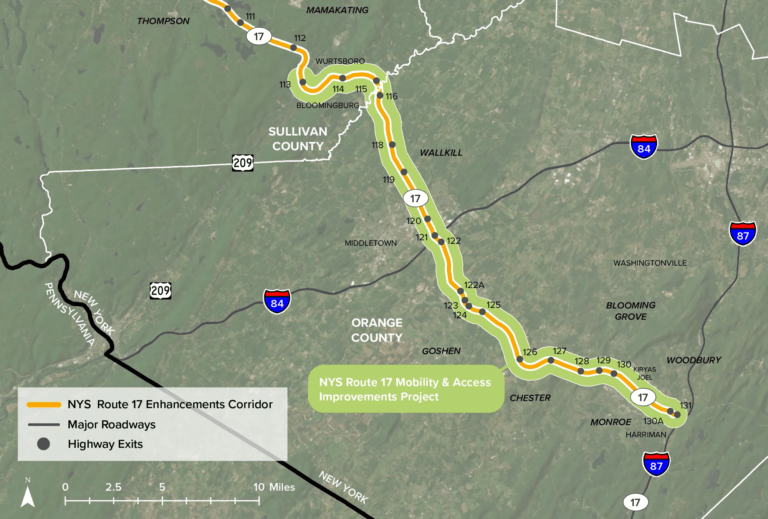
The Route 17 to I-86 conversion project is making significant strides, marking a transformative phase for the region. The New York State Department of Transportation (NYSDOT) recently updated the public on the progress of this ambitious project, which aims to upgrade a 30-mile stretch of Route 17 between Exit 113 in Wurtsboro and Interstate 87 in Orange County to meet federal interstate standards¹.

One of the key milestones achieved is the commencement of the Draft Environmental Impact Statement (DEIS), a crucial step in the project’s approval process. This document will assess the potential environmental impacts of the project and outline mitigation measures. Public outreach and involvement efforts are also underway, ensuring that community feedback is incorporated into the planning process.

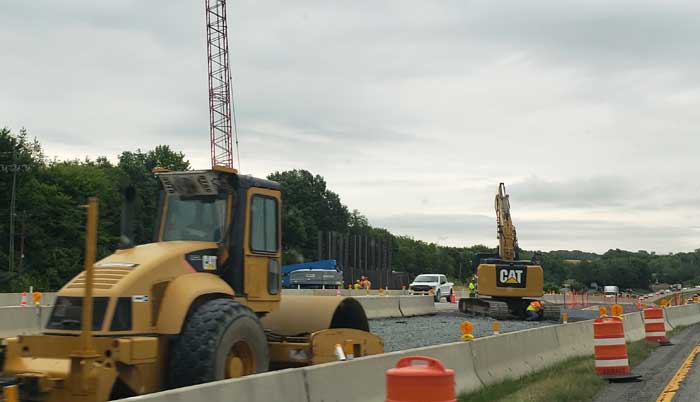
The project includes the construction of a third lane in each direction on Route 17 in sections of Orange and Sullivan counties, aimed at improving congestion-related travel times and speeds. Additionally, the planned Stage II improvements to Exit 122 at Crystal Run Road in the Town of Wallkill are set to begin soon, with an estimated cost of $75 million to $85 million.

New York Governor Kathy Hochul has committed a total of $1 billion for the conversion of Route 17 to I-86, highlighting the state’s dedication to enhancing transportation infrastructure. The project is expected to significantly improve mobility, reduce travel times, and boost economic growth in the region.

Sources