Following the container ship collision with the Francis Scott Key Bridge in Baltimore in March, 2024, resulting in the death of six construction workers, the National Traffic Safety Board has reviewed bridged around the country and determined that two in New Jersey should be evaluated to determine how vulnerable they are to collapse.
“Newark Bay’s Vincent R. Casciano Bridge, which is under the jurisdiction of the New Jersey Turnpike Authority, and the Commodore Barry Bridge, partially in New Jersey but owned by the Delaware River Port Authority, are the two crossings in the Garden State that are included in the NTSB list of structures that should get a risk assessment.”
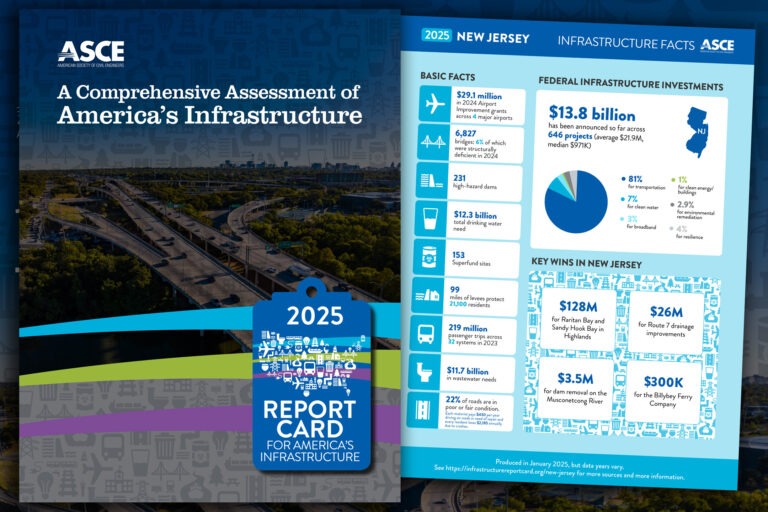
The 2025 Infrastructure Report Card by the American Society of Civil Engineers (ASCE) evaluates the state of America’s infrastructure across 18 categories, assigning grades from A to F based on criteria such as capacity, condition, funding, future needs, operation and maintenance, public safety, resilience, and innovation. This quadrennial report highlights progress made since the passage of the Infrastructure Investment and Jobs Act (IIJA) in 2021 while identifying ongoing challenges and investment gaps.
Key Findings
Overall Grade Improvement: The national grade for infrastructure improved from C- in 2021 to C in 2025. Nearly half of the assessed categories saw grade increases, with ports receiving the highest grade (B) and stormwater and transit rated lowest (D). For the first time since 1998, no category received a D- grade.
Positive Impact of Federal Investments: The IIJA has significantly influenced improvements in transportation, water systems, energy networks, and waste management. However, sustained investment is necessary to maintain momentum and address aging infrastructure systems.
Introduction of Broadband as a Category: Broadband was added as a graded category for the first time in 2025, receiving a grade of C+. Its inclusion reflects its growing importance in modern infrastructure.
Persistent Challenges: Despite progress, nine categories remain within the D range. Aging infrastructure continues to be vulnerable to extreme weather events and natural disasters, emphasizing the need for resilience-focused investments. Additionally, unreliable data on performance indicators hampers proactive decision-making in sectors like schools, broadband, energy, levees, stormwater, and public parks.
Infrastructure Grades
Investment Needs
To bring all infrastructure categories to a state of good repair (grade B), ASCE estimates $9.1 trillion in investment is required over the next decade (2024–2033). Current funding levels are projected to provide $5.4 trillion during this period, leaving a $3.7 trillion gap. Specific gaps include:
Drinking Water: $309 billion
Bridges: $373 billion
Energy: $578 billion
Levees: $91 billion
Dams: $166 billion
If federal funding reverts to pre-IIJA levels, this gap could increase significantly.
Economic Implications
Sustained investment at current levels would save American families $700 annually by reducing inefficiencies and maintenance costs. Conversely, underinvestment would result in significant economic losses:
$5 trillion in lost gross economic output over 20 years (2024–2043)
$244 billion reduction in U.S. exports
Job losses totaling 344,000 by 2033
$1.9 trillion in lost disposable income for families.
Recommendations
The report emphasizes several strategies for improving infrastructure:
Resilience Planning: Prioritize designs that withstand extreme weather events and natural disasters to reduce long-term costs.
Sustained Investment: Maintain or increase current funding levels to ensure certainty for long-term planning.
Enhanced Data Collection: Implement standardized data collection practices across all sectors to improve asset management and decision-making.
Innovation Incentives: Encourage innovative technologies and materials to improve efficiency and sustainability.
New Jersey
New Jersey’s infrastructure faces considerable challenges and requires significant investment, especially in transportation. The state’s roads are costly for drivers, with each motorist spending an average of $430 annually due to needed repairs. Furthermore, 7.8% of the state’s bridges are classified as structurally deficient.
Beyond transportation, New Jersey’s drinking water infrastructure needs are estimated at $8.6 billion. There are also 229 dams identified as having high-hazard potential. In education, the state’s schools have a capital expenditure shortfall of $1.58 billion.
The report highlights that this deteriorating infrastructure impacts New Jersey’s economic competitiveness and underscores the need for sustained investment and leadership from all government levels to address these issues.
Conclusion
The 2025 Infrastructure Report Card demonstrates encouraging progress due to recent federal investments but underscores the need for sustained funding and strategic planning to address persistent challenges. By closing investment gaps and prioritizing resilience and innovation, America can unlock its infrastructure’s full potential while safeguarding public health, safety, and economic growth for future generations.
PJM Interconnection operates the largest wholesale electricity market in North America, coordinating power flows across 13 states and Washington D.C. for 65 million customers. This regional transmission organization (RTO) has become a critical institution in America’s energy landscape, balancing competing demands for reliability, affordability, and sustainability in one of the world’s most complex power systems.
Origins of PJM and the modern grid
The origins of PJM date back to 1927 when utilities in Pennsylvania, New Jersey, and Maryland formed an interconnection to share reserve power. This cooperative approach represented a radical departure from the era’s standard practice where each utility operated as an isolated monopoly. The early interconnection helped prevent blackouts by allowing members to back each other up during emergencies, while reducing costs through shared resources.
As the electric grid grew more interconnected throughout the 20th century, the need for centralized coordination became apparent. The Northeast Blackout of 1965 – which left 30 million people without power – demonstrated the vulnerabilities of fragmented grid operations. This catalyzed support for stronger regional coordination, leading to PJM’s evolution into an independent system operator in the 1990s following federal electricity market reforms.
PJM Today
Today, PJM operates at the center of a sophisticated energy ecosystem. The organization performs two vital functions that keep lights on across its territory. First, as a grid operator, PJM engineers constantly balance electricity supply and demand in real-time, dispatching power plants every five minutes to match the second-by-second fluctuations in consumption. This complex dance maintains the grid’s critical 60Hz frequency within tight tolerances.
It’s important to note that PJM does not own the power plants that generate the electricity; they are owned by a diverse mix of entities, from the New Deal era Tennessee Valley Authority (TVA) to Talen Energy in Maryland. For example, New Jersey’s last remaining nuclear facility – Salem/Hope Creek Generating Station – is owned and operated by PSEG in partnership with Excelon. What power generating stations get built where and what type they are (coal, nuclear, natural gas, wind, solar, etc…) are subject to local, state, and federal authorities and state energy policies like New Jersey’s Energy Master Plan. Currently, about 30-35% of power generated within the PJM grid is from nuclear, 50-55% from natural gas, 10-15% coal, ~5-8% from renewables (wind, solar, and hydro), and less than 2% from oil and battery storage.
Caption: Hope Creek Nuclear Generating Station is owned by PSEG/Excelon. The electricity it generates is distributed via the PJM grid
Second, as market administrator, PJM runs competitive auctions that determine electricity prices and compensate generators. The energy market matches supply with demand on an hourly basis, while the separate capacity market ensures adequate generation resources will be available in future years. PJM also operates markets for ancillary services that provide voltage support and other grid stability functions.
The transition to competitive markets in the late 1990s transformed PJM from a utility cooperative into an independent system operator. This restructuring introduced market-based pricing that rewarded efficiency and innovation. Where monopoly utilities once received guaranteed returns on their investments, generators in PJM’s markets now compete to provide electricity at the lowest cost.
For more about how the grid operates, watch “The Power Behind the Switch”
Growing Challenges
However, PJM faces growing challenges as the energy landscape evolves. The rapid growth of renewable energy presents both opportunities and complications. While wind and solar provide clean electricity, their intermittent nature requires new approaches to grid management. PJM must coordinate thousands of distributed energy resources while maintaining reliability as traditional coal and nuclear plants retire.
Market design has become another flashpoint. State clean energy policies sometimes conflict with PJM’s federally-regulated wholesale markets. When states subsidize preferred generation resources like nuclear plants or offshore wind, it can distort price signals in PJM’s competitive markets. These tensions have led to protracted legal and regulatory battles over market rules.
Infrastructure represents another pressing challenge. Much of PJM’s transmission system was built decades ago and requires upgrades to handle new power flows. Building new lines faces opposition from landowners and local communities, while cybersecurity threats grow as grid operations become more digitally connected.
Perhaps most significantly, electricity demand is surging after years of flat growth. Data centers, electric vehicles, and industrial electrification are driving projections of 4.5% annual load growth in PJM territory – a dramatic increase that will require new generation and transmission investments. This comes as the industry struggles with supply chain delays and workforce shortages.
Looking ahead, PJM must navigate these challenges while maintaining its core mission of reliable, affordable electricity. The organization’s ability to adapt will help determine whether the eastern U.S. can successfully transition to a clean energy future without compromising grid reliability. PJM’s decisions over the coming decade will shape the region’s energy landscape for generations to come.
References
Brattle Group. (2023). “Resource adequacy in transition: Challenges for PJM’s capacity market”. https://www.brattle.com
Federal Energy Regulatory Commission. (1999). “Order No. 2000: Regional transmission organizations”. https://www.ferc.gov
North American Electric Reliability Corporation. (2023). “Long-term reliability assessment”. https://www.nerc.com
PJM Interconnection. (2023). “The PJM story: A history of innovation”. https://www.pjm.com
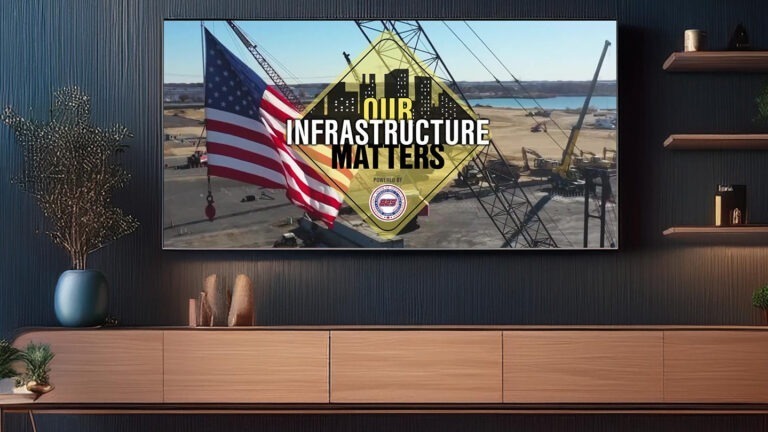
“Our Infrastructure Matters” is a news program highlighting important infrastructure projects and issues throughout the region. From roads and bridges to rails and tunnels. From the energy and communications grids to drinking water, wastewater, and stormwater.
Episode 3 includes the following segments:
Explainer: Electrical Grid
The Hudson Tunnels: Unlock the Past. Gateway to the Future
“Cinderella Man” James Braddock
News 12 feature on Local 825 and the New Jersey Training Center
IUOE International Training & Education Center (ITEC)
“In a recent op-ed, Trenton City Council President Yazminelly Gonzalez addresses the rising energy costs and their disproportionate impact on communities of color. Drawing from her background in community service, instilled by her father, Gonzalez expresses concern over the high cost of living in New Jersey, particularly the energy burdens faced by Black and Latino communities. The op-ed highlights the importance of using one’s voice to advocate for these communities and find solutions to alleviate the financial strain caused by increasing energy expenses.”
New Jersey has a rich mining history dating back to the early 1700s, with iron being the most common mineral extracted. Mining thrived for centuries, contributing significantly to the colonial economy and the Revolutionary War effort. By 1970, however, mining operations had largely ceased, leaving behind a network of abandoned mines beneath 75 municipalities across eight counties. Recent sinkholes along Route 80 have disrupted transportation, highlighting the potential consequences of this hidden legacy. A state DEP database lists 588 abandoned mines, including iron, copper, and graphite mines. Residents can use an interactive map to check for mines near their addresses.
“State officials reviewed crash data for pedestrian fatalities on state highways for 2018-2022 and identified the 10 Murphy referred to as being the most dangerous, according to Stephen Schapiro, a spokesman for the state Department of Transportation.
The list includes three intersections along US 1&9 in Elizabeth, two each on Route 129 in Trenton and Route 9 in Old Bridge and three along Route 27, two in Franklin in Somerset County and one in Roselle in Union County. All are slated to be upgraded with smart-signal technology or other measures designed to reduce accidents.”
The I-95 bridge connecting New Jersey and Pennsylvania is set to be replaced soon. The bridge, which has been in use for decades, is showing signs of wear and tear, prompting officials to plan for its replacement. The new bridge will be designed to improve traffic flow and safety for motorists. The project is expected to take several years to complete and will involve significant construction work. During this time, there will be lane closures and detours to accommodate the construction. The replacement of the bridge is part of a larger effort to upgrade infrastructure in the region and ensure the safety and efficiency of transportation networks. The project has received funding from both state and federal sources, highlighting its importance to the region’s transportation system. Once completed, the new bridge will provide a safer and more reliable route for commuters and travelers.
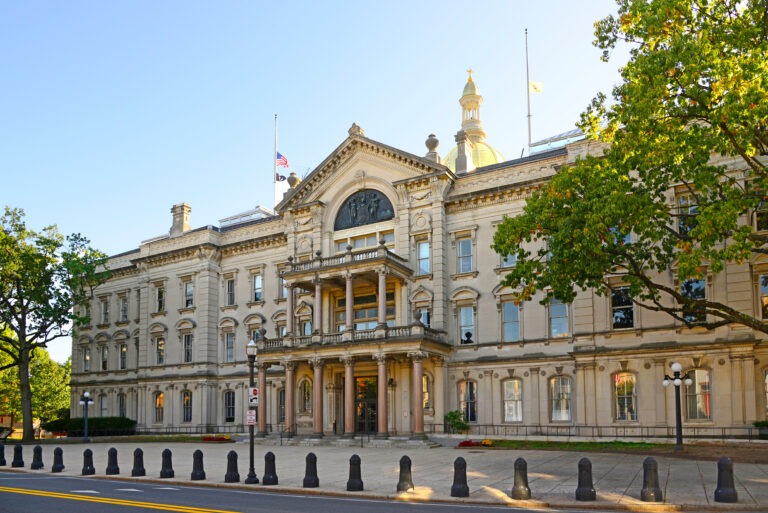
The New Jersey Board of Public Utilities’ (NJBPU) March 13 Public Stakeholder Meeting was supposed to be the public’s first view of the draft of the 2024 Energy Master Plan (EMP), the “State’s blueprint to achieve 100% clean energy by 2050.” The EMP is a critically important document that sets state energy policy regarding the production, distribution, consumption, and conservation of energy in the state for the next five years. It affects the daily lives of NJ residents in myriad ways – how they heat, cool, and power their homes, how they get to work, what kind of stove they can buy, and how much of their monthly budget will go towards paying for energy.
So after the 2019 Energy Master Plan (released in 2020) boldly shifted away from fossil fuels and towards renewable energy sources like offshore wind and solar, many were interested in what the next Energy Master Plan (originally scheduled for 2024) would bring. After all, many of the near-term goals of the 2019 Energy Master Plan had been missed; energy storage goals, EV adoption goals, offshore wind goals, etc… Plus, the 2019 EMP asserted that the clean energy goals could be met in part because statewide energy usage was dropping.
A lot has changed in five years. Artificial Intelligence (AI), EVs, building electrification and other technologies are now expected to cause a spike in energy demand. And one by one, offshore wind companies abandoned plans to develop wind farms off the Jersey Shore. Orsted withdrew in fall of 2023. Shell withdrew in January 2025. As of publication, EDF Renewables’ 2.8GW Atlantic Shores project is on life support due to Shell’s withdrawal from the project.
With all of this in mind, there was keen interest in the draft of the 2024 Energy Master Plan and its unveiling at the March 13 Public Stakeholder Meeting. The hope was that the 2024 draft EMP would recognize the missed goals and missteps of the previous plan and chart a path forward based on these new realities. And, just weeks after watching the NJBPU approve increased electricity rates (for the 7th consecutive year), there was hope that the EMP would seriously address the issue of cost; the 2019 EMP did not include ratepayer costs.
But what was presented at the meeting by consultant Energy+Environmental Economics (E3) was not a complete draft, but instead a short slide presentation titled, “Executive Summary DRAFT”, or, as NJBPU called it in their public notice of the meeting, “Overview of the draft 2024 Energy Master Plan”. Just 62 slides of charts and graphs. No backing or support data for others to analyze and provide constructive feedback on.
As a point of comparison, the Draft 2019 New Jersey Energy Master Plan was 108 text pages (not slides) with 4 pages of endnotes and is based upon the 2019 Integrated Energy Plan (IEP) which was 124 text pages with 19 pages of sources, references, and notes that could be independently reviewed. By their own benchmark, the “Overview of the draft 2024 Energy Master Plan” is woefully inadequate.
A private well in Washington Township, Warren County, New Jersey, has been found to contain alarmingly high levels of per- and polyfluoroalkyl substances (PFAS), also known as “forever chemicals.” The well, located at a self-storage facility, recorded a total PFAS concentration of 18,997 parts per trillion, the highest ever seen in New Jersey and among the highest in the nation. PFAS are a group of chemicals used in various applications due to their durability and resistance to degradation. However, they have been linked to serious health issues, including cancer and birth defects. The New Jersey Department of Environmental Protection (DEP) has requested the Environmental Protection Agency (EPA) to take over the response to this pollution. Federal investigators have expanded well testing in the area to determine the extent of the contamination. The DEP and EPA are working together to address this significant environmental and public health concern.



![These bridges in and around NJ make list to evaluate for risk of collapse [NorthJersey.com]](https://tristateinfrastructurenews.com/wp-content/uploads/2025/04/NTSB-2-NJ-Bridges-768x512.png "These bridges in and around NJ make list to evaluate for risk of collapse [NorthJersey.com]")


![Trenton City Council President guest oped: Rising Energy Costs Hurts Communities of Color [The Trentonian]](https://tristateinfrastructurenews.com/wp-content/uploads/2025/03/TrentonianOpEd-768x726.jpg "Trenton City Council President guest oped: Rising Energy Costs Hurts Communities of Color [The Trentonian]")
![Mapping NJ’s hundreds of abandoned mines [NJ Spotlight]](https://tristateinfrastructurenews.com/wp-content/uploads/2025/04/NJ-Mines-NJDEP-Bureau-of-GIS-768x668.png "Mapping NJ’s hundreds of abandoned mines [NJ Spotlight]")
![Can NJ fix these 10 deadliest intersections? [NJ Spotlight]](https://tristateinfrastructurenews.com/wp-content/uploads/2025/03/AdobeStock_135952493-768x475.jpeg "Can NJ fix these 10 deadliest intersections? [NJ Spotlight]")
![This I-95 bridge connecting N.J. and Pennsylvania could be replaced soon [NJ.com]](https://tristateinfrastructurenews.com/wp-content/uploads/2025/03/I95-Delaware-River-Bridge-Google-768x429.png "This I-95 bridge connecting N.J. and Pennsylvania could be replaced soon [NJ.com]")
![‘Startlingly high’ levels of PFAS pollution found in Warren County hot spot [NJ Spotlight]](https://tristateinfrastructurenews.com/wp-content/uploads/2025/03/PFAS-in-Washington-Twp-Google--768x379.png "‘Startlingly high’ levels of PFAS pollution found in Warren County hot spot [NJ Spotlight]")