“Ma, a renowned expert in Chinese technology and founder of the media company Tech Buzz China, took her team on the road to get a firsthand look at the country’s AI advancements. She told Fortune that while she isn’t an energy expert, she attended enough meetings and talked to enough insiders to come away with a conclusion that should send chills down the spine of Silicon Valley: In China, building enough power for data centers is no longer up for debate.
‘This is a stark contrast to the U.S., where AI growth is increasingly tied to debates over data center power consumption and grid limitations,’ she wrote on X.”
”WSJ went inside the nuclear plant to learn the steps it takes to restart the clean energy source and examined the regulations in place in order to restart these reactors.”
Governor Murphy recently signed two bills meant to increase accountability and transparency in decision making by the regional grid operator PJM. Given the overwhelming lack of transparency in New Jersey’s energy policy, especially related to the state’s Energy Master Plan (EMP), we must ask, who holds our legislators and regulators accountable? AENJ has been asking for answers and transparency from the Board of Public Utilities (BPU) since the 2020 Energy Master Plan was released without a price tag, and all we have received are hollow answers and severely redacted documents. In fact, the BPU has gone more than 2,200 days without releasing the cost of the revised EMP.
This new legislation seeks to ensure that PJM is serving ratepayers by utilizing a pricing model that obtains adequate energy resources at the lowest possible cost at PJM’s annual capacity market auction. But it also directs the BPU to continue advocating with other states for reforms at PJM that will increase energy supply, protect ratepayers, and prioritize clean energy generation. That’s hard to do, given that natural gas, which has precipitated a decade and more of affordable energy and reduced emissions (and which accounts for 49 percent of New Jersey’s total electricity generation) is frowned upon in the EMP.
New Jersey isn’t the only state powered by affordable natural gas. According to PJM’s Generation Fuel Mix chart, natural gas also accounts for 43 percent of all PJM generation, thanks to the abundance of the Marcellus shale, and the entire region has seen natural gas replace coal and lower energy costs and emissions
If New Jersey is truly committed to incentivizing the development of new generation mixes in-state to meet growing electricity demand then natural gas must be part of the plan and included in the EMP.
There’s also no mention in the legislation of New Jersey’s halted plans to convert decommissioned coal plants to natural gas to maintain baseload generation. That is because the state looked to replace them with wind farms. Combined with the failure to replace 620 megawatts of generation from the Oyster Creek Nuclear Generation Station, the loss of these in-state generators made the state more reliant on imported generation and market-driven price spikes.
It’s absurd for BPU President Christine Guhl-Sadovy to call out PJM for transparency while the BPU itself has failed to be transparent and release the cost of the revised EMP and provide details on just how New Jersey plans to continue to meet the electricity demands of New Jersey businesses and residents. For the public to understand how decisions made at PJM may affect electricity reliability, affordability and sustainability, the BPU and elected officials must do the same.
Ron Morano is the Executive Director of Affordable Energy New Jersey.
“An economic analysis of the Newark Bay-Hudson County Extension Improvements Program released July 24 found that the program’s first project will generate $2.8 billion in economic activity and create more than 25,000 jobs, many offering prevailing wage and benefits, totaling $2 billion in earned income.”
“The first project includes the replacement of 16 bridges and nine ramps. This is the highest priority because of the deteriorating condition of the nearly 70-year-old structures. Construction will begin in 2026 and is estimated to take 10 years. A major portion of the project is the replacement of the Vincent R. Casciano Bridge over Newark Bay with twin cable-stayed bridges.”
The New Jersey Utilities Association (NJUA) issued a statement on behalf of its members last week saying it shares NJ residents’ frustration with significant bill increases for energy supplies. NJUA President and CEO Rich Henning also said it’s clear that the state needs to take control of its energy destiny and develop and construct new power generation to meet currently increasing and associated future demand.
“According to new polling from Independent Women’s Voice, 85% of likely voters in the 2025 New Jersey statewide elections worry about rising energy costs expected to result from existing state climate policies–including 83% of women.”
”Governor Phil Murphy (D-NJ)’s Energy Master Plan, an executive order signed in 2023 mandating the state reach 100% clean energy by 2035 through solar, wind, electric vehicles, and batteries, is squarely to blame for higher utility bills. Murphy’s green transition plan is estimated to cost $1.4 trillion in lost income, or $140,000 per average New Jerseyan over the next 25 years, while yielding no tangible environmental benefit. This isn’t sustainable for struggling families who already can’t pay their energy bills on time.”
”The Passaic River is a total of 80 miles long—winding and wrapping through Northern New Jersey, through complex tributaries and swampland and waterfalls, providing habitats for several species of birds and animals. Three major drinking water facilities draw from the river directly. In total, more than two million people drink from the Passaic.
But beneath the surface, 17 miles of it is full of hazardous amounts of dioxin, a highly toxic byproduct from manufacturing processes, mixing with other cancer-causing chemicals along the river’s bottom. Dioxin is a “forever chemical”—manufactured chemicals known to persist in the environment and in the body.”
”The river has been unusable for decades. People can’t swim in it or fish. Langa said she suspects it will be another decade until locals see the beginnings of a healthier Passaic. And that’s without any future disruptions. The process, she said, takes a lot of time with bureaucratic red tape, and people are getting burned out.”
New Jersey faces an existential threat in the form of climate change, state environmental officials warn, a threat that has them pushing new regulations that would force builders to take future sea-level rise into account.
But not Netflix.
…
The Netflix exemption is one of those rare times when New Jersey’s progressive activists and business leaders are on the same side, if for different reasons.
When the new flood rules were released, environmental groups criticized them for not going far enough, while businesses said they remain too stringent. Both groups, however, are ticked that Netflix gets to play by different rules.”
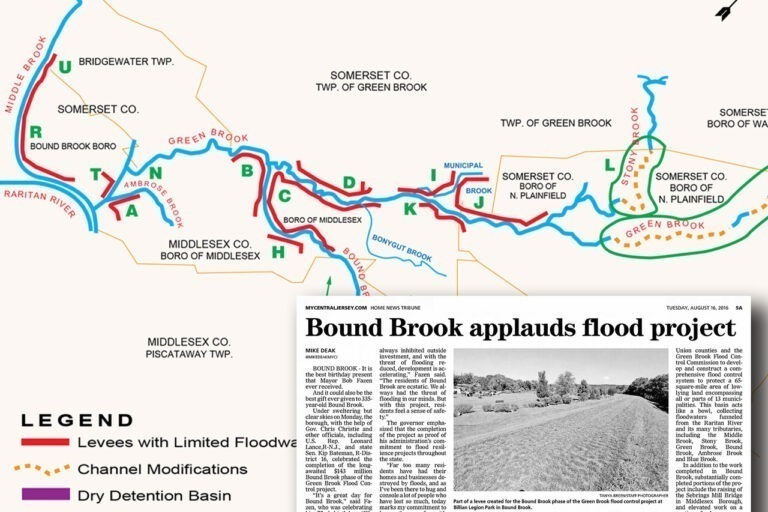
Bound Brook, New Jersey, sits at the confluence of the Green Brook and the Raritan River, placing much of the borough on a natural floodplain. This geography made the town especially vulnerable whenever heavy rains swelled both waterways beyond their banks. Residents grew accustomed to the rising water and hurried sandbagging efforts every time a storm threatened.
The_Courier_News_1973_08_02_Page_2
The_Courier_News_1971_08_31_Page_1
In August 1973, torrential rains caused the Green Brook to overflow, transforming streets into rivers and flooding basements. Six people died, and the flooding caused millions of dollars in damage across Central New Jersey. Downtown Bound Brook bore the brunt of the deluge. This catastrophe followed an earlier major flood in 1971, underscoring that patchwork defenses were no match for nature’s fury.
The_Central_New_Jersey_Home_News_1971_08_30_1
The_Central_New_Jersey_Home_News_1971_08_31_17
Tropical Storm Floyd in 1999 delivered another gut punch, claiming two lives and inflicting roughly $80 million in damages in the Green Brook sub-basin.
Courier_Post_1999_09_19_Page_8
The_Courier_News_1999_10_12_Page_12
Green Book Flood Control Project
In 1986, Congress authorized the U.S. Army Corps of Engineers to design and build the Green Brook Flood Control Project for the 68-square-mile basin covering 13 municipalities. After years of studies, land acquisitions, and environmental reviews, construction kicked off in 1999. The flood control strategy for Bound Brook centered on:
Levees built from impervious clay cores and covered with protective grass
Floodwalls formed by steel-reinforced concrete columns deeply anchored into bedrock
Pump stations to evacuate water that accumulated behind barriers
Road and railroad closure gates to seal off flood paths during high-water events
This layered approach allows water to be contained, diverted, or pumped out before it can overwhelm homes and businesses.
The Corps’ planning process involved detailed soil borings, wetland delineations, and coordination with the New Jersey Department of Environmental Protection to secure necessary permits. These upfront efforts ensured the massive earthen and concrete structures would stand firm for decades.
Key achievements in Bound Brook include the completion of the R2 levee system, designed to withstand a 150-year flood, and the installation of closure gates across railroad underpasses. The Talmadge Avenue Bridge was raised to levee height, and sections of railroad embankment blocking river flow were removed, dramatically improving drainage. These measures are functionally complete in the borough, while downstream and upstream work continues into the late 2020s. In Bridgewater, the Finderne Wetlands mitigation project adds upstream storage to soften flood peaks before they reach Bound Brook’s defenses.
A Protected Future
Today, when heavy rains pound central New Jersey, Bound Brook’s defenses hold. During 2011’s Hurricane Irene and 2021’s Hurricane Ida, streets that once drowned under rushing torrents saw only minor ponding, proof of the Corps’ foresight and engineering prowess. The town no longer braces for inevitable destruction but instead watches storms pass with confidence. As remaining segments finish by 2030, Bound Brook stands as a model of resilience—where once water reigned, human ingenuity now ensures safety and peace of mind.
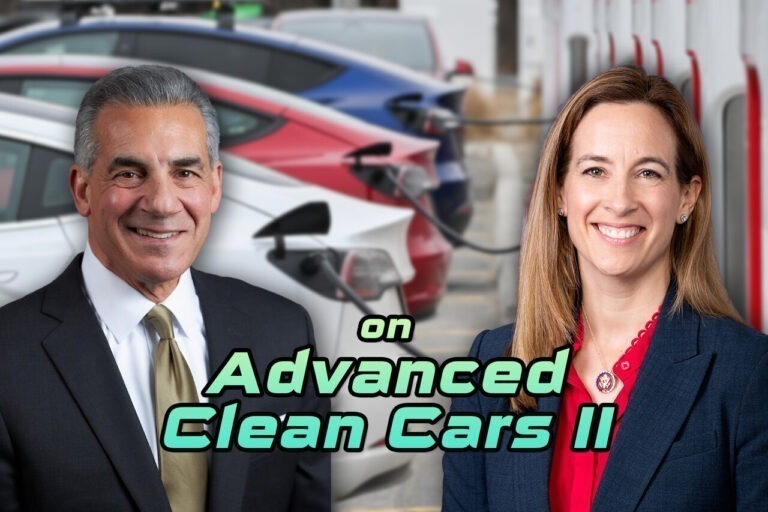
Advanced Clean Cars II (ACC II) is a regulatory framework adopted by New Jersey in November 2023 that mandates a transition to zero-emission vehicles (ZEVs) for new light-duty vehicle sales. 51% of 2027 model year vehicles (which go on sale in 2026) must be ZEVs (EVs, plug-in hybrids, and hydrogen-fueled vehicles). The percentage increases steadily until 2035, when 100% of all new vehicle sales must be ZEVs.
Mikie Sherrill’s Position
Democratic gubernatorial candidate Mikie Sherrill strongly supports New Jersey’s ACC II framework and Governor Phil Murphy’s 2035 clean energy goals. Sherrill has signaled she would continue Murphy’s energy and transportation policies, which include the phase-out of gasoline-powered vehicle sales by 2035, increased electrification, and substantial investment in renewable sources such as solar and wind. Her legislative actions show support for California-style clean car regulations: she voted against H.J.Res.88, which would have overturned the EPA’s approval of California’s Advanced Clean Cars II rule and, by extension, New Jersey’s adoption.
Sherrill’s campaign rhetoric emphasizes expanding community solar projects, utilizing underused spaces for clean energy generation, and increasing consumer incentives for purchasing electric vehicles. She has stated a commitment to making clean and affordable energy “accessible like never before,” arguing that ACC II will provide long-term health, environmental, and economic benefits for New Jersey residents.
However, Sherrill’s support for ACC II comes with controversy. Critics argue the policy could drive up energy and vehicle costs, especially as New Jersey’s grid infrastructure is challenged to meet future demand. Even among Democrats, there is growing concern that the aggressive clean car mandates could be costly and disruptive. Sherrill’s stance remains unwavering in prioritizing environmental action and electrification, signaling a continuation, rather than a deviation, from Murphy’s legacy.
Jack Ciattarelli’s Position
Republican candidate Jack Ciattarelli takes a distinctly critical stance toward ACC II and the broader push for rapid vehicle electrification. Ciattarelli argues that the ACC II mandate is an overreach of executive power—a “California-style mandate” being imposed on New Jersey without proper legislative oversight. He’s joined with Republican leaders in calling for public legislative hearings on the rule, instead of administrative adoption by the Department of Environmental Protection.
Ciattarelli’s public comments stress the risks of higher costs for consumers, limitations in EV infrastructure (particularly charging stations), and concerns that banning new gasoline vehicles will hurt working-class families and small businesses. He champions a slower, market-driven transition to cleaner vehicles, voicing support for “all-of-the-above” energy solutions, including natural gas and nuclear as part of the mix, rather than full-scale electrification paired with renewables.
Ciattarelli points to the grid’s inability to handle the surge in power demand anticipated from mass EV adoption and warns that consumers could face unreliable service and sharply rising energy bills. He has joined other opponents in calling the ACC II rules “restrictive” and believes the transition should be directed by legislative consensus and consumer demand, not mandates.



![AI experts return from China stunned: The U.S. grid is so weak, the race may already be over [Fortune]](https://tristateinfrastructurenews.com/wp-content/uploads/2025/09/large-TINN-Lede-Fortune-China-Grid-768x512.jpg "AI experts return from China stunned: The U.S. grid is so weak, the race may already be over [Fortune]")
![Inside the $1.6B Plan to Restart Three Mile Island [Wall Street Journal]](https://tristateinfrastructurenews.com/wp-content/uploads/2025/09/large-WSJ-Three-Mile-Island-768x512.jpg "Inside the $1.6B Plan to Restart Three Mile Island [Wall Street Journal]")

![Analysis says Turnpike project will boost economy by $2.8 billion, create about 25,000 jobs [ROI-NJ]](https://tristateinfrastructurenews.com/wp-content/uploads/2025/09/TINN-Lede-ROINJ-Turnpike-768x512.jpg "Analysis says Turnpike project will boost economy by $2.8 billion, create about 25,000 jobs [ROI-NJ]")
![Trade Group Shares NJ Residents’ Frustrations Over Electric Bill Hikes [Patch]](https://tristateinfrastructurenews.com/wp-content/uploads/2025/08/large-TINN-Lede-Patch-Utilities-High-Bills-768x512.jpg "Trade Group Shares NJ Residents’ Frustrations Over Electric Bill Hikes [Patch]")
![Poll Finds New Jersey Residents Prioritize Energy Security Over Radical Climate Policies [Real Clear Energy]](https://tristateinfrastructurenews.com/wp-content/uploads/2025/08/large-TINN-Lede-Energy-Real-Clear-Energy-Independent-Women-Voice-Poll-768x512.jpg "Poll Finds New Jersey Residents Prioritize Energy Security Over Radical Climate Policies [Real Clear Energy]")
![The Slow-Moving Fight to Clean New Jersey’s Most Contaminated River [Inside Climate News]](https://tristateinfrastructurenews.com/wp-content/uploads/2025/08/large-TINN-Lede-Inside-Climate-News-Passaic-River-768x512.jpg "The Slow-Moving Fight to Clean New Jersey’s Most Contaminated River [Inside Climate News]")
![NJ has new regulations to protect against flooding — but Hollywood gets a pass [New Jersey Monitor]](https://tristateinfrastructurenews.com/wp-content/uploads/2025/08/large-TINN-Lede-Netflix-PACTjpg-768x512.jpg "NJ has new regulations to protect against flooding — but Hollywood gets a pass [New Jersey Monitor]")