


Combined sewer overflows (CSOs) are old-style sewer systems that spill untreated sewage into rivers, streams, and streets when heavy rain overwhelms the system.
New Jersey has 217 CSO outfalls across 21 municipalities, discharging an estimated 23 billion gallons of sewage and stormwater into waterways each year.
State and local agencies are investing billions in sewer upgrades.
Heavy rain doesn’t just cause flooding. In many older cities, it can also force raw sewage onto streets and into nearby rivers, bays and streams. The problem lies beneath our feet. In communities served by combined sewer systems, the same underground pipes carry both stormwater and wastewater from homes, businesses and industries. Under normal conditions, everything flows to a wastewater treatment plant. But during intense rainfall, the volume of water can overwhelm the system.
To prevent sewage from backing up into homes and businesses, the excess flow is diverted through relief points known as combined sewer overflows, or CSOs. These emergency discharges can send a mixture of stormwater, untreated sewage, bacteria, floatable trash, industrial pollutants and debris either into local waterways or onto city streets. While the practice protects buildings and critical infrastructure from more severe flooding, it also creates significant public health and environmental concerns.
A system built for another century
New Jersey’s CSO problem is the legacy of sewer systems built in the late nineteenth and early twentieth centuries, when growing industrial cities needed an efficient way to move wastewater and storm runoff away from homes and businesses. At the time, combined sewer systems were considered an engineering achievement. One network of pipes could carry everything away from densely populated urban centers, helping cities expand during a period of rapid growth.
What engineers could not have anticipated was how dramatically those cities would change. In the 1850’s, when Newark’s sewer system was built, it was home to about 50,000 residents. Today that number is closer to 325,000. As populations grow, open land is replaced with non-permeable structures, which makes flooding harder to avoid. All the while, climate patterns are shifting. Sewers designed more than a century ago for much simpler cities are now being asked to handle more intense weather than any of its original designers could have imagined. These aging systems are not unique to Newark. CSOs remain in service across 21 New Jersey municipalities. Most of them are older, densely developed communities that grew long after their underground infrastructure was built. Those municipalities are:
- Bayonne (Hudson County)
- Camden (Camden County)
- East Newark (Hudson County)
- Elizabeth (Union County)
- Fort Lee (Bergen County)
- Gloucester City (Camden County)
- Guttenberg (Hudson County)
- Hackensack (Bergen County)
- Harrison (Hudson County)
- Hoboken (Hudson County)
- Jersey City (Hudson County)
- Kearny (Hudson County)
- Newark (Essex County)
- North Bergen (Hudson County)
- Paterson (Passaic County)
- Perth Amboy (Middlesex County)
- Ridgefield Park (Bergen County)
- Trenton (Mercer County)
- Union City (Hudson County)
- Weehawken (Hudson County)
- West New York (Hudson County)
Source: New Jersey Department of Environmental Protection (NJDEP), Combined Sewer Overflow (CSO) Program.
A hidden problem measured in billions of gallons
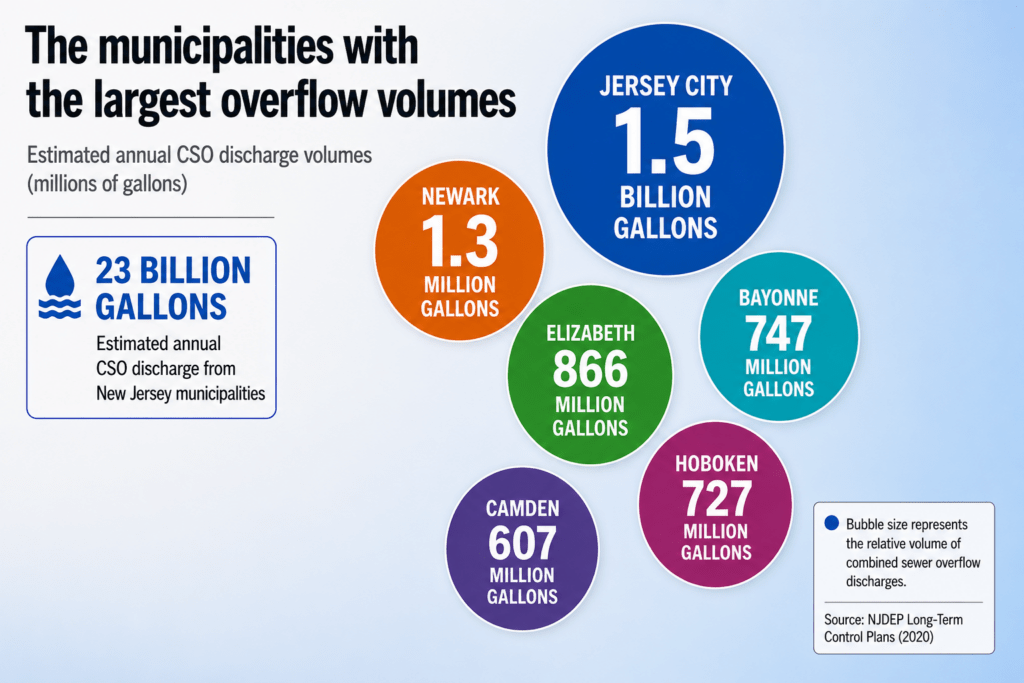
These 21 municipalities collectively discharge an estimated 23 billion gallons of untreated sewage and stormwater into waterways each year. That is enough water to fill tens of thousands of Olympic-sized swimming pools, all entering rivers, bays and streams that flow through some of the state’s most densely populated communities.
The exact number of overflow events varies by year, location and rainfall intensity. A particularly wet summer can trigger significantly more overflows than a dry year. Yet despite the size of the problem, there is no single statewide record that allows residents to easily track every overflow event. Information is scattered across long-term control plans, permit fact sheets, utility reports, Jersey WaterCheck summaries, local dashboards and newer federal reporting systems. For the average resident trying to understand what is happening in a nearby river, finding reliable information can be surprisingly difficult. Still, publicly available reports can reveal the scope of the challenge.
Streets to sewers
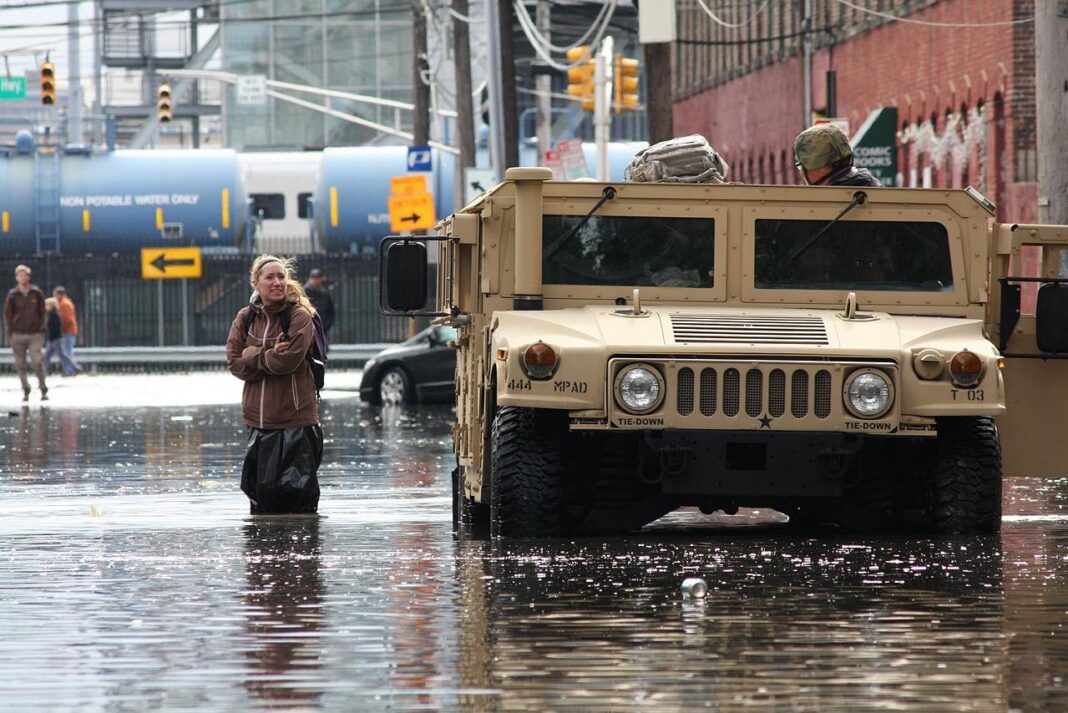
The most alarming consequence of CSOs is what happens on New Jersey’s streets. When intense rain overwhelms a combined sewer system, stormwater and untreated sewage can back up through manholes, storm drains and catch basins, flooding streets, sidewalks and, in some cases, basements with contaminated water. During major storms over the past decade, heavy rainfall has repeatedly inundated neighborhoods across North Jersey, leaving roads underwater and prompting health officials to warn residents to avoid contact with floodwaters because they may contain raw sewage.
During a CSO event, floodwater can contain disease-causing bacteria, viruses and parasites from untreated sewage, including pathogens such as E. coli, Salmonella, norovirus, Giardia and Cryptosporidium. Exposure can occur by walking through floodwaters, cleaning out a flooded basement or allowing children or pets to come into contact with contaminated water after a storm.
Even after floodwaters recede, bacteria levels in rivers, bays and tidal waterways can remain elevated for days following an overflow event, which is why public health agencies routinely advise people to avoid direct contact with urban waterways after heavy rainfall.
The environmental consequences extend beyond public health. Untreated sewage carries nutrients, organic waste and other pollutants that fuel algae growth, reduce dissolved oxygen and place additional stress on aquatic ecosystems already burdened by decades of industrial contamination. Waterways such as the Lower Passaic River, Newark Bay and portions of the Hudson River waterfront continue to receive combined sewer overflow discharges despite years of cleanup efforts.
Combined sewer overflows are often thought of as a water-quality issue. In reality, they are also a neighborhood issue, a transportation issue and a public health issue, affecting the streets people drive, walk and live on whenever aging sewer systems are overwhelmed by increasingly intense storms.
Falling behind
In 1994, the EPA established the National Combined Sewer Overflow (CSO) Control Policy, forcing cities to reduce raw sewage discharges from antiquated, single-pipe water systems. Phase I mandated immediate implementation of “Nine Minimum Controls” – low-cost fixes like clearing debris and optimizing system storage -alongside designing a Long-Term Control Plan (LTCP). Phase II requires executing the Long-Term Control Plan.
New Jersey has lagged years behind this federal timeline. The state missed the EPA’s strict July 2020 deadline to finalize its municipal Phase II permits. As of publication, all but one of the 21 CSO municipalities has a finalized LTCP; Perth Amboy is awaiting final permit issuance.
Executing these LTCPs will cost billions of dollars and take decades to complete. Some of the LTCPs include separating stormwater and sanitary sewer lines where practical. Others are expanding wastewater treatment capacity, constructing storage facilities to capture excess flows, rehabilitating aging sewer infrastructure or installing real-time monitoring systems that optimize existing capacity. Green infrastructure, including rain gardens, bioswales, tree trenches and permeable pavement, is also being deployed to reduce the amount of stormwater entering combined sewer systems before it reaches the pipes.
Whether those efforts will be enough remains an open question. Climate change is producing more frequent and intense rainfall, placing additional pressure on infrastructure that, in many cases, was designed more than a century ago. Additoinally, many of these improvements depend on access to reliable and affordable electricity. Pump stations, treatment plants and advanced monitoring systems all require significant amounts of energy to operate, making adequate power supply a hurdle in modernizing wastewater systems. Time will tell if New Jersey can deliver the billions of dollars in infrastructure improvements needed to finally rid its streets and waterways from raw sewage before increasingly severe storms outpace the state’s progress.
Sources:
New Jersey Department of Environmental Protection. (n.d.). Combined sewer overflow (CSO) program. State of New Jersey. https://www.nj.gov/dep/dwq/cso.htm
New Jersey Department of Environmental Protection. (2015). New Jersey Pollutant Discharge Elimination System (NJPDES) permit requirements for combined sewer overflow permittees. State of New Jersey. https://www.nj.gov/dep/dwq/pdf/cso_permit_factsheet.pdf
New Jersey Future. (2025). Combined sewer overflows in New Jersey: Fact sheet. New Jersey Future. https://www.njfuture.org
Jersey Water Works. (n.d.). Combined sewer overflows. Jersey WaterCheck. https://jerseywatercheck.org
U.S. Environmental Protection Agency. (2024). Combined sewer overflows (CSOs). https://www.epa.gov/npdes/combined-sewer-overflows-csos
U.S. Environmental Protection Agency. (2025). Sewer overflow and bypass event reporting. https://echo.epa.gov
New Jersey Infrastructure Bank. (2025). Annual report 2025. New Jersey Infrastructure Bank. https://www.njib.gov