


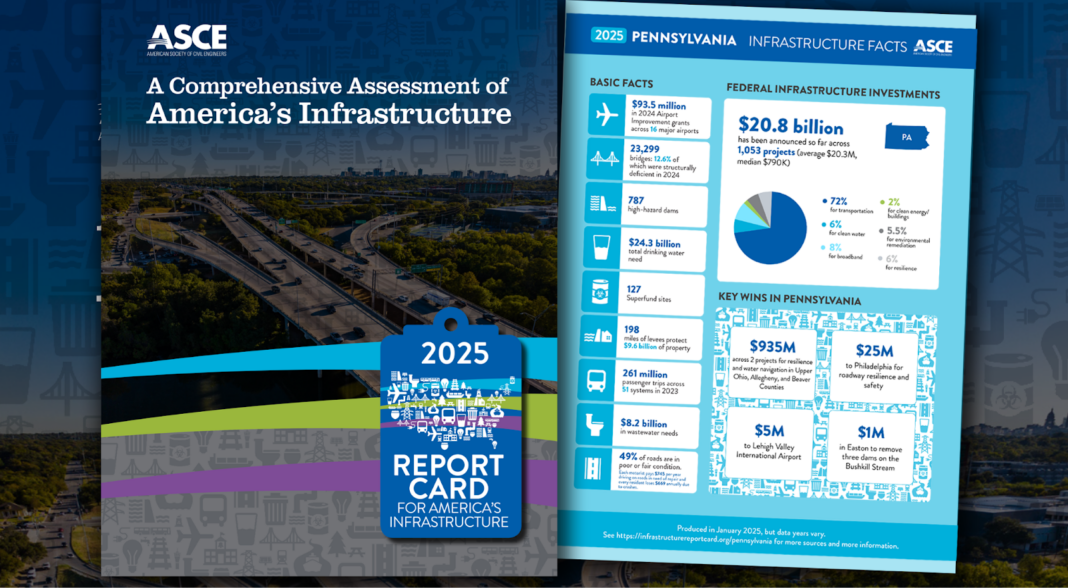
The American Society of Civil Engineers’ 2025 Infrastructure Report Card evaluates infrastructure across 18 categories, grading systems from A to F based on condition, capacity, funding, resilience, public safety, and future needs. The report highlights progress since the Infrastructure Investment and Jobs Act was passed in 2021, but it also makes clear that Pennsylvania continues to face serious infrastructure challenges, particularly in water systems and aging transportation assets.
Water Infrastructure: A System Under Pressure
Pennsylvania’s water systems received some of the lowest grades in the report.
Drinking Water — Grade: D
Public water systems across the country are struggling to meet replacement goals while also complying with new regulations. Over the next 10 years, Pennsylvania faces a projected $10.2 billion funding gap. Lead service lines remain a public health concern, particularly in underserved communities, and emerging contaminants such as PFAS add new regulatory and treatment challenges.
Wastewater — Grade: D-
Many sewer systems are approaching 75 years old, with some pipes more than a century old. Aging systems discharge sewage into surface waters each year. The Commonwealth faces an estimated $8.4 billion funding gap over the next decade, while expected funding is only about $900 million — roughly one-tenth of what is needed annually.
Stormwater — Grade: D
Stormwater systems perform adequately during minor events but are increasingly overwhelmed by stronger and more frequent storms. An estimated $2 billion in assets have reached the end of their useful life, and total needs are projected at $6.7 billion over the next three to five years. While more than 65 utilities now provide dedicated stormwater funding, Pennsylvania lacks a comprehensive statewide asset database, and its primary stormwater design guidance is more than 15 years old.
Despite these challenges, only 6% of federal infrastructure funding in Pennsylvania is directed toward clean water.
Transportation: Heavy Use, Heavy Wear
Transportation receives the largest share of federal funding, 72% of announced infrastructure dollars, but significant needs remain.
- 49% of roads are in poor or fair condition, costing motorists an average of $745 per year in vehicle operating costs.
- Pennsylvania has 23,299 bridges, and 12.6% are structurally deficient, among the highest totals in the country.
- Residents also lose an average of $669 annually due to crashes, reflecting safety and congestion impacts.
Transportation investment is helping stabilize conditions, but aging assets and decades of deferred maintenance continue to drive costs.
Investment Needs

Caption: PENNVEST (Pennsylvania Infrastructure Investment Authority) is a state-affiliated agency providing low-interest loans and grants for water, sewer, and stormwater projects in Pennsylvania.
Pennsylvania’s water infrastructure needs are significant, but the state is already making meaningful progress.
In 2026, the state announced a historic $559 million investment through PENNVEST, funding 36 projects across 25 counties. These projects focus on replacing lead service lines, upgrading aging systems, improving treatment capacity, and reducing contaminants like PFAS.
This level of investment shows a clear shift toward long-term planning and system upgrades rather than short-term fixes.
Still, the scale of need means more work lies ahead. To build on this progress, Pennsylvania will need to continue focusing on a few key priorities:
- Replacing aging infrastructure before failures occur, especially in older cities and towns
- Expanding treatment upgrades to meet new health standards and emerging contaminants
- Investing in stormwater systems to better handle stronger, more frequent storms
- Supporting local utilities with stable funding tools so they can plan ahead instead of reacting to emergencies
Major Projects
In western Pennsylvania, nearly $935 million is being invested in upgrades to the locks and dams on the upper Ohio River near Pittsburgh, including facilities at Emsworth, Dashields, and Montgomery. These structures, some dating back nearly a century, are being modernized to handle larger commercial vessels more efficiently. The upgrades will reduce delays for barges carrying materials such as coal, petroleum, steel, and aggregates, helping protect jobs and support the region’s manufacturing and energy economy.
In Philadelphia, $25 million is being invested in roadway resilience and safety improvements. The project will strengthen vulnerable corridors, improve drainage to better manage heavy rainfall, and enhance safety measures. The goal is straightforward: reduce crash risks, prevent costly storm damage, and keep traffic moving in one of the state’s most economically vital regions.
Read the 2025 ASCE Infrastructure Report Card:
Read the 2025 ASCE Pennsylvania Infrastructure Report Card:
Sources:
Pennsylvania Infrastructure Investment Authority (PENNVEST). (2026, January 21). Shapiro administration announces the investment of $559.7 million in water infrastructure projects in 25 counties across the Commonwealth. Commonwealth of Pennsylvania.