



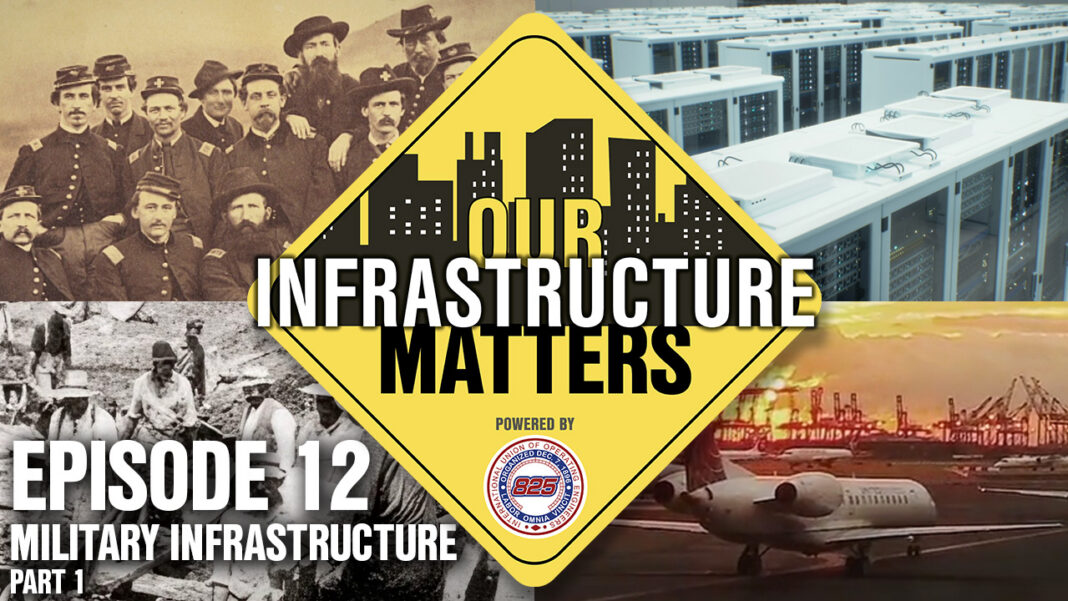
Military Infrastructure Part 1
“Our Infrastructure Matters” is a news program highlighting important infrastructure projects and issues throughout the region. From roads and bridges to rails and tunnels. From the energy and communications grids to drinking water, wastewater, and stormwater.
Episode 12 includes the following segments:
- Military Infrastructure, Part 1 – 0:58
- Understanding Data Centers – 7:33
- Training for Operating Engineers – 14:14
- New Jersey’s Airport Network – 16:55
- The Delaware and Raritan Canal – 24:23
News 12 +
Watch Our Infrastructure Matters on New 12 +
http://news12.plus/new-jersey/
Additional Episodes
Transcript
[01:00:58:09 – 01:01:45:04]
New Jersey is often associated with suburbs, beaches, and its location between two major American cities. But hidden across the state is a network of military infrastructure that has shaped the defense of the United States for more than two centuries. From revolutionary war encampments to modern joint military bases, from experimental weapons laboratories to massive naval ammunition depots, New Jersey has repeatedly served as a strategic backbone for American defense. Constructing and maintaining these installations required enormous engineering efforts, runways capable of supporting the world’s largest aircraft, research laboratories for advanced weapons development, and even rail-connected piers stretching miles into the Atlantic.
[01:01:46:05 – 01:03:21:01]
Behind these projects were thousands of skilled workers, ironworkers, electricians, laborers, operating engineers, and carpenters. Many organized through building trades unions that supplied the trained workforce needed for large federal construction programs. This is the story of New Jersey’s military infrastructure, how it began, how it expanded, and how these historic installations continue to shape the state today. Revolutionary War, the Strategic Crossroads New Jersey’s military importance began during the American Revolution. Because the state sat between British-controlled New York City and the revolutionary capital in Philadelphia, it became a strategic battleground. During the war, George Washington and the Continental Army camped repeatedly across the state while maneuvering against British forces. One of the most important locations was Morristown, where Washington established winter headquarters during 1777, and again during the brutal winter of 1779 to 1780. The second encampment occurred at Jockey Hollow, where thousands of soldiers built a grid of nearly a thousand small log huts to house the army while Washington directed military operations from nearby Ford Mansion. Another major encampment site was Middlebrook encampment, located along the Wachung Mountains. From the ridge above the Raritan Valley, Washington’s troops could monitor British forces stationed in New Brunswick while maintaining a strong defensive position.
[01:03:22:02 – 01:04:22:10]
Continental Army troops also moved through and fought in areas such as Princeton, where Washington secured a crucial victory during the winter campaign of 1777. Though these early encampments consisted largely of temporary structures, they established New Jersey’s strategic importance in American military planning. The War of 1812, Coastal Defenses Several decades later, New Jersey again became strategically important during the War of 1812. The young United States faced the threat of British naval attacks along the Atlantic coast, particularly near the entrance to New York Harbor. To defend this vital harbor, the federal government expanded coastal fortifications along Sandy Hook. The site that would later become Fort Hancock began developing defensive installations during this era. Early batteries and artillery placements were built to monitor the harbor entrance and provide warning of approaching enemy ships.
[01:04:23:10 – 01:04:31:09]
Construction during this period involved masonry fortifications, earthen embankments, powder magazines, and coastal artillery platforms.
[01:04:32:10 – 01:05:31:12]
Although the defensive network was still relatively small compared with later fortifications, the War of 1812 marked the beginning of permanent coastal defense systems in New Jersey. These early installations laid the groundwork for the much larger harbor defense complexes that would be built in the late 19th and early 20th centuries. The Civil War, Training, and Mobilization During the American Civil War, New Jersey again became an important mobilization center. Although the state was far from the main battlefields, it played a key role in training and organizing Union troops. One of the most important military camps was Camp Olden, named after New Jersey Governor Charles Smith Olden. Located near Trenton, the camp served as a mustering and training ground for Union regiments before they were sent south to fight. Thousands of soldiers passed through Camp Olden between 1861 and 1865.
[01:05:32:20 – 01:05:44:00]
Temporary barracks, drill fields, supply depots, and administrative buildings were constructed to support the mobilization effort. Other camps across the state also supported Union troops.
[01:05:45:05 – 01:06:40:01]
Facilities near rail lines and ports allowed soldiers and equipment to move quickly toward major transportation hubs in Philadelphia and New York. These early mobilization camps demonstrated how New Jersey’s transportation network, railroads, ports, and roadways could support large military deployments. Picatinny Arsenal, the Weapons Laboratory One of the most important permanent military installations in the state is Picatinny Arsenal, established in 1880 in Morris County. The site was chosen because its valleys and hills provided natural containment for explosives testing. Picatinny quickly became the U.S. Army’s primary center for munitions research and weapons development. The complex required extensive infrastructure, laboratories, manufacturing buildings, testing ranges, and rail systems to safely move explosives.
[01:06:41:14 – 01:07:03:07]
Explosive storage bunkers were constructed with reinforced concrete designed to contain accidental blasts. Union construction trades helped build many of these facilities, particularly electricians installing specialized laboratory systems, ironworkers erecting structural steel, and operating engineers handling large-scale excavation.
[01:07:04:07 – 01:07:31:05]
Today, Picatinny remains one of the Army’s leading weapons research centers. By the beginning of the 20th century, New Jersey’s military role had evolved dramatically. A storied history of temporary encampments and coastal defenses had given way to permanent installations dedicated to training, weapons development, and national defense. But the scale of what came next would dwarf everything that had come before it.
[01:07:37:25 – 01:08:46:05]
Before you’ve finished your morning coffee, you’ve probably interacted with a data center dozens of times. Your alarm synced with the cloud. Your weather app downloaded the forecast. Your bank account updated overnight transactions. Emails arrived. Music streamed. Social media feeds refreshed. Each action feels instant. But behind every click, swipe, search, and stream is a network of computers housed in buildings that most people never see and rarely think about. At its simplest, a data center is a facility that houses computer servers. But a better comparison might be a modern library. Instead of storing books, data centers store, process, and distribute information. Every photo saved to the cloud. Every online purchase. Every streaming movie. Every business transaction. Every medical record. All of it relies on data centers operating around the clock. The importance of these facilities becomes clearer when you imagine a world without them. Hospitals rely on data centers to access patient records. Emergency responders depend on digital communications.
[01:08:47:05 – 01:14:13:15]
Businesses use them to process transactions. Governments rely on them to deliver services and safeguard information. In many ways, data centers have become just as essential to modern society as highways, power plants, and water systems. For decades, demand for computing power has continued to grow. From mainframe computers to personal computers. From the internet to cloud computing. Each technological revolution required more infrastructure. Today, artificial intelligence is driving the next wave of growth. Every AI-powered search, recommendation engine, image generator, and chatbots depends on powerful data centers working behind the scenes. But AI is also transforming industries far beyond consumer applications. Pharmaceutical companies are using AI to accelerate drug discovery. Financial institutions are deploying it to detect fraud and manage risk. Healthcare providers are exploring AI-assisted diagnostics. And businesses across the economy are using it to analyze data, automate processes, and improve decision-making. As AI adoption expands, data centers are increasingly viewed as foundational infrastructure for future economic growth. But AI creates a challenge that few people ever think about. Modern AI processors generate significantly more heat than traditional computing equipment. As computing power increases, so does the challenge of keeping these systems cool. For years, most data centers relied on traditional air cooling. Cold air moved through server rooms while hot air was pushed away. As computing demands increased, operators adopted chilled water systems and evaporative cooling technologies to improve efficiency. But the AI era is forcing the industry to rethink cooling altogether. Today, some of the most advanced facilities use direct-to-chip liquid cooling, sending coolant directly to the hottest processors. Others are adopting closed-loop systems that continuously recycle cooling fluid while minimizing water consumption. Some operators are even experimenting with immersion cooling, where entire servers are submerged in specialized non-conductive liquids. As AI continues to grow, cooling technology may become just as important as the processors themselves. These national conversations are now playing out right here in New Jersey. In Kenilworth, an artificial intelligence cloud computing company plans to redevelop a former pharmaceutical research facility into a modern data center. As with many data center projects across the country, residents have raised questions about noise, energy demand, water use, and quality of life. According to an independent acoustic study, normal operations are expected to generate between 42 and 49 decibels, roughly comparable to the sound of a household refrigerator. The study also found that existing background noise from the nearby Garden State Parkway is already higher than the projected operational noise levels. Questions about energy demand are also common. The project includes approximately $150 million in funding for a new electrical substation intended to increase capacity for both the facility and the broader local grid. Water use has become another major topic in data center development. The facility is expected to use a closed-loop cooling system designed to minimize ongoing water consumption. After an initial startup phase, cooling fluid continuously circulates through the system, reducing the need for significant ongoing water use. Construction activity will bring temporary increases in traffic and site activity. However, once operational, data centers typically employ smaller workforces and generate less daily traffic than many industrial or commercial facilities. As more facilities are proposed nationwide, communities are weighing important questions about energy consumption, water use, land development, and environmental impact. At the same time, nearly every digital service people use every day depends on this infrastructure. The challenge facing communities, policymakers, and industry leaders is finding the right balance between supporting technological growth and addressing legitimate local concerns. As artificial intelligence continues to reshape the economy, demand for computing power will continue to grow. That means the buildings behind our digital lives, the data centers that quietly power communication, commerce, healthcare, transportation, and countless other services will become increasingly important. The next time a text message arrives, a bank balance updates, a favorite show begins streaming, or an AI assistant answers a question, it’s worth remembering that none of it happens by accident. Behind every click, swipe, search, and prompt is a vast network of infrastructure working quietly in the background. Most people may never visit a data center, but they rely on one every day.
[01:14:13:29 – 01:14:57:03]
(Engine Revving) Bulldozers, excavators, and cranes. Heavy machinery covers the lot of the Operating Engineers Training Center, Local 825 in Dayton, New Jersey. It’s where 7,800 union members across New Jersey and lower New York train before building local infrastructure. We have everything almost soup to nuts that you would see in the construction industry. We teach everything here. Greg Lullaby, a second generation crane operator, now oversees the training center’s operations. We invest in training every year because what we do is so critical. Before operating heavy equipment. Pull it back to you nice and easy. The trainees start here.
[01:14:57:03 – 01:15:42:27]
We have about 170 students now, and then we retrain. A big component of what we do is taking somebody like myself who may have been around 40 years, but the technology changed. All students, both men and women, have to undergo OSHA safety training and get familiar with the heavy equipment. We’d have two people standing on the ground right there. You’re the pitcher and they’re standing where they want the ball to go. They told me practicing on the simulator gives them the confidence they need on the heavy hitters. This one just has different variations to it with cranes and drills. These future operators are in high demand with major construction ramping up. Local 825 is bridging tradition and technology for a brighter future. Roxanne Evans, News 12.
[01:15:44:06 – 01:16:51:06]
When union labor and contractors come together for one common goal, anything can be accomplished. E-LEC, the engineers’ labor employer cooperative. We are the Labor Management Fund for the International Union of Operating Engineers, Local 825. From Kingston to Cape May, and from river to river, we’re creating the opportunities that spawn real economic development and building the future. As members of the business community and chambers of commerce, we create the partnerships needed to collaborate success. As advocates, we shape the public policy in local town halls and statehouses that protect our members and generate possibilities. We eliminate entry barriers that ensures our members are ready on day one for whatever work our contractors require. And as industry innovators, we develop grant programs to help our contractors compete in underrepresented market sectors. This is what the 21st century organized labor looks like. This is E-LEC. Building the infrastructure New York and Jersey relies on.
[01:16:53:27 – 01:17:05:25]
Planes come in and out of New Jersey constantly because we sit at the center of New York City and Philadelphia. Within just a few dozen miles, millions of passengers move through the state’s airports every year,
[01:17:05:25 – 01:17:22:01]
But New Jersey’s airport network didn’t appear overnight. It developed over more than a century through early aviation experimentation, wartime mobilization, the rise of commercial jet travel, and billions of dollars in modern infrastructure expansion.
[01:17:23:04 – 01:17:38:13]
Building and expanding these airports required enormous engineering effort, draining wetlands, pouring miles of concrete runways, erecting terminals, installing navigation systems, and constantly rebuilding to accommodate new generations of aircraft.
[01:17:38:13 – 01:17:46:07]
This is the story of how New Jersey’s airport network was created and the role union labor played in shaping it.
[01:17:47:11 – 01:18:13:24]
In the early 1900s, planes were brand new to us. Early aircrafts needed very little infrastructure, just open land where pilots could take off and land. New Jersey quickly became an early hub for aviation activity because of its proximity to New York City and Philadelphia and its relatively flat terrain. One of the earliest and most important aviation facilities in the region was Teeterboro Airport, which opened in 1919.
[01:18:13:24 – 01:19:21:12]
Construction crews cleared land, built early hangers, installed fuel systems, and graded landing fields. Even in these early years, skilled trades were essential. Building hangers required steel fabrication and structural assembly. Maintenance facilities required electrical wiring, plumbing, and machine shops. Many of these tradespeople performing this work were already members of emerging building trade unions that had begun organizing across the Northeast in the late 19th and early 20th centuries. As aviation technology improved, these simple airfields quickly became inadequate and outdated. Runways had to be longer, surfaces stronger, and facilities larger. The stage was set for a much bigger project. That project arrived in 1928 with the construction of Newark Liberty International Airport. At the time, Newark Airport was considered one of the most ambitious aviation projects in the country. The site chosen for the airport was a large stretch of marshland along Newark Bay. Turning wetlands into a functioning airport required massive earth-moving and engineering work.
[01:19:21:12 – 01:19:33:25]
Iron workers assembled steel frameworks. Carpenters built structural supports and interior spaces. Laborers moved and compacted earth. Operating engineers ran bulldozers, dredges, and cranes.
[01:19:33:25 – 01:19:54:24]
Unions such as the Laborers International Union of North America, the International Union of Operating Engineers, and the International Brotherhood of Electrical Workers represented many of the skilled trades involved in these large infrastructure projects. By the early 1930s, Newark Airport had become one of the busiest commercial airports in the world.
[01:19:54:24 – 01:20:50:04]
The next major transformation came during World War II. Aviation became essential to the war effort, and airports across the United States were expanded or adapted for military use. In New Jersey, existing airfields were upgraded to handle military aircraft, cargo operations, and pilot training. Runways had to be lengthened and reinforced to support heavier planes. New hangars and maintenance facilities were built quickly to support wartime production and logistics. Union construction crews were heavily involved in these rapid expansion efforts. Skilled trades worked long hours to meet strict military deadlines, building infrastructure capable of supporting aircraft production, testing, and deployment. The wartime construction boom left a lasting legacy. Many of the improvements made during this period later supported the rapid expansion of commercial air travel after the war.
[01:20:50:13 – 01:22:20:02]
the 1950s and 1960s, the introduction of jet aircraft dramatically increased passenger capacity and required even larger runways, terminals, and support infrastructure. Newark underwent multiple waves of reconstruction. Runways were lengthened and strengthened. Terminals were expanded. Cargo facilities were added. Road and rail connections were improved to handle increasing passenger traffic. Each expansion required coordinated construction by multiple building trades. Union agreements helped standardize wages, safety procedures, and training across large infrastructure projects. As passenger demand grew through the late 20th century, Newark evolved into one of the country’s busiest international gateways. While Newark dominates commercial aviation in the state, several other airports form an important regional network. Atlantic City International Airport began as a naval air station during World War II before transitioning into a civilian airport serving southern New Jersey. Further north, Trenton Mercer Airport grew from a small municipal airfield into a regional passenger airport with scheduled commercial service. And Teeterboro Airport evolved into one of the busiest business aviation airports in the United States. Each of these airports has undergone decades of runway improvements, terminal renovations, and infrastructure upgrades, many completed through projects involving union construction trades.
[01:22:21:07 – 01:23:17:26]
Airport construction continues today. One of the largest recent projects was the new Newark Liberty International Airport Terminal A, which opened in 2023 after a multi-billion dollar redevelopment. The project involved thousands of construction workers across dozens of trades, installing structural steel, electrical systems, advanced baggage handling technology, and modern passenger facilities. Many of these projects operate under project labor agreements that coordinate union trades and ensure access to a highly skilled workforce. From early airfields carved out of farmland to massive modern terminals serving millions of passengers, New Jersey’s airport network reflects nearly a century of construction and expansion. And behind that infrastructure is the work of generations of builders, many of them union tradespeople, who helped shape one of the busiest aviation systems in the world.
[01:23:21:19 – 01:23:28:05]
(Upbeat Music)
[01:24:21:28 – 01:24:45:12]
When we think about New Jersey infrastructure, we usually picture highways, rail lines, ports, and pipelines. But long before Route 1 or the Northeast Corridor Railroad, there was another transportation spine running quietly through the heart of the state. It was hand dug, it reshaped cities, and it still matters today. This is the story of the Delaware and Raritan Canal.
[01:24:45:12 – 01:25:32:27]
In 1676, William Penn, founder of Pennsylvania, proposed creating a water route across what he called the “Narrow Waste of New Jersey.” His goal was ambitious, a protected inland passage connecting Philadelphia to New York Harbor, avoiding the dangerous Atlantic route. Penn even ordered a survey to see if it was possible to cut a way across the country to Sandy Hook. No record survives that the survey ever happened, but the idea never disappeared. For the next hundred years, the concept slept quietly while colonies grew, fought a revolution, and became a nation. But by the early 1800s, America turned its attention to internal improvements, and New Jersey found itself at the center of everything.
[01:25:33:29 – 01:25:41:20]
By the 1820s, enthusiasm for a canal linking New York and Philadelphia reached a fever pitch. But there was a problem.
[01:25:42:21 – 01:25:43:06]
Railroads.
[01:25:43:06 – 01:25:47:27]
New Jersey lawmakers were split between canal supporters and railroad advocates.
[01:25:48:10 – 01:26:00:20]
The legislature chartered both, and then merged them, creating a canal-rail partnership known as the Joint Companies, the Delaware and Raritan Canal Company, and the Camden and Amboy Railroad.
[01:26:01:21 – 01:26:09:02]
Construction on both began the same year. By 1833, the railroad was running from Bordentown to South Amboy.
[01:26:10:07 – 01:26:20:03]
On June 25, 1834, the canal officially opened. Senator Peter Dumont Vroom boarded a ceremonial barge for a two-day journey across the state.
[01:26:20:03 – 01:26:51:27]
The canal itself formed a giant meandering “Y” across New Jersey, 44 miles from Bordentown to New Brunswick, a 22-mile feeder canal from Ravenrock to Trenton. The engineering was remarkably sophisticated. The feeder canal was 6 feet deep and 50 feet wide. The main canal was 7 feet deep, later expanded to 8 and 75 feet wide. Seven locks lifted boats up to Trenton. Seven more brought them back down to sea level at the Raritan River.
[01:26:53:01 – 01:27:09:14]
Stone riprap lined the banks to prevent erosion. Swing bridges pivoted sideways so vessels of any mast height could pass. By 1868, even the locks were powered by steam. And once built, the canal barely needed modification for the next century.
[01:27:10:00 – 01:28:12:14]
Before the canal, shipping goods from Philadelphia to New York by sea could take two weeks. The canal transformed cities at its ends. Trenton’s population quadrupled. Ironworks, ceramic factories, and manufacturers surged in. But the canal’s greatest beneficiaries were New York and Pennsylvania. Pennsylvania anthracite coal, destined for New York’s furnaces and homes, became the canal’s lifeblood. At its peak in 1871, nearly three million tons of freight passed through the canal, more than the Erie Canal carried that same year. And it wasn’t just canal boats. Sailboats, steam tugs, yachts, and even naval vessels passed through this narrow waterway. Ironically, the canal’s decline began with its own partner. In 1871, the Pennsylvania Railroad leased the canal and its rail connection for 999 years. From that moment on, canal traffic steadily fell.
[01:28:13:18 – 01:28:23:05]
Railroads were faster. They ran day and night. They didn’t freeze in the winter. By 1893, the canal was operating at a loss and never recovered.
[01:28:23:05 – 01:28:39:28]
Yet, the canal wasn’t finished. As industries spread out in the 1930s and 40s, they needed water. And the canal could provide it, cheaper than wells. So the canal reinvented itself, not as a transportation corridor, but as a water supply system.
[01:28:39:28 – 01:28:51:21]
In 1973, the canal was listed on the National Register of Historic Places. One year later, citizen advocacy helped create the Delaware and Raritan Canal State Park.
[01:28:53:01 – 01:29:36:15]
Today, more than a million people visit the canal each year. It’s a recreational corridor, a conservation link, a historic landmark, and it still supplies water to industry, agriculture, and drinking water systems serving nearly one million New Jersey residents. This canal helped build cities, power industry, and shape the economy of an entire region. The Delaware and Raritan Canal reminds us that infrastructure doesn’t disappear when its original purpose ends. When we preserve it, adapt it, and understand its history, it continues to serve us in ways its builders could never have imagined. And that’s why our infrastructure matters.
[01:29:37:19 – 01:29:49:00]
(Music)