



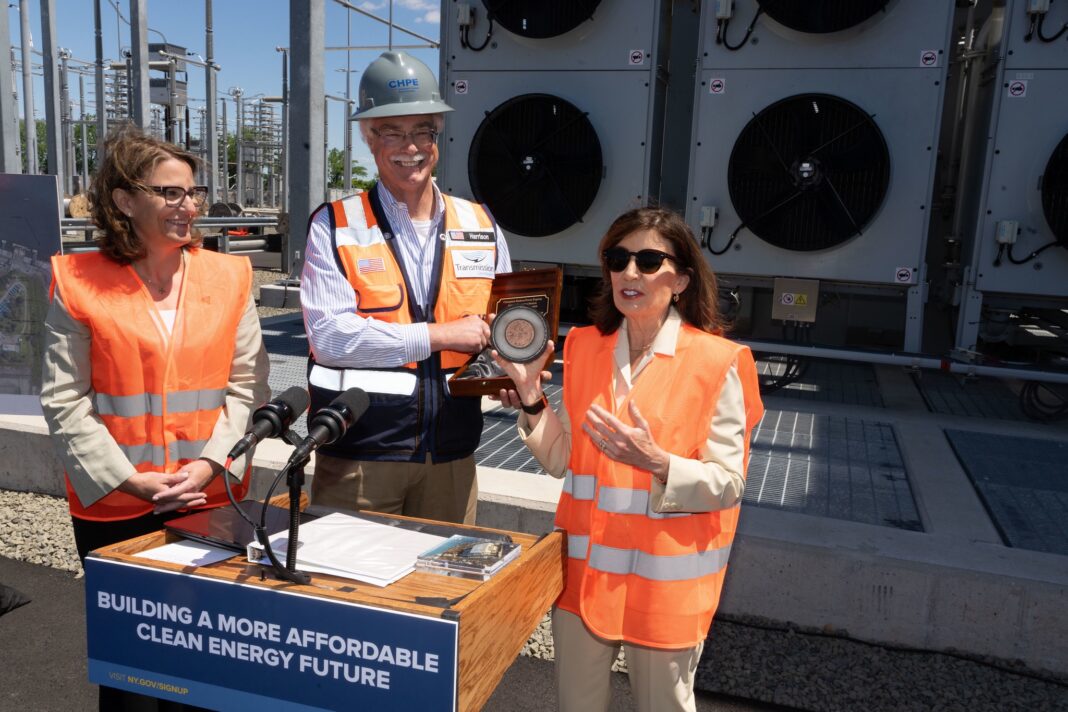
The new transmission line will supply enough clean energy to meet up to 20% of New York City’s electricity needs.
The 339-mile CHPE transmission line is delivering renewable hydropower from Hydro-Québec to New York City and can supply enough electricity to meet up to 20% of the city’s annual power needs.
CHPE strengthens grid reliability just as New York experiences record summer electricity demand, providing 1,250 megawatts of firm, carbon-free power during periods of peak usage.
CHPE is expected to reduce carbon emissions by 37 million metric tons through 2040.
Champlain Hudson Power Express begins delivering clean energy to New York City
The Champlain Hudson Power Express (CHPE), a 339-mile high-voltage transmission line capable of supplying up to 20 percent of New York City’s annual electricity demand, is now fully operational. The project delivers renewable hydropower from Hydro-Québec directly to New York City, completing an energy infrastructure investment that took more than a decade to develop and construct.
Hydro-Québec’s long-term contract with the New York State Energy Research and Development Authority (NYSERDA) officially began June 1. The utility can now supply electricity through the state’s Tier 4 renewable energy program and participate in the New York Independent System Operator’s wholesale energy and capacity markets after completing testing ahead of schedule.
“We can place transactions based on market dynamics,” said Peter Rose, senior director for stakeholder relations at Hydro-Québec. “Depending on the prices for New York City, if they support the transaction, we will bid.”
Hydro-Québec intends to participate in New York’s summer capacity markets, when electricity demand in New York City typically reaches its highest levels. “The good thing with being done early is we can provide capacity to New York City when it needs it most,” Rose said.
Building a new path for clean energy
Buried underground and beneath waterways for nearly its entire route, CHPE stretches from the Canadian border through Lake Champlain and the Hudson River before terminating in Astoria, Queens. The project includes more than 25 miles of underground transmission line along U.S. Route 9W in Rockland County.
The line can deliver 1,250 megawatts of renewable electricity to the nation’s largest city. State officials estimate CHPE will provide approximately 10.4 terawatt-hours of electricity each year, reducing New York City’s reliance on fossil fuel-fired generation and cutting greenhouse gas emissions over the coming decades.
The project also adds a major new source of electricity at a time when New York’s power needs are growing. As millions of residents rely on air conditioning during periods of extreme heat, CHPE can help strengthen reliability by delivering steady, carbon-free electricity directly into New York City’s constrained electric grid.
That need became particularly clear this summer when statewide demand climbed above 32,000 megawatts and the New York Independent System Operator issued an Energy Watch. Bringing CHPE online ahead of schedule allowed the project to begin contributing during one of the most demanding periods of the year.
Years of work before construction began
Although CHPE had already received federal approval, the project still needed support from state and local governments, community leaders and residents along its route. The Engineers Labor-Employer Cooperative (ELEC825) worked closely with the project’s community outreach team for several years to build consensus and explain the project’s economic, workforce and energy benefits.
Much of that work occurred before construction began. Daniel Ortega, Community Affairs Director for ELEC825, submitted letters of support to county and state agencies, testified at in-person and virtual public hearings and met with elected officials at every level of government to advocate for the project.
“Projects like CHPE don’t move forward on engineering alone,” Ortega said. “They require years of community engagement, conversations with local officials and helping residents understand why the project matters.”
Governor Kathy Hochul and NYSERDA played central roles in advancing CHPE as part of New York’s clean energy strategy. Their support helped move one of the state’s largest energy infrastructure investments from the approval process into construction and, ultimately, operation.
Thousands of union jobs
CHPE’s impact extends beyond the electricity it will deliver. Construction created more than 1,400 direct jobs for members of Operating Engineers Local 825, the Laborers, IBEW and other union trades while generating more than $400 million in wages and benefits.
The project also supported an estimated 3,200 indirect and induced jobs throughout the construction period. Billions of dollars were invested in the project, while host communities benefited from new tax revenue and the economic activity generated by construction.
These investments were especially important as New York emerged from the economic disruption caused by the COVID-19 pandemic. CHPE demonstrated how major infrastructure projects can support immediate employment while building energy systems intended to serve residents and businesses for decades.
Operating Engineers Local 825 supported CHPE because the project combined reliable energy infrastructure with family-sustaining union careers and investment in local communities. Its construction also demonstrated the range of skilled workers required to build a modern transmission system across hundreds of miles of varied terrain.
Investing in the clean energy workforce
CHPE also created a $40 million Green Economy Fund to expand access to careers in New York’s clean energy economy. The fund partners with existing training programs to support workforce development and prepare New Yorkers for employment in growing energy and infrastructure sectors.
That investment aligns with Local 825’s longstanding emphasis on apprenticeship, training and continuing education. Modernizing the electric grid will require not only new generation and transmission infrastructure, but also a workforce trained to build, operate and maintain increasingly complex energy systems.
CHPE provides a model for how environmental, economic and workforce goals can be pursued through the same infrastructure investment. The project is now delivering renewable electricity to New York City; its longer-term impact will be measured through improved grid reliability, sustained benefits for local communities and the skilled careers created by the transition to a cleaner energy system.
Source:
Hydro-Québec. (2026). Champlain Hudson Power Express enters commercial operation. https://www.hydroquebec.com/
New York Independent System Operator. (2026). Energy Watch and grid operations updates. https://www.nyiso.com/
New York State Energy Research and Development Authority. (2026, June 16). Governor Hochul celebrates completion of Champlain Hudson Power Express project. https://www.nyserda.ny.gov/About/Newsroom/2026-Announcements/2026-06-16-Governor-Hochul-Celebrates-Completion-Of-Champlain-Hudson-Power-Express-Project