




A survey of expert analysis from Brookings, RAND, and MIT Technology Review
The race to AI and AGI (Artificial General Intelligence) has huge implications in geopolitics, global stability, and economics
USA and China are approaching AI with completely different strategies
America’s AI advantage over China can be measured in months
China lags in computing power, but is spending billions to close the gap
The competition between the United States and China over artificial intelligence is reshaping global power, economic strategy, and military capability. As AI becomes the backbone of national security, industrial productivity, and digital governance, the stakes of this rivalry extend far beyond technology companies or research labs. They influence how nations project influence, how alliances form, and how emerging markets choose their digital infrastructure. Understanding these dynamics requires clear, credible, analysis from institutions that study geopolitics, defense, and global governance with rigor. The following reading list brings together authoritative articles from Brookings, RAND, and MIT Technology Review. Together, they offer an overview of how AI is transforming the U.S.–China relationship — and what it could mean for global stability, economic leadership, and the future of democratic versus authoritarian digital systems.
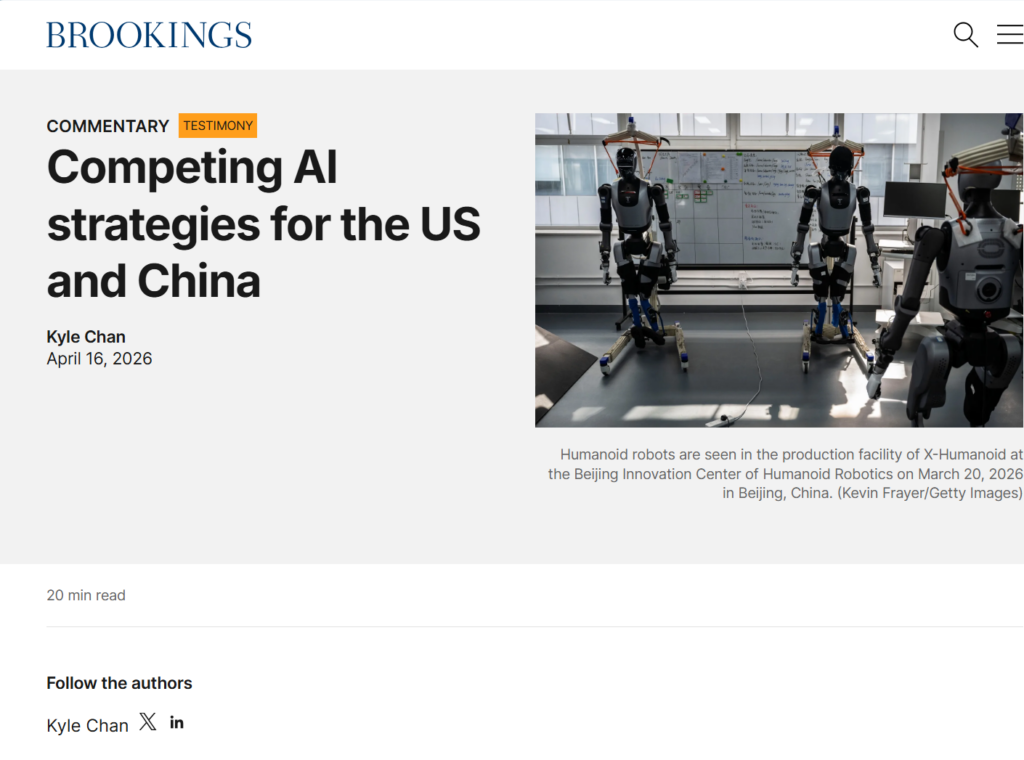
“Competing AI strategies for the US and China”
Brookings
In testimony before the U.S. House Select Committee on Strategic Competition Between the United States and the Chinese Communist Party in April, Brookings research fellow Kyle Chan testified that the United States and China are pursuing fundamentally different pathways to AI power. The U.S. strategy is driven by frontier model breakthroughs, massive private‑sector investment, and leadership in cutting‑edge research. China, by contrast, is focused on “full-stack”, rapid, nationwide deployment of AI across manufacturing, logistics, public services, and governance, aiming to embed AI deeply into its economic and administrative systems. These divergent approaches create a strategic competition over which nation can translate AI into real‑world influence fastest and most effectively. The stakes extend beyond technology: whoever leads shapes global digital norms, standards, and governance models. Chan warns that if the U.S. falls behind, China could gain long‑term geopolitical leverage through AI‑enhanced military capabilities, digital infrastructure exports, and influence in emerging markets. The future balance of global power may hinge on how each country aligns AI development with national strategy.
https://www.brookings.edu/articles/competing-ai-strategies-for-the-us-and-china
“The Artificial General Intelligence Race and International Security”
RAND Corporation
The emerging race toward artificial general intelligence (AGI) is reshaping international security, especially within the broader strategic competition between the United States and China. Expert analyses commissioned by Perry World House and RAND’s Geopolitics of AGI Initiative, explores whether the greatest risks arise during the ambiguous pre‑AGI period or from a rapid, competitive sprint toward AGI itself. Contributors debate whether AGI will fundamentally alter nuclear stability or instead democratize access to destructive capabilities. Several argue that traditional arms‑control frameworks are inadequate for AGI, proposing new governance models such as an “AI cartel” to separate military and civilian development. Across the papers, a set of strategic dilemmas emerges — speed versus caution, perception versus reality, and competition versus cooperation — all of which require deliberate choices to ensure AGI strengthens rather than destabilizes global security.
https://www.rand.org/pubs/perspectives/PEA4155-1.html
“China’s open-source bet”
MIT Technology Review
China’s leading AI labs are reshaping global competition by releasing powerful “open‑weight” models that developers can download, modify, and run locally. This strategy took off after DeepSeek open‑sourced its R1 reasoning model in 2025, matching top U.S. systems at far lower cost. Chinese labs—including Z.ai, Moonshot, Alibaba’s Qwen, and MiniMax—now dominate global model downloads and user‑generated variants, surpassing U.S. firms on Hugging Face. Open‑weight access lets developers experiment cheaply and customize models without relying on American APIs, driving adoption across the Global South. Countries like Singapore and Malaysia are building sovereign AI ecosystems on Chinese foundations. The approach isn’t purely idealistic: open‑source accelerates feedback loops and compensates for China’s limited access to advanced chips. Despite concerns about content controls and alleged distillation misuse, China’s open‑source momentum is making the AI landscape more multipolar—and increasingly difficult for Silicon Valley to contain.