


A look at the careers, training and workforce behind the infrastructure that powers everyday life.
Every October, Careers in Construction Month highlights the people and career paths behind the built environment. The industry touches virtually all others. Water has to reach the faucet for a baker to make dough. Hospitals need specialized buildings before doctors and nurses can care for patients. Trains need tracks and tunnels. Nearly every system that keeps modern life moving first has to be physically built.
Even the industry that looks digital on the surface; Artificial intelligence, cloud computing and streaming services depend on data centers. The facilities require land preparation, structural work, cooling equipment, electrical systems, backup generation and connections to an increasingly strained power grid.
The U.S. construction industry employed approximately 8.36 million people in August 2026, according to the Bureau of Labor Statistics. Average hourly earnings across the industry were $41.66. For New Jersey, the latest BLS state data show 167,400 construction jobs in August 2026 alone.
Construction’s employment footprint extends beyond the jobsite as well. A 2019 Economic Policy Institute analysis estimated that every 100 direct construction jobs supported another 88 jobs among construction-adjacent industries. That broader network includes material suppliers, equipment manufacturers and businesses providing transportation, administrative services and other related industries.
The infrastructure we rarely see
Much of the built environment operates unnoticed until something goes wrong. A broken water main exposes the miles of pipe beneath a city. A power outage draws attention to substations and transmission networks. A rail disruption highlights the tunnels, bridges, signals and tracks carrying passengers every day, and also ruins the commuters evening.
Maintaining those systems requires ongoing work, particularly in the Northeast, where new infrastructure is often being built alongside systems that have served for generations. The Hudson Tunnel Project, for example, will add a new rail connection between New Jersey and Manhattan before the existing 116-year-old North River Tunnel is rehabilitated. About 200,000 passenger trips currently depend on that crossing each day.
Apprenticeships to advanced technology
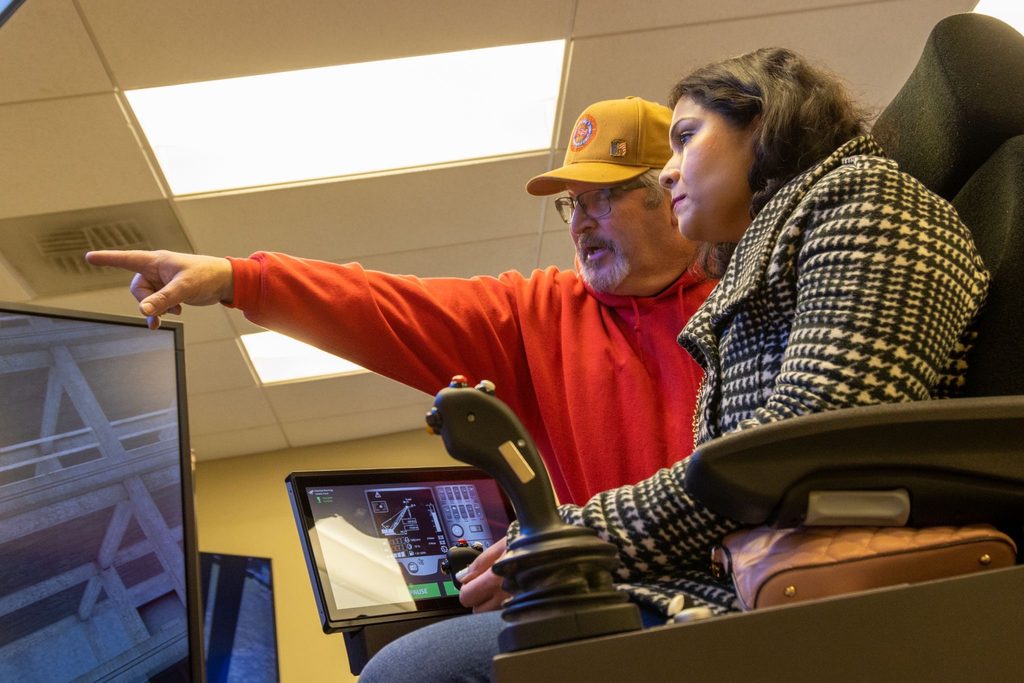
Apprentices at the IUOE Local 825 training center use a crane simulator to practice operating controls, moving loads and making precise lifts in a controlled environment.
Technology is changing the construction workforce along with virtually every other industry. Modern jobsites increasingly incorporate GPS-guided machinery, drones, digital plans, automated equipment, advanced surveying and sophisticated monitoring systems.
A major infrastructure project can involve dozens of occupations before it is finished, including engineers and surveyors to operating engineers, ironworkers, electricians, laborers and inspectors. For many of those careers, the path begins with a registered apprenticeship, which combines paid on-the-job experience with classroom instruction.
New Jersey has several well-established examples. IUOE Local 825 trains a class of roughly 100 heavy-equipment operators and mechanics each year through a four-year apprenticeship that includes at least 144 hours of classroom and hands-on instruction annually, along with roughly 1,500 hours of work experience. Its training facilities in New Jersey and New York house more than 90 pieces of equipment, including cranes, pavers, dozers, backhoes and pile drivers.
That training can also translate directly into a college education, challenging the outdated notion that careers in the trades are separate from higher education. Thomas Edison State University recognizes up to 52 college credits for graduates of Local 825’s registered apprenticeship, giving members a substantial head start toward degree programs including construction and technical studies.
Other programs illustrate the range of careers available. IBEW Local 102’s electrical apprenticeship combines at least 900 hours of classroom instruction with 8,000 hours of on-the-job training over five years. Home IBEW Local 102. UA Local 9 offers five-year apprenticeships in plumbing, pipefitting and HVAC service, with apprentices earning a percentage of the journeyman wage that increases as they progress.
The Tri-State region offers a preview
New York and New Jersey provide a concentrated look at the scale of the work ahead. Gateway is advancing one of the largest passenger-rail investments in the country. At the same time, the Port Authority’s proposed 2026-2035 capital program calls for major work at Newark Liberty International Airport, JFK, LaGuardia, PATH, the Midtown Bus Terminal, bridges, tunnels and the region’s seaport system.
Historic efforts to increase energy supply are underway right now, and it’s the operating engineers and skilled laborers that will build these upgrades. Nuclear power already supplies more than 40 percent of New Jersey’s electricity through the Salem and Hope Creek plants, and the state has launched a process to pursue at least 1,100 megawatts of new nuclear generation, potentially creating another major construction and workforce need.
Clean water alone is creating major infrastructure demands, from upgrading aging treatment systems to removing PFAS and replacing lead service lines. Meeting that need requires more than new funding and equipment; it requires the skilled workforce to build and maintain the systems themselves.
Sources:
Build Your Future. (n.d.). Careers in Construction Month. Careers in Construction Month Build Your Future
Gateway Development Commission. (n.d.). The Gateway Program. Gateway Program Gateway Program –
International Brotherhood of Electrical Workers Local 102. (n.d.). Apprenticeship. IBEW Local 102 apprenticeship
International Union of Operating Engineers Local 825. (n.d.). Apprenticeship. IUOE Local 825 apprenticeship