




A wake-up call for New Jersey’s built environment
The recent heat dome and aftermath challenged NJ’s energy and transportation infrastructure
PJM alerted data centers to be ready to switch to backup power
extensive NJ Transit delays, cancellations
breaking storms caused flooding and power loss
29 suspected heat-related fatalities
The intense heat wave that gripped New Jersey in late June and culminated over the Independence Day weekend of 2026 was more than a public health emergency; it was a brutal stress test for the state’s critical infrastructure. Breaking long-standing temperature records before dissolving into violent storms and widespread flash flooding, the multi-day event exposed deep-seated vulnerabilities in the region’s power grid, transportation systems, and structural engineering paradigms.
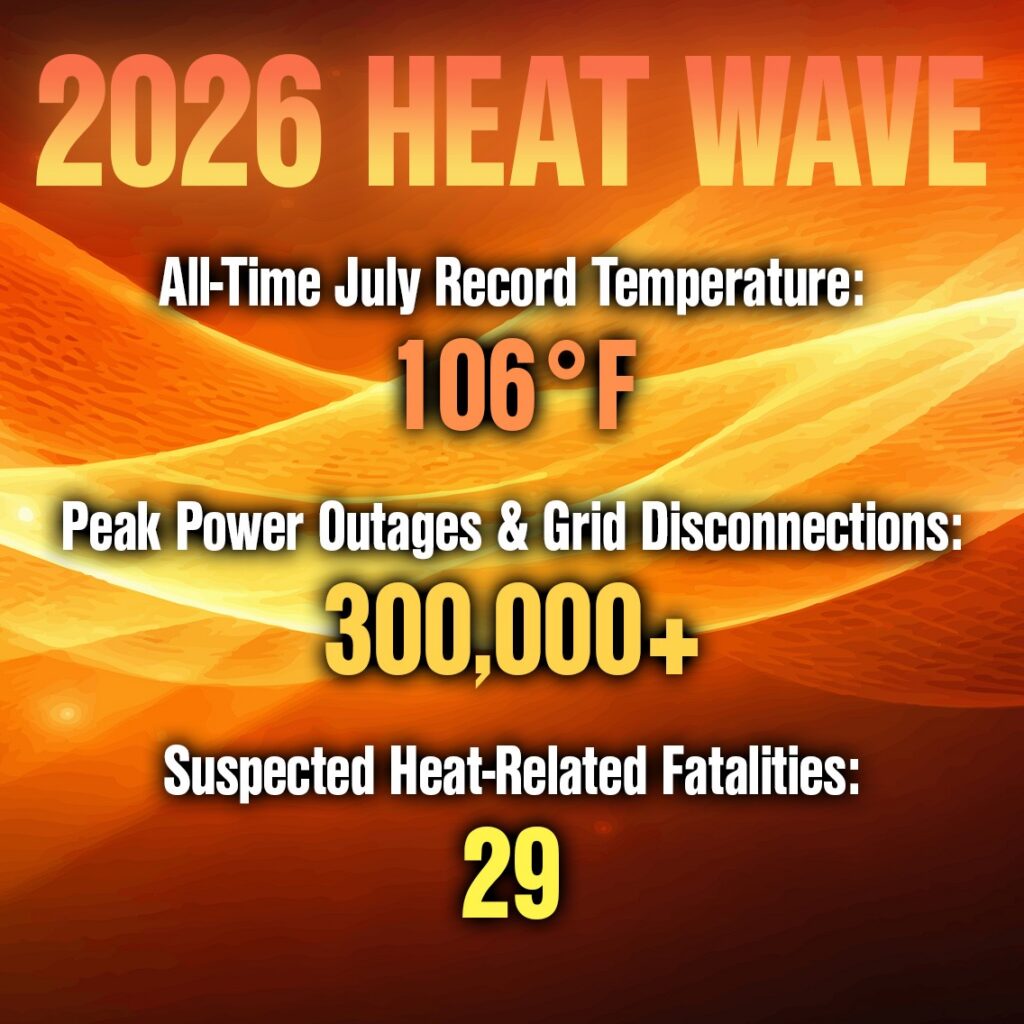
As Governor Mikie Sherrill noted during an emergency briefing, this historic heat dome represented the most punishing meteorological stretch the Garden State has experienced in fourteen years. With ambient temperatures skyrocketing to an all-time July record of 106°F in Atlantic City and urban heat island effects pushing the real-feel heat index to a staggering 110°F, New Jersey found itself operating at the very margin of its operational tolerances. When the heat dome finally collapsed on July 6, it unleashed severe downpours and 70 mph winds, executing a compounding double-blow to an already fatigued built environment.
Grid under siege
The primary battleground of the late June heat wave was New Jersey’s electrical distribution network. For nearly a week, overnight temperatures refused to drop below the high 70s, denying substations, transformers, and residential structures their natural nocturnal cooling cycles. This thermal saturation coincided with unprecedented cooling demands, driving regional transmission organizations to capacity thresholds.
PJM Interconnection issued escalating grid warnings to protect the Mid-Atlantic electrical network. Operations began with a Hot Weather Alert and a mandatory recall of all transmission maintenance outages. As cooling demand surged, PJM declared Maximum Generation and Emergency Load Management Alerts to maximize capacity. Crucially, they secured federal emergency 202(c) orders, bypassing emissions caps and placing massive data centers on short-notice standby to switch to backup power, successfully averting catastrophic regional blackouts.
While utility providers like PSE&G and Jersey Central Power & Light (JCP&L) had anticipated high seasonal loads, the compounding effect of the heat dome degraded equipment efficiency. Transformers, which rely on ambient air exchange to dissipate heat generated during power step-down operations, suffered accelerated thermal aging. This set the stage for systemic failures when the outer bands of the subsequent storm front collided with the superheated air mass.
The resulting violent storms uprooted weakened trees, throwing heavy canopy onto vulnerable overhead distribution lines. At its peak, over 300,000 homes and businesses across the state were plunged into darkness. This was not a simple matter of wind-snapped wires; it was an intersectional infrastructure failure where thermally stressed equipment met severe mechanical impacts from storm debris, significantly prolonging utility restoration efforts.
Mass (transit) deceleration
For commuters and travelers over the holiday weekend, the heat wave manifested as a complete logistical standstill. NJ Transit and Amtrak operations along the Northeast Corridor and commuter branches became heavily degraded. The culprit lay in the physical physics of linear infrastructure exposed to extreme thermal expansion. The aging catenary systems – the overhead wires providing electrical propulsion to trains – expanded under the relentless 105°F heat, sagging well below safe physical tolerances. When trains attempted to pass at operational speeds, the risk of tearing down these vital lines forced mandatory speed restrictions across the network. Simultaneously, rail steel temperatures reached estimated peaks well above 130°F due to direct solar radiation, elevating the threat of “sun kinks” or thermal misalignment track buckling.
When the storm front arrived on July 6, it introduced severe infrastructure damage, particularly along the Morris & Essex and North Jersey Coast lines. Seventy-mile-per-hour wind gusts threw mature timber across catenary lines and blocked tracks, forcing total cancellations. The compounding impacts revealed that New Jersey’s transit network remains brittle to rapid meteorological shifts, lacking the resilient design and automatic tensioning systems required to absorb rapid swings from extreme heat to violent convective storms.
Hydraulic shock
The finale of the heat wave brought a stark transformation from extreme drought conditions to intense hydraulic overload. The atmospheric energy trapped by the heat dome fueled torrential downpours on July 6, overwhelming municipal stormwater infrastructure across northern and central New Jersey.Systems designed for historical stormwater baselines proved entirely inadequate against the sheer volume of water deposited within compressed timeframes.
Major state highways quickly transformed into rivers, trapping motorists and forcing local emergency services to divert limited resources toward high-water vehicle rescues. The rapid accumulation of water also exerted catastrophic dead loads on large-footprint commercial rooftops. In Ocean Township (Monmouth County), a partial roof collapse occurred at a BJ’s Wholesale Club as stormwater accumulation outpaced the structural drainage capacity. While structural debris briefly trapped two shoppers, miraculous luck prevented injuries. However, the structural failure serves as an urgent indicator that commercial and industrial structural codes must adapt to account for intense, short-duration precipitation events that follow severe thermal stress.
Public health
The New Jersey Department of Health’s ongoing investigation into at least 29 suspected heat-related deaths highlights the severe consequences of modern structural shortfalls. A significant portion of these fatalities occurred indoors, where aging housing stock lacked adequate thermal insulation, ventilation, or operational air conditioning. Urban centers experienced a pronounced “urban heat island” effect, where vast expanses of asphalt and concrete absorbed heat during the day and re-radiated it at night, creating a localized ambient baseline far higher than surrounding rural environments. Emergency departments across the state reported a sharp spike in heat stroke and exhaustion cases. This healthcare surge demonstrated that the state’s medical infrastructure remains vulnerable to sudden spikes in volume driven by environmental crises, particularly when coinciding with localized power grid failures that render domestic cooling appliances useless.
The new normal?
The events of late June and early July 2026 have made one reality undeniable: the historical environmental baselines used to engineer New Jersey’s infrastructure are obsolete. If the state is to maintain operational continuity in an era characterized by volatile weather patterns, a systemic shift in capital deployment and engineering standards must occur.
For the power grid, this means accelerating the undergrounding of critical distribution circuits and deploying smart-grid technologies capable of automatically isolating damaged nodes without dropping entire sub-stations. For transit authorities, it demands the rapid replacement of fixed-tension catenary wires with modern constant-tension systems that utilize balance weights to adjust to extreme thermal fluctuations. Finally, municipal building and stormwater codes must be rewritten to mandate higher structural load capacities for flat commercial roofs and larger retention diameters for drainage networks.
Sources:
Amtrak. (2026, July 5). Service alert: Heat-related speed restrictions and infrastructure updates on the Northeast Corridor. Northeast Corridor Operations. https://www.amtrak.com/alerts
Andrews, C., Shahid, Y., & Main, J. (2026). Comparing ambient and personal measurements of exposure to urban heat stress in public housing environments. Rutgers University Institutional Repository. https://scholarship.libraries.rutgers.edu/
Jersey Central Power & Light. (2026, July 6). JCP&L restoration updates: Severe convective storm impacts following regional heat dome. FirstEnergy Corp Utility Dashboards. https://www.firstenergycorp.com/nj-outages
New Jersey Department of Health. (2026, July 6). Preliminary morbidity and mortality report: Heat-related surveillance and suspected fatalities during the late-June/July 2026 extreme heat event. Office of Population Health and Epidemiology. https://www.nj.gov/health/
NJ Transit. (2026, July 6). Travel advisory: Significant infrastructure delays and storm-related cancellations on Morris & Essex and North Jersey Coast Lines. NJ Transit Press Room. https://www.njtransit.com/press-releases
Office of the Governor. (2026, July 5). Transcript: Governor Mikie Sherrill provides emergency briefing on state-wide heat dome, grid stabilization efforts, and utility response. State of New Jersey. https://www.nj.gov/governor/news/
PJM Interconnection. (2026, July 1). *PJM hot weather operations update – July 1, 2026*. PJM Inside Lines. https://insidelines.pjm.com/pjm-hot-weather-operations-update-july-1-2026/
PJM Interconnection. (2026, July 2). *PJM hot weather operations update – July 2, 2026*. PJM Inside Lines. https://insidelines.pjm.com/pjm-hot-weather-operations-update-july-2-2026/
PJM Interconnection. (2026, July 3). Emergency procedures and peak load analysis during high thermal saturation events: Mid-Atlantic region. PJM Grid Operations Data. https://www.pjm.com/markets-and-operations
PJM Interconnection. (2026, July 10). *PJM serves load through record-breaking July heat*. PJM Inside Lines. https://insidelines.pjm.com/pjm-serves-load-through-record-breaking-july-heat/
State Climate Office of New Jersey. (2026, July 6). Monthly meteorological summary: Record-breaking July temperatures and subsequent convective storm front. Rutgers University Department of Geography. https://climate.rutgers.edu/stateclim/
Township of Ocean Police Department. (2026, July 6). Incident report: Partial structural roof collapse at commercial venue on Route 35 due to hydraulic precipitation overload. Monmouth County Emergency Services. https://www.oceantwp.org/police