



AI is coming for jobs—and creating new ones. New Jersey is in the middle of both
New Jersey is positioning itself within the expanding artificial intelligence sector as industries across the country adjust to rapid adoption of AI tools and automation. The effort reflects both an economic development strategy and an attempt to prepare the state’s workforce for structural changes expected over the next decade.
A recent Cognizant report estimates AI could unlock $4.5 trillion in U.S. labor productivity by automating or assisting up to 93% of current job tasks. While projections vary, most analyses agree that AI is likely to reshape job functions across sectors rather than eliminate them outright, with growth expected in supervisory, technical, and AI-augmented roles. In light of this expected sea of change, what is New Jersey doing to to align its workforce, education system, and industry partnerships with changes already underway?
A multi-pronged strategy
New Jersey’s AI strategy is built around several interconnected initiatives rather than a single statewide program.
At the center is the NJ AI Hub at Princeton, a nonprofit innovation center backed by the New Jersey Economic Development Authority, Princeton University, Microsoft, CoreWeave, and other partners. Located in West Windsor, the Hub has secured more than $70 million in initial funding and is intended to support research collaboration, workforce training, and early-stage company development.
Programs connected to the Hub include startup acceleration efforts such as Plug and Play AI Accelerator which connects AI start-up founders with investors and corporate partners. Microsoft’s TechSpark initiative is also operating through the Hub, focusing on workforce development and training pathways tied to emerging technology roles.
Microsoft has also brought its TechSpark initiative to the Hub, focused on aligning workers with emerging roles through training and local partnerships. “[Techspark] brings economic development programs to regions around the United States…because we believe that talent is everywhere – but opportunity is not” said Marie Pryor, community manager for Microsoft and director of workforce for the Hub. Techspark recently helped Rutgers roll out an AI certificate program. The Hub continues to expand its offerings, including AI Apprenticeships for community college students and Faculty futures, which is designed to help teachers integrate AI into higher education.
Colleges around the state are also expanding AI-focused programming. Rutgers University, the New Jersey Institute of Technology, Stevens Institute of Technology, Rowan University, and Kean University have all introduced or expanded AI-related degrees and certificate programs, often in coordination with industry partners.
Corporate investment and workforce disruption
New Jersey’s AI-related growth is occurring alongside broader restructuring in established industries.
Pharmaceutical companies including Johnson & Johnson and Merck & Co. are integrating AI into drug discovery, clinical trials, and supply chain optimization. In financial services, firms such as BNY Mellon and Prudential Financial are applying AI in fraud detection, risk modeling, and automation. BNY Mellon has also invested in governance-focused AI research through partnerships tied to its New Jersey operations.In financial services, firms such as BNY Mellon and Prudential Financial are applying AI in fraud detection, risk modeling, and automation. BNY Mellon has also invested in governance-focused AI research through partnerships tied to its New Jersey operations.
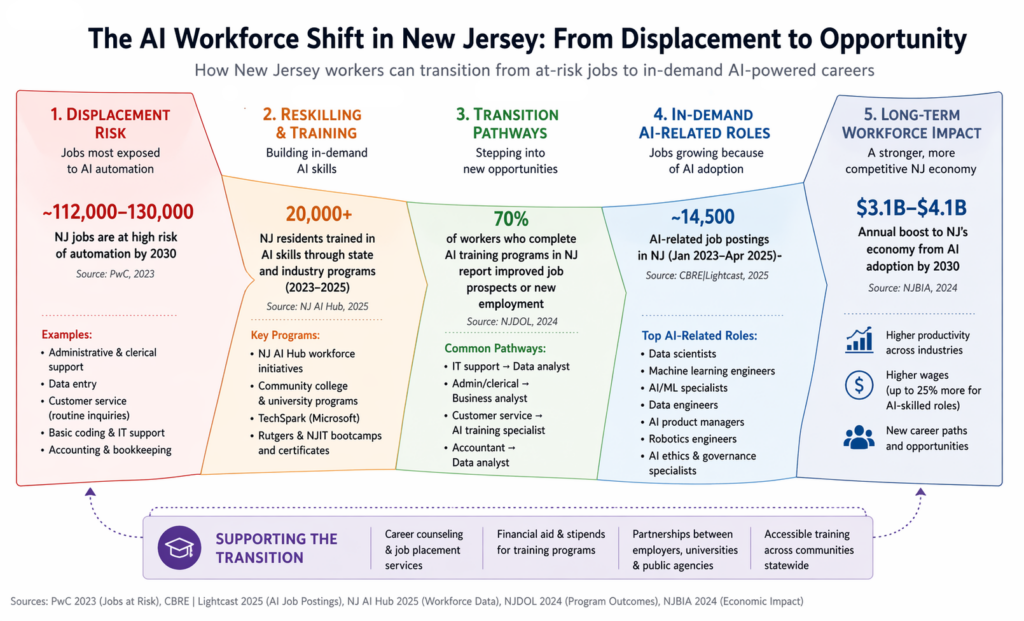
At the same time, workforce reductions across several legacy industries are reshaping employment patterns in the state. WARN filings between 2023 and 2025 show approximately 14,000 layoffs across New Jersey, concentrated in pharmaceuticals, biotech, and related sectors. Several major employers have announced cuts:
- Bristol Myers Squibb reduced more than 1,100 roles
- Novo Nordisk cut over 800 positions
- Novartis eliminated nearly 500 jobs
- Johnson & Johnson announced 190 of layoffs
- Amazon has laid off over 800 employees across multiple New Jersey facilities in 2026 alone
While these layoffs are not solely attributed to AI, they reflect broader restructuring trends occurring alongside increased automation and efficiency investments.
The result is a labor market in transition, with some displaced workers moving toward roles in data infrastructure, AI systems support, and analytics. A potential upside is higher wages. New Jersey’s median annual wage across occupations is roughly $55,000, while many AI-related roles are $120,000. The shift could represent an opportunity for workers to move up the pay scale, although doing so requires access to additional training or certification, with both the time commitment and cost posing potential barriers.
The rise of data centers
AI growth is also visible in physical infrastructure. The state is home to more than 80 data centers, with additional facilities planned as demand continues to rise.
That expansion has generated growing public pushback. Concerns have focused on environmental impacts, rising energy demand and the strain on an already tight power supply. Critics argue that data center growth will contribute to already-high energy costs and have valid questions about land use, water consumption and how these facilities will change the character of surrounding communities.
At the same time, data centers are becoming a central part of the state’s economic landscape. Companies including OpenAI, Amazon, Microsoft, Google, and Meta rely on large-scale computing infrastructure to support AI-driven products and services, many of which offer high-paying jobs. Those opportunities are more likely to grow in states that can meet the infrastructure demands required to support them. Construction of data centers also drives demand for skilled trades, along with longer-term technical and operational roles.
Still, the scale of resource use remains a challenge. Data centers require significant amounts of electricity and water, prompting discussion about how to manage that demand. Newer data centers employ closed loop cooling systems, which reduce water usage considerably but in turn require more power for cooling. In other parts of the country, some operators have begun exploring “bring your own power” (BYOP) models, which rely on dedicated energy sources such as onsite natural gas turbines or, in some cases, nuclear generation. Microsoft’s efforts tied to Three Mile Island in Pennsylvania reflect the scale of power needs associated with long-term AI growth. Still, the scale of resource use remains a challenge. Data centers require significant amounts of electricity and water, prompting discussion about how to manage that demand. In other parts of the country, some operators have begun exploring “bring your own power” (BYOP) models, which rely on dedicated energy sources such as onsite natural gas turbines or, in some cases, nuclear generation. Microsoft’s efforts tied to Three Mile Island in Pennsylvania reflect the scale of power needs associated with long-term AI growth.
Pennsylvania is positioning itself as a formidable competitor in the race for AI investment, largely because it can meet those energy demands. With abundant natural gas production from the Marcellus Shale and a strong existing nuclear fleet, the state offers a level of reliable, around-the-clock power thatNew Jersey does not match. State leaders have also moved aggressively to attract data center development, with billions of dollars in announced and proposed projects tied to AI infrastructure in recent years. As demand for high-performance computing continues to rise, Pennsylvania’s ability to deliver both power and capacity is expected to give it a significant edge in attracting AI jobs and long-term investment.
A pivotal moment for New Jersey’s workforce
New Jersey’s approach to AI is ultimately a wager on transition. The state is betting that investments in training, infrastructure, and innovation can offset job losses in legacy sectors and create a more competitive economy. The challenge is timing. Job displacement is happening now, workforce transformation takes time. Energy and water usage also remain challengesWhether New Jersey succeeds will depend on how effectively it connects those two realities: helping workers move from yesterday’s roles into tomorrow’s economy before the gap between them widens.
Sources:
Cognizant. (2024). New work, new world: Preparing for AI-driven productivity gains. Cognizant Center for the Future of Work. https://www.cognizant.com
MIT Technology Review. (2024, September 26). Three Mile Island is getting a second life as Microsoft bets on nuclear power for AI. https://techcrunch.com/2024/09/20/microsoft-taps-three-mile-island-nuclear-plant-to-power-ai
New Jersey Business & Industry Association. (2024). Economic impact of artificial intelligence in New Jersey. https://www.njbia.org
New Jersey Council of County Colleges. (2026, January 15). New Jersey’s community colleges launch state’s first USDOL-registered data scientist AI apprenticeship, advancing New Jersey’s innovation economy. https://www.njcommunitycolleges.org/news/new-jerseys-community-colleges-launch-states-first-usdol-registered-data-scientist-ai-apprenticeship-advancing-new-jerseys-innovation-economy/
New Jersey Department of Labor and Workforce Development. (2025). WARN notices and layoffs data. State of New Jersey. https://www.nj.gov/labor
New Jersey Department of Labor and Workforce Development. (2025). 2025 WARN notice archive. https://www.nj.gov/labor/assets/PDFs/WARN/2025_WARN_Notice_Archive.pdf
New Jersey Department of Labor and Workforce Development. (2026). 2026 WARN notice archive. https://www.nj.gov/labor/assets/PDFs/WARN/2026_WARN_Notice_Archive.pdf
New Jersey Economic Development Authority. (2025). Next New Jersey Program – AI. https://www.njeda.gov
New Jersey AI Hub. (2025). About the NJ AI Hub. https://njaihub.org
NJBIZ. (2026, March 20). Plug and Play AI accelerator launches at NJ AI Hub. https://njbiz.com/plug-play-ai-accelerator-launch-nj-ai-hub-princeton/
Princeton University. (2025). NJ AI Hub announcement and research initiatives. https://www.princeton.edu
Microsoft. (2025, January 31). Governor Murphy and Princeton University President Eisgruber announce Microsoft and CoreWeave as founding partners in NJ AI Hub. Microsoft News Center. https://news.microsoft.com/source/2025/01/31/governor-murphy-and-princeton-university-president-eisgruber-announce-microsoft-and-coreweave-as-founding-partners-in-nj-ai-hub/Microsoft. (2024). TechSpark: Advancing digital skills and economic opportunity. https://www.microsoft.com