


When a water main breaks, the immediate impact is easy to see: water flooding streets, crews working to contain the damage, police and detour signs re-routing traffic. What is less visible is the broader economic cost. In their 2025 scorecard, the American Society of Civil Engineers noted that NJ’s drinking water infrastructure needs $32.2 billion dollars of investment.
“According to the Passaic Valley Water Commission, 56 water main breaks were reported in January 2025, which is double the number reported in January 2024.”
- Water main breaks surge across New Jersey during winter freeze, News12 New Jersey.
The hidden economic disruption
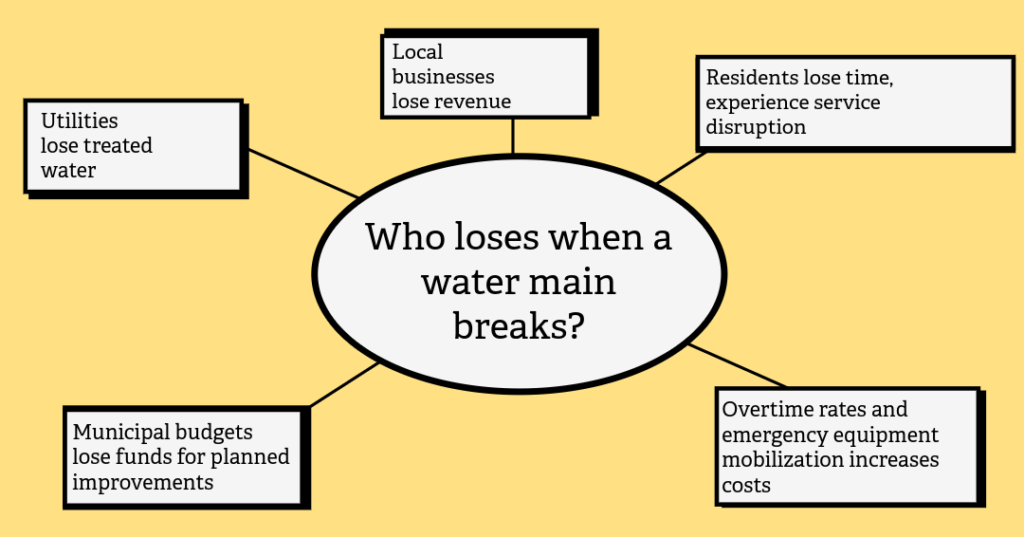
Unlike planned infrastructure projects, water main breaks happen without warning. Crews must respond immediately, whether that means working overnight or in hazardous conditions. This urgency drives up costs, with overtime labor, emergency equipment mobilization and expedited materials all contributing to higher expenses. Business disruption and long-term damage to public assets all add up, creating a ripple effect through local economies.
A repair that might cost significantly less as a planned replacement project becomes more expensive when handled as an emergency. Road closures and detours can cause disruption for local businesses, leading to lost customers, delayed deliveries and reduced revenue. If excavators are digging and police lights are flashing in front of your favorite bakery, do you maneuver through the chaos, or does the morning Dunkin’ just get skipped?
Water service interruptions can also impact business. For industries that depend on access to water, such as food service or healthcare, even a brief outage can mean lost income and additional costs to reopen safely. John Donald, who owns the restaurant Alfonso’s in Somerville, told CBS news, “It’s frustrating because this is the second time within a year that this has happened. Last time, we were closed for a day and a half. Any pizzeria that has dough has to boil the water first, chill it overnight. With today’s economy and the way food prices are and the way labor is going up every year, it’s very difficult to make money.”
There is also the cost of water itself. When a main breaks, thousands of gallons of treated water can be lost. That water has already been pumped, treated and distributed, meaning utilities have paid for it without receiving any revenue in return. This was the case twice in Patterson in 2025. In August, a 30-inch,140-year-old water main broke leaving nearly 200,000 homes and businesses with reduced service and a boil water order used by the Passaic Valley Water Commission.
On a larger scale, repeated breaks strain municipal budgets. Funds that could be used for planned improvements are instead redirected to emergency repairs. Over time, this reactive approach creates a cycle where systems fall further behind, increasing the likelihood of future failures.
The case for proactive investment
Studies and real-world examples show that proactive investment can significantly reduce these costs. Planned projects allow utilities to schedule work during normal hours, coordinate with local stakeholders and minimize disruption. Costs are less variable, timelines are clear and impacts can be managed.
Hoboken offers a clear example of what that approach looks like in practice. Over the past decade, the city has invested in a proactive water main replacement program, targeting some of its oldest and most failure-prone pipes. As part of that effort, approximately 20 percent of Hoboken’s water mains have been replaced through planned upgrades rather than reactive repairs. The results have been measurable.
In 2013, Hoboken experienced 34 water main breaks in a single year, each one requiring emergency response, road closures and unplanned spending. By 2021,that number had dropped to just 12 annual breaks. City officials estimate the program is saving roughly $100,000 per year in repair expenses alone, not including the avoided economic disruption to businesses and residents.
This is counter to the trends seen in the rest of the state, where water main breakshave steadily increased since 2023. New Jersey has one of the oldest water systems in the nation, reflecting the state’s long history of public water service. Much of its infrastructure predates modern construction standards, including lead service lines that are more prone to corrosion, leaks and structural failure over time. These older materials, combined with decades of wear, increase the likelihood of breaks and system-wide vulnerabilities, particularly during seasonal temperature swings.

Source: U.S. EPA Water Needs Survey (DWINSA), 2023
Despite this, many systems continue to rely heavily on reactive maintenance, often due to funding constraints or competing priorities. The upfront cost of replacing aging infrastructure can be difficult to justify, even when long-term savings are clear. But the economic case for action is growing stronger.
Sources:
City of Hoboken water infrastructure upgrades (Phase 1):
City of Hoboken. (2023, July 13). City of Hoboken secures financial relief following February water main break. https://www.hobokennj.gov/news/city-of-hoboken-secures-financial-relief-following-february-water-main-break
City of Hoboken. (n.d.). Water main replacement program (drinking water infrastructure upgrades phase 1).https://www.hobokennj.gov/resources/drinking-water-infrastructure-upgrades-phase-1
NJ Advance Media. (2025, August 11). Toilets, showers set up as N.J. city enters 4th day of water issues after large main break. NJ.com. https://www.nj.com/passaic-county/2025/08/toilets-showers-set-up-as-nj-city-enters-4th-day-of-water-issues-after-large-main-break.html
New Jersey American Water. (2025). Annual report to the New Jersey Board of Public Utilities. https://www.amwater.com/njaw/resources/PDF/rates/Water-Wastewater-Rates/new-jersey-amwater-annual-bpu-2025report.pdf
New Jersey American Water. (2024). Annual report to the New Jersey Board of Public Utilities. https://www.amwater.com/njaw/resources/PDF/rates/Water-Wastewater-Rates/new-jersey-amwater-annual-bpu-2024report.pdf
New Jersey American Water. (2023). Annual report to the New Jersey Board of Public Utilities. https://www.amwater.com/njaw/resources/PDF/rates/Water-Wastewater-Rates/new-jersey-amwater-annual-bpu-report.pdf
U.S. Environmental Protection Agency press release (New Jersey lead pipe funding):
U.S. Environmental Protection Agency. (2024, May 2). New Jersey to get over $123 million for lead pipe replacement to advance safe drinking water. https://www.epa.gov/newsreleases/new-jersey-get-over-123-million-lead-pipe-replacement-advance-safe-drinking-water
Water Finance & Management article on non‑revenue water costs:
WFM Staff. (2025, May 21). Report: Non‑revenue water costs U.S. utilities $6.4 billion annually. Water Finance & Management. https://waterfm.com/report-non-revenue-water-costs-u-s-utilities-6-4-billion-annually/
Water main breaks surge across New Jersey during winter freeze
News12 New Jersey.