


[This is multi-part series on NJ Transit – Part I can be found here. Part II can be found here.]
New Jersey Transit (NJ TRANSIT) is the nation’s largest statewide public transportation system, providing nearly 270 million passenger trips each year across 263 bus routes, 12 rail lines, and three light rail lines. The agency connects major employment centers, universities, and communities, supporting economic growth, environmental sustainability, and social equity.
Yet, for nearly half a century, the agency has been dogged by a recurring pattern of fiscal instability—short-term fixes, capital-to-operating transfers, mounting debt, and deferred maintenance. With Governor Sherrill’s Executive Order to improve the NJ Transit rider experience, now is a good time to review the history of the agency and the funding and structural challenges that have led to this moment.
The 2020s: Pandemic Shock, Federal Aid, and Renewed Crises
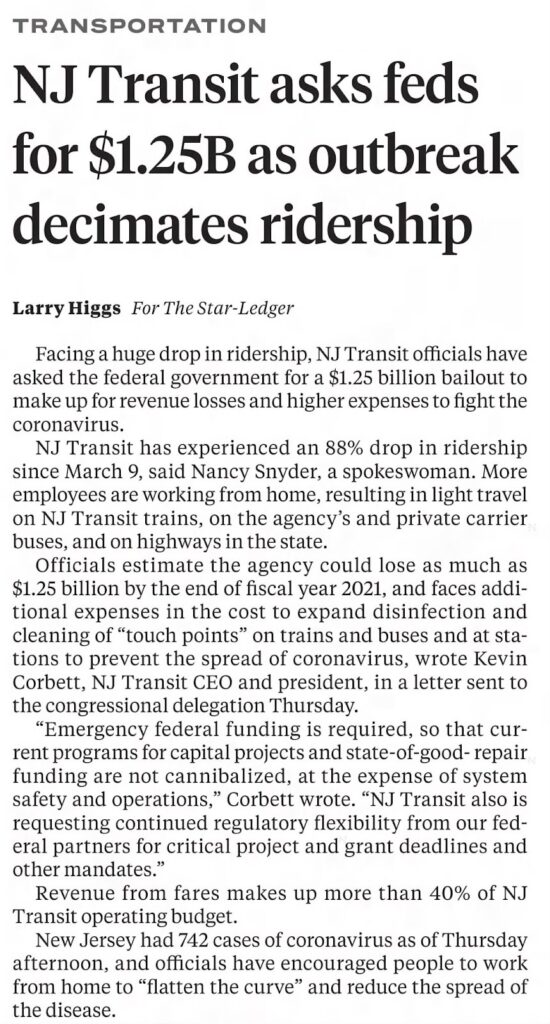
The COVID-19 pandemic delivered an unprecedented shock. Ridership collapsed by 85% in early 2020, and fare revenue plummeted from $978 million in FY 2019 to $301 million in FY 2021. The operating gap ballooned by $940 million (71%) over the period, threatening mass layoffs and service cuts.
Federal relief funds provided a temporary lifeline. NJ TRANSIT received $1.2 billion from the CARES Act (2020–2021), $1.1 billion from the CRRSAA, and nearly $1.9 billion from the American Rescue Plan (2022–2024), allowing the agency to maintain service and avoid drastic fare hikes. However, these funds were always intended as a stopgap, and by FY 2025, they were nearly exhausted.
As the pandemic receded, ridership began to recover, reaching 219.6 million passenger trips in FY 2024 and generating $758 million in fare revenue. But the recovery was uneven: bus ridership rebounded to 92% of 2019 levels, while rail ridership—more dependent on office commuters—reached only 67%. The rise of hybrid and remote work, along with persistent safety and reliability concerns, limited the pace of recovery.
With federal aid running out and fare revenue still below pre-pandemic levels, New Jersey enacted a new Corporate Transit Fee—a surtax on corporations with net income over $10 million—to fund NJ TRANSIT. For FY 2026, the fee is projected to generate $789 million, nearly 25% of the agency’s operating budget. Passenger fares are expected to contribute 31%, with 15% coming from the New Jersey Turnpike Authority and the remainder from commercial revenue and other sources.
However, the fee is not constitutionally dedicated to NJ TRANSIT, and some of the revenue has been diverted to other state priorities. Advocates and analysts warn that without a permanent, protected funding stream, the agency remains vulnerable to future budget crises and political maneuvering.
In 2024, NJ TRANSIT implemented its first fare hike in nearly a decade—a 15% increase—to help close a $107 million operating deficit. Additional 3% annual increases are planned for the foreseeable future. Labor costs, which account for 60% of the operating budget, have risen sharply, with recent contracts granting wage increases and improved benefits to bus drivers, mechanics, and engineers. A threatened rail strike in 2025 was narrowly averted, but only after tense negotiations and political intervention.
Kick the Can
Across four decades, a clear pattern emerges: NJ TRANSIT’s leaders and political overseers have repeatedly opted for temporary fixes over structural solutions. The agency has relied on capital-to-operating transfers, one-time revenue infusions, and deferred maintenance to balance its books, while accumulating debt and postponing critical investments. Each crisis has been met with a patchwork of fare hikes, toll transfers, and federal grants, but the underlying funding gap has persisted—and, in many ways, deepened.
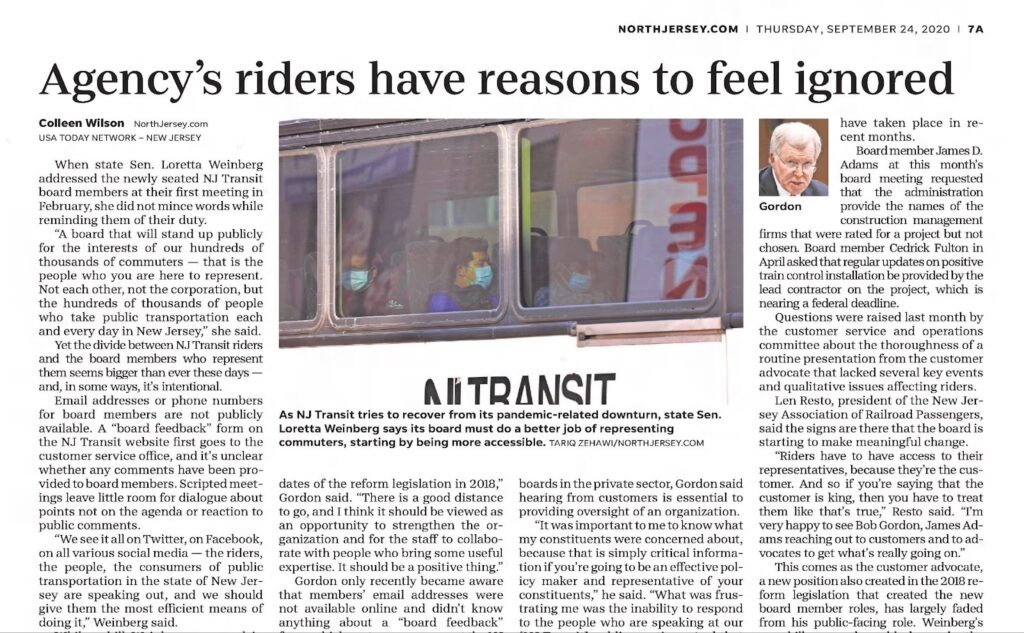
The consequences are visible in the system’s aging fleet, service disruptions, and eroding public trust. Deferred maintenance has produced a backlog of capital needs, with billions required to bring the system to a state of good repair. The lack of a dedicated, constitutionally protected revenue source has left NJ TRANSIT at the mercy of annual budget negotiations and shifting political priorities.
Looking Forward
Despite its challenges, NJ TRANSIT remains indispensable to the state. It is the nation’s largest statewide public transportation system, providing nearly 270 million passenger trips each year across 263 bus routes, 12 rail lines, and three light rail lines. NJ Transit connects major employment centers, universities, and communities, supporting economic growth, environmental sustainability, and social equity. Public transportation in New Jersey eliminates 150 million vehicle trips annually, prevents 644,000 metric tons of greenhouse gas emissions, and saves households 24–34% on transportation costs. It generates $5 billion in economic activity each year and supports transit-oriented development that revitalizes cities and towns.
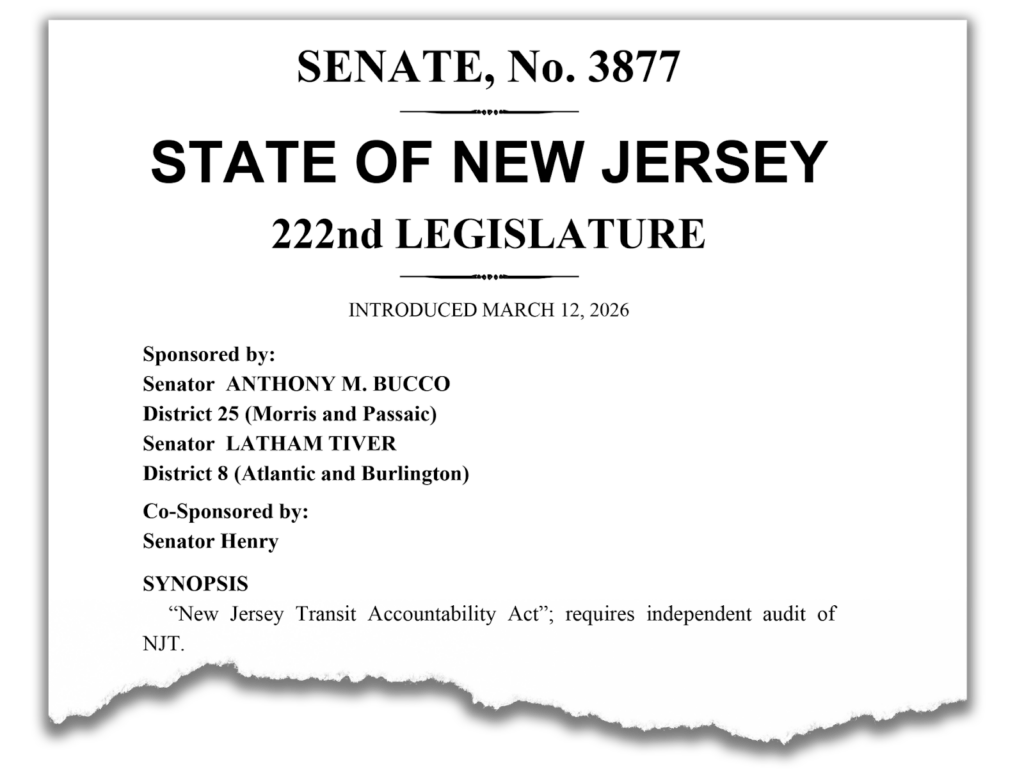
In March 2026, NJ Senate bill S3877 “The New Jersey Transit Accountability Act” was introduced in the NJ Senate, co-sponsored by Senators Bucco, Tiver, and Henry. The legislation mandates an independent audit of NJ Transit’s financial and budget practices since 2018. It aims to increase transparency regarding capital fund diversions and the pandemic’s impact on service demands.
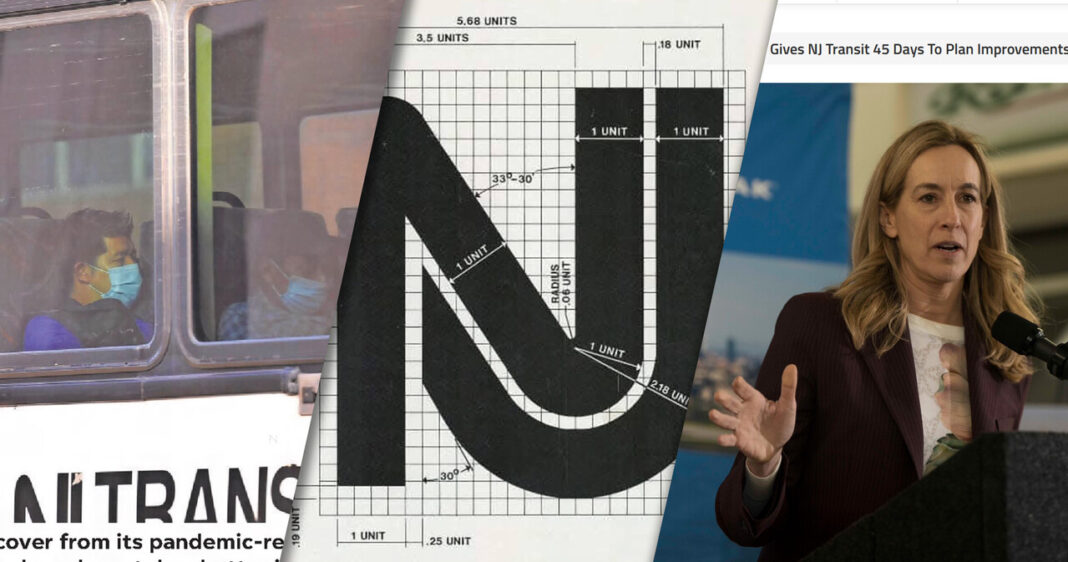
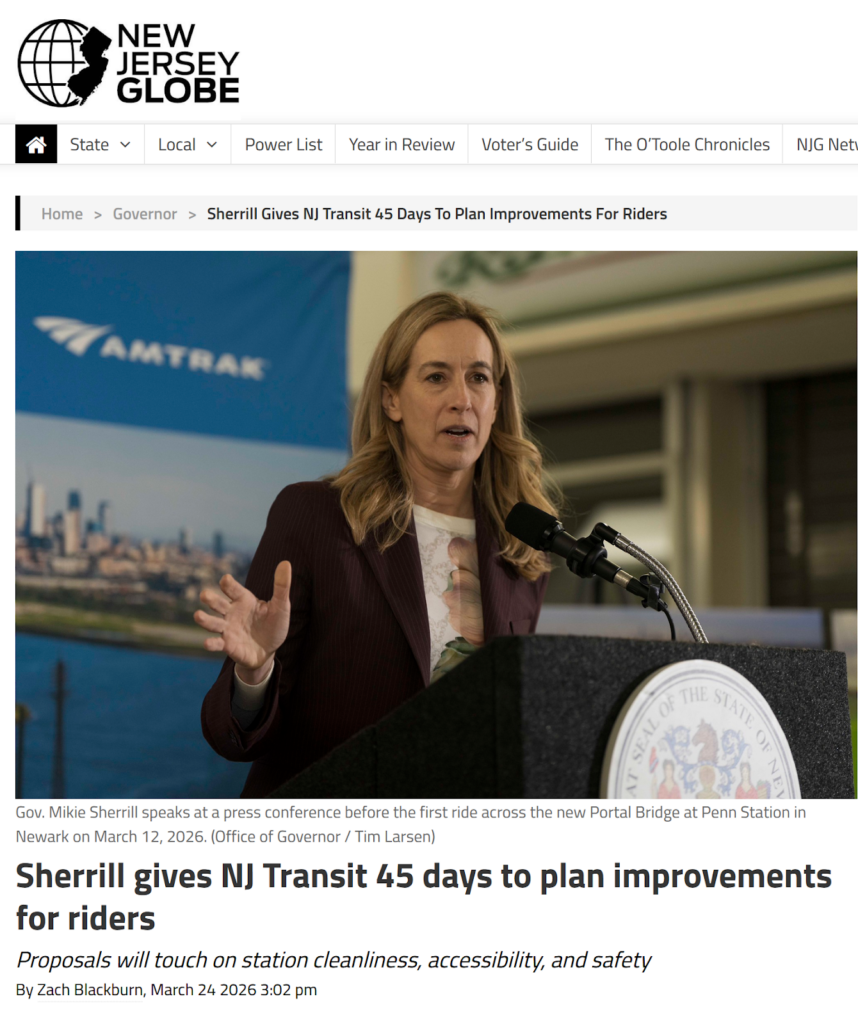
Later that month, Governor Mikie Sherrill signed an executive order requiring NJ TRANSIT to produce a comprehensive plan within 45 days to address service reliability, cleanliness, accessibility, and real-time information. The order mandates immediate improvements—such as repairing escalators and elevators, enhancing station lighting, and upgrading digital tools—while also laying the groundwork for long-term investments in fleet replacement and infrastructure modernization.
After decades of kicking the can down the tracks, this current call for fixing NJ TRANSIT is refreshing. The most urgent need is for a dedicated, recurring revenue source—protected by statute or constitutional amendment—to fund both operations and capital investments. Peer agencies like New York’s MTA and San Francisco’s BART rely on such dedicated streams, providing greater stability and predictability.
Additionally, Transit-oriented development (TOD) and joint development projects can generate lease revenue, profit-sharing, and increased property tax receipts. The agency’s 2025 Land Plan estimates that land-based developments could yield $1.9 billion over 30 years, boosting annual non-farebox revenue by 64% if fully implemented.
Recent reforms have strengthened board oversight and transparency, but further improvements are needed. Proposals include expanding the board to include more rider and regional representation, establishing independent customer advocates, and mandating regular performance audits and public reporting.
A renewed focus on asset management is essential. The agency must prioritize preventive maintenance, fleet replacement, and infrastructure upgrades to reduce breakdowns and improve reliability. Federal Transit Administration (FTA) guidance on Transit Asset Management provides a framework for achieving and maintaining a state of good repair.
While federal grants will remain important, NJ TRANSIT should work to maximize matching funds and advocate for stable, long-term federal support. Partnerships with the New Jersey Turnpike Authority, Port Authority, and local governments can also provide additional resources and coordination for major projects.
Fare policy must balance revenue needs with equity concerns. Targeted discounts for low-income riders, fare capping, and integrated payment systems can make transit more accessible while protecting vulnerable populations from the burden of repeated fare hikes.
Ultimately, sustainable transit funding requires political courage and public buy-in. Leaders must resist the temptation to defer tough choices and instead make the case for investment in a system that underpins New Jersey’s economy, environment, and quality of life. Recent executive actions and public listening sessions signal a new commitment to rider experience and accountability, but lasting change will depend on sustained advocacy and legislative action.
Sources
Bond, M., & DiPetrillo, S. (2025). From challenge to resilience: The evolution of NJ Transit funding and a roadmap to a reliable future. Alan M. Voorhees Transportation Center, Rutgers University. https://vtc.rutgers.edu/wp-content/uploads/2025/02/NJ-Transit-Funding-Report-2025.pdf
Reitmeyer, J. (2025, May 20). The financial questions that still hang over NJ Transit. NJ Spotlight News. https://www.njspotlightnews.org/2025/05/nj-transit-budget-deficit-funding-corporate-transit-fee
Reitmeyer, J. (2024, December 12). NJ Transit faces nearly $1 billion deficit as federal aid expires. NJ Spotlight News. https://www.njspotlightnews.org/2024/12/nj-transit-budget-gap-federal-aid-ending
Reitmeyer, J. (2024, March 7). Murphy proposes corporate transit fee to stabilize NJ Transit. NJ Spotlight News. https://www.njspotlightnews.org/2024/03/nj-transit-corporate-transit-fee-budget
Johnson, T. (2023, September 18). NJ Transit’s capital needs far exceed available funding. NJ Spotlight News. https://www.njspotlightnews.org/2023/09/nj-transit-capital-plan-funding-shortfall
Railway Age. (2025, May 22). NJ Transit Board approves $3.16B operating budget, $1.684B capital program. https://www.railwayage.com/passenger/commuterregional/nj-transit-approves-2026-budget
NorthJersey.com (Stile, C.). (2024, April 4). NJ Transit’s funding crisis decades in the making.
https://www.northjersey.com/story/news/columnists/charles-stile/2024/04/04/nj-transit-funding-crisis-history/72938460007
The Star‑Ledger / NJ.com (Higgs, L.). (2023, June 28). How NJ Transit used capital funds to cover operating costs for decades.
https://www.nj.com/traffic/2023/06/nj-transit-diverted-capital-funds-to-operations-for-decades.html
NJ Transit. (2025). FY2026 Operating Budget.
https://www.njtransit.com/sites/default/files/2025-05/NJT-FY2026-Operating-Budget.pdf
NJ Transit. (2025). FY2026 Capital Program.
https://www.njtransit.com/sites/default/files/2025-05/NJT-FY2026-Capital-Program.pdf
NJ Transit. (2024). Annual Ridership Trends Report.
https://www.njtransit.com/sites/default/files/2024-02/NJT-Ridership-Trends-2024.pdf
New Jersey Office of Legislative Services. (2024). Budget analysis: NJ Transit.
https://www.njleg.state.nj.us/analysis/2024/NJT-Budget-Analysis.pdf
New Jersey Turnpike Authority. (2024). FY2025 Financial Plan (including NJ Transit transfer).
https://www.njta.com/media/2025-financial-plan.pdf
U.S. Government Accountability Office. (2001). Commuter rail: Information on funding, ridership, and capital needs.
https://www.gao.gov/products/gao-01-214
Federal Transit Administration. (2023). National Transit Database: NJ Transit profile.
https://www.transit.dot.gov/ntd/data-product/nj-transit-profile
New Jersey Legislature. (2026). Senate Bill 3877: “New Jersey Transit Accountability Act”; requires independent audit of NJT. https://pub.njleg.gov/Bills/2026/S4000/3877_I1.HTM
The Newark Times. (2026, March 25). Riders first: Governor Sherrill signs executive order demanding accountability for NJ Transit rail and bus service. https://thenewarktimes.com/riders-first-governor-sherrill-signs-executive-order-demanding-accountability-for-nj-transit-rail-and-bus-service/