



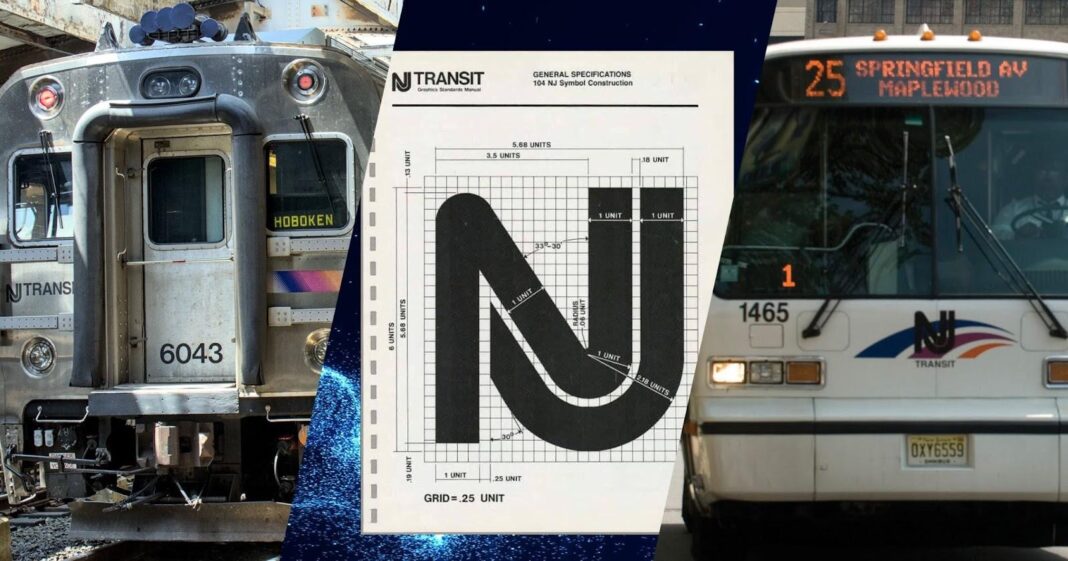
[This is multi-part series on NJ Transit]
New Jersey Transit (NJ TRANSIT) is the nation’s largest statewide public transportation system, providing nearly 270 million passenger trips each year across 263 bus routes, 12 rail lines, and three light rail lines. The agency connects major employment centers, universities, and communities, supporting economic growth, environmental sustainability, and social equity.
Yet, for nearly half a century, the agency has been dogged by a recurring pattern of fiscal instability—short-term fixes, capital-to-operating transfers, mounting debt, and deferred maintenance. With Governor Sherrill’s Executive Order to improve the NJ Transit rider experience, now is a good time to review the history of the agency and the funding and structural challenges that have led to this moment.

The 1980s: Birth Amid Crisis
By the late 1970s, New Jersey’s once-vibrant network of private bus and rail operators was collapsing under the weight of deindustrialization, suburbanization, and the lure of the automobile. In 1976, the federal government created Conrail to rescue failing railroads, but left New Jersey with a patchwork of services and no clear path forward. The New Jersey Public Transportation Act of 1979 established NJ TRANSIT to “acquire, operate and contract for transportation service in the public interest,” setting the stage for a new era of public stewardship.
In 1980, NJ TRANSIT acquired Transport of New Jersey, the state’s largest private bus company, and soon after, the Newark City Subway. By 1983, it had assumed control of commuter rail operations from Conrail, and by 1984, it was running bus service in Mercer County. These moves unified New Jersey’s fragmented transit landscape under a single public entity. But the systems NJ TRANSIT inherited were in dire shape. Decades of underinvestment had left buses and trains aging and unreliable.
The agency launched a $772 million capital program, funded by federal grants and the newly established state Transportation Trust Fund (TTF, 1984), to renew its fleet and infrastructure. The average bus age plummeted from 13.5 to 4.5 years between 1979 and 1989. And as service reliability improved from FY 1983 to FY 1988, rail ridership surged 40%.
The 1980s funding model relied heavily on federal support through the Urban Mass Transportation Act and state backing via the TTF. The TTF, financed by fuel taxes and later by bonds, provided a dedicated—if not always sufficient—stream for capital projects. Still, the agency’s operating budget was vulnerable to annual appropriations and political winds in Trenton. When operating subsidies lagged behind rising expenses, the agency began to experiment with capital-to-operating transfers—using funds intended for long-term investments to plug short-term budget holes. This practice set a precedent that would haunt the agency for decades to come.

The 1990s: Expansion and New Projects
The 1990s were a period of optimism and growth. Total ridership increased by 22.8% over the decade, buoyed by economic expansion and new service offerings. The agency launched ambitious projects, including the planning and early development of the Hudson–Bergen Light Rail (HBLR), the River LINE, and the Newark Light Rail Extension. These investments were designed to support urban revitalization, reduce congestion, and connect growing communities to jobs and amenities.
Backed by federal New Starts funding and state-issued bonds, the HBLR aimed to kickstart transit-oriented development along the Hudson waterfront. By 1996, the Federal Transit Administration (FTA) had pledged $825 million—about 75% of the initial segment’s cost—contingent on performance metrics and ridership projections. The River LINE and Newark Light Rail Extension followed similar models, leveraging federal and state dollars for transformative infrastructure.
Yet, beneath the surface, the agency’s financial foundation was eroding. The Transportation Equity Act for the 21st Century (TEA-21) eliminated federal operating assistance for large urban transit agencies in 1998, slashing NJ TRANSIT’s federal support for day-to-day operations. State operating aid also declined, falling from $289 million in FY 1993 to under $150 million by FY 2000. Meanwhile, fares were frozen for much of the decade, and inflation-adjusted fare revenue actually fell by 19%.
To bridge the gap, NJ TRANSIT turned to alternative revenue sources—parking fees, station retail leases, and leveraged lease agreements—but these could not keep pace with rising costs. The agency increasingly relied on capital funds to cover operating expenses, diverting Section 5307 and 5309 federal formula funds at rates unmatched by any other U.S. transit agency. By the late 1990s, the agency was also issuing Certificates of Participation (COPs), pledging future federal grants to finance fleet purchases and other capital needs.
The result was a mounting debt burden. NJ TRANSIT’s debt grew from $351 million in FY 1996 to $1.65 billion by FY 1999. The state’s reluctance to establish a dedicated, recurring revenue source for transit left the agency dependent on a patchwork of annual appropriations, toll transfers, and one-time fixes.
Sources
Bond, M., & DiPetrillo, S. (2025). From challenge to resilience: The evolution of NJ Transit funding and a roadmap to a reliable future. Alan M. Voorhees Transportation Center, Rutgers University. https://vtc.rutgers.edu/wp-content/uploads/2025/02/NJ-Transit-Funding-Report-2025.pdf
Reitmeyer, J. (2025, May 20). The financial questions that still hang over NJ Transit. NJ Spotlight News. https://www.njspotlightnews.org/2025/05/nj-transit-budget-deficit-funding-corporate-transit-fee
Reitmeyer, J. (2024, December 12). NJ Transit faces nearly $1 billion deficit as federal aid expires. NJ Spotlight News. https://www.njspotlightnews.org/2024/12/nj-transit-budget-gap-federal-aid-ending
Reitmeyer, J. (2024, March 7). Murphy proposes corporate transit fee to stabilize NJ Transit. NJ Spotlight News. https://www.njspotlightnews.org/2024/03/nj-transit-corporate-transit-fee-budget
Johnson, T. (2023, September 18). NJ Transit’s capital needs far exceed available funding. NJ Spotlight News. https://www.njspotlightnews.org/2023/09/nj-transit-capital-plan-funding-shortfall
Railway Age. (2025, May 22). NJ Transit Board approves $3.16B operating budget, $1.684B capital program. https://www.railwayage.com/passenger/commuterregional/nj-transit-approves-2026-budget
NorthJersey.com (Stile, C.). (2024, April 4). NJ Transit’s funding crisis decades in the making.
https://www.northjersey.com/story/news/columnists/charles-stile/2024/04/04/nj-transit-funding-crisis-history/72938460007
The Star‑Ledger / NJ.com (Higgs, L.). (2023, June 28). How NJ Transit used capital funds to cover operating costs for decades.
https://www.nj.com/traffic/2023/06/nj-transit-diverted-capital-funds-to-operations-for-decades.html
NJ Transit. (2025). FY2026 Operating Budget.
https://www.njtransit.com/sites/default/files/2025-05/NJT-FY2026-Operating-Budget.pdf
NJ Transit. (2025). FY2026 Capital Program.
https://www.njtransit.com/sites/default/files/2025-05/NJT-FY2026-Capital-Program.pdf
NJ Transit. (2024). Annual Ridership Trends Report.
https://www.njtransit.com/sites/default/files/2024-02/NJT-Ridership-Trends-2024.pdf
New Jersey Office of Legislative Services. (2024). Budget analysis: NJ Transit.
https://www.njleg.state.nj.us/analysis/2024/NJT-Budget-Analysis.pdf
New Jersey Turnpike Authority. (2024). FY2025 Financial Plan (including NJ Transit transfer).
https://www.njta.com/media/2025-financial-plan.pdf
U.S. Government Accountability Office. (2001). Commuter rail: Information on funding, ridership, and capital needs.
https://www.gao.gov/products/gao-01-214
Federal Transit Administration. (2023). National Transit Database: NJ Transit profile.
https://www.transit.dot.gov/ntd/data-product/nj-transit-profile