


[This is multi-part series on NJ Transit – Part I can be found here]
New Jersey Transit (NJ TRANSIT) is the nation’s largest statewide public transportation system, providing nearly 270 million passenger trips each year across 263 bus routes, 12 rail lines, and three light rail lines. The agency connects major employment centers, universities, and communities, supporting economic growth, environmental sustainability, and social equity.
Yet, for nearly half a century, the agency has been dogged by a recurring pattern of fiscal instability—short-term fixes, capital-to-operating transfers, mounting debt, and deferred maintenance. With Governor Sherrill’s Executive Order to improve the NJ Transit rider experience, now is a good time to review the history of the agency and the funding and structural challenges that have led to this moment.
The 2000s: Rising Debt and Operating Deficits
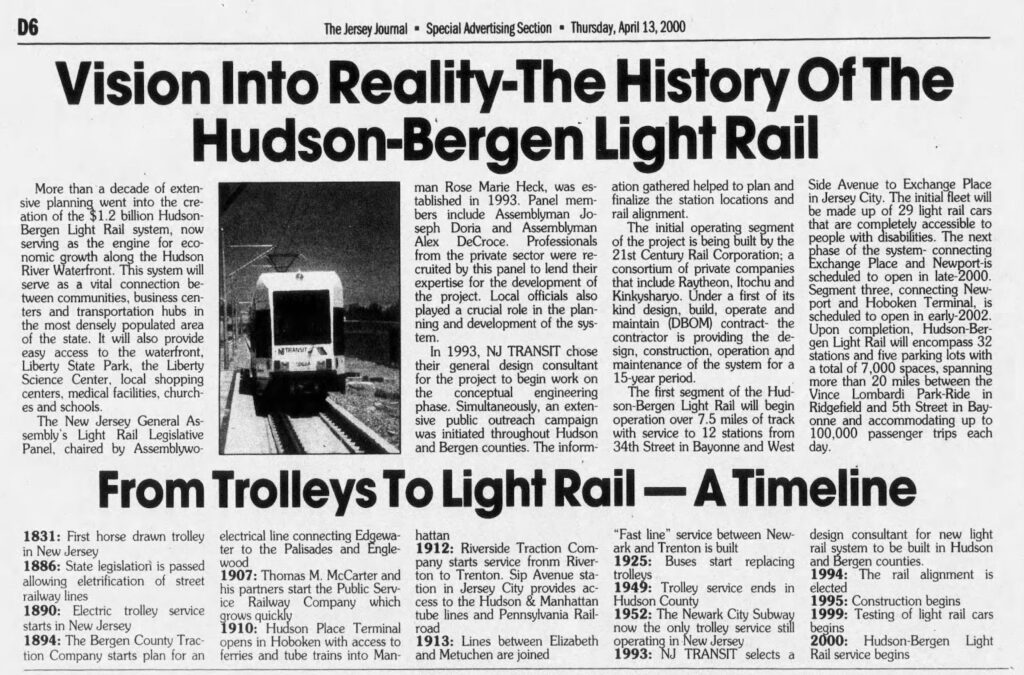
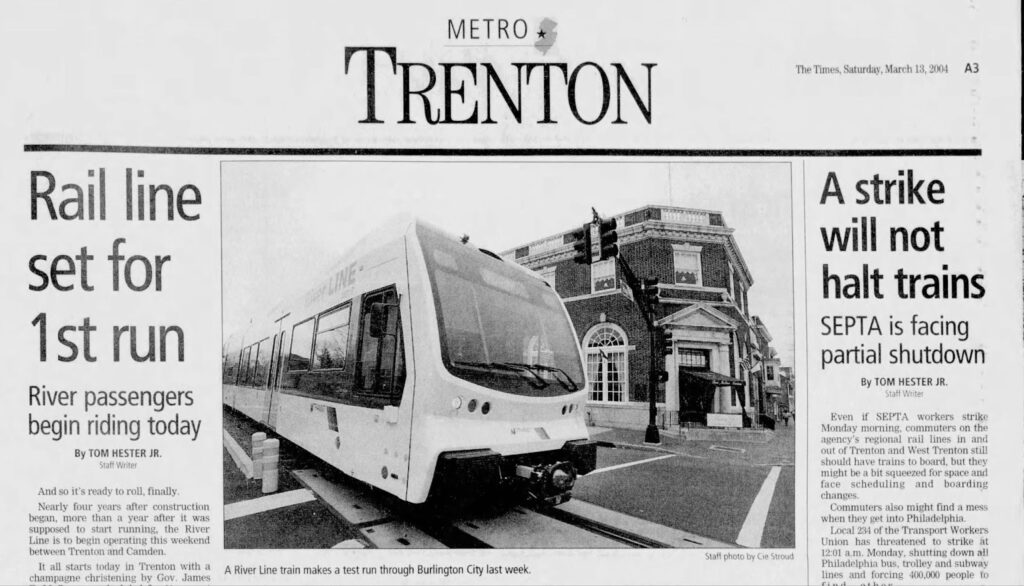
The new millennium saw NJ TRANSIT complete some of its most ambitious projects. The Hudson-Bergen Light Rail opened its first segment in 2000, with subsequent phases extending service through Hoboken, Weehawken, and Bayonne. The River LINE, a 34-mile diesel light rail between Camden and Trenton, debuted in 2004, and the Newark Light Rail Extension followed in 2006. The agency also launched Midtown Direct service, connecting the Hoboken Division to Penn Station New York and spurring a sustained rise in rail ridership.
These expansions delivered tangible benefits: new mobility options, economic development, and increased property values near stations. A 2008 Rutgers study found that development near five HBLR stations generated over $5.3 billion in economic growth, while properties within a quarter mile of stations appreciated 18.4% more than others.
But the cost of growth was steep. NJ TRANSIT’s fare revenue rose from $441 million to $828 million between FY 1999 and FY 2009, but operating expenses doubled from $903 million to $1.83 billion and the operating deficit soared by 145.7%, due to higher labor costs, rising fringe benefits, and the expense of maintaining an expanded system. Debt continued to mount, reaching $3.57 billion by FY 2009.
The agency’s reliance on fare revenue—without sufficient external support—meant that every new service expansion widened the operating gap. Even if fare revenue had kept pace with expenses, the deficit would have grown by 111%. The true benefits of these investments—economic growth, congestion relief, and environmental gains—were externalized, while the agency absorbed the financial risk.
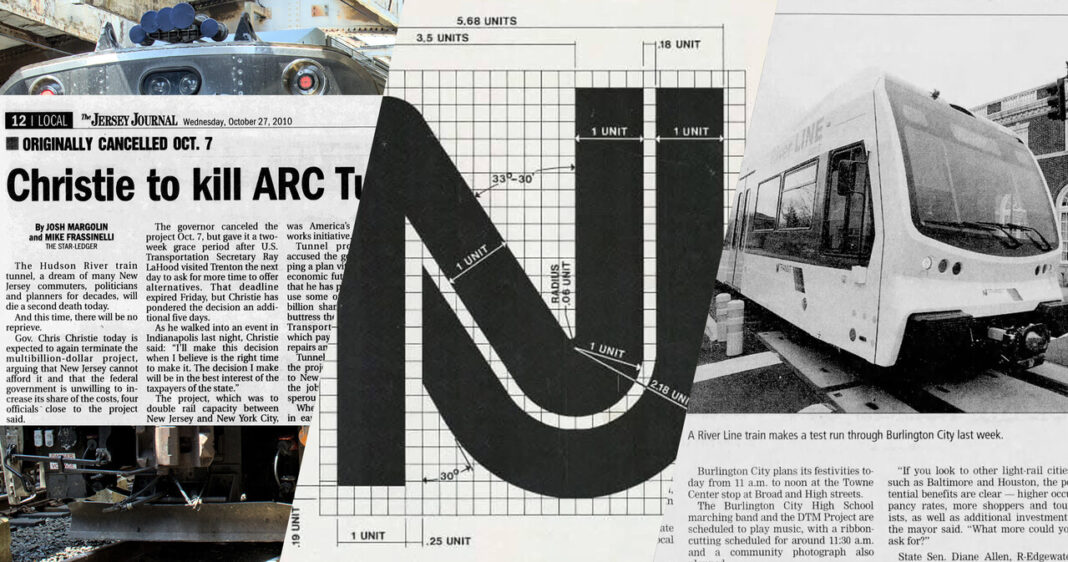
The decade’s most consequential project was the Access to the Region’s Core (ARC) tunnel, a proposed $8.7 billion commuter rail link between Secaucus Junction and Manhattan. Backed by federal, Port Authority, and state funds, ARC promised to double trans-Hudson rail capacity. Construction began in 2009, but by 2010, cost projections had risen to nearly $11 billion, and Governor Chris Christie, citing the risk of overruns and the state’s lack of funds, canceled the project. The decision forfeited federal funding, redirected Port Authority money to highway projects, and left New Jersey with a critical capacity shortfall that persists to this day.
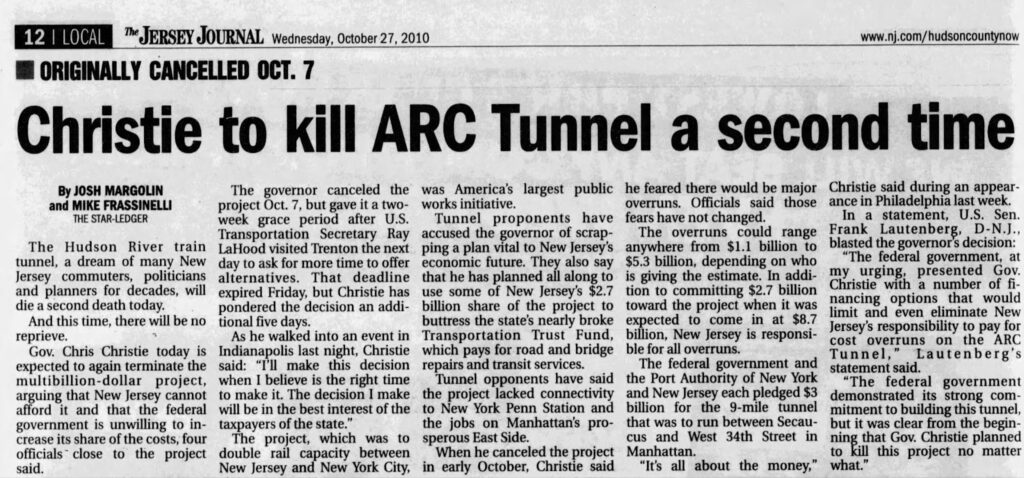
Throughout the 2000s, political leaders continued to avoid structural solutions. The state’s Transportation Trust Fund Authority (TTFA) issued billions in bonds to finance capital projects, but as debt service consumed a growing share of available funds, less was left for new investments or maintenance. By 2010, $845 million of the $1.6 billion TTF was devoted to debt payments, leaving only $350 million for operating expenses and $405 million for capital programs.
The agency’s practice of capital-to-operating transfers became institutionalized, with federal and state capital funds routinely diverted to cover operating shortfalls. Deferred maintenance and asset deterioration accelerated, as resources were stretched thin and long-term needs were sacrificed for short-term survival.
The 2010s: Deferred Maintenance and Capital Deterioration
The 2010s marked a turning point. For the first time in its history, NJ TRANSIT experienced a decade of declining ridership—down 2.7% after decades of growth. The Great Recession, coupled with state austerity measures, forced the agency to raise fares by 25% in 2010, reduce state funding, and implement hiring and salary freezes. Operational support from the state’s General Fund fell by over 90% from FY 2009 to FY 2016.
With debt service absorbing an ever-larger share of the budget, the agency could no longer finance new rolling stock or major upgrades. NJ TRANSIT managed to reduce its debt by $2.09 billion (62%) from FY 2010 to FY 2017, but at a steep cost: capital assets declined from over $10 billion to around $7.3 billion, as $500 million in annual rolling stock depreciation went unreplaced. By FY 2017, the agency had only $60 million in active, fully funded capital contracts—a fraction of what was needed to maintain a state of good repair.
The consequences were stark. Major mechanical failures rose throughout the decade, from 200.6 per year from 2010 to 2014, to 258 per year from 2015 to 2019, a rise from 29%. By 2018 and 2019, NJ TRANSIT’s commuter rail system averaged around one mechanical failure per day, with 375 and 352 failures per year, respectively, the highest in the nation. Service disruptions, delays, and customer complaints eroded public confidence and political support.
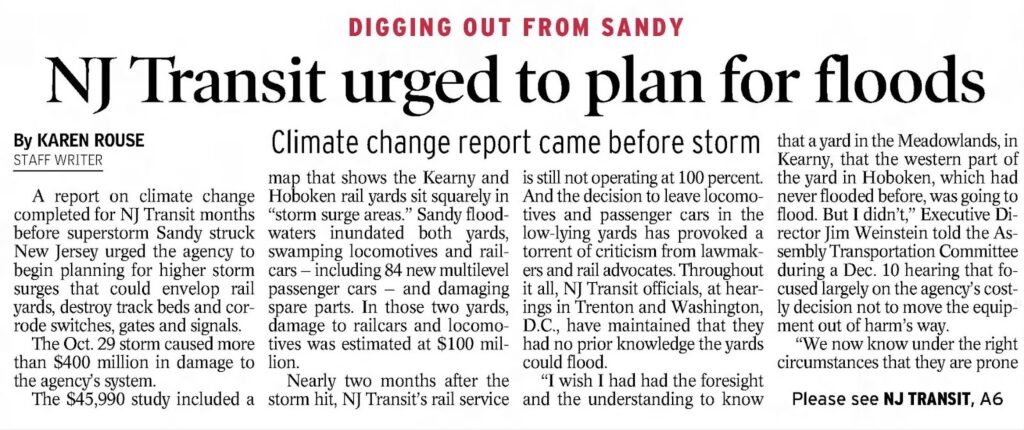
Superstorm Sandy in 2012 compounded the crisis, damaging more than 300 rail cars and locomotives, as well as critical infrastructure. The agency incurred $213 million in additional recovery costs in FY 2013 and 2014, further straining limited resources.
Source: The Herald-News, December 26, 2012
With traditional funding sources exhausted, NJ TRANSIT doubled down on capital-to-operating transfers. By the mid-2010s, the agency was diverting hundreds of millions in capital funds each year to cover operating expenses, a practice that masked the true extent of the funding gap but left the system increasingly vulnerable to breakdowns and obsolescence.
Political leaders responded with a mix of short-term fixes and governance reforms. The state increased transfers from the New Jersey Turnpike Authority and the Clean Energy Fund, but these were insufficient to close the gap. Calls for a dedicated, recurring revenue source grew louder, but legislative action remained elusive. In 2018, Governor Phil Murphy ordered an audit of NJ TRANSIT’s finances and enacted reforms to strengthen board oversight and transparency, but the agency’s structural challenges persisted.
Sources
Bond, M., & DiPetrillo, S. (2025). From challenge to resilience: The evolution of NJ Transit funding and a roadmap to a reliable future. Alan M. Voorhees Transportation Center, Rutgers University. https://vtc.rutgers.edu/publication/from-challenge-to-resilience-the-evolution-of-nj-transit-funding-and-a-roadmap-to-a-reliable-future/
Reitmeyer, J. (2025, May 20). The financial questions that still hang over NJ Transit. NJ Spotlight News. https://www.njspotlightnews.org/2025/05/nj-transit-budget-deficit-funding-corporate-transit-fee
Reitmeyer, J. (2024, December 12). NJ Transit faces nearly $1 billion deficit as federal aid expires. NJ Spotlight News. https://www.njspotlightnews.org/2024/12/nj-transit-budget-gap-federal-aid-ending
Reitmeyer, J. (2024, March 7). Murphy proposes corporate transit fee to stabilize NJ Transit. NJ Spotlight News. https://www.njspotlightnews.org/2024/03/nj-transit-corporate-transit-fee-budget
Johnson, T. (2023, September 18). NJ Transit’s capital needs far exceed available funding. NJ Spotlight News. https://www.njspotlightnews.org/2023/09/nj-transit-capital-plan-funding-shortfall
Railway Age. (2025, May 22). NJ Transit Board approves $3.16B operating budget, $1.684B capital program. https://www.railwayage.com/passenger/commuterregional/nj-transit-approves-2026-budget
NorthJersey.com (Stile, C.). (2024, April 4). NJ Transit’s funding crisis decades in the making.
https://www.northjersey.com/story/news/columnists/charles-stile/2024/04/04/nj-transit-funding-crisis-history/72938460007
The Star‑Ledger / NJ.com (Higgs, L.). (2023, June 28). How NJ Transit used capital funds to cover operating costs for decades.
https://www.nj.com/traffic/2023/06/nj-transit-diverted-capital-funds-to-operations-for-decades.html
NJ Transit. (2025). FY2026 Operating Budget.
https://www.njtransit.com/sites/default/files/2025-05/NJT-FY2026-Operating-Budget.pdf
NJ Transit. (2025). FY2026 Capital Program.
https://www.njtransit.com/sites/default/files/2025-05/NJT-FY2026-Capital-Program.pdf
NJ Transit. (2024). Annual Ridership Trends Report.
https://www.njtransit.com/sites/default/files/2024-02/NJT-Ridership-Trends-2024.pdf
New Jersey Office of Legislative Services. (2024). Budget analysis: NJ Transit.
https://www.njleg.state.nj.us/analysis/2024/NJT-Budget-Analysis.pdf
New Jersey Turnpike Authority. (2024). FY2025 Financial Plan (including NJ Transit transfer).
https://www.njta.com/media/2025-financial-plan.pdf
U.S. Government Accountability Office. (2001). Commuter rail: Information on funding, ridership, and capital needs.
https://www.gao.gov/products/gao-01-214
Federal Transit Administration. (2023). National Transit Database: NJ Transit profile.
https://www.transit.dot.gov/ntd/data-product/nj-transit-profile