



TLDR:
1. The Bayonne Bridge turns 95 on November 15; it opened in 1931 as the world’s longest steel arch bridge.
2. A $1.7 billion reconstruction raised its roadway 64 feet, allowing larger cargo ships to reach regional ports while preserving the historic arch.
3. The reconstruction extended the bridge’s expected service life by another 100 years, preparing the historic crossing for its second century.
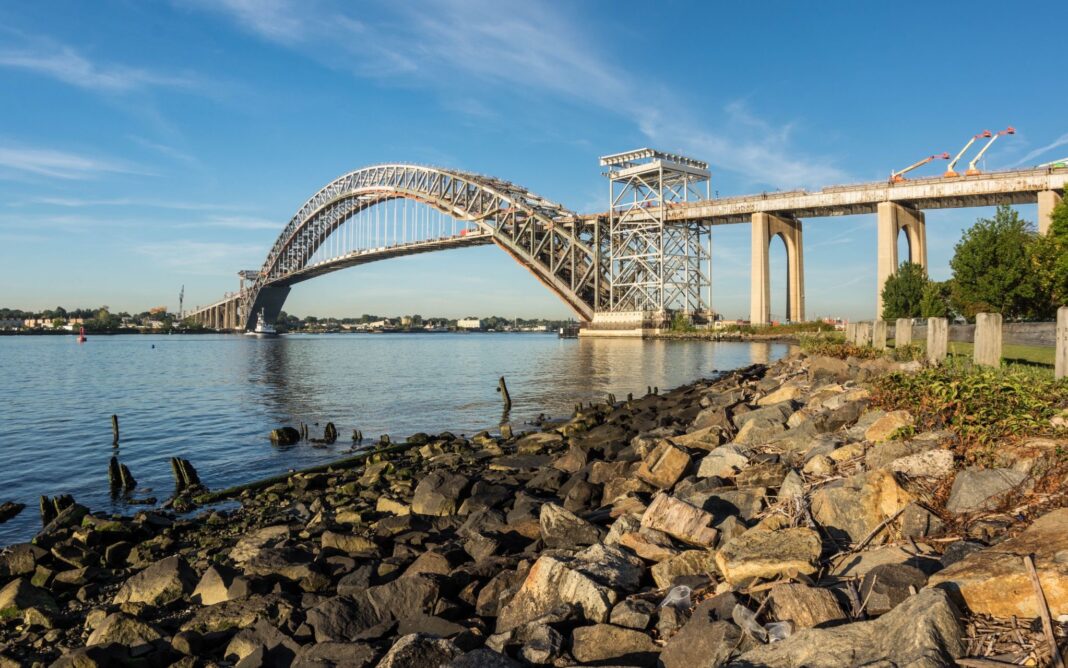
The Bayonne Bridge marks its 95th anniversary on November 15, a milestone for a crossing that opened as the world’s longest steel arch bridge and later underwent an extraordinary transformation. Its familiar arch still connects Bayonne and Staten Island, but the roadway now sits 64 feet higher, allowing larger cargo ships to reach the region’s ports.
Planning a regional connection
The Bayonne Bridge was the last of three Port Authority crossings built to connect New Jersey with Staten Island, following the Goethals Bridge and Outerbridge Crossing. The plans outlined the route across the Kill Van Kull paralleling the ferry service between Bayonne and Port Richmond. The goal was to preserve the existing street patterns in both communities, but doing so required the bridge to cross the waterway at an angle, making the span longer than a crossing straight across the channel. The Bayonne Bridge was built under a project labor agreement, establishing coordinated labor terms for the skilled tradespeople who constructed the crossing.
The familiar arch was not the first design considered. A suspension bridge initially offered an economical solution for carrying vehicles, bicycles and pedestrians, but Port Authority commissioners wanted to preserve the possibility of adding two rail transit tracks; adapting the suspension design for trains would have been too expensive.
Engineer Othmar H. Ammann, working with architect Cass Gilbert, developed the steel arch that became the bridge’s defining feature. Their plans also considered ornamental stonework at the arch’s supports, but financial considerations left the steel structure exposed.
Construction began in September 1928, with completion initially expected in early 1932. The work involved both the steel arch over the channel and long approach viaducts carried on concrete piers, some reaching 110 feet high.
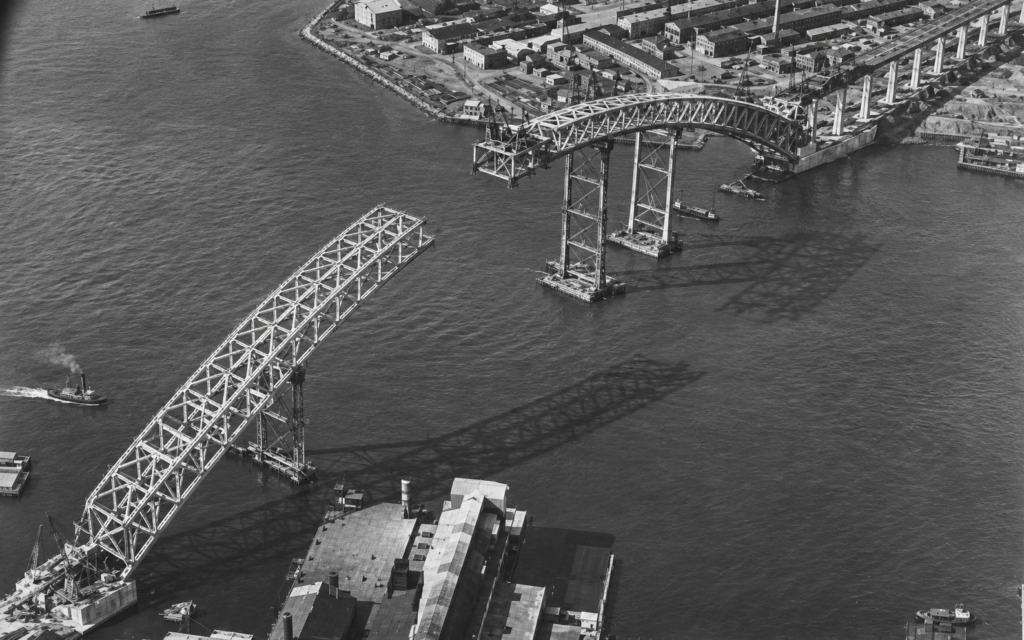
The Bayonne Bridge’s arch had to be assembled without blocking the Kill Can Kull’s shipping channel. To meet the challenge, engineers devised a temporary support system that used hydraulic jacks. Sections of the truss cantilevered over the support system as the arch grew toward its connecting point. Photo and caption courtesy of PAYNJ.
The completed bridge cost $13 million, according to the Port Authority, and finished several months ahead of schedule and $3 million under budget. Its 1,675-foot main span held the world record for a steel arch until the New River Gorge Bridge opened in West Virginia in 1977.
The achievement extended beyond its size. The American Society of Civil Engineers identifies the bridge’s use of manganese steel in major structural elements and advances in structural analysis among its engineering contributions; the American Institute of Steel Construction also recognized its beauty with a 1931 award.
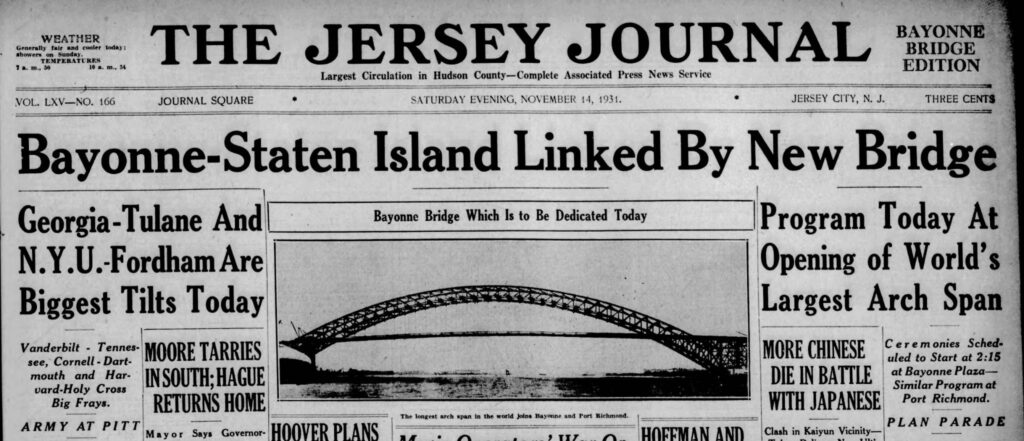
The bridge was dedicated on November 14, 1931, and opened to traffic the following day. According to the Port Authority, approximately 7,000 motorists crossed on opening day, along with nearly 7,000 pedestrians who paid a nickel to walk across.
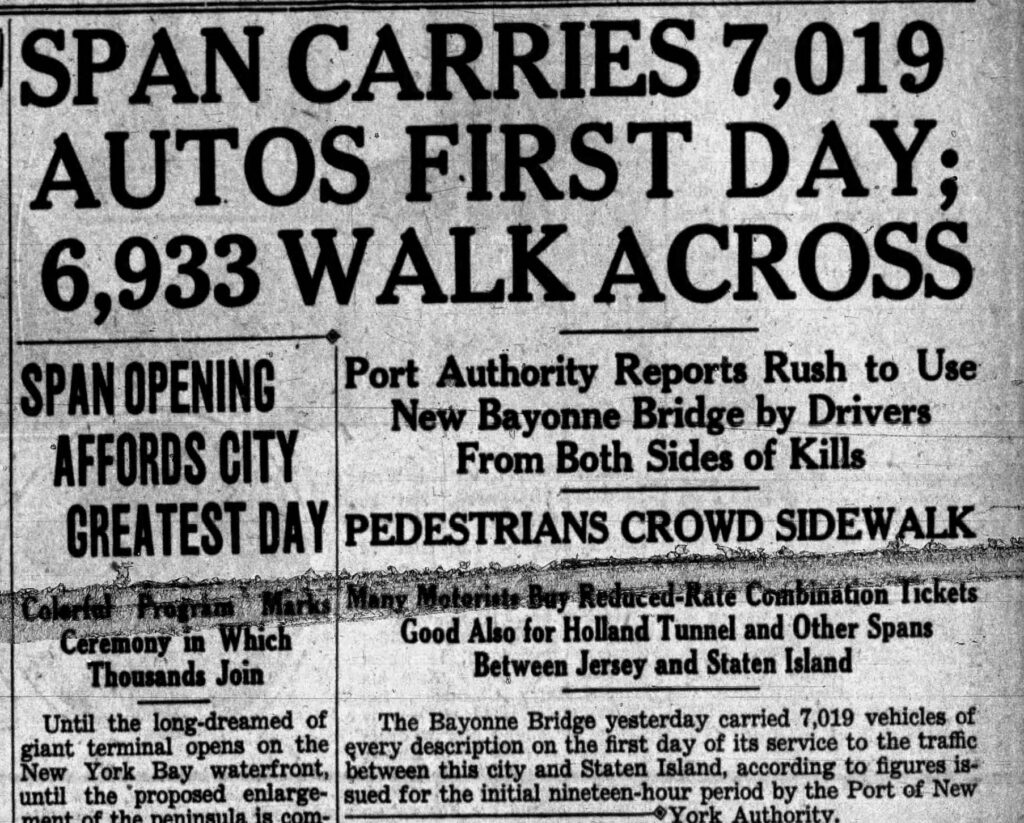
The Bayonne Times, November 16, 1931
The celebration also had an international connection. Golden scissors used for the Bayonne ribbon cutting were later used at the opening of Australia’s Sydney Harbour Bridge, its better-known sister span, in March 1932.
A new roadway inside the old arch
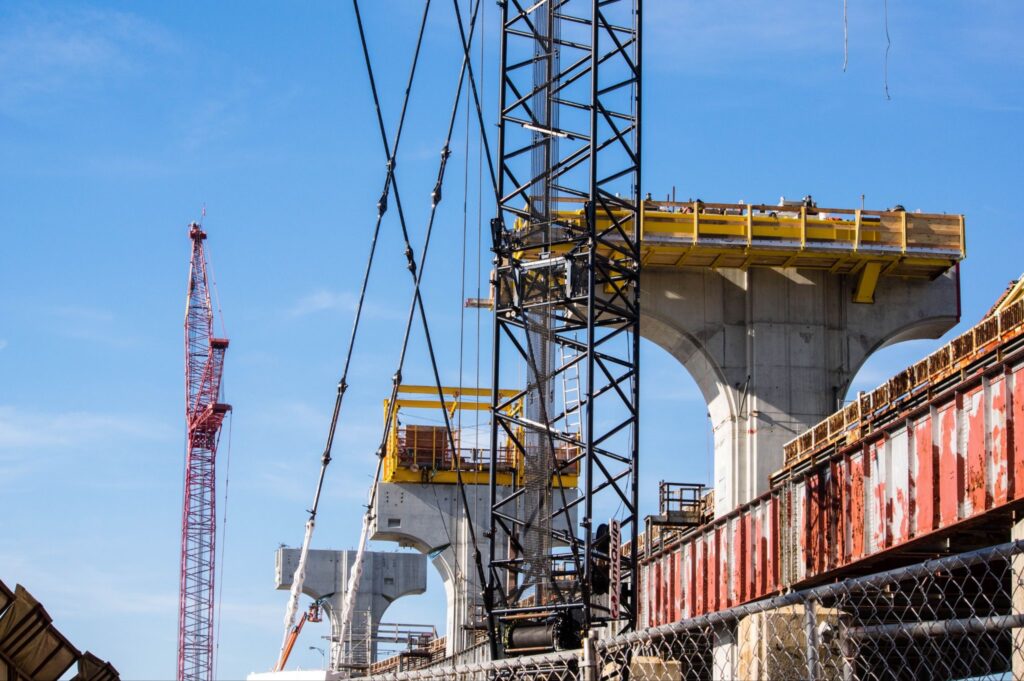
Over time, the bridge’s original clearance became an obstacle to the larger container ships entering global service. Ships bound for terminals in Newark, Elizabeth and Staten Island had to pass beneath a roadway with roughly 151 feet of navigational clearance.
The solution preserved the steel arch while replacing the roadway within it. Construction began in 2013 on the $1.7 billion program, with a Skanska-Kiewit joint venture carrying out the main construction work and HDR and WSP leading the design.
Crews built the higher roadway above the existing deck in a carefully staged operation that maintained traffic during portions of construction. The work also required strengthening the arch; Roads & Bridges reported that more than 4,000 tons of steel plates were added to handle increased loads.
Operating Engineers Local 825 members were among the union tradespeople who carried out the reconstruction. Their work helped turn a complex design into a crossing that could continue serving drivers while opening the shipping channel to larger vessels.
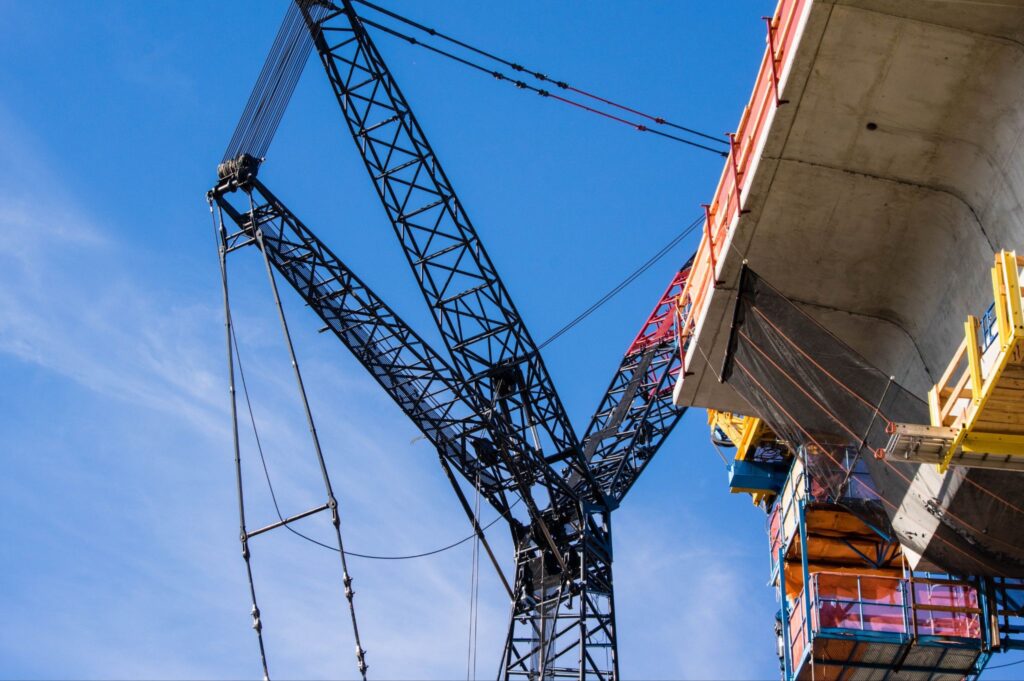
The full 215-foot navigational clearance was achieved in June 2017, and the completed project was rededicated in June 2019. Drivers gained wider lanes, shoulders and a median barrier; pedestrians and cyclists gained a 12-foot-wide shared-use path. HDR describes the project as extending the landmark’s life by another 100 years, an engineering objective that underscores the importance of continued inspection and maintenance as the original arch ages.
The design also preserves an option that dates to the bridge’s earliest planning: rail transit. The rebuilt southbound structure was designed to accommodate future light rail, although that provision alone does not establish a funded project.
As the bridge approaches its centennial in 2031, its most immediate contribution remains carrying road traffic above an active shipping channel while giving larger vessels access to port terminals. Keeping both routes working will depend on the same combination of engineering, skilled labor and sustained investment that made its transformation possible.
Sources:
American Society of Civil Engineers. (n.d.). Bayonne Bridge. https://www.asce.org/about-civil-engineering/history-and-heritage/historic-landmarks/bayonne-bridge
Budzynski, B. W. (2019, November 5). No. 1 bridge: Bayonne Bridge. Roads & Bridges. https://www.roadsbridges.com/bridges/article/10652290/no-1-bridge-bayonne-bridge
HDR. (n.d.). Bayonne Bridge Navigational Clearance Project. https://www.hdrinc.com/portfolio/bayonne-bridge-navigational-clearance-project
International Union of Operating Engineers Local 825. (n.d.). I.U.O.E. Local 825 100th anniversary [History book]. https://unionhistories.com/images/uploads/books/pdf/iuoe-825-history-book-web.pdf
Port Authority of New York and New Jersey. (n.d.). History of the Bayonne Bridge. https://www.panynj.gov/bridges-tunnels/en/bayonne-bridge/history.html
Port Authority of New York and New Jersey. (2019, June 14). Iconic Bayonne Bridge rededication caps Port Authority’s $1.7 billion project [Press release]. https://www.panynj.gov/port-authority/en/press-room/press-release-archives/2019_press_releases/iconic_bayonne_bridgerededicationcapsportauthoritys17billionproj.html
Rastorfer, D. (2007). Bayonne Bridge: A landmark by land, sea, and air. Port Authority of New York and New Jersey. https://www.panynj.gov/content/dam/bridges-tunnels/bayonne-bridge-shpo-documents/Bayonne%20Bridge%20Publication.pdf
Skanska. (n.d.). Bayonne Bridge Navigational Clearance Replacement of Main Span Roadway & Approach. https://www.skanska.com/us/en/construction/transportation-infrastructure/bridges/bayonne-bridge-navigational-clearance-replacement-of-main-span-roadway–approach
Stolz, R. (2019, June 14). The new Bayonne: Bridge to the modern age of mobility. PANYNJ PORTfolio. https://portfolio.panynj.gov/2019/06/14/the-new-bayonne-bridge-to-the-modern-age-of-mobility/