


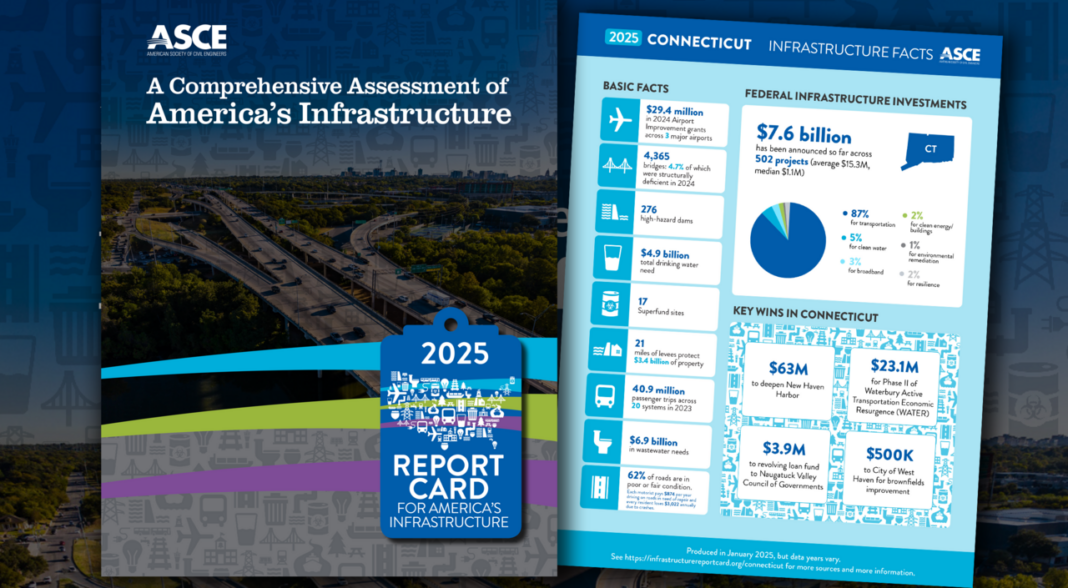
The American Society of Civil Engineers’ Infrastructure Report Card evaluates infrastructure systems using grades from A to F based on condition, capacity, funding, resilience, public safety and future needs.
Infrastructure conditions are improving in Connecticut, particularly in the transportation and water infrastructure sectors. Several categories showed incremental progress in recent years, reflecting stronger maintenance practices and new investment. Still, long-term funding gaps challenge the state’s ability to modernize infrastructure.
The most recent evaluation examined five key infrastructure sectors: bridges, drinking water, rail, roads and wastewater. Grades ranged from B for rail to D+ for roads, with an overall infrastructure grade of C.
Roads: The State’s Lowest-Rated Infrastructure
Roads received the lowest grade of any infrastructure category in Connecticut, earning a D+.
Much of the state’s roadway network was built decades ago and is experiencing increasing wear from heavy traffic volumes. Connecticut is one of the most densely populated states in the country, and its roads carry a significant amount of commuter, freight and regional traffic. As a result, congestion and pavement deterioration remain persistent challenges.
There are 21,430 miles of roadways in the state of Connecticut; 19% of which are owned and maintained by the Connecticut Department of Transportation (CTDOT) and the remaining 81% by municipalities, of which 77% of local miles are in poor riding condition.
Water Infrastructure: Aging but Reliable
Connecticut’s drinking water systems received a C grade.
More than 97 percent of residents served by community water systems receive water that meets all health standards, exceeding national benchmarks. However, much of the infrastructure delivering that water is aging. Some pipes date back to the late 1800s and early 1900s, making rehabilitation and replacement a growing priority.
Over the next two decades, the state is expected to need more than $4 billion to maintain and upgrade drinking water infrastructure. Leaking water mains also contribute to losses estimated between 15 and 20 percent of total water production, highlighting the importance of ongoing investment and asset management programs.
Wastewater systems face similar challenges. Many treatment facilities and collection networks are decades old and require upgrades to maintain reliability and meet modern environmental standards.
Transportation Improvements
While roads remain the state’s lowest-graded infrastructure category, other transportation systems show stronger performance.
Connecticut’s bridges received a C, reflecting improvements in maintenance and inspection programs. State officials have reduced the percentage of bridges in poor condition in recent years, helping the state meet federal condition requirements.
Rail infrastructure received the highest grade at B, reflecting the strength of Connecticut’s passenger rail system, which connects closely with Metro-North Railroad and serves tens of millions of riders each year.
Investment and Workforce Needs
Federal funding from the Infrastructure Investment and Jobs Act is expected to provide Connecticut with more than $5 billion in infrastructure funding over five years, supporting transportation, water and resilience projects.
Even with that investment, civil engineers warn that a long-term funding gap remains between current spending and future infrastructure needs. Connecticut’s infrastructure is among the oldest in the nation, with many assets more than 50 years old.
The report also highlights workforce shortages as a growing challenge. Contractors, engineering firms and public agencies all report difficulty recruiting skilled workers needed to design, build and maintain infrastructure projects.
Looking Ahead
Connecticut has made measurable progress in several infrastructure categories, particularly in bridges and water systems. Continued investment, improved resilience planning and workforce development will be critical to maintaining that momentum.
Without sustained funding and strategic upgrades, however, aging infrastructure and growing transportation demands could continue to strain the systems that support the state’s economy and daily life.
Sources
American Society of Civil Engineers. 2022 Connecticut Infrastructure Report Card.
ASCE Infrastructure Report Card. https://infrastructurereportcard.org/state-item/connecticut/