



An overview of the federal Superfund program
Superfund cleanups combine environmental investigation, engineering, construction, enforcement and long-term monitoring.
At the Cornell-Dubilier Electronics site, PCB and solvent contamination spread through buildings, soil, groundwater, nearby properties and Bound Brook, requiring several different cleanup methods.
Responsible parties are required to pay whenever possible; federal funding supports work when polluters cannot be found or cannot cover the full cost.
New Jersey’s long industrial history helped build the state’s economy, but it also left behind contaminated factories, landfills, waterways and industrial properties. The federal Superfund program is responsible for addressing the most serious of those sites.
Created by Congress in 1980, Superfund gives the U.S. Environmental Protection Agency broad authority to investigate releases of hazardous substances, require responsible parties to perform or pay for cleanup and use federal money when a viable responsible party cannot be found. The work can involve demolishing buildings, excavating contaminated soil, dredging waterways, treating groundwater or restricting how a property may be used.
At the former Cornell-Dubilier Electronics site in South Plainfield, the cleanup has required nearly all of those approaches. Electronics components were manufactured at the 26-acre facility from 1936 to 1962. PCBs and industrial solvents used in production contaminated buildings, soil, groundwater, nearby properties and Bound Brook. The EPA added the site to the National Priorities List in 1998; cleanup work has continued in phases for more than two decades.
The scale and duration of the work illustrate an important point: Superfund cleanup is not a single construction project. It is a combination of environmental investigation, engineering, public-health protection, enforcement and long-term monitoring that can continue for years even after the most visible work is finished.
How a site enters the Superfund program
A contaminated property does not automatically become a Superfund site. EPA first conducts a site inspection, reviewing historical records and collecting information about possible releases. The agency considers the toxicity and quantity of the contaminants, the likelihood that they could move through soil, air, groundwater or surface water and the number of people or sensitive environments that could be exposed.
Sites are then evaluated through EPA’s Hazard Ranking System. Those presenting the most serious potential risks may be proposed for the National Priorities List, which identifies contaminated sites eligible for long-term federal remedial action.
An immediate danger does not have to wait for that process. EPA can undertake a removal action to respond quickly to a chemical spill, contaminated drinking water, an unstable waste pile or another urgent threat. These actions may include removing hazardous materials, installing fencing, supplying clean water or temporarily relocating residents.
Long-term remedial work follows a more extensive process. EPA conducts a remedial investigation to determine what is contaminated, how far that contamination has spread and how people or ecosystems could come into contact with it. A feasibility study then compares potential cleanup methods, including their effectiveness, reliability, environmental impact and cost.
EPA presents a preferred alternative to the public before issuing a Record of Decision that establishes the selected remedy. Engineers then translate that decision into plans, specifications and construction requirements during remedial design. Remedial action is the phase in which the cleanup is physically built and implemented.
That sequence can be lengthy, but it serves an important purpose. Digging into a contaminated property without understanding how pollutants move can spread the problem, expose workers or leave the primary source of contamination untouched.
Different contaminants require different solutions
There is no universal technique for cleaning a Superfund site. The appropriate remedy depends on the contaminant, the depth and concentration of the pollution, the type of soil, groundwater conditions, nearby development and the property’s likely future use.
Excavation is one of the most visible approaches. Contaminated soil or sediment is dug up, loaded into trucks and transported to a facility legally permitted to accept it. Clean material may then be brought in to restore the excavated area.
This approach permanently removes contaminated material from a community, but it can require years of heavy construction and thousands of truck trips. Crews must control dust, stormwater and the movement of equipment to keep contamination from spreading during the work.
At the former Cornell-Dubilier site, EPA removed PCB-contaminated soil from 34 nearby residential properties during an early phase of the cleanup. The agency later demolished 18 contaminated buildings, transported approximately 26,400 tons of building debris for disposal and excavated another 21,000 tons of contaminated soil and debris from the former industrial property.
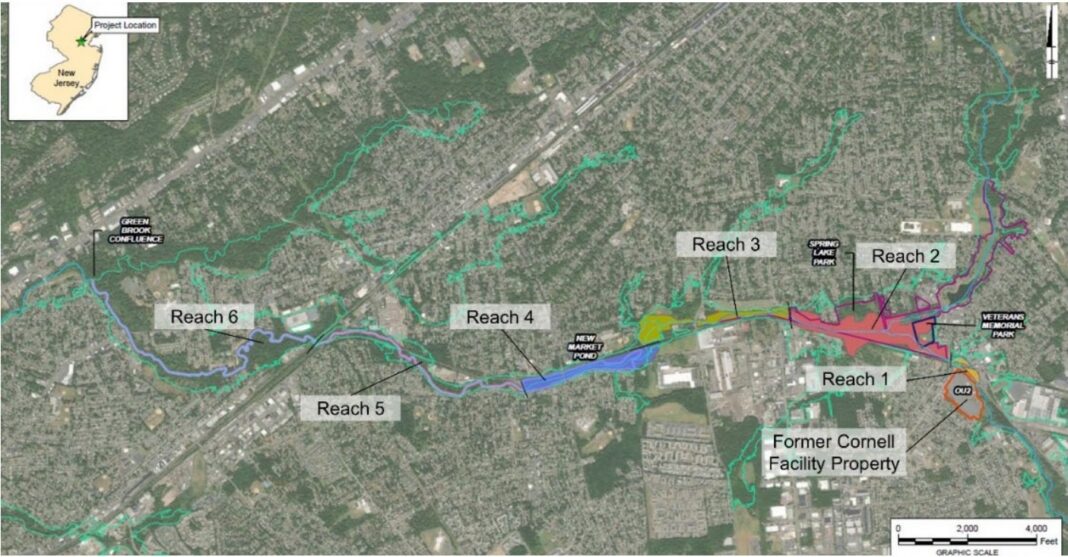
EPA is now addressing PCB-contaminated sediment and floodplain soil along Bound Brook. The brook is being divided into reaches so that crews can work progressively downstream. Surface water must be redirected before contaminated sediment and soil can be excavated, staged in covered areas and transported to permitted disposal facilities. EPA expects the current work in the Bound Brook area to continue for approximately five years.
Removal is not always the best or only option. A cap can isolate contaminated material beneath layers of clean soil, pavement, clay or engineered synthetic barriers. Caps prevent people from contacting the waste and reduce the amount of rainwater passing through it, which can slow the movement of contamination into groundwater. They require inspection and maintenance; future excavation or development may also be restricted.
Some contaminated soil can be treated instead of removed. At the Cornell-Dubilier site, EPA used thermal treatment on part of the former facility property. The soil was heated so that contaminants would vaporize and could be extracted and captured. Material that could not be treated effectively was transported off-site.
Other treatment technologies use chemical reactions or microorganisms to break contaminants down, reduce their toxicity or make them less mobile. The objective is not merely to move contaminated material somewhere else, but to reduce the danger it presents whenever practical.
Groundwater can extend the cleanup for decades
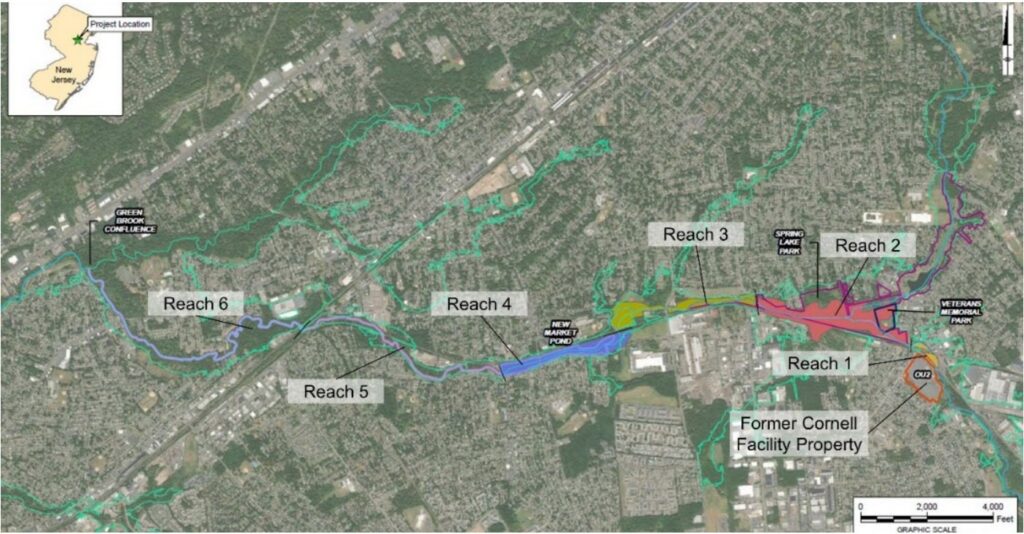
The cleanup of the Bound Brook was divided into 6 reaches to be able to better manage the work. Reach 1 was completed in 2023. EPA is currently cleaning up reach 2. Graphic courtesy of the U.S. Environmental Protection Agency, Cornell-Dubilier Electronics Superfund Site Community Update, Winter 2025–2026.
Groundwater is among the most difficult parts of many Superfund cleanups. Contaminants can migrate underground beyond the original property, and pollution trapped in soil or fractured rock can continue feeding a groundwater plume long after the original release ends.
EPA reports that groundwater contamination has been addressed at approximately 85 percent of National Priorities List sites where a remedy has been selected. Common strategies include treating the source, preventing the plume from spreading and restoring the groundwater where that is technically feasible.
Pump-and-treat systems use wells to draw contaminated groundwater from beneath a site. The water is sent through an above-ground treatment plant before it is discharged or returned to the ground. Pumping can also control the direction of groundwater flow, preventing contaminants from reaching drinking-water wells, wetlands, streams or other sensitive areas.
Cornell-Dubilier now has a groundwater extraction and treatment facility that captures groundwater contaminated with trichloroethylene, commonly known as TCE, before it can migrate into Bound Brook. Such systems may operate for years after their construction is complete because groundwater moves slowly and contamination can be difficult to remove from underground formations.
Other sites may use in-place treatment. Chemicals, nutrients or other materials can be injected underground to destroy contaminants or convert them into less harmful forms. Permeable reactive barriers allow groundwater to pass through a treatment material, while underground slurry or sheet-pile walls can contain a plume and keep it from spreading.
Where complete groundwater restoration is not technically practical, the remedy may combine containment, monitoring and restrictions on well installation or groundwater use. Those legal and administrative restrictions are known as institutional controls.
Cleanup also means controlling exposure
Protection begins by interrupting the ways people could be exposed. Contaminated soil can be removed, treated, capped or fenced off. Polluted groundwater can be captured before it reaches a drinking-water supply. Vapor monitoring can determine whether volatile chemicals are moving from groundwater or soil into buildings. Fishing advisories can prevent people from consuming fish that have accumulated contaminants from polluted sediment.
At Cornell-Dubilier, EPA has combined these protections. The public water supply is routinely tested; groundwater restrictions prevent the use of untreated groundwater for drinking. EPA has also conducted sampling to determine whether vapors from contaminated groundwater are entering nearby buildings.
During the Bound Brook work, crews are redirecting water, covering staged soil and controlling runoff. EPA plans to monitor the air for dust, maintain fencing and barriers around work zones and coordinate truck traffic with South Plainfield, Piscataway and Middlesex County. Signs warn anglers not to eat fish from Bound Brook and New Market Pond because of PCB contamination.
These measures matter because cleanup itself can temporarily disturb contaminated material. The work must protect construction workers, nearby residents and recreational users while still removing the pollution that created the long-term risk.
Who pays for Superfund cleanup?
The name “Superfund” can create the impression that every cleanup is paid entirely by the federal government. The funding system is actually more complicated.
Under the Comprehensive Environmental Response, Compensation and Liability Act, EPA can pursue current and former property owners, facility operators, companies that generated hazardous waste and parties that arranged for its transportation or disposal. These potentially responsible parties may agree to investigate and clean a site under EPA oversight, reimburse the government for work it already performed or pay into a settlement.
EPA describes this as an “enforcement first” approach. Money recovered from responsible parties is used before federal construction funding whenever possible; doing so preserves public funds for abandoned sites and cases in which the responsible companies no longer exist or cannot afford the work.
In 2015, EPA announced the recovery of $22 million from D.S.C. of Newark Enterprises and its sole shareholder for cleanup costs and natural-resource damages connected to Cornell-Dubilier. EPA received $16.2 million of that settlement, while New Jersey and federal natural-resource trustees received the remainder. At that time, EPA reported that its cleanup costs at the site had already exceeded $180 million.
That gap demonstrates one of Superfund’s central challenges. The company responsible for pollution may have closed, reorganized, sold the property or lack the resources to pay for a cleanup whose cost was never anticipated when the contamination occurred.
When responsible-party funding is unavailable or insufficient, EPA can finance work through congressional appropriations and the Superfund trust fund. The 2021 Infrastructure Investment and Jobs Act provided $3.5 billion for National Priorities List remediation and reinstated federal excise taxes on certain chemicals and imported chemical substances.
Cornell-Dubilier received infrastructure funding to continue excavating PCB-contaminated soil and sediment along Bound Brook. EPA estimated that portion of the project alone would cost $152 million. The federal funding allowed work to continue without waiting for another viable responsible party or a future annual appropriation.
Construction completion is not necessarily the end
EPA may declare a site’s construction complete even though treatment and monitoring are still underway. The designation means that the physical components of the remedy have been built, not necessarily that every cleanup standard has already been achieved.
A groundwater treatment plant, for example, may be fully constructed but need to operate for decades. A capped area may require regular inspection, while deed restrictions must remain enforceable. Sampling may continue to confirm that a contaminant plume is stable and that exposure pathways remain controlled.
When hazardous substances remain above levels that allow unlimited use and unrestricted exposure, EPA generally conducts a review at least every five years. The review evaluates whether the remedy is operating as intended, whether land-use restrictions are effective and whether new information has changed the understanding of the site’s risks.
Only after cleanup goals have been achieved and the site is considered protective of human health and the environment can it be deleted from the National Priorities List. Even then, some sites continue to require maintenance or restrictions.
The long-term responsibility is part of what Superfund status provides. The program does not simply remove visible waste and move on; it establishes a system for investigating contamination, controlling exposure, constructing a remedy and verifying that the protection lasts.
For communities near New Jersey’s former factories, landfills and industrial waterways, a successful cleanup can protect drinking water, restore waterways, return contaminated land to productive use and prevent another generation from inheriting the same risk. Cornell-Dubilier also shows why progress can take decades: the contamination extends across buildings, residential properties, groundwater, floodplains and miles of sediment, and every part requires a different engineering response.
The work now moving downstream along Bound Brook is one phase of that larger effort. Its success will depend not only on removing contaminated material, but on maintaining treatment systems, monitoring exposure pathways and ensuring sufficient funding remains available until the full remedy is complete.
Sources:
U.S. Environmental Protection Agency. Cornell-Dubilier Electronics Superfund site community update: Winter 2025–2026. https://semspub.epa.gov/work/02/766027.pdf
U.S. Environmental Protection Agency. Finding potentially responsible parties. https://www.epa.gov/enforcement/finding-potentially-responsible-parties-prp
U.S. Environmental Protection Agency. How Superfund addresses groundwater contamination. https://www.epa.gov/superfund/how-superfund-addresses-groundwater-contamination
U.S. Environmental Protection Agency. Superfund: CERCLA overview. https://www.epa.gov/superfund/superfund-cercla-overview
U.S. Environmental Protection Agency. Superfund cleanup process. https://www.epa.gov/superfund/superfund-cleanup-process
U.S. Environmental Protection Agency. Superfund five-year reviews. https://www.epa.gov/superfund/superfund-five-year-reviews
U.S. Environmental Protection Agency. $22 million paid for cleanup costs and natural resource damages at the Cornell-Dubilier Electronics site in South Plainfield, NJ. https://www.epa.gov/archive/epa/newsreleases/22-million-paid-cleanup-costs-and-natural-resource-damages-cornell-dubilier-electronics.htm